Your AI Executive Assistant
Executive Thought Leadership on Autopilot
Sera_01: Semantic Executive Resource Engine
Built for AI Search Visibility
Your Voice, on Every Channel

Marketing Insights_
Real 2026 costs of ghostwriting agencies, freelancers, in-house hires and AI tools, plus trust research and a framework for choosing.
October 6, 2026
8 Min Reads
Morgan Von Druitt
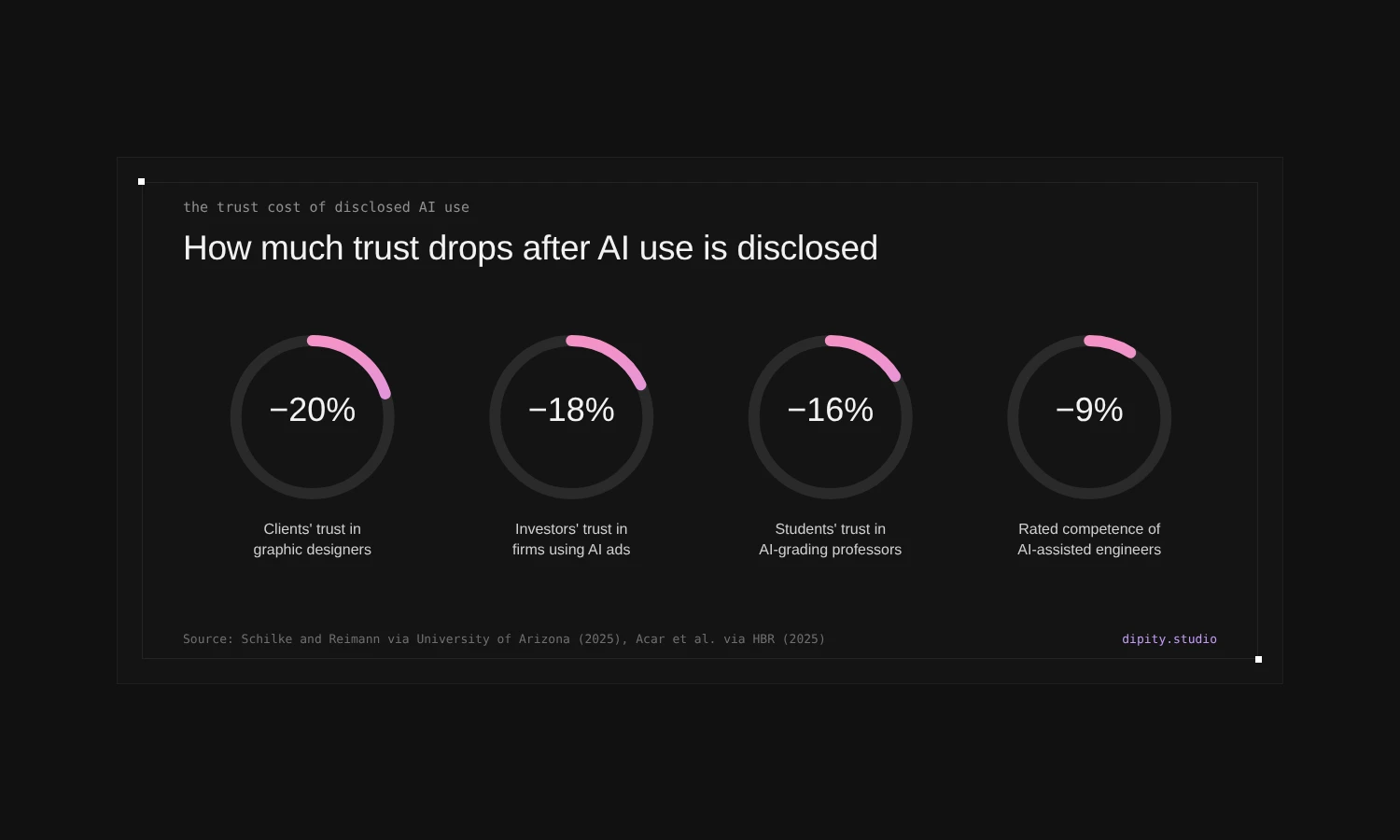
Executive content got cheap to produce and expensive to trust. Originality.ai's July 2026 analysis of 5,000 public LinkedIn posts classified 81.2% of long-form posts as likely AI. Research from the University of Arizona found clients placed 20% less trust in graphic designers once AI use was disclosed. At Dipity, we build content systems for founders and executive teams. This guide compares the real 2026 cost of a ghostwriting agency, a freelance ghostwriter, an in-house hire, and AI-assisted tools, then gives you a framework for picking one.
You have four realistic paths. Hire a ghostwriting or executive content agency, contract a freelance ghostwriter, add a content marketer to payroll, or run an AI-assisted system with a human in the loop. Each one trades money, executive time, and voice control differently. The cheapest option on paper is rarely the cheapest once you count the CEO's hours.
Demand for this work keeps rising because buyers reward it. The 2025 Edelman-LinkedIn B2B Thought Leadership Impact Report found 79% of hidden buyers are more likely to champion a vendor in an RFP if that vendor consistently publishes quality thought leadership. Consistency is the operative word. Most executives cannot sustain it alone.
Marketing teams already lean on AI to fill the gap, with mixed results. Content Marketing Institute's 2026 B2B research reports that 9 in 10 marketers use AI to produce content, while fewer than 4 in 10 say it improved performance. The same survey ranked investment in human resources last among 2026 priorities, at 9%.
The rest of this guide prices each path with sourced numbers, then weighs what you get for the money.
Executive ghostwriting agencies typically charge $1,500 to $5,000 per month for a mid-tier LinkedIn program, and $3,000 to $10,000 or more for full-service work. Most funded SaaS companies land between $2,000 and $5,000 a month. Broader content marketing agencies on Clutch bill an average of $100 to $149 an hour. Annualized, an agency runs $24,000 to $60,000 for most startups.
Sproutworth's 2026 pricing breakdown for SaaS founders lists four tiers. Freelance writers run $500 to $1,500 per month for one or two posts a week. SaaS-focused ghostwriters charge $1,000 to $3,000. Mid-tier agencies charge $1,500 to $5,000 for four to five weekly posts. Full-service programs with engagement and analytics start at $3,000 and pass $10,000 a month.
Hourly agency rates line up with that range. Clutch's content marketing pricing guide, updated in September 2026, puts the average agency rate between $100 and $149 an hour. Rates drop sharply outside North America and Western Europe. The same guide notes most reviewed content projects come in under $10,000.
What does the retainer buy? A good agency brings an editor, a strategist, and a process for pulling ideas out of a busy executive. You pay for that system, which explains the premium over a single freelancer.
Ask any agency where your interview transcripts live and who owns them after you leave. The answer tells you how portable your investment is.
Freelance ghostwriters range widely. Marketplace writers on Upwork charge a median of $32 an hour. Experienced professionals surveyed by the Editorial Freelancers Association charge $75 to $100 an hour for blog ghostwriting and 25 to 40 cents per word. Business and marketing ghostwriting runs 50 cents to $1.00 per word. A 1,200-word blog post costs roughly $300 to $1,200 depending on the tier.
Upwork's ghostwriter cost page puts typical hourly rates between $20 and $45. The low end buys speed, not strategy. Expect to supply the ideas, the structure, and heavy edits yourself.
The Editorial Freelancers Association 2026 rate chart, based on a survey run from November 2025 to January 2026, gives a clearer view of professional rates. Blog post ghostwriting sits at 25 to 40 cents per word, or $75 to $100 an hour. Business and marketing ghostwriting runs 50 cents to $1.00 per word, or $87.50 to $125 an hour.
Run the math on a weekly 1,200-word blog post. At the EFA blog rate, that costs $300 to $480 per post. At the business and marketing rate, it costs $600 to $1,200. Four posts a month lands between $1,200 and $4,800, before LinkedIn posts or newsletters.
Freelancers work best when one executive needs one channel and has a clear point of view. They struggle when a whole leadership team needs coverage, because each executive becomes a separate voice to learn and a separate interview to schedule.
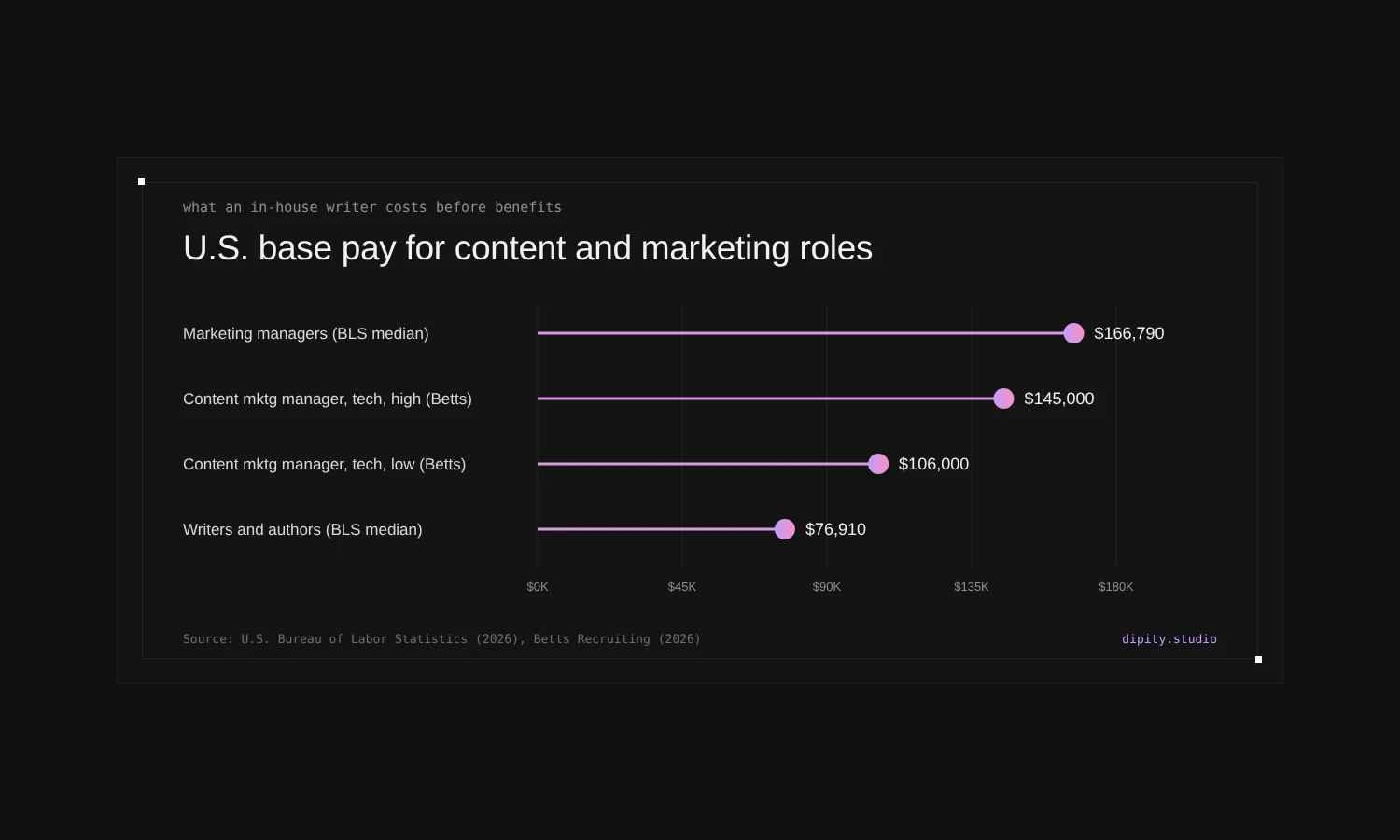
A content marketing manager in U.S. tech earns a base salary of roughly $106,000 to $145,000 in 2026. Benefits add about 30% of total compensation for the average private-sector employer. A $125,000 base salary carries a loaded cost near $178,600 a year before tools, recruiting, and ramp time. That buys one writer covering every channel.
Betts Recruiting's 2026 compensation data shows base pay for content marketing managers averaging $106,000 to $145,000 across the U.S. New York and San Francisco run $110,000 to $160,000. Remote roles sit at $100,000 to $140,000.
Government data gives a wider frame. The Bureau of Labor Statistics reports a median annual wage of $76,910 for writers and authors in May 2025. A senior hire who owns strategy costs more. BLS puts the median for marketing managers at $166,790.
Salary is only the visible part. The BLS Employer Costs for Employee Compensation release for June 2026 shows benefits averaged 30% of employer compensation costs in private industry. Divide a $125,000 base by 0.70 and the loaded cost lands near $178,600. Your actual benefits mix will differ, so treat that as an estimate.
An in-house hire earns the cost when content becomes a core channel. You get full-time attention, deep product knowledge, and someone who sits in the room when strategy changes. You also get one person, one set of strengths, and a single point of failure when they leave.
Executive time is the hidden line item in every option. Writing LinkedIn posts yourself takes about 4 to 6 hours a week. A good ghostwriter cuts that to 30 to 60 minutes of interviews and review. AI-assisted systems can shrink the input further, but only if they capture real ideas instead of generating generic ones. No option reaches zero without losing your voice.
Sproutworth estimates that writing LinkedIn posts that perform takes 4 to 6 hours a week when a founder does it alone. That adds up to roughly 200 to 300 hours a year. With a ghostwriter, the founder spends 30 to 60 minutes a week on a call or a Slack thread.
Put a price on those hours. A founder or CMO earning $250,000 a year costs the company far more per hour than any freelancer. The real comparison weighs your hourly value against the retainer, not the retainer against zero.
The input still has to come from you. Buyers reward insight they cannot find elsewhere. The Edelman-LinkedIn data shows 71% of hidden buyers rank thought leadership above traditional marketing or sales materials for demonstrating a vendor's value. A writer or a model cannot invent your judgment. They can only package it.
Pick the option that protects the hour you spend thinking, then outsource the hours you spend typing.
Yes, when they know AI wrote it. Multiple peer-reviewed studies find disclosed AI authorship lowers trust, perceived authenticity, and perceived competence, even when the content is identical. The penalty is steepest for personal and social writing, which describes most executive LinkedIn posts. Readers do not penalize a human ghostwriter the same way, largely because they rarely know one exists.
The largest evidence base comes from Oliver Schilke and Martin Reimann's 13 experiments with over 5,000 participants, published in Organizational Behavior and Human Decision Processes in 2025. Investors trusted firms 18% less when ads disclosed AI use. Students trusted professors 16% less. Trust dropped further when someone else exposed the AI use with a detector.
Professional reputations take a hit too. In a study reported in Harvard Business Review, 1,026 engineers rated identical Python code. Reviewers rated the author's competence 9% lower when they believed AI helped write it.
Context matters. A 2025 study by Hiroki Nakano and colleagues had 261 participants evaluate 990 responses across six contexts. Disclosure lowered ratings of trustworthiness, caring, competence, and likability, with the sharpest drops in social and interpersonal writing. Readers with higher AI literacy were more tolerant.
Researchers at Macquarie University named the resulting bind. In a 547-person experiment published in 2026, participants said AI disclosure mattered, then rated disclosed content lower. The authors warn this "risks creating perverse incentives for non-disclosure of GenAI use." News shows the same pattern. Luca Cian's work, summarized by UVA Darden, found an "AI-generated" label cut trust in news by 7 to 14 percentage points.
The takeaway for executives is practical. Readers punish content that feels machine-made and ideas that feel borrowed. The defense is substance only you could supply, approved by you, in a voice your colleagues would recognize.
Voice authenticity depends on how well the process captures the executive's real thinking, not on whether a human or a model types the draft. Generic AI tools flatten voice and make posts sound alike. Human ghostwriters capture nuance but drift as writers change. The strongest results come from systems that interview the executive, store the ideas, and check every draft against a voice model.
Sameness is the measurable risk with unguided AI. A study by Anil Doshi and Oliver Hauser in Science Advances, summarized by ScienceDaily, gave 300 writers access to AI story ideas. Less creative writers improved, with stories up to 26.6% better written. Stories using one AI idea were also 10.7% more similar to each other. Individual quality rose while collective novelty fell.
On LinkedIn, that sameness is now the default. With 81.2% of sampled long-form posts flagged as likely AI, a post that sounds like everyone else's disappears. Originality.ai also reports that LinkedIn is rolling out a way for users to flag posts that seem like AI slop.
Take a Series A CTO who posts twice a week. A generic AI tool gives her polished posts about "scaling engineering culture" that read like a hundred others. A ghostwriter who interviews her about a failed database migration gets a story nobody else can tell. An AI system that runs the same interview and stores the details gets the story too, at a fraction of the cost, if she still approves each draft.
We cover the staffing side of this in our guide to hybrid AI content strategy for B2B SaaS. The short version: let machines handle format and frequency, and keep humans in charge of ideas and judgment.
Match the option to your stage, the number of executives you need to cover, and how much of your thinking you want to own. Pre-seed founders with one channel do fine with a freelancer. Teams with several executives and a strong brand bet benefit from an agency or an in-house hire. AI-assisted systems fit teams that need coverage across many leaders and channels without a six-figure line item.
Start by counting voices and channels. One founder on LinkedIn is a small job. A CEO, CTO, and VP of Sales across LinkedIn, a blog, and a newsletter is a content operation. Cost scales with that matrix for every human option. Software pricing scales far slower.
Ask three questions before you sign anything. Who owns the interview notes and voice data? How does the process stop your posts from sounding like everyone else's? How many minutes a week does it need from each executive? Clear answers beat a low price.
For the bigger picture on why this matters to buyers, read B2B thought leadership: what buyers reward.
Sera sits in the AI-assisted category and is built to address its two weak spots: generic voice and lost knowledge. She interviews executives, stores their ideas in a knowledge base the company owns, and scores drafts against each leader's voice before anyone sees them. Plans start at $50 per month, with a 7-day free trial.
Sera, the AI head of content from Dipity, interviews executives by phone, webcam, chat, or text. Each conversation feeds an editable knowledge base that stays with your company if people or vendors change. Her voice model combines semantic and stylometric layers, and a Sera Check score flags drafts that drift from how the executive actually writes. She drafts for LinkedIn, X, your blog, newsletters, YouTube, and Instagram, and nothing publishes without approval.
Custom Enterprise plans cover larger teams. For a team weighing a $3,000 agency retainer or a $150,000 hire, that changes the math on covering every executive. Founder voice compounds over time, as we argue in why founders are becoming the product. Start a free Sera trial or see how the Dipity product works.
Ready to try it? See Sera pricing, from $50 per month, or Book a Demo to watch Sera interview an executive and draft in their voice.
Most funded SaaS companies spend $2,000 to $5,000 a month on LinkedIn ghostwriting, according to Sproutworth's 2026 pricing guide. Entry-level freelancers start near $500 a month. Full-service executive programs can pass $10,000.
An agency is usually cheaper for one to three executives. A U.S. content marketing manager in tech earns $106,000 to $145,000 in base pay before benefits. An agency at $2,000 to $5,000 a month costs $24,000 to $60,000 a year.
Research shows disclosure lowers trust, and discovery by a third party lowers it further. The safest path is to use AI as a drafting tool on top of your own ideas, approve every word, and follow any disclosure rules your industry or platform sets.
It can get close when it learns from your own interviews, transcripts, and past writing, and when every draft gets checked against a voice model. Generic prompts produce generic posts. Your approval step remains the final voice check.
Plan on 30 to 60 minutes a week for interviews and review, compared with 4 to 6 hours writing alone. Less time than that usually means the ideas are coming from someone else.
Acar, O. A., Gai, P. J., Tu, Y., and Hou, J. (2025). Research: The hidden penalty of using AI at work
Betts Recruiting. (2026). Top content marketing manager compensation trends in tech for 2026
Clutch. (2026). Content marketing agency pricing guide
Content Marketing Institute. (2025). New B2B research finds winning marketing teams are building fundamentals, not just playing with prompts
Demand Gen Report. (2025). Marketers need to gear content to hidden B2B buyers: Edelman/LinkedIn
Edelman and LinkedIn. (2025). 2025 B2B Thought Leadership Impact Report: The hidden buyer
Editorial Freelancers Association. (2026). Editorial rates
Nakano, H., Takezawa, J., Matulic, F., Yang, C.-L., and Yatani, K. (2025). Understanding reader perception shifts upon disclosure of AI authorship
Originality.ai. (2026). LinkedIn AI content study: 81% of long-form posts are likely AI
Sahebi, S., Formosa, P., and Bankins, S. (2026). The AI penalty and disclosure paradox: Trust, authenticity and knowledge uptake in AI-mediated communication
ScienceDaily. (2024). AI found to boost individual creativity, but results in less varied content
Sproutworth. (2026). LinkedIn ghostwriting for SaaS founders: Pricing, process, and ROI
University of Arizona. (2025). Disclosing AI use can backfire, research shows
University of Virginia Darden School of Business. (2025). The AI disclosure dilemma
Upwork. (2026). How much does it cost to hire a ghostwriter?
U.S. Bureau of Labor Statistics. (2026). Advertising, promotions, and marketing managers: Occupational outlook handbook
U.S. Bureau of Labor Statistics. (2026). Employer costs for employee compensation, June 2026
U.S. Bureau of Labor Statistics. (2026). Writers and authors: Occupational outlook handbook

Looking for further details?






Our experienced team values clarity and craftsmanship, excelling in production systems.