Your AI Executive Assistant
Executive Thought Leadership on Autopilot
Sera_01: Semantic Executive Resource Engine
Built for AI Search Visibility
Your Voice, on Every Channel

Marketing Insights_
Buyers rank vendors before first contact and trust people over logos. Here is the data on founder reach and a system to scale the founder's voice.
September 25, 2026
8 Min Reads
Morgan Von Druitt
Founders are becoming the product. Buyers pick a favorite vendor before they ever talk to sales, and they pick people they trust over logos they ignore. The 6sense 2025 Buyer Experience Report found 94% of buying groups ranked preferred vendors before first contact. Your point of view is what those buyers read, quote, and remember. At Dipity, we build systems to capture your point of view once and publish from the result every week, without burning you out.
Your B2B buyer reads your founder's posts. Watches a podcast clip. Asks an AI assistant about your category. All before a demo. The product still has to work. But the reason a buyer puts you on the shortlist often comes down to one thing: whether the person running this company understands their problem better than anyone else.
This shift turns the founder-led brand into a core asset. The founder's methodology, opinions, and taste become part of what the customer buys. We covered the channel side in why your face is the best go-to-market channel for an AI startup. This post covers the data behind the shift and the risk inside the model.
The risk is real. A company built on one person's voice goes quiet the week the person gets busy. The answer is a system, and the back half of this post lays one out step by step.
Buyers do most of their research alone. They build a shortlist, pick a favorite, and avoid reps for as long as possible. By the time a seller joins the conversation, the deal already leans one direction. Your founder's public thinking is one of the few signals buyers see from your company during this window.
The same research shows buyers purchased from their preliminary favorite 77% of the time.
Buyers want less contact, not more. Gartner research reported by Digital Commerce 360 found 67% of B2B buyers favor a rep-free experience, and 45% used AI tools during a recent purchase. When your founder stays invisible during research, your company reads as a feature list. When your founder is visible, your company reads as a point of view.
Before first contact, buyers see these:
The window before first contact is where deals get decided. Your founder should be in the room even when nobody from sales is. For the search side of this shift, read how AI search is rewriting B2B discovery.
Buyers stopped trusting logos. They trust people they feel close to. The 2026 Edelman Trust Barometer puts trust in "My CEO" at 66 percent, while nearly 7 in 10 fear institutional leaders mislead the public. A founder reads as a person. A company page reads as an institution.
The B2B data backs this up. LinkedIn's 2025 Influence Report with Ipsos found 93.7% of marketers agreed trust was the most important factor in building a successful B2B brand. The same study found 62.3% value being recommended as reliable by peers over high brand awareness alone.
The comparison between voices is the sharpest finding. Per the LinkedIn and Ipsos benchmark, endorsements from experts were 1.7x more likely to give a brand the edge over a rival than written content from the company itself. A founder is an expert with a name. Company copy is company copy.
AI makes the gap wider. HubSpot's 2026 State of Marketing found 62.7% of marketers believe they need more unique, human-centered content to compete with AI content. When every company page sounds the same, a founder with a specific opinion stands out.
Here is the difference in practice. A company page posts, "We are proud to announce our new integration." A founder posts, "We shipped this integration because three customers told us their ops lead spent every Friday copying data between two tools. Here is what we learned building the fix."
Authority beats activity. Buyers trust the founder who shows the work. For more on what earns this trust, read what B2B buyers reward in thought leadership.
People have bigger networks and better click-through than pages. LinkedIn's own benchmark says employee networks carry 10 times as many connections as a company page has followers, and employee shares get 2 times the click-through rate. Your founder is usually the highest-reach employee you have.
LinkedIn published this figure in 2017, so treat the number as a long-standing benchmark rather than a fresh measurement. Distribution follows people.
This is the core of the founder personal brand B2B case. Your company page speaks to existing followers. Your founder's profile reaches a whole network, plus every second-degree connection who sees a reshare.
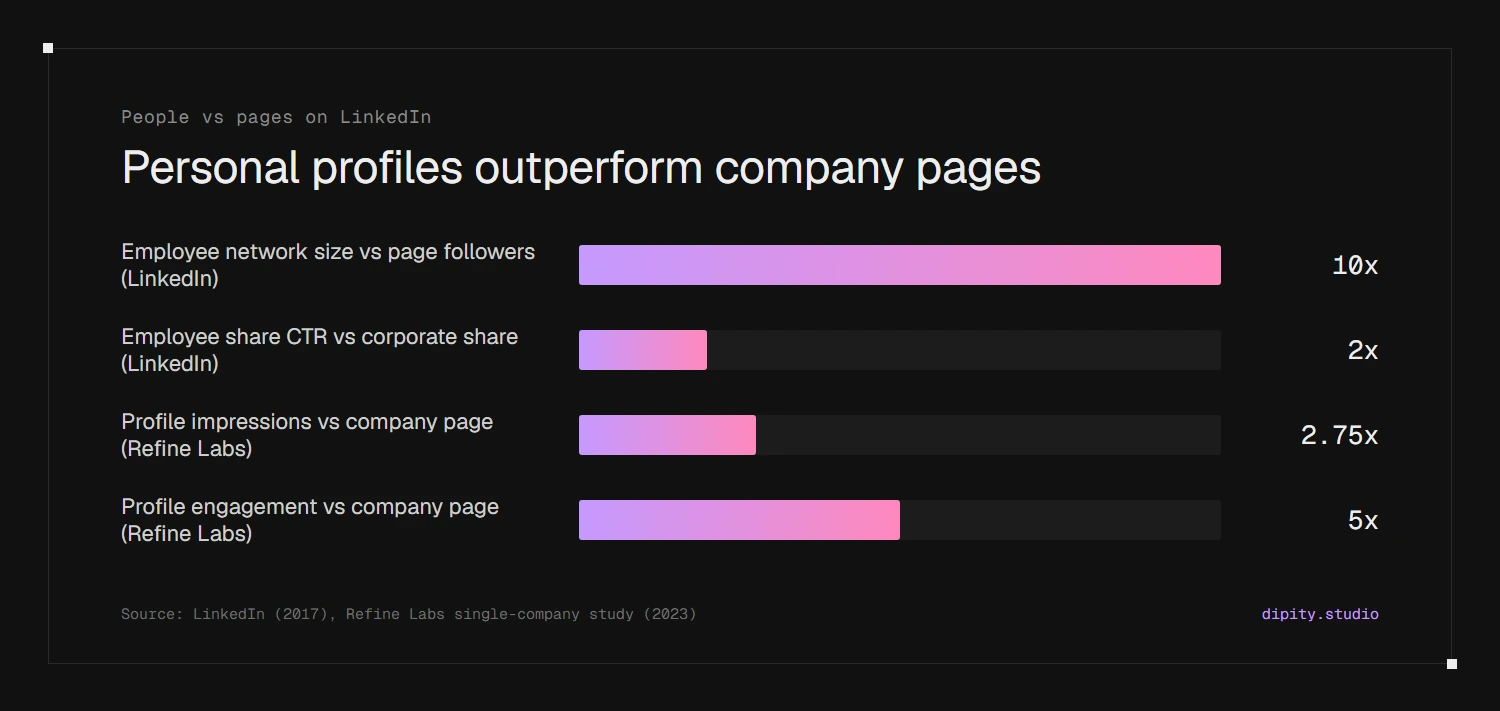
Two companies have published their own numbers. Refine Labs ran a single-company study comparing 7 employees' personal profiles to the company page over the same period. Personal profiles drove 2.75x more impressions and 5x more engagement, despite "an average follower count, 46% lower than the Refine Labs company page." The sample is small: one company and seven people. Read the result as a practitioner benchmark.
Chili Piper reported a similar pattern in a first-party write-up on Thought Leader Ads, the LinkedIn format for promoting employee posts. One campaign hit 3.26% engagement at a $42.27 CPM. The team wrote, "The results so far are much better than promoted posts from our company page."
The company page still has a job. The founder's profile does the reaching. Build your plan around the person, and read why CEO LinkedIn content converts higher than company pages for the channel math.
Investors read the same feeds your buyers read. Academic research from Wharton links an active startup social presence to closing rounds, raising more capital, and drawing a broader investor pool. A visible founder gives investors proof of conviction and market pull before the first meeting.
The Wharton paper dates to 2017, when X was still Twitter. The platform name changed. The logic did not.
You also carry measurable value once your company grows. Bain's analysis of founder-led companies found they outperformed nonfounder-led counterparts by 2.1 times in total shareholder returns since 2015, and founder-led tech companies beat industry peers by 2.6 times. These numbers measure performance, not posting habits. They show you are an asset worth making visible.
Lovable gives you a clean example of a founder going direct. CEO Anton Osika announces milestones on X, and TechCrunch has sourced reporting from those posts. TechCrunch reported Lovable crossed $100M ARR eight months after launch with 45 full-time employees. The posts did not cause the growth. They turned the founder into the primary news source for his own company. You want to own this position during a raise.
Your feed is part of your data room. Investors check the feed whether you plan for the check or not. See what investors check before a raise for the full list.
Founder dependency is the hidden tax on a founder-led brand. You get busy with a raise, a hire, or a launch. Posting stops. The audience drifts. The fix: separate your thinking from your calendar so the voice keeps publishing without a blank page every week.
Most founders post in bursts. Three weeks on, six weeks off. The payoff lives in consistency.
The quality bar is lower than you think. The 2024 Edelman and LinkedIn research found only 15% of survey respondents rated thought leadership quality "very good." Show up every week with a sharp, specific view and you clear the bar by default.
Dependency shows up in five predictable ways:
Playbooks beat heroics. A brand built on heroics dies the first busy quarter. A brand built on a system keeps publishing.
Record the methodology once. Store the raw material in a knowledge base your company owns. Publish from the base on a fixed cadence. You spend your time on interviews and approvals, not blank pages. Every post traces back to your real opinions, stories, and frameworks.
The raw material already lives in your head. Sales calls and investor pitches repeat the same core ideas every week. Record those ideas once, in your own words.
Format matters too. The LinkedIn and Ipsos research found video is 20% more effective than the same content in written form. One founder interview feeds text posts, blog articles, and short clips.
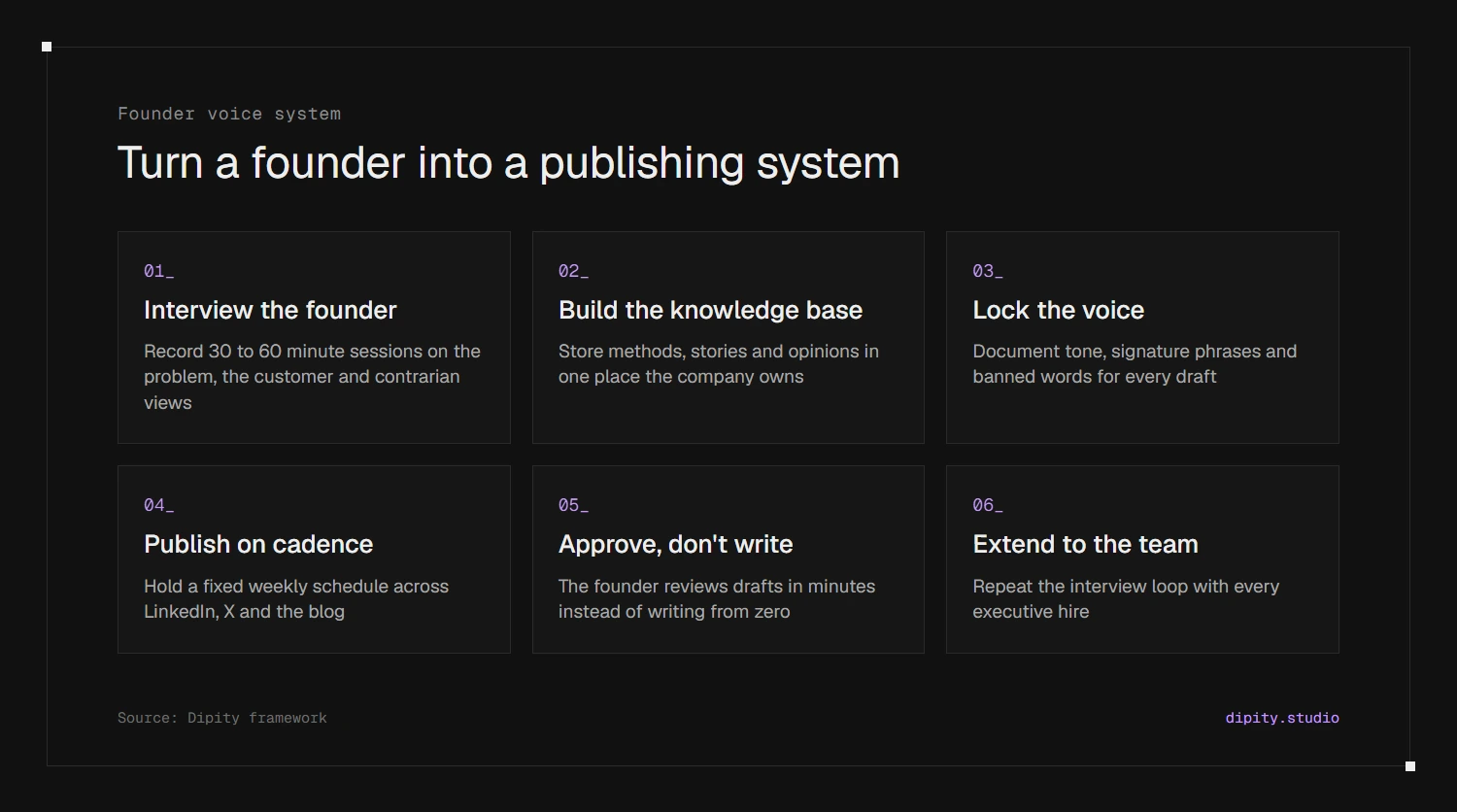
Here is the six-step system we run at Dipity:
Sera runs this loop for you. Sera interviews you by chat, text, phone, webcam, or Google Meet, builds the knowledge base, learns your voice profile, and drafts for LinkedIn, X, and the blog. Nothing publishes without your approval. For the full model, read how to create an authority content engine.
Run the same capture loop with every executive hire. Interview each leader. Build a voice profile. Publish on a personal cadence from the shared knowledge base. Your company gains more human voices, and the founder stops being the only point of trust.
The distribution math holds for executives too. Each leader brings a separate network. Each one reaches a different member of the buying group.
A head of product writes about roadmap tradeoffs. A head of sales writes about the questions buyers ask in week one. The founder sets the thesis. The team proves the thesis.
Take a 20-person SaaS company with a founder, a head of product, and a first sales hire. The founder posts on category views. The head of product posts on build decisions. The sales lead posts on customer patterns. Three voices, one knowledge base. Each leader spends time on interviews and approvals only.
The interviews produce more than posts. Each leader's methodology becomes a playbook your company owns. AI agents execute against those playbooks. This is how a lean team scales capacity without headcount, and the hybrid AI content strategy for B2B SaaS covers the split between human input and AI output.
Founder voice is the moat. An executive team with a shared voice widens the moat.
Record one interview this week. Turn the transcript into a knowledge base, lock in your founder's voice, and publish on a fixed weekly cadence. Add each executive as you hire. The goal is a founder-led brand which keeps publishing whether or not the founder has a free afternoon.
Buyers rank you before they ever call. They trust people over pages. Investors read the same feeds. Every fact you publish points back to your founder's point of view as part of the product.
Winning founders treat their thinking as company IP, capture the thinking once, and ship from the system every week. The playbook behind the channel lives here: how to build founder-led content as a growth channel.
Turn your founder into a system. Start with Sera, the AI head of content which interviews your executives, builds a knowledge base your company owns, and publishes in each leader's voice. See how the pieces fit on the Dipity product page.
Start with your personal profile. Personal profiles reach bigger networks and pull more engagement than company pages. Use the company page to reshare your posts and hold product news.
Yes. Trust data shows people trust leaders they feel close to more than institutions. B2B research backs this up: expert endorsements beat company-written content. A founder with a clear point of view reads as a trusted expert. A logo reads as marketing.
Academic research ties an active startup social presence to closing rounds and raising more. Investors check your public feed before the first meeting. A consistent feed signals conviction, customer insight, and market pull.
Plan on about an hour a week for interviews and approvals. Delegate the writing. Never delegate the thinking. A ghostwriter or an AI system works when drafts come from your recorded methodology and you approve every post.
Thought Leader Ads let a company promote posts from employees and executives as paid ads. Chili Piper published a first-party report finding stronger results than promoted company page posts. Treat vendor reports as directional. Test the format against your own page ads.
Executive visibility means your leadership team publishes under their own names, not only the founder. Each leader reaches a different network and a different member of the buying group. The same interview and approval system you built for yourself scales to the whole executive team.
6sense. (2025). The Timeline for Influencing B2B Buyers Is Shrinking: Insights From 6sense's 2025 Buyer Experience Report
Bain & Company. (2026). The Magic of Founder-led Companies
Chili Piper. (n.d.). LinkedIn Thought Leader Ads
Edelman. (2026). 2026 Edelman Trust Barometer Reveals Trust is In Peril As Society Slides from Grievance into Insularity
Gartner (via Digital Commerce 360). (2026). Gartner: Two-thirds of B2B buyers prefer rep-free purchasing as AI reshapes sales
Heim, A. (2025). Eight months in, Swedish unicorn Lovable crosses the $100M ARR milestone
HubSpot. (2026). 2026 State of Marketing: Data from 1,500+ global marketers
LinkedIn. (2017). The Real Value of Your Employees' Social Media Reach
LinkedIn. (2024). Reach Beyond The Ready: B2B Thought Leadership Research From LinkedIn and Edelman
LinkedIn & Ipsos. (2025). Be Category-Famous and Accelerate Social Trust: 2025 B2B Marketing Benchmark: The Influence Report
Refine Labs. (2023). Personal LinkedIn Profiles Outperform Company Pages with 5x More Engagement
Wharton Mack Institute. (2017). Social Is the New Financial: How Startup Social Media Activity Influences Funding Outcomes

Looking for further details?






Our experienced team values clarity and craftsmanship, excelling in production systems.