
Your AI Executive Assistant
Executive Thought Leadership on Autopilot
Sera_01: Semantic Executive Resource Engine
Built for AI Search Visibility
Your Voice, on Every Channel

AI Insights_
Google rewards helpful content, not human typing. Why AI-only content commoditizes, and a weekly hybrid model: executive interviews, AI drafts, human approval.
September 20, 2026
8 Min Reads
Morgan Von Druitt
Your AI content strategy for B2B SaaS wins when humans bring the expertise and AI brings the speed. Among B2B marketers using AI for content, 87% report better productivity. Only 58% report better content quality, according to the Content Marketing Institute. Google is not the obstacle. Ahrefs found 86.5% of top-ranking pages contain some AI-generated content. At Dipity, we build the hybrid version. Executive interviews go in. AI production runs in the middle. Human approval happens before anything ships.
A hybrid AI content strategy divides labor by strength. You bring the raw material: founder interviews, customer stories, opinions earned from years in the market. AI handles production: transcripts, drafts, repurposing, formatting. A human signs off on every piece before publication.
You already feel the gap. HubSpot's 2026 State of Marketing found 62.7% of marketers believe they need more unique, human-centered content to compete. Everyone has the same models. Few teams have a process for pulling the founder's knowledge out of the founder's head. We laid out the full system in how to create an authority content engine.
This guide covers what the data says about AI content and rankings, why AI-only output turns into commodity content, and a weekly operating model with named roles. Run the model as written. Or trim the model to fit a two-person team.
Generative AI is table stakes in B2B marketing now. Your budget is flowing toward AI tools faster than your team builds the process to use them well. Adoption is near-universal. Results are not. The gap between using AI and earning a return from AI is where most B2B SaaS content programs stall.
The adoption numbers leave little room for debate. The CMI trends research reports 95% of B2B marketers say their organizations use AI-powered applications. Content creation tools top the list. Spending follows. Gartner data covered by Marketing Dive shows 15.3% of marketing budgets on average now go toward AI.
Your returns lag behind your spend. In the same Gartner survey, only 30% of CMOs feel their organizations have the infrastructure to lead in AI. McKinsey's State of AI, as reported by CX Today, found only 39% of organizations report any EBIT impact attributable to AI.
Access to AI is no longer an advantage. Every competitor has the same tools. Your edge comes from the workflow around the tools and the expertise going into them.
Yes. Google ranks content on quality, not on how the content was produced. AI-assisted pages rank every day. The penalty targets pages built to manipulate rankings and pages published at scale without added value. Pure AI output rarely reaches position one, where human-written pages dominate the results.
Google settled the policy question in 2023. Google Search Central stated: "Appropriate use of AI or automation is not against our guidelines." The same post ran under a clear heading: "Rewarding high-quality content, however it is produced."
Ranking data backs the policy. The Ahrefs ranking study of 600,000 pages measured the correlation between AI share and rank at 0.011, effectively zero. The same study adds a warning: "purely AI content rarely reaches the #1 position."
Google's guidance on generative AI content draws the line. Using generative AI tools "to generate many pages without adding value for users may violate Google's spam policy on scaled content abuse." Volume alone is the risk.
Look at the Semrush numbers for a concrete example. Semrush's 2026 study of 42,000 blog posts across 20,000 keywords found position 1 results are 8x more likely to be human-written. Most SEOs miss this. In the same research, 72% of SEOs say AI content ranks at least as well as human-written content. Both findings hold. AI content ranks. Human-led content takes the top spot.
Stop asking whether AI content ranks. Ask whether your page adds something no model produces alone. Our guide to answer engine optimization shows how the same rule applies inside AI answers, and our breakdown of how AI search is rewriting B2B discovery shows where buyers now find you.
AI-only content becomes commodity content because every competitor pulls from the same models trained on the same public web. Output converges on the same points in the same order. Without first-hand experience or a real point of view, your page offers nothing to separate your company from ten others.
The web already runs on AI drafts. Ahrefs analyzed 900,000 new pages from April 2025 and found 74.2% contained AI-generated content. Mixed human and AI pages made up 71.7% of the sample. Pure AI pages were only 2.5%. Hybrid is already the default. Doing hybrid well is the open question.
Quality drops when human input disappears. In the CMI survey, 12% of AI content users say quality decreased. Google's Search Quality Rater Guidelines assign the Lowest rating to main content made with "little to no effort, little to no originality, and little to no added value for visitors to the website." Raters are trained to spot low-effort AI pages.
CNET is your cautionary tale. In January 2023, Engadget reported CNET had corrected 41 of the 77 AI-written articles. The editor paused the program and wrote: "We've paused and will restart using the AI tool when we feel confident the tool and our editorial processes will prevent both human and AI errors." The model was not the failure. Skipping review was.
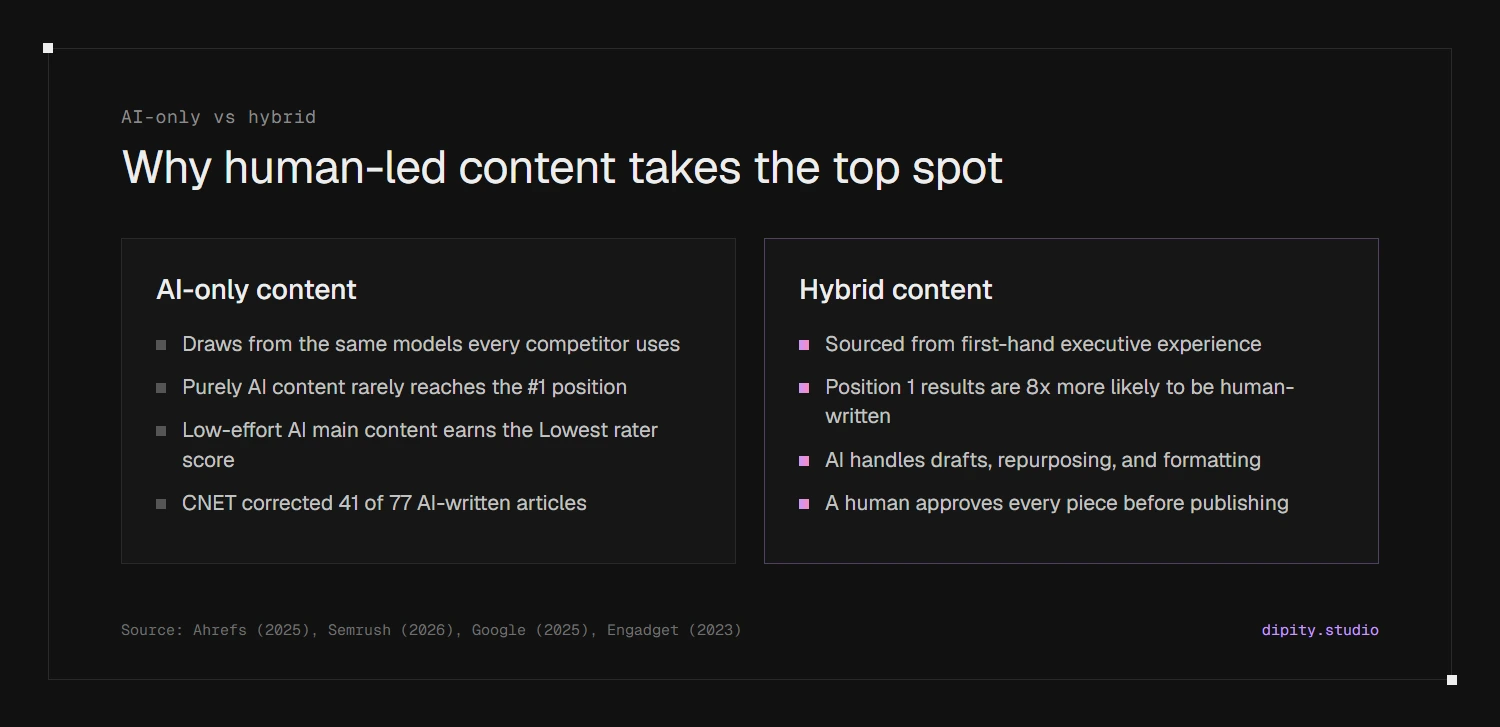
Speed without a source produces sameness. Sameness at scale produces risk. Fix both with stronger input upstream and firm review downstream.
AI belongs in production work: transcription, first drafts, repurposing, formatting, and distribution. These tasks eat hours and need little judgment. Teams running AI on this layer report real savings in time and cost. Senior people get their hours back for ideas and review instead of typing.
The gains show up in hard numbers. In the Gartner 2025 CMO Spend Survey, covered by MarTech, CMOs said the technology improved efficiency on time (49%) and costs (40%) and raised capacity to produce more content (27%). HubSpot's research puts hours on the table. About one-third of marketers save 10 to 14 hours per week with AI. Another third save 15 or more.
Marketers are clear-eyed about what this tool does. Per the same HubSpot report, 73.4% view AI as helping marketers rather than replacing them. The saved hours go back to strategy, interviews, and review.
Klarna proves the production upside at enterprise scale. Marketing Dive reported AI helped Klarna cut sales and marketing spend by 11% in Q1 2024 while running more campaigns and producing more marketing materials. AI accounted for 37% of the quarter's marketing savings, about $10 million on an annualized basis. The image production cycle dropped from six weeks to seven days. Klarna is a consumer fintech, so treat this as proof of production efficiency, not a B2B content playbook.
Hand AI the production line. Keep the thinking, the stories, and the final call with people. Playbooks over heroics.
You keep E-E-A-T by feeding AI the first-hand experience only your leaders hold. Then you attribute, review, and disclose with honesty. Google asks whether your content shows first-hand expertise. A model has never run your company, closed your deals, or fixed your churn. Your executives have done all three.
Google lays out the test in guidance on helpful, people-first content. One question asks whether your content shows "first-hand expertise and a depth of knowledge." The same page tells publishers to evaluate content through "Who, How, and Why." The page also asks whether the use of automation is "self-evident to visitors through disclosures or in other ways."
Buyers look for the same signal. The 2025 Edelman-LinkedIn B2B Thought Leadership Impact Report found 56% of target buyers use thought leadership as part of their vendor evaluation process. At seed and Series A, you are the chief expert. We break down what buyers reward in B2B thought leadership.
E-E-A-T is a sourcing problem, not a writing problem. Fix the source, and AI drafts become safe to publish. Founder voice is the moat.
A hybrid operating model runs on three roles and one weekly loop. You supply source material in a 30-minute interview. AI turns your transcript into drafts across channels. A content owner edits for proof and specifics. You approve before anything ships. The loop repeats every week.
Process beats tooling. Per CMI, 74% of B2B marketers point to strategy refinement as the biggest driver of improvement. Budgets are shifting too. In the Gartner survey, 39% of CMOs plan to cut back on agency spending by eliminating unproductive agency relationships and streamlining rosters. Money is moving from retainers to AI plus in-house judgment.
This model fits a seed or Series A team with no dedicated content hire. Three roles run the show: the executive (source and approval), AI (production), and a content owner (editing and publishing). The content owner is often your first marketing hire or a part-time operator. Pair this model with the tools in our minimum viable stack for seed to Series A founders.
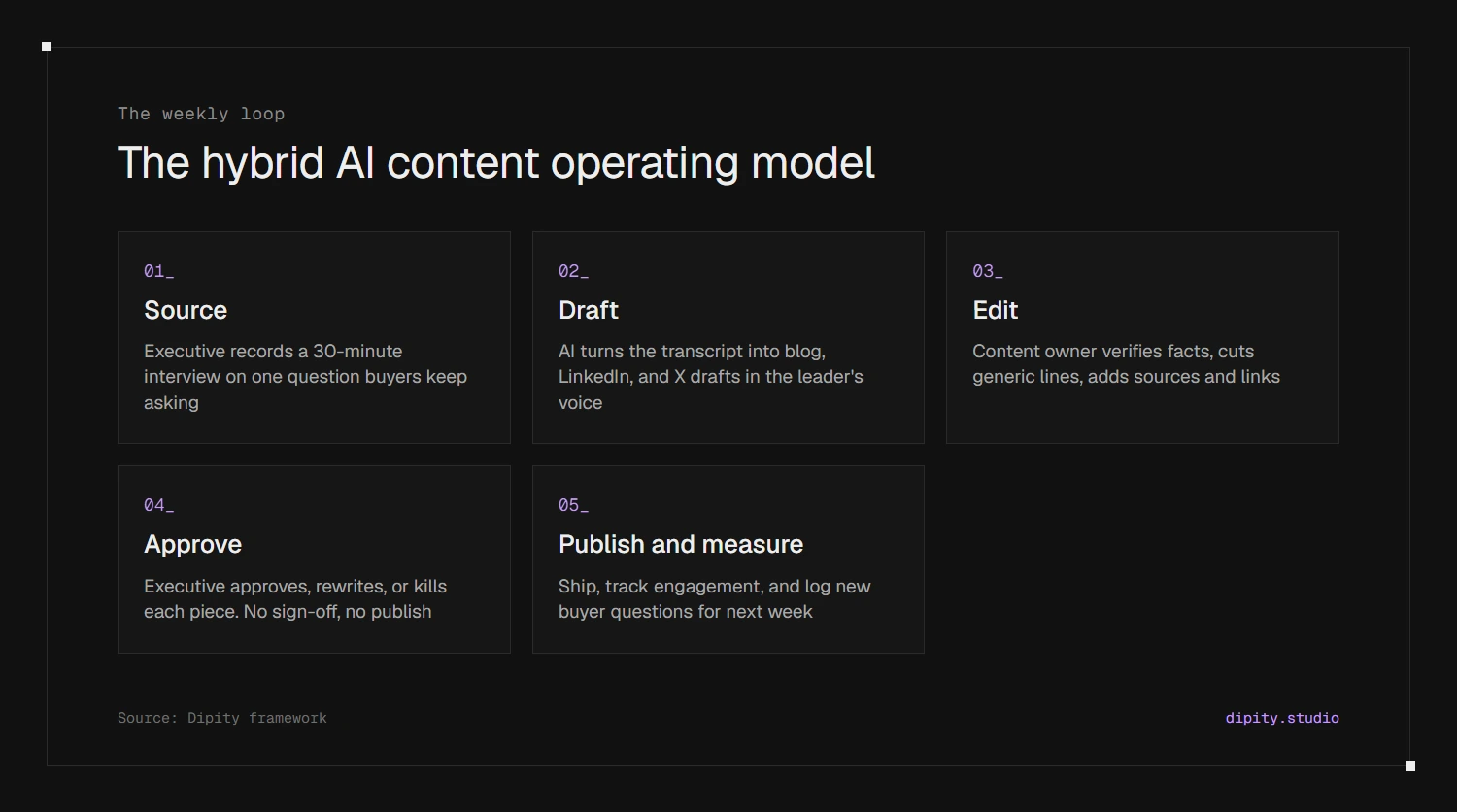
One interview a week gives you a blog post, a handful of social posts, and a growing knowledge base your company owns. Tie the weekly loop to a quarterly plan with our guide to strategic content roadmaps.
Pick one executive. Schedule one interview. Set one approval rule. Do all three this week. Record 30 minutes on the question buyers ask most. Let AI produce the drafts. Edit for proof and specifics. Have the executive approve every piece before anything goes live. Run this loop for a full quarter before you add channels.
Drafting is a solved problem. Every team runs the same models. The data is clear: drafting speed does not win the top ranking or earn buyer trust. Expertise capture wins both. Your founder's stories, calls, and hard-won opinions are the input no competitor owns. Our playbook on founder-led content as a growth channel covers the distribution side.
Sera is the AI head of content from Dipity. She runs this loop for you. Sera interviews your executives by chat, text, phone, webcam, or Google Meet. Every answer feeds a knowledge base your company owns, plus a voice profile for each leader. Then Sera drafts LinkedIn posts, X posts, and blog articles in each leader's voice. Every draft waits for approval before publishing. Approval is the default.
Stop feeding AI generic prompts. Feed AI your founder instead. Start with Sera today, or see how the system works on the Dipity product page.
No. Google cares about quality and helpfulness, not how you produced the content. Where you get in trouble is publishing dozens of AI pages with no added value or using automation to manipulate rankings. Both violate Google's spam policies.
A hybrid AI content strategy pairs human source material with AI production and human approval. Your executives supply expertise through interviews. AI drafts and repurposes. A human edits and signs off before anything goes live.
Generative AI now handles drafting, repurposing, and production work across most B2B marketing teams. Budgets are shifting toward AI tools and away from agency retainers. The companies seeing returns redesigned their workflows around AI instead of bolting tools onto old processes.
Split the work by task, not by percentage. Humans supply ideas, stories, and final review. AI handles transcription, first drafts, formatting, and channel versions. Top-ranking pages tend to be human-led, so keep a person in charge of every piece.
Source every piece from first-hand executive experience. Put a named expert on the byline. Have a subject-matter owner review every claim. Be open about how you made the content. AI drafts the words, and your leaders supply the experience behind them.
Ahrefs. (2025). AI-Generated Content Does Not Hurt Your Google Rankings
Ahrefs. (2025). What Percentage of New Content Is AI-Generated?
Content Marketing Institute. (2025). B2B Content and Marketing Trends: Insights for 2026
CX Today. (2025). McKinsey's State of AI: The Scaling Gap Is Now CX's Problem
Edelman and LinkedIn. (2025). 2025 B2B Thought Leadership Impact Report
Engadget. (2023). CNET corrected 41 of its 77 AI-written articles
Google. (2023). Google Search's guidance about AI-generated content
Google. (2025). Google Search's Guidance on Generative AI Content on Your Website
Google. (2025). Search Quality Rater Guidelines
Google. (n.d.). Creating helpful, reliable, people-first content
HubSpot. (2026). 2026 State of Marketing: Data from 1,500+ global marketers
ICONIQ Growth. (2025). The State of Go-to-Market in 2025
Marketing Dive. (2024). Klarna uses gen AI to cut marketing spend
Marketing Dive. (2026). AI remains a top priority for CMOs, but spending lags: Gartner
MarTech. (2025). CMOs brace for cuts as marketing budgets stay flat
Semrush. (2026). Does AI Content Rank in Search? [Survey + Data Study]

Looking for further details?






Our experienced team values clarity and craftsmanship, excelling in production systems.