
Your AI Executive Assistant
Executive Thought Leadership on Autopilot
Sera_01: Semantic Executive Resource Engine
Built for AI Search Visibility
Your Voice, on Every Channel

Business Essentials_
Ten B2B companies that named and won a category, from Salesforce to Clay, with the move each made, verified outcomes, and a pattern to copy.
October 6, 2026
8 Min Reads
Morgan Von Druitt
Category leaders take most of the money in their markets. Play Bigger's Time to Market Cap study found category kings captured about 76% of the market value among venture-backed tech companies founded since 2000. Being first is no guarantee. Golder and Tellis's study of about 500 brands found 47% of market pioneers failed. At Dipity, we help founders build authority around the ideas they want to own. This guide profiles 10 B2B companies that named a category and won it, with the move each one made, a verified outcome, and the pattern you can copy.
Category creation means naming a problem and a new way to solve it, then teaching the market to buy that way. The winners in B2B did more than ship a product. They coined a term, gave it a point of view, and repeated it until buyers, analysts, and competitors used it too. The company that defines the category usually captures most of its value.
If you want the theory first, start with our explainer on what category creation is and when it pays off. This post is the case file. Each profile below answers three questions. What did the company call the category? What move made the name stick? What happened next, measured by revenue, valuation, or analyst recognition?
The research behind the strategy is consistent. In a Stanford eCorner talk, Play Bigger co-author Al Ramadan described research on roughly 8,000 venture-backed U.S. companies. Thirty-five category kings held 76% of the market cap in that set. The same Time to Market Cap report found the time for a company to reach a $1 billion value fell from 8.5 years to 2.9 years across the eras it studied.
Academic work on market categories explains why the name matters so much. Granqvist and Siltaoja's review in Organization Theory describes how firms use category labels to access funding, reputation, and status. A shared label also helps establish that a new category is viable at all. Andreessen Horowitz partner Martin Casado makes the commercial version of the point in an a16z episode on category creation. The purpose of defining a category, in his framing, is setting the price.
We grouped the 10 companies by the kind of category they built. Some reframed a business model. Some reframed a data architecture. Some invented a job title.
These three companies named a new way of buying and running software. Salesforce attacked installed software. HubSpot attacked interruptive outbound marketing. Zuora named the shift to recurring revenue. Each picked a clear enemy and gave buyers a simple word for the alternative.
Category: cloud CRM delivered as a subscription, sold under the banner of "no software." Move: Salesforce launched in February 2000 at an event themed around the end of software. The company's own history records that it hired actors to stage a mock protest outside a Siebel Systems conference, which earned its first major coverage in The Wall Street Journal. The enemy was the incumbent's whole delivery model.
Outcome: Salesforce became the first cloud computing company to pass $1 billion in annual revenue, for the fiscal year ending January 31, 2009. Its fiscal 2026 results filed with the SEC report revenue of $41.5 billion, up 10% year over year.
Category: inbound marketing. Move: Co-founder Brian Halligan told Sequoia's Crucible Moments podcast that the founders contrasted pulling buyers in through search, social, and blogging with outbound marketing. They chose not to trademark the phrase, so the whole industry could adopt it. They also published a book codifying the method.
Outcome: HubSpot's full-year 2025 results show revenue of $3.13 billion, up 19%, and 288,706 customers, up 16%.
Category: the Subscription Economy, with Zuora as the billing and revenue system behind it. Move: Founder Tien Tzuo evangelized the shift from one-time sales to recurring revenue for years, well beyond Zuora's own product. In the deal-closing announcement, Tzuo credited Zuora's vision with sparking the shift to the Subscription Economy.
Outcome: Silver Lake and GIC agreed to acquire Zuora in a transaction valued at $1.7 billion, and the deal closed in February 2025. The phrase outgrew the company. That gap is a lesson we return to below.
All three names describe the buyer's world instead of a product spec. That is why they spread.
Snowflake and Databricks both rewrote how enterprises describe their data stack. Snowflake recast a cloud warehouse as "the Data Cloud," an ecosystem bigger than any single product. Databricks published a research paper arguing the warehouse would be replaced by the "lakehouse." Both names now anchor businesses with billions in revenue.
Category: the Data Cloud, now framed as the AI Data Cloud. Move: On June 2, 2020, Snowflake unveiled the Data Cloud as an ecosystem where customers, partners, and data providers could share live data without copying it. The company stopped describing itself as a warehouse and started describing a network.
Outcome: Snowflake's fiscal 2026 results, filed with the SEC, report product revenue of $4,472.3 million, up 29% year over year. The same release counts 733 customers with trailing 12-month product revenue above $1 million and 790 of the Forbes Global 2000 as customers. Every press release now opens with the category name.
Category: the lakehouse. Move: Databricks co-founders Michael Armbrust, Ali Ghodsi, Reynold Xin, and Matei Zaharia published a paper at the CIDR database conference arguing the data warehouse architecture "will wither in the coming years." They used peer-reviewed research as the category manifesto. Engineers took it seriously because it read like science.
Outcome: In December 2025, Databricks announced a revenue run-rate above $4.8 billion, growth above 55% year over year, and a Series L raise valuing the company at $134 billion. Its data warehousing product passed a $1 billion run-rate in under four years from general availability.
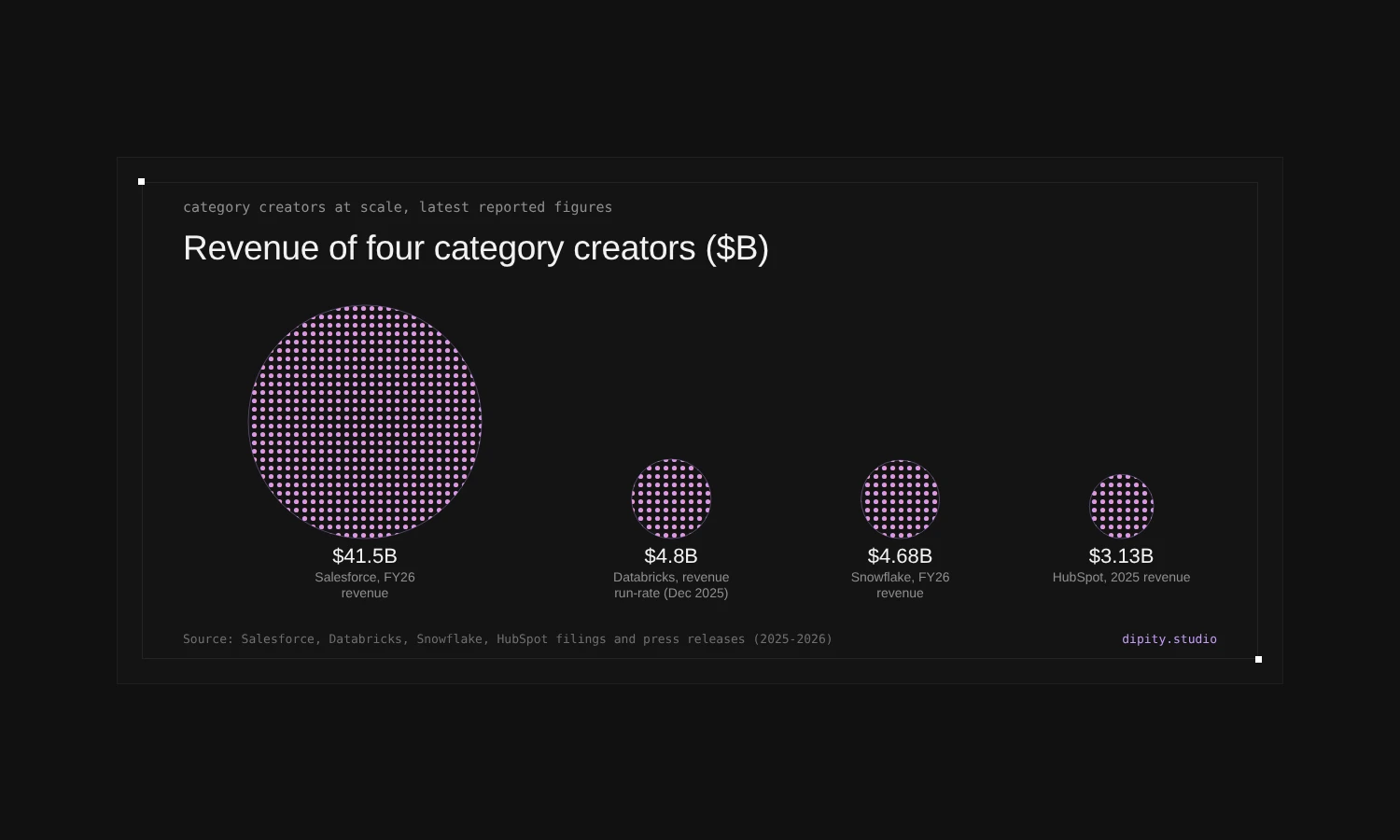
Technical buyers trust evidence. Databricks gave them a paper. Snowflake gave them a network they could join. Both made the new name feel inevitable.
Sales software is crowded, yet three companies still carved out named categories. Gong named revenue intelligence. Outreach built sales engagement and bought a media company to teach it. Clay invented a job title, the GTM engineer, and then trained people to fill it. Each won by educating buyers before selling to them.
Category: revenue intelligence. Move: Gong used AI to analyze sales calls and sold the insight as a new class of software. Early investor Norwest writes in its Gong case study that Gong created the revenue intelligence category and the market followed. Norwest adds that Gartner adopted the term as a distinct category.
Outcome: TechCrunch reported a $250 million Series E at a $7.25 billion valuation in 2021. In March 2025, Gong announced it had passed $300 million in ARR, with more than 4,500 companies as customers. In December 2025, Gartner named Gong a Leader in its Magic Quadrant for Revenue Action Orchestration, placing it highest on Ability to Execute among 12 vendors.
Category: sales engagement. Move: In 2018, Outreach made its first acquisition, buying the media company Sales Hacker. CEO Manny Medina told GeekWire the main limit on growth was buyers not knowing the solution existed. Sales Hacker brought about 150,000 monthly blog visitors, conferences, and webinars.
Outcome: GeekWire reported in 2021 that Outreach raised $200 million at a $4.4 billion valuation. Its ARR reached $100 million in fall 2020, with more than 4,600 customers.
Category: GTM engineering, with Clay as the platform GTM engineers use. Move: Co-founder Varun Anand told Crunchbase News that Clay first introduced the GTM engineer role in 2023. He described the job as coding revenue instead of coding software. Clay named the person before it named the product category.
Outcome: Clay raised a $100 million Series C at a $3.1 billion valuation in August 2025. In September 2026, The Next Web reported a $115 million Series D at a $7.1 billion valuation. The same report notes Clay is putting $1 million into training GTM engineers. Clay has not disclosed revenue.
Education did the selling for all three. Buyers could not want a category nobody had explained to them.
Gainsight and Drift built communities and vocabularies before they built market share. Gainsight organized the customer success profession around its Pulse conference. Drift sold "conversational marketing" as a cleaner name for real-time buyer chat. Both reached unicorn-scale outcomes. Their paths after that diverged.
Category: customer success management. Move: Gainsight's own account says there were only about 1,000 customer success managers worldwide in 2013. That year it hosted the first Pulse conference with roughly 300 attendees. CEO Nick Mehta and then-CMO Anthony Kennada explained at SaaStr that they named the event after something bigger than the company. Pulse later grew past 6,000 attendees.
Outcome: Gainsight passed $100 million in ARR in 2020. TechCrunch reported that Vista Equity Partners acquired the company, with sources putting the price at $1.1 billion. In October 2024, Gartner published its first-ever Magic Quadrant for Customer Success Management Platforms, and Gainsight ranked highest on Ability to Execute and furthest on Completeness of Vision.
Category: conversational marketing. Move: Former Drift marketing VP Dave Gerhardt told Leadfeeder the team dropped a clunky phrase for a cleaner one. In his words, "you've got to name something." He said the term took off when customers repeated it back.
Outcome: Built In reported that Vista Equity's 2021 investment pushed Drift's valuation above $1 billion, with over 50,000 businesses using Drift. TechCrunch reported 70% ARR growth in 2020. In February 2024, Salesloft acquired Drift and described it as a pioneer in conversational marketing.
A movement gives buyers an identity to join. Gainsight turned a job into a profession. Drift turned a widget into a philosophy.
No. Naming a category creates the opening, but it does not guarantee you keep it. Classic marketing research shows many pioneers fail and later entrants often lead. Even in our list, Zuora sold for far less than its idea was worth, Drift was folded into a larger platform, and Gartner renamed Gong's category.
The strongest evidence comes from Golder and Tellis in the Journal of Marketing Research. They used historical analysis to avoid survivor bias across roughly 500 brands in 50 product categories. Market pioneers failed 47% of the time, with a mean market share of 10%. Early market leaders, who entered an average of 13 years after pioneers, failed only 8% of the time and held a mean share of 28%.
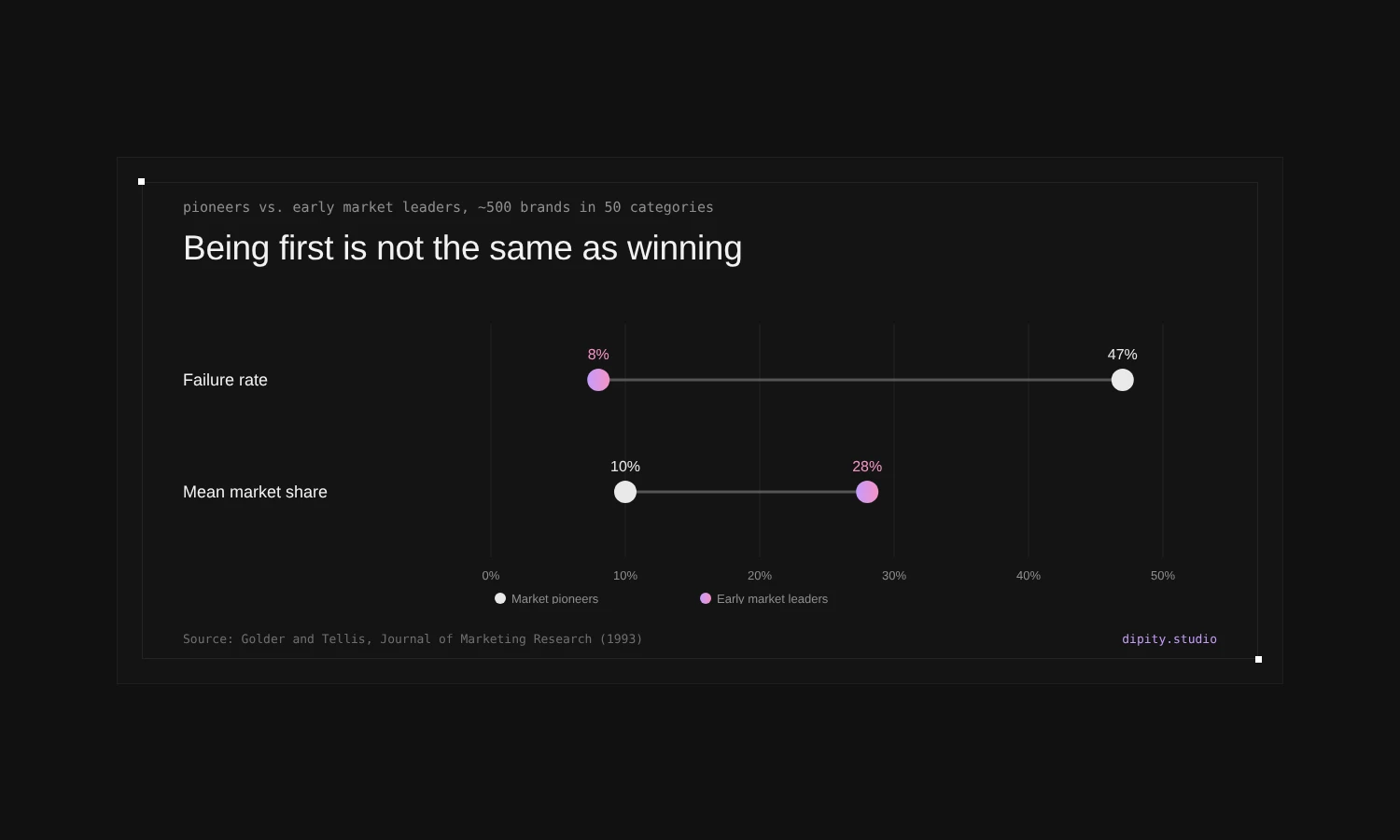
Being first and defining the category are different things. Salesforce did not invent CRM. HubSpot did not invent marketing software. Snowflake did not invent the warehouse. Each one arrived with a new frame for an existing need and then executed for years. Lieberman and Montgomery's survey of first-mover advantages made the point early. Early entry carries real costs alongside its advantages.
The cautionary cases in our list share one trait. The idea spread faster than the company's ability to own it. Zuora made "subscription economy" a common phrase, and the phrase now belongs to everyone. Drift's chat became a feature inside bigger platforms. Gong survived the renaming because its product and customer base were already the reference point.
The name opens the door. Execution and distribution decide who stays in the room.
The same five moves show up across all ten companies. Name an enemy. Coin a short, ownable term for the new way. Teach the market with ungated content, events, or research. Put the founder out front as the evangelist. Then prove the category with numbers and let customers repeat the name for you.
Look at who carried each message. Benioff staged the anti-software protest. Halligan and Shah wrote the inbound book. Tzuo evangelized subscriptions. Mehta made Pulse a community. The Databricks founders wrote the paper themselves. Category creation is founder-led content at its core, and we explain why in why founders are becoming the product.
Start small. Write down the enemy, the new term, and three proof points this week. Then publish your point of view every week from the founder's account. Buyers reward consistent conviction over volume, as we cover in B2B thought leadership: what buyers reward.
The hard part is showing up for years. Sera, the AI head of content from Dipity, interviews your executives by phone, webcam, chat, or text and builds a knowledge base your company owns. She drafts LinkedIn posts, X posts, newsletters, and blogs in each leader's voice, so your category story gets told the same way everywhere. Try Sera with a 7-day free trial.
Ready to try it? See Sera pricing, from $50 per month, or Book a Demo to watch Sera interview an executive and draft in their voice.
Gong is a clear example. It sold AI analysis of sales calls as "revenue intelligence," and its investor Norwest reports Gartner adopted the term as a distinct category. Gainsight did the same with customer success, and HubSpot with inbound marketing.
HubSpot coined inbound marketing, Drift popularized conversational marketing, Databricks introduced the lakehouse, Snowflake launched the Data Cloud, and Clay introduced the GTM engineer role. Salesforce framed its launch around the end of software.
Play Bigger's research on venture-backed tech companies found category kings captured about 76% of market value in their categories. Academic work shows pioneers often fail, so the value tends to go to whoever defines and leads the category.
Create one only when buyers lack a name for the problem you solve and you can fund years of education. If buyers already search for a category term, compete inside it with a sharper point of view.
Years. Gainsight held its first Pulse conference in 2013, and Gartner published the first Magic Quadrant for customer success platforms in 2024. Plan for a long campaign led by the founder.
Armbrust, M., Ghodsi, A., Xin, R., and Zaharia, M. (2021). Lakehouse: A new generation of open platforms that unify data warehousing and advanced analytics
Andreessen Horowitz. (2018). Category creation for startups
Built In. (2021). Drift is now valued over $1B with investment from Vista Equity Partners
Crunchbase News. (2025). AI-powered GTM startup Clay's valuation doubles
Databricks. (2025). Databricks grows more than 55% YoY, surpasses $4.8B revenue run-rate, and is raising more than $4B Series L at $134B valuation
Gainsight. (2021). Gainsight delivers record-breaking year surpassing $100 million ARR
Gainsight. (2024). Gainsight named a Leader in 2024 Gartner Magic Quadrant for Customer Success Management Platforms
Gainsight. (2025). Customer success recognized: Gainsight's journey to the Gartner Magic Quadrant
GeekWire. (2018). Sales automation company Outreach buys Sales Hacker in first-ever acquisition
GeekWire. (2021). Outreach lands $200M, pushing valuation of sales software startup to $4.4B
Golder, P. N., and Tellis, G. J. (1993). Pioneer advantage: Marketing logic or marketing legend?
Gong. (2025). Gong surpasses $300M ARR amid increased demand for AI-powered revenue solutions
Gong. (2025). Gong named a Leader in 2025 Gartner Magic Quadrant for Revenue Action Orchestration
Granqvist, N., and Siltaoja, M. (2020). Constructions, claims, resonance, reflexivity: Language and market categorization
HubSpot. (2026). HubSpot reports strong Q4 and full year 2025 results
Leadfeeder. (2026). How Drift created the conversational marketing category
Lieberman, M. B., and Montgomery, D. B. (1987). First-mover advantages
Norwest. (n.d.). Gong: Experienced entrepreneur solves a problem
Play Bigger Advisors. (2014). Time to market cap report
Salesforce. (2026). Salesforce fourth quarter and fiscal 2026 results (Form 8-K, Exhibit 99.1)
Salesforce. (n.d.). The history of Salesforce
Salesloft. (2024). Salesloft acquires Drift, expanding its AI-powered revenue orchestration platform
SaaStr. (n.d.). 5 things you need to create a category in SaaS, with Gainsight
Sequoia Capital. (n.d.). Crucible Moments: HubSpot
Snowflake. (2020). Snowflake unveils the Data Cloud
Snowflake. (2026). Snowflake fourth quarter and full-year fiscal 2026 results (Form 8-K)
Snowflake. (2026). Snowflake reports financial results for the fourth quarter and full year of fiscal 2026
Stanford eCorner. (n.d.). How to be a category king (talk transcript, Al Ramadan)
TechCrunch. (2020). Vista acquires Gainsight for $1.1B
TechCrunch. (2021). Gong grabs $250M Series E on $7.25B valuation
TechCrunch. (2021). Vista Equity takes majority stake in SaaS startup Drift
The Next Web. (2026). Clay raises $115M at a $7.1B valuation
Zuora. (2024). Zuora enters into definitive agreement to be acquired by Silver Lake and GIC for $1.7 billion
Zuora. (2025). Silver Lake and GIC complete acquisition of Zuora

Looking for further details?






Our experienced team values clarity and craftsmanship, excelling in production systems.