
Your AI Executive Assistant
Executive Thought Leadership on Autopilot
Sera_01: Semantic Executive Resource Engine
Built for AI Search Visibility
Your Voice, on Every Channel

Marketing Insights_
Category creation pays big and fails often. The data on category kings vs pioneers, and how AI founders decide to coin a term or win an existing category.
September 23, 2026
8 Min Reads
Morgan Von Druitt
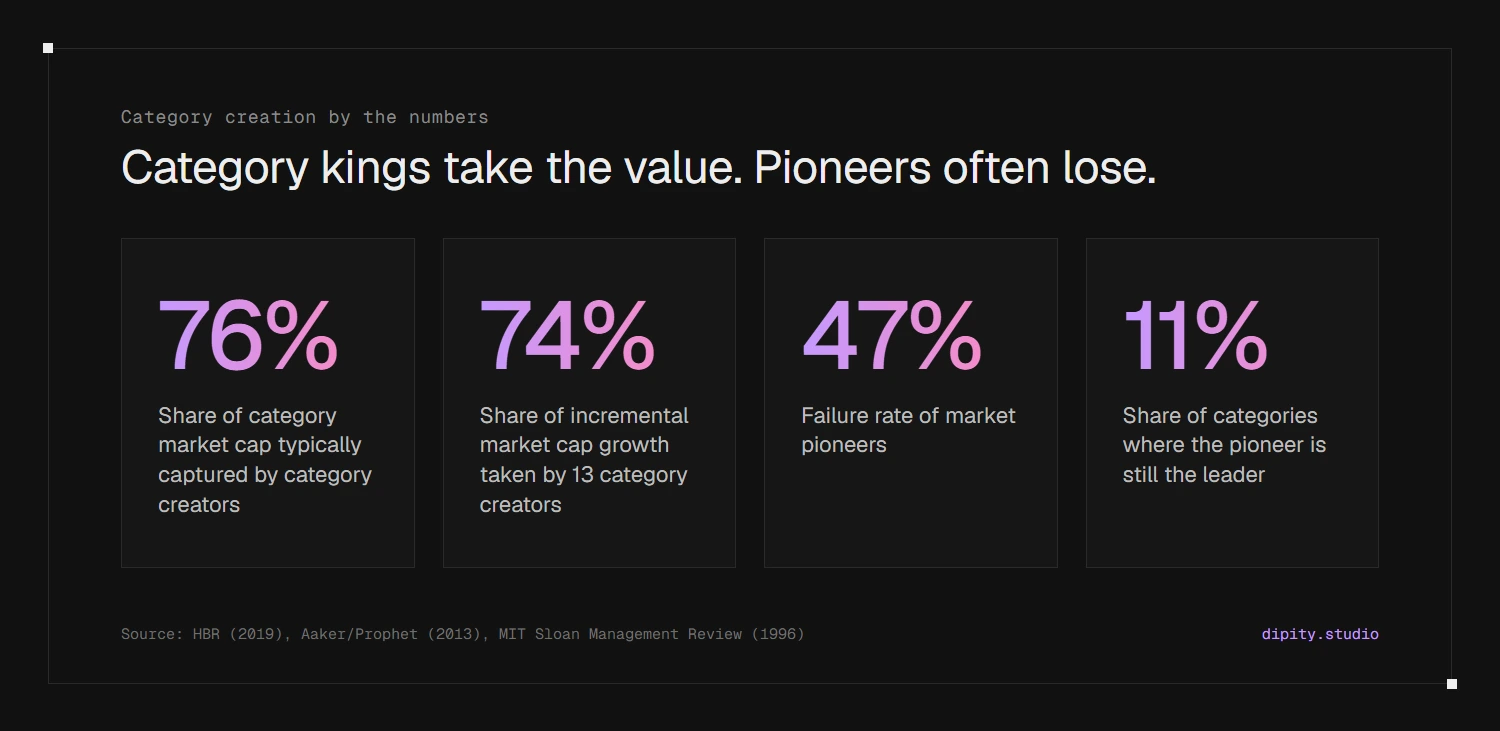
Category creation means you define a new market problem, name the solution, and become the company buyers picture when they hear the name. The payoff is enormous. Practitioner research cited in Harvard Business Review found companies creating a new category typically capture 76% of the total category market capitalization. The risk is bigger than most founders admit, though. Tellis and Golder's study of market pioneers put the pioneer failure rate at 47 percent. At Dipity, we see the winners separate on one habit: the founder keeps publishing the point of view long after launch day.
Category creation means you sell a new way of thinking before you sell a product. You name a problem your buyers already feel but have no word for. Then you teach the market. Over and over. Until your company name and the category name travel together.
Being first is a date on a calendar. Owning a category is a position in the buyer's head. Plenty of founders win the first and lose the second.
This guide covers the data on both sides, the choice between coining a term and winning an existing category, and the three moves which turn a point of view into a market. If you are still building the basics, start with the minimum viable stack for seed to Series A founders, then come back here.
Category kings win because buyers, analysts, and investors treat the leader as the reference point for the whole market. Once your name defines the problem, every competitor gets measured against you. Research on fast-growing companies shows category creators captured an outsized share of new revenue and new market value.
Be honest about where the headline number comes from. The figure traces back to Play Bigger, a category design consultancy, which studied venture-backed tech companies from 2000 to 2015. Treat the number as practitioner research, not peer-reviewed science.
A second data set points the same direction through a different lens. Eddie Yoon and Linda Deeken's analysis, quoted by David Aaker at Prophet, examined 13 category creators among Fortune's 100 fastest-growing US companies from 2009 to 2011. Their finding: "These 13 firms accounted for 53 percent of the incremental revenue growth and 74 percent of the incremental market capitalization growth over those three years."
Acquirers pay for the category, too. When SAP bought Qualtrics for $8 billion, SAP's CEO defended the price with category creator math, arguing Qualtrics created the category where the company played. The buyer did not pay for survey software. SAP paid for the company owning the frame.
The upside is real and well documented. The catch is who collects the upside. The next section answers the harder question.
Most pioneers fail. First to market does not equal category leader. Fast followers study your mistakes, copy the product, and out-market you. Tellis and Golder found pioneers lead only a small minority of the categories they opened. Startup costs keep dropping. Followers get faster every year.
The numbers are blunt. The same MIT Sloan Management Review research found "the mean market share of pioneers is 10 percent" and "market pioneers are current leaders in only 11 percent of the categories."
Followers got cheaper. Rory McDonald and Keith Krach wrote in MIT Sloan Management Review the cost of starting a digital company "has shrunk by 90%" since the dot-com crash, thanks to open source, cheap cloud computing, and social platforms. A funded rival ships your idea in months.
New categories stack risks. CB Insights reviewed 431 VC-backed shutdowns since 2023 and named poor product-market fit in 43% of cases and bad timing in 29%. A new category raises both at once. You are guessing the problem and the moment at the same time.
First is a timestamp. Leader is a title you defend every quarter. Plan the defense before you plan the launch.
Both companies named an old way of working. They gave the new way a short label. Then they repeated the label in public for years. Salesforce attacked software itself. HubSpot contrasted inbound with interruption. Neither won on features alone. Each won by owning the vocabulary buyers used to describe the problem.
The pattern is simple to describe and hard to sustain. Pick an enemy buyers already resent. Name the alternative in two or three words. Say the words everywhere, in the founder's voice, until the market says them back.
Salesforce's official history shows the company launched "at an event themed around 'The End of Software'" with 1,500 attendees. Months later, Salesforce hired actors "to stage a mock protest outside a Siebel Systems conference." The stunt earned the company a first major press mention in The Wall Street Journal. Decades later, the category still pays. Salesforce reported FY26 revenue of $41.5 billion, up 10% year over year.
HubSpot took the same path with a softer enemy. On Sequoia's Crucible Moments podcast, Brian Halligan defined inbound as "Pulling people in through Google, through search, through social, through blogging," versus outbound, which meant "interrupting people in their daily lives." The payoff shows in the numbers. HubSpot reported 2025 revenue of $3.13 billion and 288,706 customers.
The playbook repeats across decades. Name the old way, name the new way, and never stop saying the new name in public.
Only coin a new term when buyers describe a problem no existing category names, and when you have the budget and founder hours to educate the market for years. Otherwise, win an existing category with a sharper point of view. Investors reward perceived category winners either way. Your choice here shapes your raise.
AI makes this decision urgent. Menlo Ventures reports enterprise AI grew from $1.7B to $37B since 2023, faster than any software category in history. Startups took 63% of the AI application market in 2025, up from 36% a year earlier.
Capital follows the frame. J.P. Morgan commentary in the Q2 2026 PitchBook-NVCA Venture Monitor says investors aim "to build allocations in perceived fund returners and category winners." Looking like the category leader is a fundraising input, not a marketing vanity metric. Read more in what investors check before a raise.
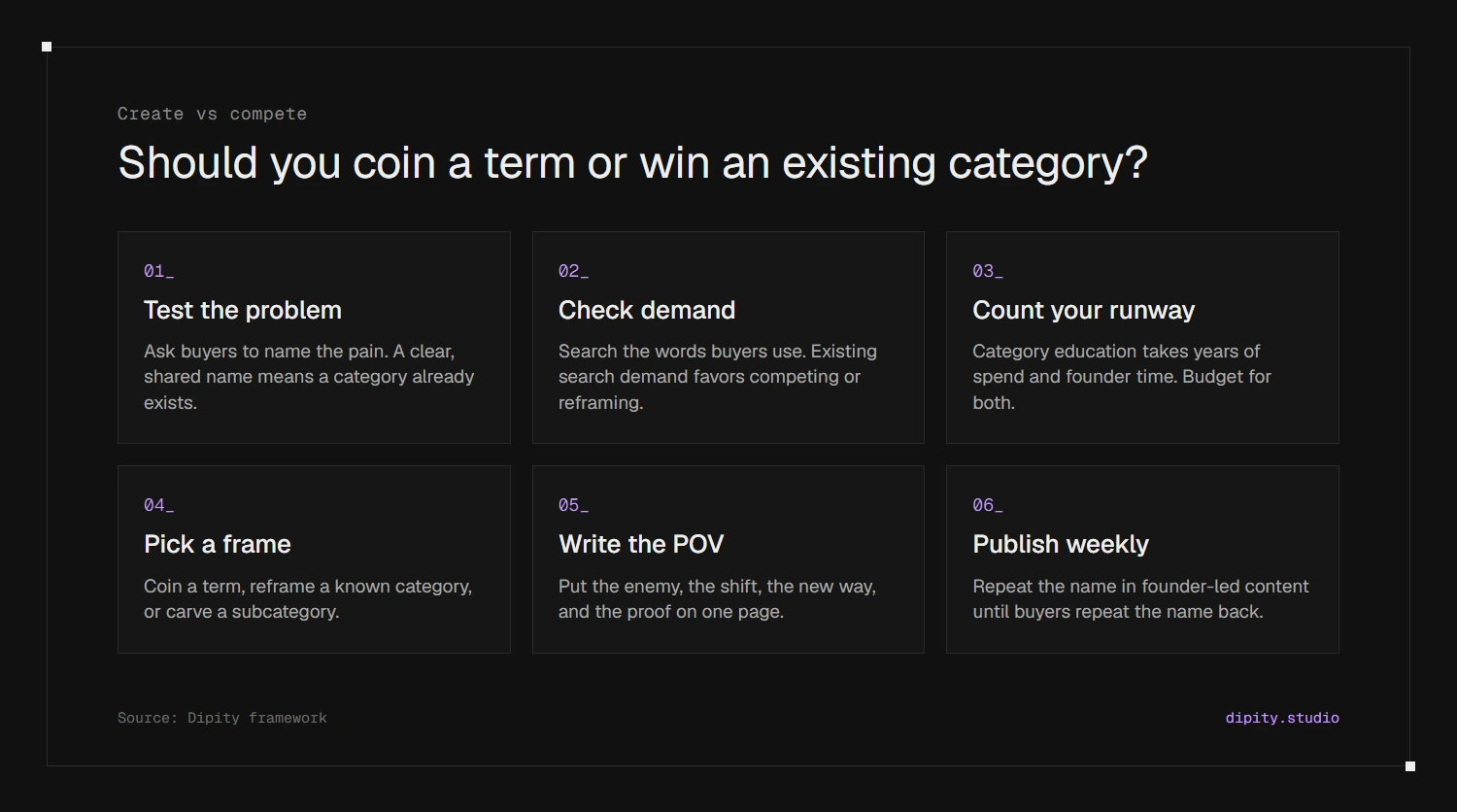
Most seed teams should reframe before they coin. Reframing borrows existing demand and gives you a sharper name to own.
Start with the point of view. The name comes later. Write down the old way, why the old way fails now, and the new way your product enables. Then pick a two or three word name buyers will say out loud. The name only sticks once the point of view is sharp.
Your point of view is the real product here. Salesforce did not ship a feature list. The company shipped an enemy, a reason the enemy was losing, and a new way forward.
Features get copied in months. A point of view built on your team's expertise, your customer stories, and your data is far harder to clone. Write the point of view down once. Then turn the document into a playbook every hire and every AI agent on your team works from. Playbooks over heroics.
A name without a point of view is a slogan. A point of view with no name never spreads. Build both in this order. Feed both into an authority content engine.
Founder-led content evangelizes a category when the founder repeats a point of view in public, over and over, until buyers, analysts, and investors adopt the language. HubSpot proves the model. The founders taught inbound constantly and let anyone use the term. The term spread and pointed back to HubSpot.
Category creation rarely starts as a master plan. On the same Sequoia podcast, Dharmesh Shah said, "We didn't deliberately say, 'Oh, we're gonna go out and create this category.'" The founders chose not to "trademark it or copyright it." Every blogger and agency repeating "inbound" pointed buyers back to the source.
Frequency beats polish. A category name spreads when strangers use the name without you in the room. Buyers trust people over logos, which is why CEO content on LinkedIn outperforms company pages and why founders are becoming the product.
The hard part is consistency. Weekly publishing dies when every post depends on a free afternoon. Dipity built Sera, the AI head of content, for this gap. Sera interviews founders by chat, text, phone, webcam, or Google Meet. She builds a knowledge base the company owns, learns each leader's voice, and drafts LinkedIn, X, and blog posts. Every draft waits for your approval before publishing.
Founder voice is the moat. Category language belongs to whoever says the words most often, in public, with proof. For the full system, see founder-led content as a growth channel and why your face is the best go-to-market channel for an AI startup.
Analysts and acquirers redraw categories as markets mature. Your category gets merged into a bigger one. Whoever leads the new frame wins. Gong and Drift both built billion-dollar companies on coined categories. Then both watched the market re-cut those categories within a few years.
Gong named revenue intelligence and rode the label hard. TechCrunch reported Gong raised $250M at a $7.25 billion valuation in 2021, tripling the prior valuation, after "ARR grew 2.3x between Q1 last year and this year." By 2025, Gartner's first Magic Quadrant for Revenue Action Orchestration described a market "emerging from the convergence of previously separate sales engagement and revenue intelligence markets," per Gong's press release. Gong earned a Leader spot in the bigger frame.
Drift tells the other half. Vista Equity Partners' 2021 announcement notes "Drift introduced Conversational Marketing five years ago," and the company passed a $1 billion valuation. In 2024, Kirkland and Ellis announced the combination of Drift with Salesloft, forming a company with nearly 6,000 global customers. Conversational marketing now lives inside a broader revenue platform.
Category creation never finishes. Keep publishing your point of view as the market re-frames. Keep your entity authority tight as AI search rewrites B2B discovery. Stop, and someone else names the next category for you.
Write your point of view on one page. Decide whether to coin, reframe, or compete. Commit the founder to weekly public content. Then build a system to keep output steady for years. The companies owning categories are the ones which never stopped explaining them.
Category creation rewards discipline over launch-day noise. The data says category kings take most of the value. The same data says most pioneers lose. Sustained narrative work separates the two groups. Authority > Activity.
Your week one plan is short. Draft the enemy, the shift, and the new way. Test the name on five buyers. Publish one founder post on your point of view. Publish again next week. Pair the effort with thought leadership buyers reward, not generic takes.
Sera keeps the engine running when your calendar fills up. One interview feeds a knowledge base your company owns. Sera drafts category content in your voice for your approval. Start with Sera today or see how the Dipity product works.
Category creation means you name a new market problem and position your company as the obvious answer. You teach buyers a fresh way to think about the problem, then you become the reference point for the whole market. Salesforce with cloud software and HubSpot with inbound marketing are classic examples.
Category creation describes the outcome: a new market with your company at the center. Category design is what consultancies call the deliberate process behind the outcome. The process covers your point of view, the name, and the go-to-market plan. In practice, founders use the two terms almost interchangeably.
Treat the widely shared category king figure as directional. The number comes from Play Bigger, a category design consultancy. Play Bigger studied venture-backed tech companies. Independent research on market pioneers shows a harsher picture for companies which arrive first but fail to lead.
Not for most seed-stage teams. Creating a category demands years of market education. Reframing an existing category borrows demand buyers already have. Coin a new term only when buyers feel a problem no current name describes.
Plan in years, not quarters. HubSpot, Salesforce, and Gong repeated their category language for years before the market adopted the terms. AI categories form faster. The window to claim a name is shorter too.
Founder-led content puts your point of view in front of buyers, analysts, and investors in a voice people trust. Repetition in public is how a coined term turns into a shared term. A system like Sera keeps the publishing cadence steady when you are busy.
Aaker, D. (2013). Creating New Subcategories Is the Path to Real Growth: More Data
CB Insights. (2026). Why Startups Fail: Top 9 Reasons
Gong. (2025). Gong Named a Leader in 2025 Gartner Magic Quadrant for Revenue Action Orchestration
HubSpot. (2026). HubSpot Reports Strong Q4 and Full Year 2025 Results
Kirkland and Ellis. (2024). Kirkland Counsels Vista Equity Partners-Backed Salesloft on Combination with Drift
McDonald, R., and Krach, K. (2020). How Would-Be Category Kings Become Commoners
Menlo Ventures. (2025). 2025: The State of Generative AI in the Enterprise
PitchBook and National Venture Capital Association. (2026). Q2 2026 PitchBook-NVCA Venture Monitor
Salesforce. (n.d.). The History of Salesforce
Salesforce. (2026). Salesforce Delivers Record Fourth Quarter Fiscal 2026 Results
Sequoia Capital. (n.d.). HubSpot: An Underdog Helps Invent Modern Marketing, and Then Takes on Goliath
TechCrunch. (2021). Gong Going Gangbusters, Grabs $250M Series E on $7.25B Valuation
Tellis, G. J., and Golder, P. N. (1996). First to Market, First to Fail? Real Causes of Enduring Market Leadership
Vista Equity Partners. (2021). Drift Announces Strategic Investment from Vista Equity Partners
Yoon, E., Lochhead, C., and Cole, N. (2019). The Difference Between a First Mover and a Category Creator

Looking for further details?






Our experienced team values clarity and craftsmanship, excelling in production systems.