
Your AI Executive Assistant
Executive Thought Leadership on Autopilot
Sera_01: Semantic Executive Resource Engine
Built for AI Search Visibility
Your Voice, on Every Channel

Business Essentials_
Tool sprawl wastes seed budgets. The minimum viable stack by function, what to buy at seed vs Series A, and why systems beat headcount.
September 27, 2026
8 Min Reads
Morgan Von Druitt
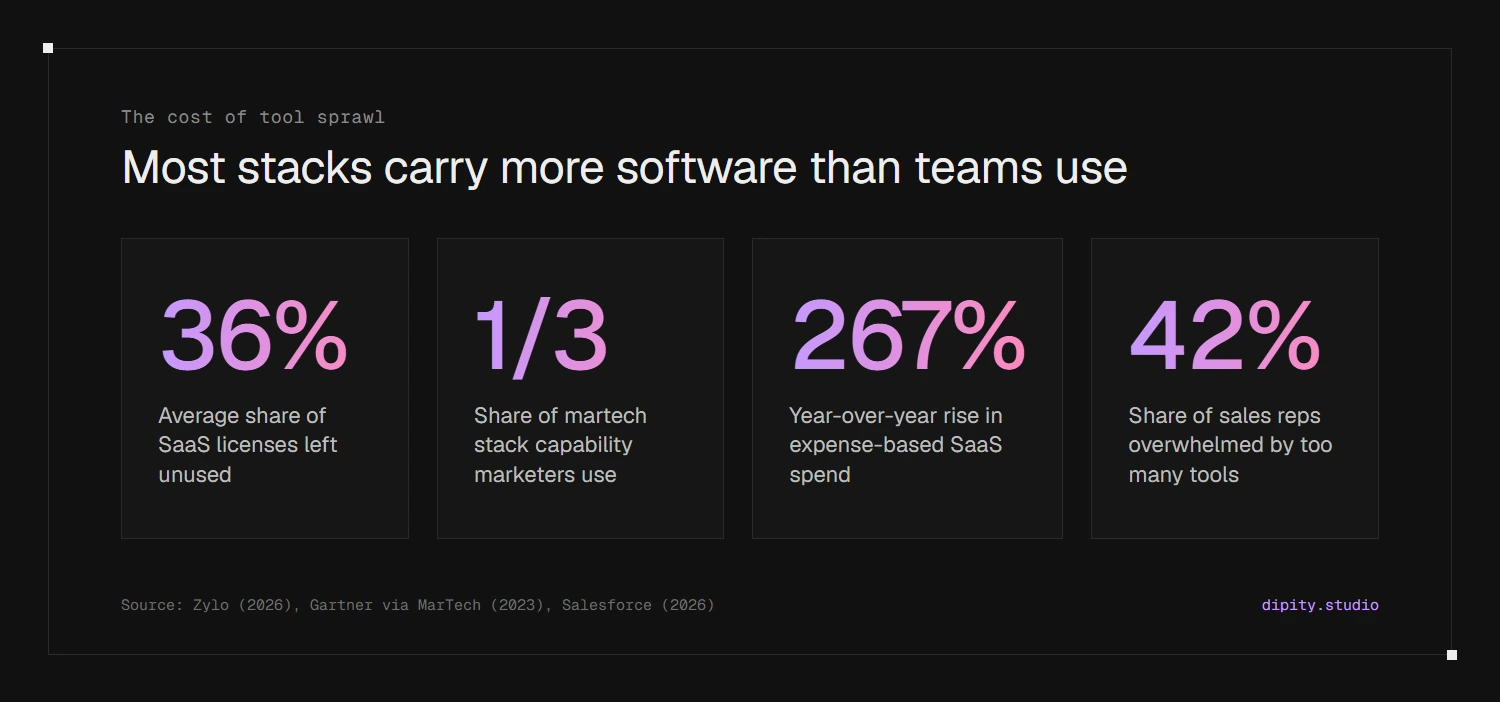
The minimum viable stack for startups is the smallest set of tools to let your seed-stage team publish, sell, and measure without hiring more people. Most founders buy the opposite. Zylo's 2026 SaaS Management Index found organizations leave an average of 36% of their SaaS licenses unused. SaaS Capital's 2026 benchmarks put median revenue per employee at private SaaS companies at $141,125. At Dipity, we build for one rule: systems over headcount.
Your minimum viable stack is one tool per job, owned by one person, reviewed every quarter. Content and voice. CRM and enrichment. Outbound. PR. Analytics. An AI layer tying the pieces together. Anything beyond this list needs a revenue reason to stay.
Seed teams got smaller. Carta data summarized by a16z speedrun shows the average seed company now runs with 6.2 equity-holding employees, down from 10.3 at the 2021 peak. Fewer people means every tool has to do work a hire used to do.
This guide breaks down the stack by function: what to buy at seed, what to add at Series A, and what to skip. Budget questions live in our companion piece on B2B SaaS spending benchmarks for seed to Series A. Read both before your next renewal cycle.
Tool sprawl drains budgets because nobody owns the stack. Founders, contractors, and early hires each swipe a card for a tool they like. The seats outlive the need. You end up paying for idle software while your team complains about missing capacity.
The waste shows up even at large companies with procurement teams. Gartner's 2023 Martech Report, as covered by MarTech, found marketers use only one-third of their martech stack's capability, down from 58% in 2020. Zylo flags a second problem. Per the same Zylo release, expense-based SaaS spend increased 267% year over year. ChatGPT is now the most expensed application.
Both data sets skew toward enterprise buyers. Your seed team has no operations group and no procurement review. The same drift runs faster with fewer people watching.
AI tools accelerate the problem. Menlo Ventures reports 27% of all AI application spend comes through product-led growth motions, nearly 4x the rate in traditional software. AI arrives through a free trial and a credit card. Nobody signs a contract. Nobody checks the renewal.
Audit your stack every quarter. One founder, one spreadsheet, one hour. Cut first. Then buy.
Lean AI-native companies prove a small team with strong systems outproduces a large team with weak ones. Gamma and Lovable reached nine-figure revenue with headcounts smaller than many sales floors. Investors now measure you against this efficiency, even at seed, so your stack decisions show up in your metrics.
Start with the medians, since outliers distort. SaaS Capital's revenue per employee study reports companies with $1 million to $3 million in ARR have a median ARR per employee of $109,644. Most seed and early Series A companies sit in this band.
The AI cohort runs far higher. Bessemer's State of AI 2025 describes AI Shooting Stars reaching about $3M ARR in year one at roughly $164K ARR per FTE, with Supernovas hitting about $1.13M ARR per FTE. GTM data points the same direction. ICONIQ's State of Go-to-Market 2026 found high AI adopters run leaner GTM teams at every revenue band.
Case study: Gamma and Lovable. TechCrunch reported Gamma profitably hit $100 million in ARR with only about 50 employees, after reaching $50 million profitably in its first two years. Lovable crossed $100M ARR eight months after launch with only 45 full-time employees. By March 2026, TechCrunch reported Lovable at $400 million ARR with 146 full-time employees, or $2.77 million in ARR per employee.
Treat these two as outliers, not benchmarks. The lesson sits in the pattern. Both teams bought systems before bodies.
Your first target is the SaaS Capital median, then the AI cohort. Hit the median with fewer people and your next round gets easier. Our guide to what investors check before a raise shows where this number surfaces in diligence.
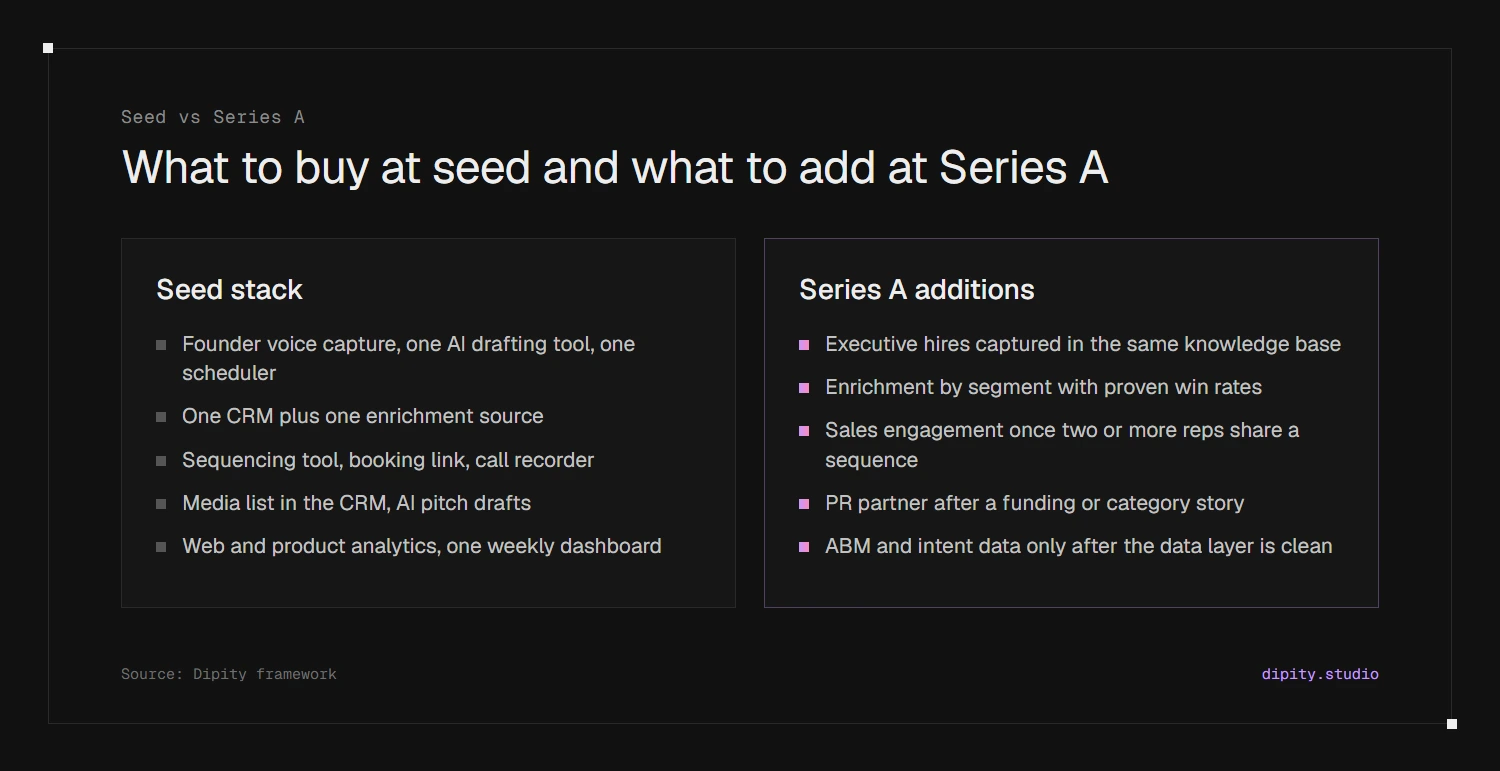
You need three things in this layer: a system to capture founder expertise, one AI drafting tool trained on your voice, and one scheduler. Skip the content agency at seed. Your founder's knowledge is the raw material. A good system turns interviews into weekly posts.
AI in marketing is the baseline now. HubSpot's 2026 State of Marketing reports 86.4% of marketing teams use AI in at least a few marketing areas. Duke's research shows where headcount is heading. The CMO Survey's 2026 findings say marketing headcount growth dropped by 50% since last year. Companies project AI will account for more than half of all marketing activities within three years.
The trap is generic output. Every competitor runs the same models. Founder voice is your moat. Build a stack to capture how you think before AI writes a single word.
Dipity built Sera for this layer. Sera interviews executives by chat, phone, webcam, or Google Meet. The tool builds a knowledge base your company owns and drafts in each leader's voice. Pair Sera with an authority content engine and a hybrid AI content strategy so output compounds.
Your minimum contact enrichment stack needs three things: one CRM, one enrichment source, and a written rule for data hygiene. Clean data beats more data. Add a second or third vendor before the first one is clean, and you multiply duplicates, confuse reps, and burn hours every single week.
Bad CRM data costs real money. Validity's State of CRM Data Management in 2025 found 37% of organizations lose revenue directly because of data quality. The same report says workers spend 13 hours per week, on average, hunting for basic information in the CRM.
AI raises the stakes. Validity also found "45% of companies' CRM data isn't prepared for AI," per the report release. Every agent you deploy later reads from this CRM. Garbage in, garbage agents out.
Add a second data vendor only after you prove a coverage gap in a segment you sell to every week. Until then, one clean source wins every time.
Your minimal sales stack at seed stage is a CRM, one sequencing tool, a scheduler, and a call recorder. You sell. The tools support your calendar, not a sales floor. Add an SDR stack only after you close repeatable deals from a known playbook.
Stacking tools hurts output. Salesforce's State of Sales reports sellers use an average of 8 tools to close deals, and 42% of sales reps feel overwhelmed by too many tools. Citing Gartner, Salesforce adds overwhelmed sellers are 45% less likely to attain quota.
Bigger teams are trimming their stacks. Salesforce found 84% of sales teams without an all-in-one platform plan to consolidate their technology. AI earns a seat when you aim the tool at pipeline quality. ICONIQ reports AI-influenced pipeline generation drives lead-to-MQL and MQL-to-SQL conversion rates up 11% and 8%, respectively.
Playbooks over heroics. Record what you do on calls, write down what works, then hand the playbook to your first rep and the agents supporting the rep.
A minimum viable PR stack is a media list, an AI drafting tool, and a founder with opinions worth quoting. Analytics needs one web analytics tool, one product analytics tool, and a weekly dashboard. Anything more at seed produces reports nobody reads.
PR teams already run on AI. Muck Rack's 2025 survey of 1,013 PR professionals found 75% use generative AI. 93% of those users say the technology speeds up their work. Fifty-seven percent report using at least one paid AI tool, per the same Muck Rack report.
On timing, read when a B2B startup should invest in PR. Most seed companies need founder visibility before agency retainers.
Analytics follows the same logic. Track the few numbers you review weekly: traffic by source, signups, activation, pipeline, revenue. AI search sends buyers too now. Add answer engine optimization tracking and schema markup early.
PR and analytics share one rule. If nobody reads the output weekly, cancel the tool.
At Series A, add depth where volume already proves demand. Bring in a second content voice. Turn on sales engagement for your first reps. Hire a PR partner. Add enrichment by segment. Keep the seed-stage rule alive: every addition needs an owner, a weekly use case, and a revenue reason before you sign the contract.
Series A puts budget and scrutiny in the same room. The CMO Survey's 2025 findings show 63% of marketing leaders now feel increased pressure from CFOs, up from 52%. The same survey found AI and machine learning now power 17.2% of all marketing efforts, and CMOs report a 10.8% reduction in marketing overhead costs.
Your board will ask how each dollar turns into pipeline. Run a quarterly stack audit so you have the answer before the meeting starts.
Systems over headcount. Every executive you hire brings a methodology. Capture each one as SOPs, and agents execute the work at scale.
List every tool you pay for. Cut duplicates and idle seats. Assign one owner per function. Then fill gaps in this order: voice, CRM, outbound, PR, analytics. Buy the system first. Hire people to run the system second.
Do more with less. The founders winning this cycle treat software like hires. Each tool gets a job description, a manager, and a performance review. Tools failing the review get cut.
Start with the layer most founders skip: your own voice. Your expertise feeds every other tool in the stack. Founder-led content as a growth channel works when capture is systematic, and your face is the best go-to-market channel an AI startup owns.
Sera, from Dipity, is the AI head of content built for this job. Sera interviews you, builds a knowledge base you own, and drafts posts in your voice. Nothing goes live without your approval. Start with Sera or see how the Dipity product works.
You need six tools: a founder-content capture system, one AI drafting tool with a voice profile, one scheduler, a CRM, web analytics, and product analytics. Most seed teams run fine on this list. Add another tool only when a weekly workflow breaks without one.
One general AI assistant, one AI content tool trained on your voice, and the automation built into your CRM. Stay on monthly plans. Review usage every quarter. Cancel any seat with no weekly login.
A media list in your CRM, AI-assisted pitch drafts, and a founder with a clear point of view. Agencies come later. Usually after a funding round or a launch worth covering.
Four tools: a CRM, one sequencing tool, a scheduling link, and a call recorder. You run the calls yourself. Those recordings become the playbook your first SDR follows.
Add paid enrichment once your CRM is clean and you sell to a defined segment every week. Start with one source. Overlapping vendors create duplicate records and conflicting fields.
Tools with usage-based plans, open APIs, and one shared data layer scale best. Your CRM and knowledge base should survive the jump to Series A. Point tools bought for a single campaign rarely do.
Andreessen Horowitz. (2025). 8 Takeaways from Carta's State of Seed
Bessemer Venture Partners. (2025). The State of AI 2025
Bort, J. (2025). AI PowerPoint Killer Gamma Hits $2.1B Valuation, $100M ARR, Founder Says
Heim, A. (2025). Eight Months In, Swedish Unicorn Lovable Crosses the $100M ARR Milestone
HubSpot. (2026). 2026 State of Marketing: Data from 1,500+ Global Marketers
ICONIQ Growth. (2026). State of Go-to-Market 2026
MarTech. (2023). Marketers Are Only Using One-Third of Their Stack's Capability
Menlo Ventures. (2025). 2025: The State of Generative AI in the Enterprise
Muck Rack. (2025). New Muck Rack Report Reveals Generative AI Is Now Essential for PR Professionals
SaaS Capital. (2026). 2026 Revenue Per Employee Benchmarks for Private SaaS Companies
Salesforce. (2026). 40 Sales Statistics to Watch for in 2026
TechCrunch. (2026). Lovable Says It Added $100M in Revenue Last Month Alone with Just 146 Employees
The CMO Survey. (2025). Marketing's Strategic Influence Expands, As Does Scrutiny
The CMO Survey. (2026). CMOs Face Headwinds Even as Marketing Value and AI Impact Grow
Validity. (2025). Validity Releases State of CRM Data Management in 2025 Report Revealing Disconnect Between Data Quality and AI Implementation
Zylo. (2026). Zylo's 2026 SaaS Management Index Finds AI-Native App Adoption Is Surging, with ChatGPT Now the Most Expensed App

Looking for further details?






Our experienced team values clarity and craftsmanship, excelling in production systems.