
Your AI Executive Assistant
Executive Thought Leadership on Autopilot
Sera_01: Semantic Executive Resource Engine
Built for AI Search Visibility
Your Voice, on Every Channel

AI Insights_
B2B buyers now build shortlists in AI chatbots. Here is how citations replaced rankings and a five-part playbook to get your startup cited.
September 26, 2026
8 Min Reads
Morgan Von Druitt
Two years ago, B2B buyers switched to AI search. Now, AI decides which vendors reach the shortlist before you get a single sales call. New research from G2 found 51% of B2B software buyers start their purchasing process in an AI chatbot instead of a traditional search engine. SparkToro's clickstream analysis shows 68.01% of Google searches in the first four months of 2026 ended without a click. At Dipity, we build content systems for founders. This guide shows you how citations replaced rankings and gives you a five-part playbook to become the brand AI engines name.
For twenty years, B2B discovery ran on one script. A buyer typed a keyword, scanned ten blue links, filled out a demo form. Page one paid the bills.
The script broke. Buyers now type a full question into ChatGPT, Gemini, Claude, or Perplexity and get one synthesized answer with three or four vendor names inside. The answer engine does the shortlisting. Your website never sees the visit. We covered the mechanics in our guide to answer engine optimization as a growth engine. This post goes further into what the shift means for founders between seed and Series A.
Here is the upside. AI answers reward the brand people talk about, not the biggest ad budget. A small team with a founder willing to show up in public competes with incumbents on a flatter field now.
Most of them, and the number keeps growing. Generative AI is now the top information source in B2B buying. Chatbots decide which vendors make the shortlist. Nearly every buying group picks a preferred vendor before talking to sales. If the answer engine leaves out your name, the buyer leaves you out too.
Forrester's Buyers' Journey Survey found twice as many buyers named generative AI or conversational search as a more meaningful information source than any other. The same research shows 61% of business buyers use private AI tools provided by their organization. Those tools sit behind a login. Your analytics never see them.
G2's report, titled The Answer Economy, sharpens the picture. AI chatbots are the number one source influencing which vendors make buyer shortlists. 69% of buyers chose a different vendor than initially planned based on chatbot guidance.
Timing makes this worse if you arrive late. 6sense's 2025 Buyer Experience Report found 94% of buying groups ranked preferred vendors before first contact. The vendor preferred before engaging with sellers still wins 80% of deals. Gartner's survey found 67% of B2B buyers prefer a rep-free experience. The pattern is clear. Buyers decide alone, with AI as the research assistant.
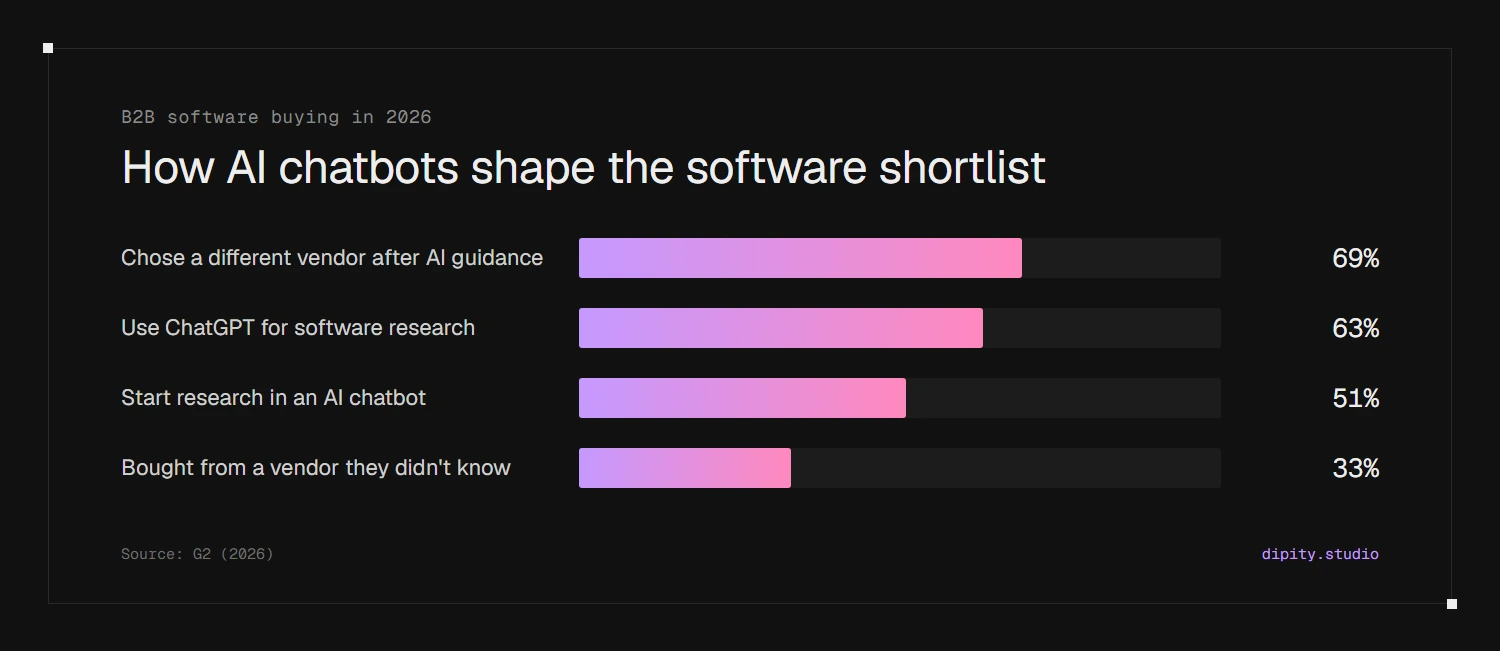
Here is what B2B buyers do inside AI tools right now:
Your first sales call is no longer the first impression. The AI answer is. Treat those answers as the top of your funnel.
AI summaries answer the question right on the results page. Fewer people click through. Pew, Ahrefs, and Seer Interactive all show click-through rates dropping hard when an AI Overview appears. Ranking first still matters. A top position now delivers a fraction of the traffic you once earned.
Pew Research Center tracked real browsing behavior and found users who saw an AI summary clicked a traditional result in 8% of visits. Users who saw no summary clicked nearly twice as often, in 15% of visits. Clicks on links inside the summary happened in only 1% of visits.
An Ahrefs study of 300,000 keywords found an AI Overview correlated with a 34.5% lower average clickthrough rate for the top-ranking page. Seer Interactive's September 2025 update measured organic CTR on AI Overview queries falling 61%. Paid CTR dropped 68%.
Back in February 2024, Gartner forecast traditional search volume and publisher traffic would fall 25% in two years. Treat this as a forecast. The click data above suggests the traffic half arrived on schedule. Meanwhile the AI audience keeps growing. Alphabet reported AI Mode passed 1 billion monthly active users, and the Gemini app reached 950 million.
Take a seed-stage security startup ranking first for "SOC 2 automation tools." Google's summary now names three vendors above the organic results. Most searchers read the summary and move on. If the summary names a competitor, the startup loses the buyer despite owning position one.
Rankings still exist. They pay less than before. Zero-click search is the default now. The goal moves from the click to the mention.
When an AI names your brand inside an answer, you get the click. You get the conversion. Brands cited in AI Overviews earn higher click-through rates. Visitors from AI tools convert at a multiple of traditional search traffic. Fewer clicks. Better clicks. The citation is the new page-one position.
The same Seer Interactive dataset showed 35% higher organic CTR and 91% higher paid CTR for brands cited in the AI Overview. Semrush's AI search traffic study put the average AI search visitor at 4.4 times the value of the average organic search visitor, measured by conversion rate.
Microsoft Clarity's analysis of 1,277 publisher and news domains found AI referrals converted at 3x the rate of other channels. Sign-up rate: 1.66% versus 0.15% for search. The sample covers publishers, not B2B software. Treat the multiple as directional.
Webflow saw this shift early. Vivian Hoang, Webflow's AEO and SEO lead, reported AI search signups grew 4x in six months. By June 2025, 8% of new signups came from AI, up from 2% in October 2024. A Graphite case study on Webflow measured a 24% signup conversion rate from LLM traffic versus 4% for non-brand SEO.
Stop chasing sessions. Chase mentions inside the answer. Buyers who arrive through a citation already carry intent.
Brand mentions across the web predict AI visibility far better than backlinks. Engines lean on what people say about you on YouTube, LinkedIn, Reddit, and in the press. Content packed with statistics, quotations, and sources also earns more citations. Links still help. Reputation helps more.
Ahrefs studied 75,000 brands and found brand web mentions show the strongest correlation with AI Overview visibility, at 0.664, compared with 0.218 for backlinks. A follow-up Ahrefs analysis reported by The Next Web found YouTube mentions correlated at roughly 0.737 with AI visibility across ChatGPT, AI Mode, and AI Overviews, while domain rating hovered between 0.266 and 0.326. These are correlations, not proof of cause.
Third-party platforms carry the load. Semrush tracked 230,000 prompts and found Google AI Mode cited LinkedIn in nearly 15% of responses. The same study watched ChatGPT cite Reddit in close to 60% of responses in early August 2025, then fall to around 10% by mid-September. Citation sources swing hard, so betting on one channel is fragile.
On the content side, the Princeton-led GEO paper found adding statistics, quotations, and citations raised visibility by up to 40% in generative engine responses. The test ran in a simulated engine, and the gain applied to sources the engine had already retrieved. Use the finding as a formatting rule, not a promise.
Authority > Activity. Ten more blog posts on your own domain move nothing if nobody else mentions you. Our breakdown of why your face is the best go-to-market channel for an AI startup covers the video half of this equation.
AI search already works as a primary acquisition channel for developer and SaaS tools. Vercel pulls a meaningful share of new signups from ChatGPT referrals. Tally, a bootstrapped form builder, calls AI search the biggest acquisition channel. Neither company paid for placement in those answers.
Vercel's team reported ChatGPT now refers around 10% of new Vercel signups, up from 4.8% the previous month and 1% six months earlier. The team adapted SEO for LLMs. They treat the chatbot as a real channel now.
Tally's update on the road from $4M to $5M ARR describes AI-powered search overtaking the viral loop as the biggest acquisition channel. In the team's words, "Where our referrals used to come mostly from ChatGPT, Gemini and especially Claude is growing fast in the past months."
If you run a startup, this opening is real. G2 also found one in three buyers (33%) purchased from a vendor they had never known before.
Neither company ran ads inside chatbots. Both are product-led teams with clear positioning and a community talking about them.
Give answer engines something worth repeating. Give them a clear entity to attach the credit to. Publish original data. Describe your company the same way everywhere. Earn mentions on third-party platforms. Put your founder on camera and on LinkedIn. Structure every page as direct answers. Then measure citations monthly.
Start with an audit. Write down the ten questions your buyers ask before they buy. Run each one in ChatGPT, Gemini, Perplexity, and Claude. Log every vendor named. The log becomes your baseline.
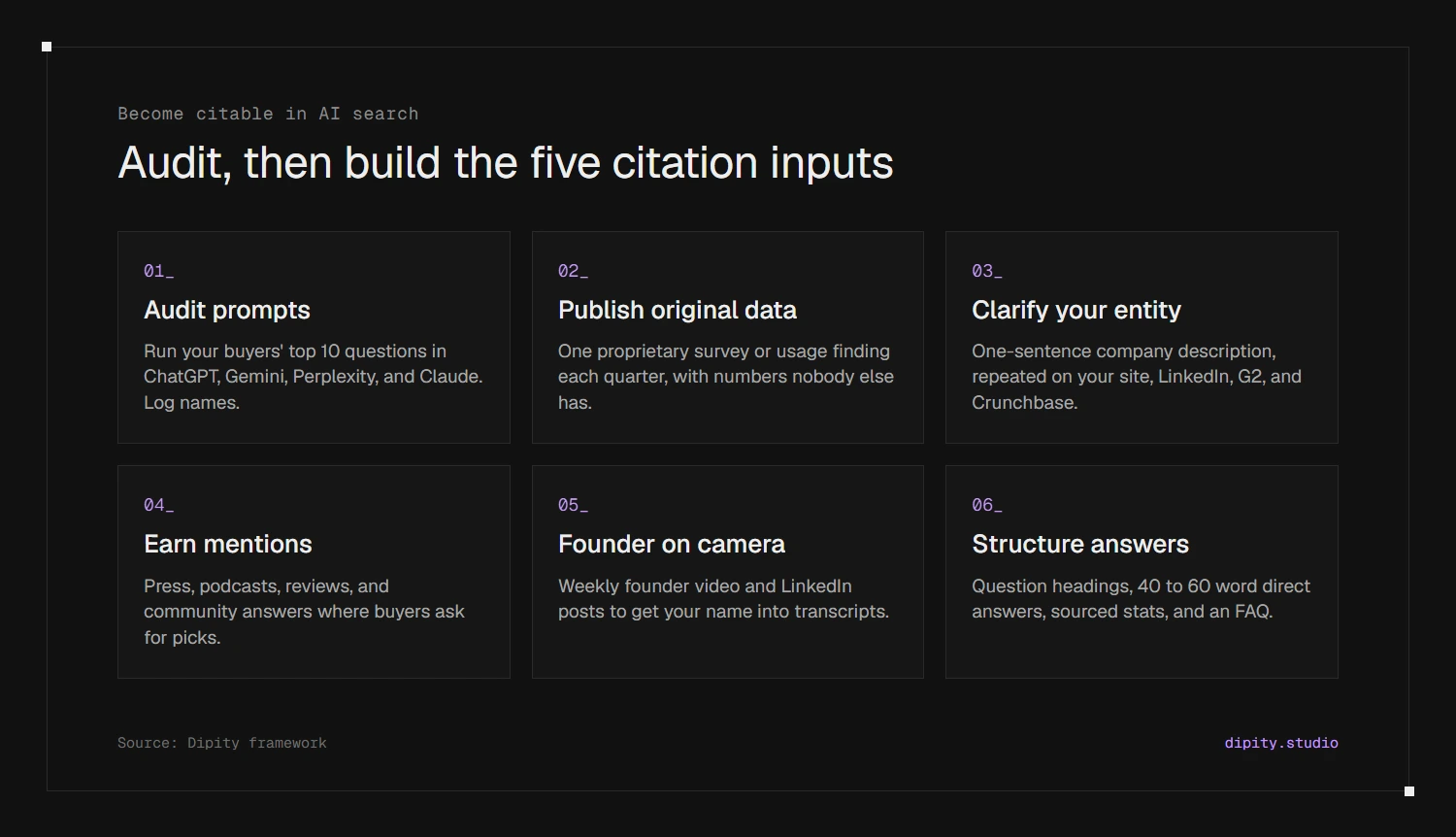
Playbooks over heroics. Run this list every month. Rerun your prompt audit every quarter. Track who gains ground. Our hybrid AI content strategy for B2B SaaS shows how to staff the system without new headcount.
Answer engines move fast and still get facts wrong. Buyers know this. They cross-check AI shortlists against reviews, peers, and vendor sites. Your content needs to be accurate enough for the engine to repeat and credible enough to survive a human fact-check. Both audiences matter now.
Forrester's State of Business Buying 2026 puts the problem bluntly: answer engines "often deliver incomplete or unreliable information." The same research found the typical buying decision now involves 13 internal stakeholders and nine external influencers.
TrustRadius's 2026 B2B Buying Disconnect Report found 63% of buyers used AI during their purchase journey. 94% of those buyers fact-check the responses at least some of the time. The report also found 83% of buyers shortlisted three or fewer products. In the report's words, "Buyers are using AI to move faster, not to think less."
Take a Series A CFO asking ChatGPT for the top three spend management tools. She gets three names. Then she checks G2 reviews, a Reddit thread, and each founder's LinkedIn before booking a call. If your reviews are thin or your founder is invisible, the AI mention dies at the verification step.
Win the citation. Then win the fact-check. Buyers reward substance over volume, and we break down how in B2B thought leadership: what buyers reward.
Run a prompt audit this week. Pick one proprietary data point to publish this month. Get your founder publishing on LinkedIn and YouTube every week. Tighten your entity description, then measure AI referrals and citations monthly. Consistency beats volume. The founder's voice is the input no competitor copies.
B2B search discovery now happens inside answers you do not control. Those answers are built from mentions you only partly influence. The winners show up often, in public, with knowledge only they have. Founder voice is the moat. We lay out the case in why founders are becoming the product.
Most founders stall on showing up weekly. Sera, the AI head of content from Dipity, interviews your executives by chat, text, phone, webcam, or Google Meet. She builds a knowledge base your company owns and drafts LinkedIn posts, X posts, and blogs in each leader's voice. Nothing publishes without your approval. Start with Sera today or see how the Dipity product works.
Buyers ask chatbots for vendor shortlists, compare options with follow-up prompts, and pull review summaries before contacting sales. G2 reports ChatGPT remains the dominant AI chatbot for B2B software research, used by 63% of buyers. Most buyers still cross-check those answers against reviews and peers.
Earn mentions on third-party sites, publish original data, and keep your company description consistent everywhere you show up. Get your founder on YouTube and LinkedIn. Those platforms feed AI answers. Structure your pages with question headings and short, direct answers.
SEO targets rankings in traditional search results. AEO, or answer engine optimization, targets the direct answers inside AI Overviews and chatbots. GEO, or generative engine optimization, is the academic term for improving visibility inside generative AI responses. The goals overlap heavily.
Yes. Multiple studies show click-through rates drop sharply when an AI Overview appears, even for the top-ranked page. Brands cited inside the Overview hold up far better than brands left out.
Segment referral traffic from chatgpt.com, perplexity.ai, gemini.google.com, and claude.ai in your analytics. Tag signups by source. Add a "how did you hear about us" field with an AI chatbot option. Rerun a fixed set of buyer prompts each quarter and log every mention.
6sense. (2025). The timeline for influencing B2B buyers is shrinking: Insights from 6sense's 2025 Buyer Experience Report
Aggarwal, P., Murahari, V., Rajpurohit, T., Kalyan, A., Narasimhan, K., and Deshpande, A. (2024). GEO: Generative engine optimization
Ahrefs. (2025). An analysis of AI Overview brand visibility factors (75K brands studied)
Ahrefs. (2025). AI Overviews reduce clicks by 34.5%
Alphabet. (2026). Alphabet earnings call Q2 2026: Sundar Pichai remarks
Forrester. (2026). B2B buyers make zero-click buying number one
Forrester. (2026). The state of business buying, 2026
G2. (2026). New G2 research: Half of B2B software buyers now start their research with AI chatbots
Gartner. (2026). Gartner sales survey finds 67% of B2B buyers prefer a rep-free experience
Graphite. (2025). Webflow LLM signups case study
MediaPost. (2024). Traditional search forecast to fall 25% by 2026: Gartner
Microsoft Clarity. (2025). AI traffic converts at 3x the rate of other channels (study)
Pew Research Center. (2025). Google users are less likely to click on links when an AI summary appears in the results
Seer Interactive. (2025). AIO impact on Google CTR: September 2025 update
Semrush. (2025). AI search and SEO traffic study
Semrush. (2025). The most-cited domains in AI: A 3-month study
SparkToro. (2026). In 2026, less than one third of Google searches still send a click
Tally. (2026). The road from $4M to $5M ARR
The Next Web. (2026). YouTube mentions are the top signal for AI brand visibility
TrustRadius. (2026). TrustRadius 2026 B2B Buying Disconnect Report reveals AI has changed how buyers research, but not what they trust
Vercel. (2025). How we're adapting SEO for LLMs and AI search
Webflow. (2025). Inside Webflow's AEO strategy

Looking for further details?






Our experienced team values clarity and craftsmanship, excelling in production systems.