
Your AI Executive Assistant
Executive Thought Leadership on Autopilot
Sera_01: Semantic Executive Resource Engine
Built for AI Search Visibility
Your Voice, on Every Channel

Marketing Insights_
Price a full executive thought leadership program across in-house, agency and AI models, with sample budgets by stage and ways to measure return.
October 6, 2026
8 Min Reads
Morgan Von Druitt
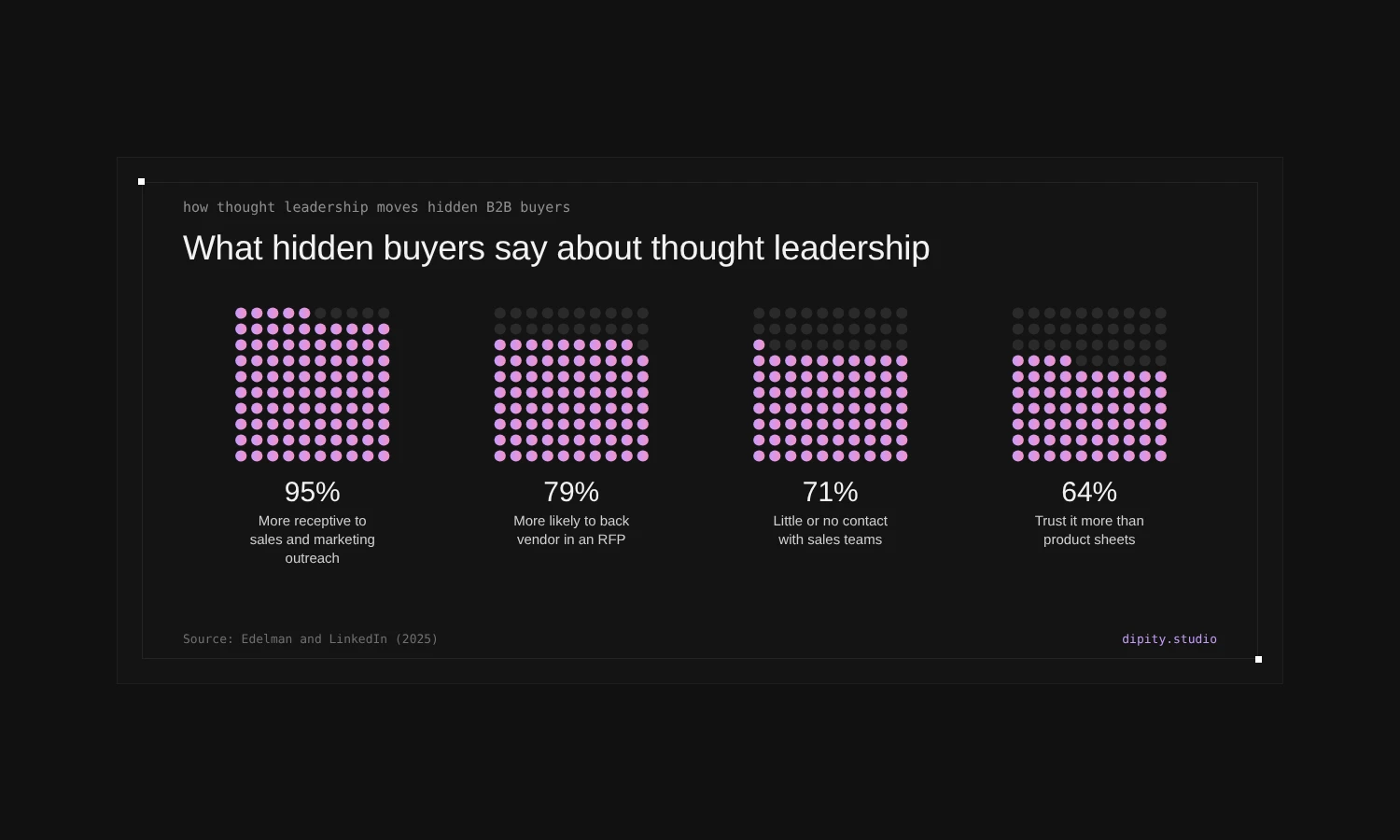
Executive thought leadership has moved from a nice-to-have to a line item CMOs have to defend. The 2025 Edelman-LinkedIn B2B Thought Leadership Impact Report found 95% of hidden buyers say strong thought leadership makes them more receptive to sales and marketing outreach. At the same time, Gartner's 2025 CMO Spend Survey found 59% of CMOs say their budget is too small to execute their strategy. At Dipity, we build content systems for executive teams. This guide prices the full program, from capture to analytics, across in-house, agency and AI-led models, with sample budgets for three company stages.
An executive content program is a system with seven parts: capture, writing, editing, design, video, distribution and analytics. Most budgets only price the writing. The other six parts, plus the executive's own time, often cost more than the words. Price the whole system before you compare models.
Writing gets the attention because it is the visible output. A LinkedIn post or a byline is the thing the CEO sees. The real work starts earlier. Someone has to pull ideas out of a busy executive, turn them into a point of view, and keep that voice consistent week after week.
The work also continues after publishing. Video is now a core format. In the Content Marketing Institute's 2025 B2B research, 58% of marketers said video produces their best results, and 61% expected their organization to increase video investment. The same report found 52% expected to increase investment in thought leadership content.
Use this list as the checklist for every quote you get. If a proposal skips three of these parts, the price is low because the scope is small.
A full in-house team for one executive program costs roughly $550,000 to $575,000 a year in loaded salary and tools once you staff writing, editing, design and video. Median US salaries for these roles sit between about $63,000 and $78,000. Benefits add roughly 30% on top. A single content hire is far cheaper, but one person cannot cover all seven parts.
The Bureau of Labor Statistics reports a median annual wage of $76,910 for writers and authors in May 2025. Editors earned a median of $77,920. Film and video editors earned $75,420, and graphic designers earned $62,960. Startups in major tech hubs often pay above these national medians.
Salary is only part of the cost. The BLS Employer Costs for Employee Compensation release shows benefits made up 30.0% of private industry compensation in June 2026. That means a salary is about 70% of what an employee costs. Divide each median wage by 0.70 to estimate the loaded figure. The chart below applies that math.
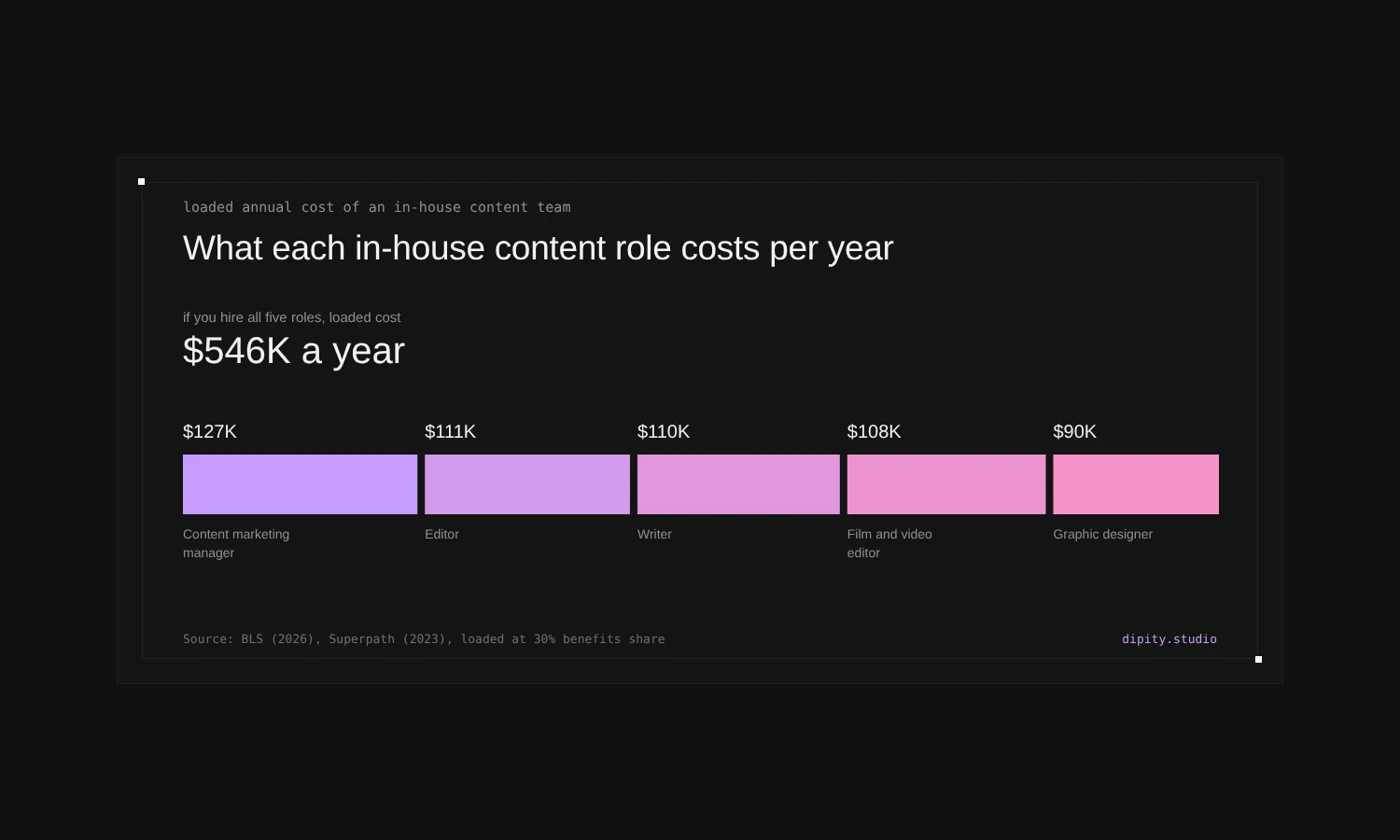
Someone also has to run the program. Superpath's salary survey of content marketers put the average content marketing manager at $89,107. PayScale lists an average base of $82,653 for the same title. Loaded, that manager costs about $118,000 to $127,000 a year.
Add those five roles together and the loaded payroll lands near $546,000. Tools, freelance overflow and paid amplification push the total higher. In-house gives you control and deep company context. It also gives you fixed cost, hiring risk and a team that sits idle when the CEO travels for three weeks.
Most B2B content agencies charge $5,000 to $15,000 a month for ongoing strategic work, according to pricing data compiled by Column Five. Production-only retainers start lower, near $2,000 to $5,000. Full-stack programs with video and design run $15,000 to $50,000 or more each month. Agencies trade fixed headcount for a variable bill.
Column Five's 2026 agency pricing guide breaks the market into three tiers. Content production runs $2,000 to $5,000 a month. A strategic content partner runs $5,000 to $15,000. Full-stack content operations run $15,000 to $50,000 or more. The same guide puts hourly rates between $100 and $250, with a national average near $125.
Prices are rising. An Ignition survey of 273 agency leaders, reported by MarketingProfs, found 97% planned to raise prices in 2025. Buyers are pushing back. Gartner's CMO survey found 39% of CMOs plan to cut agency budgets, and the same share plan to cut labor spend.
Freelancers sit between the two models. Many teams hire a freelance ghostwriter for the CEO and a separate video editor by the project. The rate math matches agency hourly pricing, but someone inside still has to coordinate capture, review and publishing. That coordination time is the cost most teams forget to count. It usually falls on a marketing lead who already has a full plate.
Agencies work best when you need volume fast and lack a content lead. Ask any agency who owns the raw interviews before you sign. Those files are the most valuable asset in the program.
Executive time is the largest hidden cost in every model. A median chief executive earns about $103 an hour in wages on a 40-hour basis, or close to $147 loaded. Five hours a month of interviews and reviews costs nearly $9,000 a year per executive at that rate. Programs that cut review cycles save real money.
The BLS reports a median annual wage of $213,990 for chief executives in May 2025. Divide by 2,080 working hours and you get roughly $103 an hour. Apply the 30% benefits share and the loaded rate is about $147. Startup CEOs often take lower cash pay with more equity, so treat this as a benchmark rather than a quote.
The opportunity cost matters more than the wage. A Harvard study of 27 CEOs, reported by CNBC, found they worked 62.5 hours a week on average and spent 72% of work time in meetings. Every hour spent rewriting a LinkedIn draft comes out of hiring, fundraising or selling.
AI drafting shrinks the writing step, which shrinks review time. In an MIT experiment on professional writing tasks, ChatGPT cut completion time by 40% and raised output quality by 18%. Writing time is falling across the field. Orbit Media's 2026 survey of 1,042 content marketers put the average blog post at 3 hours and 20 minutes, with 92.4% using AI.
Here is a fair planning range. Traditional ghostwriting usually needs a 60-minute interview plus two review rounds per piece. An interview-first AI workflow needs one shorter capture session and one approval pass. Model both numbers in your budget, then pick the one your CEO will actually sustain.
Yes, when it is good and consistent. The Edelman-LinkedIn research shows thought leadership shapes hidden buyers who never talk to sales. Academic studies link CEO social media prominence to higher firm value. The return shows up as easier sales conversations, stronger RFP positions and better reputation, which most attribution tools miss.
The 2025 Edelman-LinkedIn report surveyed nearly 2,000 professionals. 71% of hidden buyers said they have little or no interaction with sales teams. 79% said they are more likely to advocate for a vendor in an RFP if it consistently produces high-quality thought leadership. 64% trust thought leadership more than product sheets or brochures. Executive content reaches the people your reps never meet.
People carry more reach than company pages. LinkedIn's employee advocacy research found employees have around 10 times more connections than their companies do. The data is from 2017, so treat it as directional. Newer LinkedIn research reported by Demand Gen Report found 82% of B2B buyers say creator content influences them. LinkedIn also measured a 252% increase in click-through rate for Thought Leader Ads compared with standard image ads.
The academic evidence points the same way, with caveats. A 2023 study in Technological Forecasting and Social Change found CEO social media prominence correlates positively with firm value, working through sales, reputation and risk management. Research in Management Science on executive tweets found most posts move nothing, though financial posts from executives drew about 2.8 times the market reaction of firm posts. A 2024 study in the International Review of Economics and Finance found active CEOs help reduce information asymmetry with investors. These studies cover public companies, so apply them to startups with care.
Reputation research adds a softer signal. In Weber Shandwick's survey of more than 1,700 senior executives, respondents attributed 44% of their company's market value to the CEO's reputation. That figure is an executive estimate from 2015, not a measured outcome. It still shows how leaders price their own visibility. We cover what buyers reward in B2B thought leadership: what buyers reward.
Seed companies can run a founder program for under $15,000 a year with AI and part-time review. Series A teams with two or three executives should plan for $20,000 to $280,000 depending on the model. Series B programs covering four or five leaders range from about $250,000 with an AI-led lean team to more than $570,000 fully in-house.
These sample budgets are Dipity estimates built from the cited rates above. In-house figures use loaded medians. Agency figures use Column Five's tiers. AI figures use Sera's published pricing as one example. Executive time uses the $147 loaded CEO rate as a ceiling, since other executives usually earn less. For broader context on spend ratios, see our B2B SaaS spending benchmarks.
Seed stage: one founder, two LinkedIn posts a week, one blog a month.
Series A: CEO plus two executives, short video added.
Series B: four or five executives across LinkedIn, blog, newsletter and YouTube.
The hybrid model wins for most teams in this range. Keep strategy and voice ownership inside, automate capture and drafting, and buy video and design by the project. Our hybrid AI content strategy for B2B SaaS shows how to staff it.
Measure three layers: activity, audience and business impact. Track posting consistency and executive time first. Then track follower growth, engagement from target accounts and inbound mentions. Finally, tie content to pipeline with self-reported attribution and sales feedback. Cost per published piece is the simplest way to compare models.
Measurement is where most programs stall. The CMI 2025 research found 56% of B2B marketers cite difficulty attributing ROI to content. Only 51% agree their organization measures content performance effectively. Among those rating their strategy as less effective, 42% blamed a lack of clear goals.
Set goals before you set the budget. A Series A CEO trying to support a raise needs different metrics than a Series B sales team chasing enterprise deals. Our guide to what investors check before a raise covers the investor side.
Review these numbers every quarter. Cut the formats that cost the most per engaged target account. This is also where AI tools change the math. Sera, the AI Head of Content from Dipity, interviews executives by phone, webcam, chat or text, builds a knowledge base your company owns, and drafts in each leader's voice for review. It tracks consistency for you, so the cost per piece stays visible. Try Sera free for seven days and compare the numbers against your current model.
Ready to try it? See Sera pricing, from $50 per month, or Book a Demo to watch Sera interview an executive and draft in their voice.
Costs range from under $15,000 for an AI-led founder program to more than $570,000 for a fully staffed in-house team covering several executives. Agency programs usually fall between $24,000 and $600,000 a year depending on scope. Executive time adds several thousand dollars per leader in every model.
An agency is usually cheaper than a full in-house team at the seed and Series A stages. In-house becomes competitive once you run programs for four or more executives and need deep company context. A hybrid of AI capture, one internal owner and project-based video often beats both on cost.
Plan for two to five hours a month per executive. Traditional ghostwriting sits at the high end because of interviews plus multiple review rounds. Interview-first AI workflows cut the review steps and land near the low end.
Track cost per published piece, posting consistency and engagement from target accounts. Add a self-reported attribution field to demo forms and ask sales to log content mentions on first calls. Review quarterly and cut the formats with the weakest return.
There is no standard share. Gartner found marketing budgets average 7.7% of company revenue among large enterprises. Startups should size the program by the number of executives and channels, then check the total against that overall marketing budget.
Bao, X., Sun, B., Han, M., Lin, H., and Lau, R. Y. K. (2023). Quantifying the impact of CEO social media celebrity status on firm value: Novel measures from digital gatekeeping theory
CNBC. (2018). A Harvard study reveals what CEOs do all day
Column Five. (2026). Content marketing agency pricing
Content Marketing Institute. (2024). B2B content marketing benchmarks, budgets, and trends: Outlook for 2025
Demand Gen Report. (2025). The rise of B2B influencers on LinkedIn
Du, Y., Linh, T. T. T., Lu, C.-L., and Nguyen, H. T. (2024). Reaching the public with Twitter: The reputation value of CEOs
Edelman and LinkedIn. (2025). 2025 B2B Thought Leadership Impact Report: The hidden buyer
Gartner. (2025). Gartner 2025 CMO Spend Survey reveals marketing budgets have flatlined at 7.7% of overall company revenue
Huang, W., Lu, H., and Srinivasan, S. (2024). Executive tweets
MarketingProfs. (2025). Marketing agency pricing and cash flow trends
MIT News. (2023). Study finds ChatGPT boosts worker productivity for some writing tasks
Orbit Media. (2026). Blogging statistics and trends survey
PayScale. (2026). Average content marketing manager salary
PRmoment. (2015). Why a company's reputation starts with the CEO
Social Media Today. (2017). LinkedIn releases new report on how employee shared content can drive audience action
Superpath. (2023). Content marketing manager salary
U.S. Bureau of Labor Statistics. (2026). Employer costs for employee compensation, June 2026
U.S. Bureau of Labor Statistics. (2026). Occupational Outlook Handbook: Editors
U.S. Bureau of Labor Statistics. (2026). Occupational Outlook Handbook: Film and video editors and camera operators
U.S. Bureau of Labor Statistics. (2026). Occupational Outlook Handbook: Graphic designers
U.S. Bureau of Labor Statistics. (2026). Occupational Outlook Handbook: Top executives
U.S. Bureau of Labor Statistics. (2026). Occupational Outlook Handbook: Writers and authors

Looking for further details?






Our experienced team values clarity and craftsmanship, excelling in production systems.