
Your AI Executive Assistant
Executive Thought Leadership on Autopilot
Sera_01: Semantic Executive Resource Engine
Built for AI Search Visibility
Your Voice, on Every Channel

Business Essentials_
VCs rank the team first and source most deals themselves. Here are the 2026 benchmarks and the plan to build your public signal before you raise.
September 21, 2026
8 Min Reads
Morgan Von Druitt
Investors check you first. Metrics, market, and timing come second. Research from Gompers, Gornall, Kaplan, and Strebulaev found 95% of VC firms name the management team as an important factor, and 47% rank the team as the single most important one. Most of those investors form a view of you before the first meeting. They base this view on whatever you have published in public. This Dipity guide covers the criteria, the 2026 benchmarks, and the 6 to 12 month plan to build a public signal before you pitch.
Three things. Who you are. What the numbers say. Whether the market is big enough to return their fund.
The order matters. Before a partner opens your data room, they search your name. Treat the raise as a 90-day sprint and you miss the 12 months of evidence investors look for first. Founders are becoming the product, and investors size up the product before the pitch.
Here is the evidence on what VCs weigh, where they source deals, how concentrated 2026 funding has become, which benchmarks you face, and how to build your public signal in time.
VCs weigh the team first because early-stage companies give them almost nothing else to go on. Product shifts. Market shifts. Business model shifts. The founder stays. Survey data from hundreds of VC firms puts management ahead of every business factor. Early-stage investors lean on gut feel about the person sitting across the table.
The study of 885 institutional VCs at 681 firms puts the finding in plain language: "In selecting investments, VCs see the management team as more important than business related characteristics such as product or technology." No business factor outranked the team.
Gut feel matters too. Laura Huang told Knowledge at Wharton early-stage investors said "their gut feel was a more important consideration to them than some of these other things," referring to financials and market size. Gut feel forms from signals. Your public record is one of the first signals an investor sees.
Now the counter-evidence. Kaplan, Sensoy, and Strömberg tracked firms from early business plans to public companies and found "firm business lines remain remarkably stable while management turnover is substantial." The team wins the meeting. The business wins the decade.
The same VC survey ranked these business factors behind the team:
Build both stories. A credible founder narrative gets you the meeting. A credible business narrative closes the round.
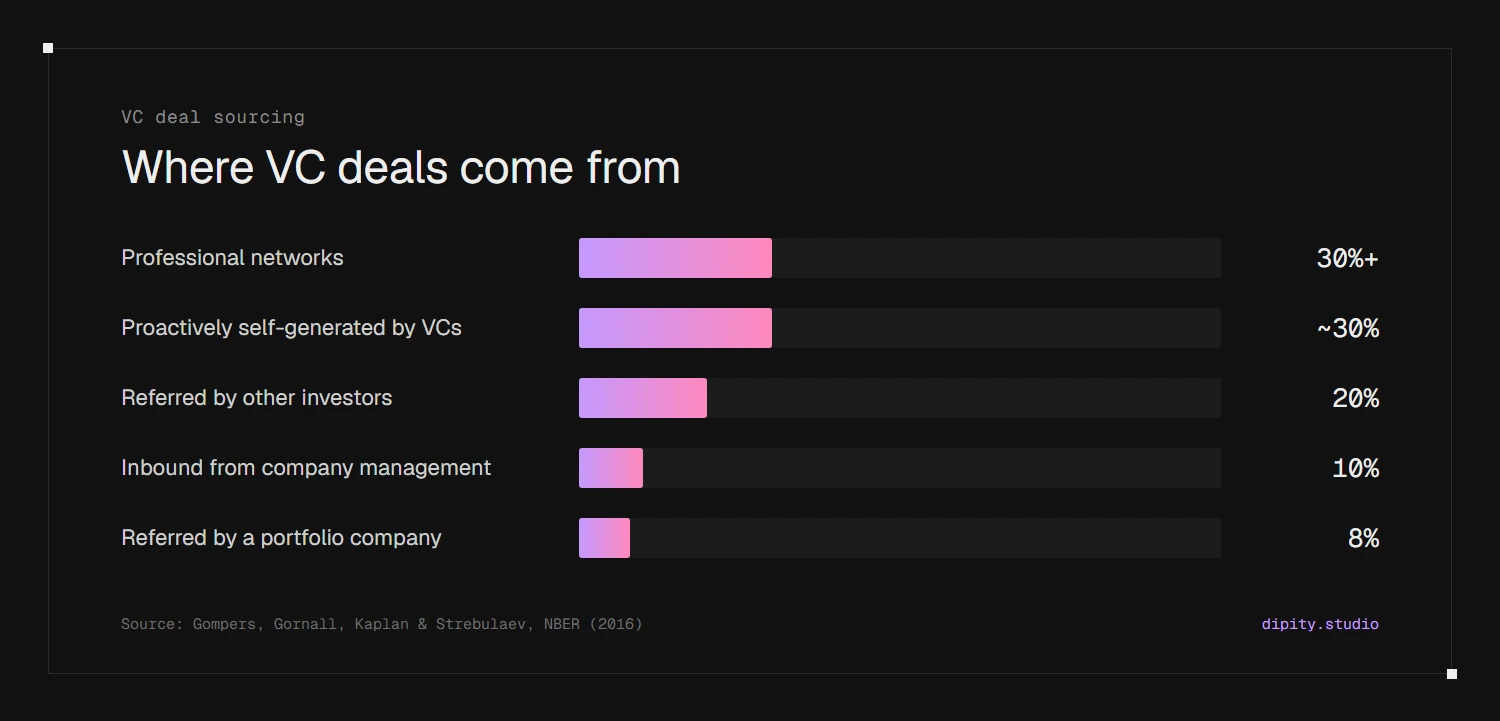
VCs find most deals by hunting for them. Networks, investor referrals, and the firm's own outbound search drive the bulk of deal flow. Cold inbound from founders is the smallest channel. If investors never come across your name, your pitch email is fighting for the thinnest slice of the pipeline.
The Gompers survey data breaks deal flow down. Over 30% of deals come through professional networks, another 20% are referred by other investors, and 8% come from portfolio companies. Almost 30% are proactively self-generated by the VC firm. Only 10% come inbound from company management.
For each deal a firm closes, the firm considers roughly 100 potential opportunities. Visibility gets you into the 100. Your metrics get you to the one.
Public presence also tracks with better outcomes. A Wharton working paper using Twitter and CrunchBase data found "an active social media presence and strong Twitter influence (followers, mentions, impressions, and sentiment) increase the likelihood a startup will close the round, the amount raised, and the breadth of the investor pool." The study is correlational, so read the result as a signal, not a guarantee. The authors also found a stronger effect for startups where quality information is scarce, such as firms outside venture hubs.
Investors say the same about their own industry. In the Q2 2026 PitchBook-NVCA Venture Monitor, Nisha Dua of BBG Ventures said, "Founders are learning about firms from more channels than ever before, and individual partner exposures matter a lot." Rick Zullo of Equal Ventures went further: "If you are not creating your own distribution, no one is going to do it for you in this market." Both were talking about fund managers. The logic applies to founders with even more force.
Be findable before you fundraise. Your face is a go-to-market channel, and the same channel feeds your investor pipeline.
VC due diligence is a months-long stress test of your team, your traction, and your risk profile. Firms burn weeks on calls, reference checks, and data room reviews. The goal is to rule out the top reasons startups die: weak product-market fit, bad timing, and broken unit economics.
The process runs slower than most first-time founders expect. The average deal takes 83 days to close. The average firm spends 118 hours on due diligence over the period and calls 10 references. Ten references. Ten people describing you, in their own words, to someone deciding on your round.
Your deck gets far less attention. DocSend data shows investors spend less than 3 minutes reviewing pitch decks. The page is undated and draws on 2020 pre-seed data, so treat the figure as directional. The deck is a short read. Your public record fills in the rest.
Every diligence process exists to screen out failure. CB Insights research on VC-backed shutdowns found poor product-market fit in 43% of cases, bad timing in 29%, and unsustainable unit economics in 19%. Expect every question in diligence to map to one of these risks:
The payoff goes to founders with a long, consistent public record. Start the record now, while nobody is grading the work yet.
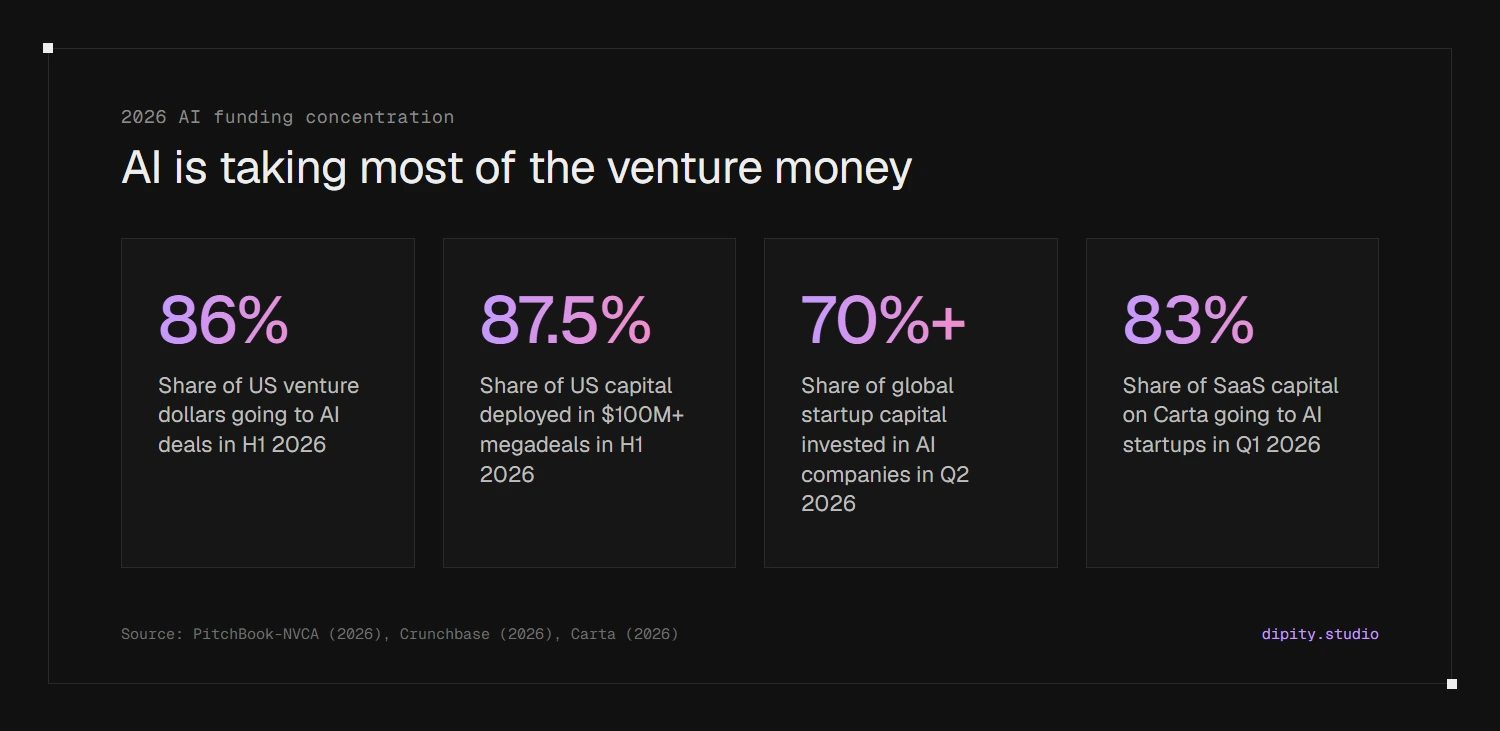
AI funding in 2026 is concentrated at the top. AI companies absorb most US venture dollars, and rounds of $100 million or more make up most of the capital deployed. At the same time, a record number of first-time founders are raising. More founders are chasing fewer, larger checks.
The PitchBook-NVCA data reports total AI deal value of $355.9 billion, or 86% of all US venture dollars in the first half of 2026. Megadeals made up 87.5% of the $412.7 billion deployed, and the half-year total already exceeds the 2025 full-year figure.
Crunchbase data shows venture funding hit a record $510 billion in the first half of 2026, above the $440 billion invested in all of 2025, and more than 70% of global startup capital in Q2 went to AI-focused companies. Carta's Q1 2026 report found 83% of SaaS capital went to AI startups. Carta also noted an AI foundational model startup at Series A might raise at a $300 million median valuation, against $55 million for a non-AI startup at the same stage.
The crowd is growing too. First-time financings reached an estimated 5,674 deals in H1 2026, putting the year on pace for more than 10,000 first rounds, a record. J.P. Morgan commentary in the same report says liquidity stays highly selective for startups without "a strong and differentiated AI story to tell, or a perceived category winner in their space."
Anthropic shows how steep the top of the market has become. Per the Q2 2026 Venture Monitor, Anthropic's $65 billion round carried a 157.1% pre-money step-up to $900 billion from $350 billion three months earlier, for a post-money valuation of $965 billion.
You do not need a frontier lab's valuation. You need a story investors read as a category winner, and category creation is how B2B founders earn the label.
Investors compare your growth and ARR against published survey medians and against the fastest AI growth curves. Growing at the median does not make you a standout. Venture investors hunt for outliers. Visibility gets your numbers read, and the numbers still decide the round.
SaaS Capital's 2026 benchmarks, drawn from more than 1,000 private B2B SaaS companies, put the median growth rate at 22%, down from 25% in 2024. Equity-backed companies reported median growth of 25%, unchanged from the prior year. If you raise venture money, the equity-backed median is your floor, not your goal.
AI raises the bar further. Bessemer's State of AI 2025 found Shooting Star startups reach roughly $3 million ARR within the first year of revenue, while ten Supernova startups averaged about $40 million ARR in their first year of commercialization. Bessemer frames the Shooting Star path as quadruple, triple, triple. Treat the Shooting Star path as the realistic bar and the Supernovas as outliers.
The market backdrop favors AI application startups. Menlo Ventures data shows startups earned nearly $2 in revenue for every $1 earned by incumbents in 2025, taking 63% of the market, up from 36% the year before.
Gong offers a clear example of traction as the proof point. In June 2021, Gong raised $250 million at a $7.25 billion valuation, triple the valuation from the prior summer, on ARR growth of 2.3x year over year. Numbers like those end debates in diligence.
Know your benchmarks cold before the first meeting. For spend ratios by stage, see our B2B SaaS spending benchmarks for seed to Series A.
Publish a clear point of view every week, under your own name, for 6 to 12 months before the raise. Pick one thesis tied to your category. Show proof as you earn the proof. When investors search your name, they find a founder who thinks in public.
Investors have nothing to read on a founder with no record. A single post the week before your raise looks like marketing. A year of posts looks like conviction.
The hard part is time. You are selling, hiring, and shipping while preparing for a raise. Founder-led content as a growth channel works when your thinking gets captured once and published many times.
Dipity built Sera for this exact job. Sera interviews you by chat, text, phone, webcam, or Google Meet, builds a knowledge base your company owns, and drafts LinkedIn, X, and blog posts in your voice. You approve every post before anything goes live. Here is the 12-month timeline we recommend:
Authority beats activity. Start the clock twelve months out, and add earned media once you know when a B2B startup should invest in PR.
Audit what investors find when they search your name. Close the gaps. Tighten your metrics against 2026 benchmarks. Pick one category thesis. Publish weekly under your own name. Keep going through the raise.
The evidence points one direction. VCs rank the team first. They find most deals through their own search. They spend months checking what founders claim. AI takes most venture dollars right now, and first-time founders are raising in record numbers. If you stay quiet, you stay invisible.
Visibility does not replace traction. Visibility gets your traction in front of the right people at the right time. Your founder voice is the moat.
Build your public record with Sera, the AI head of content built to turn your interviews into posts in your voice. See the system in action on the Dipity product page.
VCs look at your team first. Then they evaluate your business model, product, and market. For AI startups in 2026, they also want a differentiated AI story and signs you lead a category. Strong growth against benchmarks turns interest into a term sheet.
Plan for months, not weeks. From your first meeting to close, firms run reference calls, review your data room, and hold multiple partner meetings. Start preparing well before you open the round.
Wharton research links an active social presence with better funding outcomes. The evidence is correlational, so publishing alone will not get you funded. Visibility helps investors find you and evaluate you faster.
Growth at the survey median will not stand out. Investors want you well above the SaaS Capital private SaaS medians. AI companies get measured against curves like Bessemer's quadruple, triple, triple path.
Carta reports more than 60% of all venture capital raised by companies on Carta in Q1 2026 went to AI companies. US and global trackers show even higher shares for the first half of the year.
Start 6 to 12 months before the raise. A year of consistent posts gives investors a record to read before your first meeting. Late starts look like marketing. Early starts look like conviction.
Bessemer Venture Partners. (2025). The state of AI 2025
Carta. (2026). State of private markets: Q1 2026
CB Insights. (2026). Why startups fail: Top 9 reasons
Dropbox DocSend. (n.d.). How DocSend data helps founders build better pitch decks
Gompers, P., Gornall, W., Kaplan, S. N., & Strebulaev, I. A. (2016). How do venture capitalists make decisions? (NBER Working Paper No. 22587)
Gompers, P., Gornall, W., Kaplan, S. N., & Strebulaev, I. A. (2016). How do venture capitalists make decisions? (Full working paper)
Jin, F., Hitt, L., & Wu, A. (2017). Social is the new financial: How startup social media activity influences funding outcomes
Kaplan, S. N., Sensoy, B. A., & Strömberg, P. (2009). Should investors bet on the jockey or the horse? Evidence from the evolution of firms from early business plans to public companies
Knowledge at Wharton. (2017). Why early-stage investors tend to trust their gut
Menlo Ventures. (2025). 2025: The state of generative AI in the enterprise
PitchBook & National Venture Capital Association. (2026). Q2 2026 PitchBook-NVCA Venture Monitor
SaaS Capital. (2026). 2026 private B2B SaaS company growth rate benchmarks
Teare, G. (2026). Crunchbase data: Global startup investment hit record $510B in H1 2026 as AI boom accelerates funding and exits
TechCrunch. (2021). Gong going gangbusters, grabs $250M Series E on $7.25B valuation

Looking for further details?






Our experienced team values clarity and craftsmanship, excelling in production systems.