Your AI Executive Assistant
Executive Thought Leadership on Autopilot
Sera_01: Semantic Executive Resource Engine
Built for AI Search Visibility
Your Voice, on Every Channel

Marketing Insights_
A stage-by-stage founder-led marketing playbook: channels, weekly cadence, first marketing hire, investor signals and metrics from seed to Series A.
October 6, 2026
8 Min Reads
Morgan Von Druitt
The road from seed to Series A is longer than it used to be. Carta data analyzed by SaaStr shows 39% of companies raising a Series A in Q3 2025 took three or more years to get there, up from 19% in Q3 2019. The same analysis puts the new bar at $2M to $3M+ ARR. Meanwhile, the 2025 Edelman-LinkedIn thought leadership study found 79% of decision-makers are more likely to champion a vendor in an RFP when that vendor publishes quality thought leadership. At Dipity, we run founder content systems for B2B teams. This guide is a stage-by-stage playbook: which channels to run, the weekly cadence, how founder-led sales and content feed each other, when to hire your first marketer, what investors check, and the metrics to watch at each stage.
Founder-led marketing means the founder is the main channel until the company proves a repeatable motion. It runs in three stages. Pre-seed and seed is about warm conversations and learning. Seed to $1M ARR is about a steady public cadence that feeds sales. $1M ARR to Series A is about turning the founder's voice into a system a team can run.
We already made the case for why founder visibility matters in why founders are becoming the product. This post skips the why and covers the how.
The timeline matters because each stage lasts longer than founders expect. Lenny Rachitsky's research on top B2B startups found they took about two years from founding to reach $1M ARR, and roughly 1.5 years after closing their first customer. Your marketing plan has to survive that stretch with one person doing most of the work.
Each stage changes three things: the channels you run, the hours you spend, and the numbers you report. The sections below take them in order.
Every stage keeps the founder in the loop. What changes is how much of the work the founder does by hand.
At pre-seed and seed, marketing is mostly sales conversations. Start with your personal network and investor intros, then move to targeted outbound. Write in public about the problem, not the product. The goal is learning which buyer feels the pain most.
Lenny's study of how B2B startups won their first 10 customers ranks the channels in order: personal network, strategic outbound, investor networks, communities, content and an online following, press, then launch. He frames them as concentric circles moving away from the founder, with trust dropping at each ring. Content shows up fifth on that list. It supports the early work but rarely carries it.
First Round's founder-led sales series backs this up with field numbers. Pomelo Care founder and CEO Marta Bralic Kerns told First Round that 95% of the company's early calls came through warm intros from investors, angels, and personal contacts. Thena's Mike Molinet logged over 1,100 external calls in a year, more than 20 a week.
Figma used social media as a research tool before it used it as a megaphone. Dylan Field described using Twitter to identify the most influential designers, reaching out to them directly, and keeping them updated as the product changed. By launch, many of those designers amplified the message.
A workable weekly cadence at this stage looks like this:
Keep the stack light. Our guide to the minimum viable stack from seed to Series A covers the tools worth paying for this early.
Between first customers and $1M ARR, the founder's personal profile becomes the primary marketing channel. Post on LinkedIn two to five times a week. Run outbound to the people who engage. Add one owned channel, usually a newsletter. Personal profiles outperform company pages on engagement, so put the effort behind the founder's name.
Frequency pays off on LinkedIn. Buffer analyzed over 2 million posts from 94,000+ accounts and found that moving from one post a week to two to five posts a week added 1,182 impressions per post. Moving to six to ten posts a week added 5,001 per post. Buffer calls two to five posts a week the sweet spot for reach and engagement without burnout.
The account that posts matters too. Metricool's 2026 LinkedIn study of 673,658 posts found personal profiles earned a 63% higher engagement rate than company pages on average. Company pages and personal profiles drew similar impressions per post. The difference shows up in comments, which is where sales conversations start.
Lemlist shows the payoff when a founder commits to content. Guillaume Moubeche told Failory the company reached $1,000,000 in ARR after launching in 2018, with early traction coming from sharing the beta in a community of cold emailers. Aakash Gupta's breakdown of lempire reports the company went from $1M ARR in 2019 to $20M in 2022, with 90% of revenue coming from inbound product-led growth driven by content marketing.
Most of your pipeline still comes from conversations at this stage. Content makes those conversations warmer and easier to start.
Treat sales calls as the research engine and content as the distribution engine. Every objection, question, and surprise from a call becomes a post. Every post creates warmer leads for the next round of calls. Buyers say thought leadership makes them more open to outreach, so the loop compounds when it runs every week.
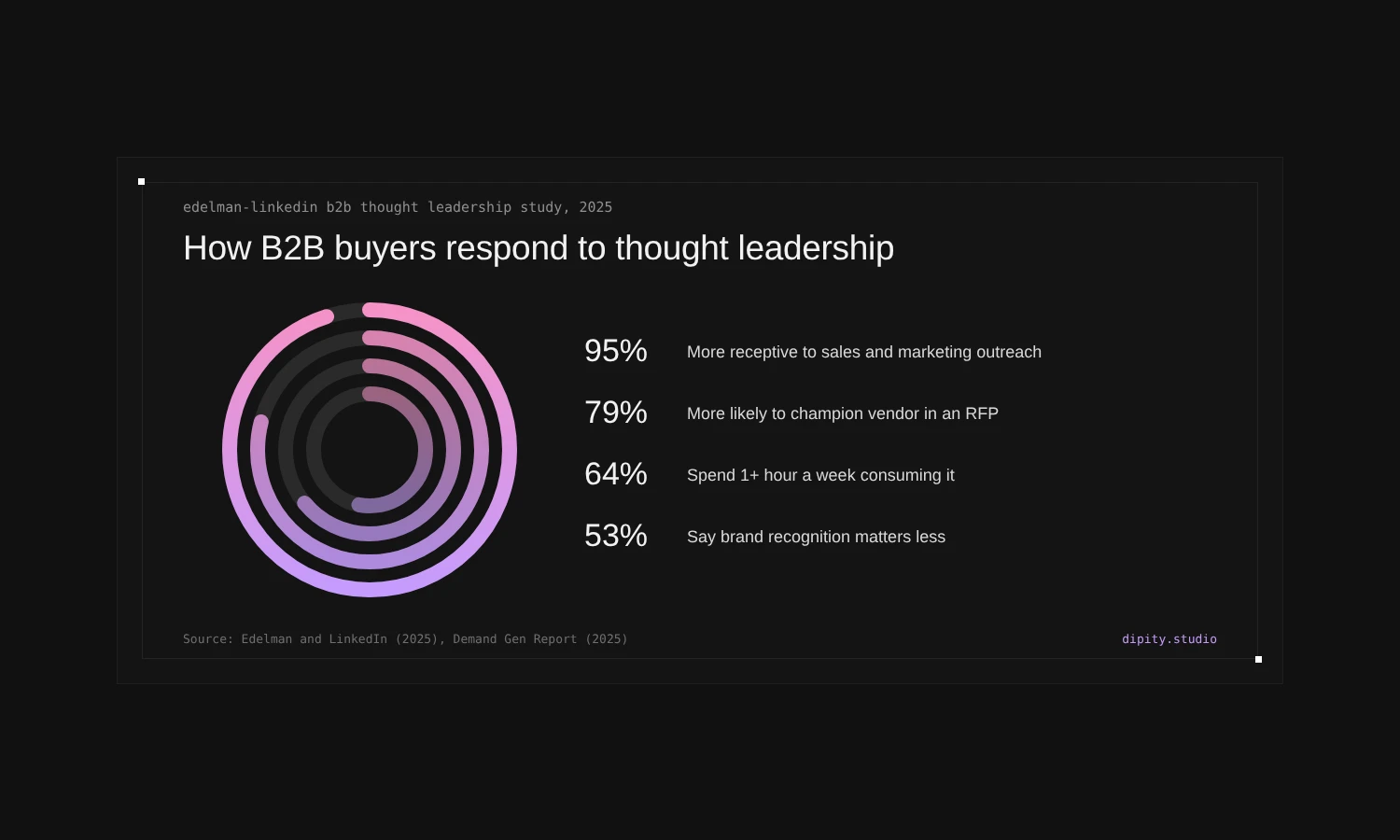
Buyers say this loop works. The 2025 Edelman-LinkedIn report, based on nearly 2,000 management-level professionals, found 95% of hidden buyers say strong thought leadership makes them more receptive to sales and marketing outreach. 64% of target buyers spend more than an hour a week consuming it. 53% said strong thought leadership makes brand recognition matter less, which helps a startup nobody has heard of yet.
LinkedIn's own data points the same direction. LinkedIn shared that nearly six in 10 buyers discover new brands through creator content in early awareness. The same data shows employees' combined networks are about 12x larger than a company's own following. For a five-person startup, the founder's network is usually that multiplier.
a16z built a whole media arm around this idea. The firm's 2026 essay on new media argues that to win you must go direct, and going direct requires being interesting. a16z speedrun's Head of GTM, Macy Mills, wrote that people buy into founders as much as products at the early stage.
The posts get better because they come from real buyers. The calls get easier because buyers already know how you think.
Hire your first marketer after at least one channel shows real traction and you have 10 to 25 paying customers who are not friends. Hire a hands-on operator who can own a number. The founder stays the voice. The marketer builds the system around that voice.
SaaStr's Jason Lemkin gives two pieces of advice that fit together. In a 2025 post, he suggests founders try content, outbound email, events, drip campaigns, PR, and paid ads themselves first, just to learn, then hire a strong full-time marketer once any of them shows traction. In another 2025 post, he says the first hire should be a hands-on, metrics-driven marketer who knows lead velocity, cost per lead, and conversion rates.
The sales-hire research from First Round offers a useful parallel. First Round partner Meka Asonye writes that founders should usually have at least 10, and probably closer to 25, B2B customers before the first sales hire. He notes Figma's first sales hire, Kyle Parrish, joined at $2M in ARR. The same logic applies to marketing. Hire to scale a channel that already works.
Some companies go much further on founder effort alone. First Round's profile of Vanta reports the company signed its first 600 customers without a proper website, and still had no marketing team at that point. Christina Cacioppo ran the early sales calls herself and reached $10M in ARR before raising a Series A.
The first marketer's job is to make the founder more visible and to keep the voice intact.
Investors look at traction first, team second, and market third. A visible founder helps in two ways. It helps investors find you, and it gives them more information to judge you. Research links startup social media activity to better funding outcomes, but traction still decides the round.
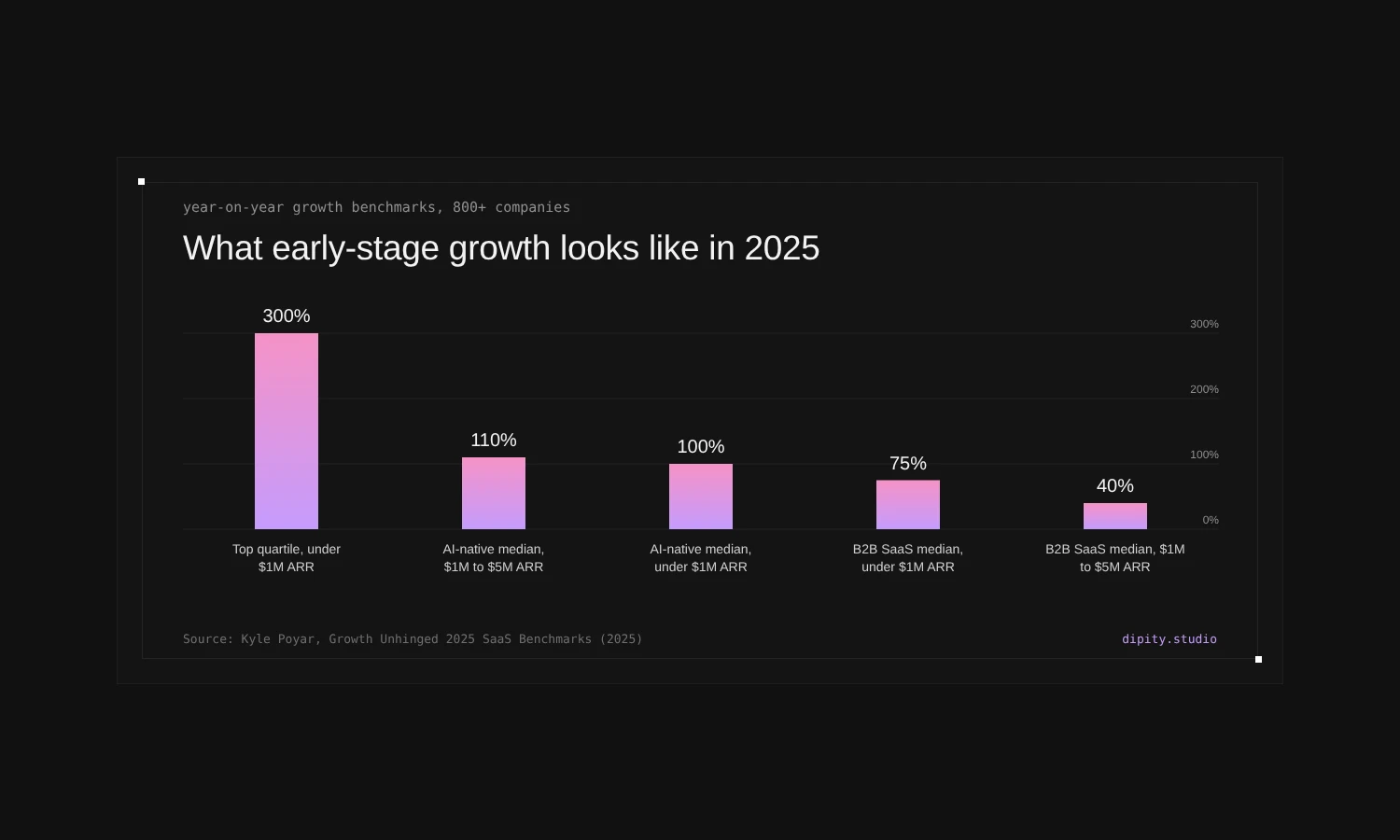
a16z speedrun is direct about the order. After reviewing over 10,000 applications, the team said traction is "number one, two, and three," followed by team and then TAM. The bar for traction has moved up. Kyle Poyar's 2025 SaaS Benchmarks report, built on more than 800 companies, found top-quartile startups under $1M ARR growing 300% year on year. Median growth under $1M ARR was 100% for AI-native companies versus 75% for B2B SaaS. Between $1M and $5M ARR, the gap widened to 110% versus 40%.
The academic evidence on founder visibility is positive but measured. Wharton researchers Fujie Jin, Lorin Hitt, and Andy Wu found an active social media presence and strong Twitter influence raised the odds a startup closed its round, the amount raised, and the breadth of the investor pool. The effect was strongest for startups outside major VC hubs. A 2024 study in the Review of Quantitative Finance and Accounting linked higher startup Twitter activity to fewer financing rounds, smaller syndicates, more total funding, and better exits.
There are limits. A Journal of Business Venturing study of 4,600 financing rounds found Twitter sentiment predicted valuations but was a weak signal compared with patents for long-term success. On the public company side, a 2026 Journal of Business Research study of 3,702 listed firms found executives' online personal brands positively affect corporate performance, with reputation as the link.
Read the research as a multiplier on traction. A founder with a public track record gives investors a searchable record of how they think. Our guide to what investors check before a raise covers the diligence side in detail.
Track learning metrics at seed, pipeline metrics on the way to $1M ARR, and efficiency metrics on the way to Series A. Vanity numbers like follower counts matter less than conversations started and deals influenced. Pick three to five numbers per stage and review them every week.
The right metrics follow what investors will ask about next. Poyar's benchmark report names CAC payback period and net revenue retention as the two strongest predictors of long-term, profitable growth. Those numbers only become meaningful after $1M ARR, so earlier stages need simpler signals.
Add one cheap tracking step at every stage. Put a "how did you hear about us" field on every demo form and ask the question on every first call. Self-reported attribution catches the LinkedIn post a buyer read two months ago that no pixel recorded.
Review the numbers weekly with whoever helps on go-to-market. When a number stops moving, change one input at a time.
Make the weekly cadence smaller than you think you need, then protect it. Capture ideas from calls you already take instead of creating content from scratch. Document your voice early so a first marketer or a tool can draft in it. Consistency over months beats bursts of activity.
The biggest risk in founder-led marketing is the gap. Founders post daily for three weeks, close a round or a big deal, and go quiet for two months. Buffer's data shows reach builds with steady frequency, and the Edelman-LinkedIn data shows buyers reward vendors that publish consistently. A missed month resets both.
The fix is to separate thinking from writing. Your thinking happens on sales calls, investor updates, and team meetings already. Record those, pull the insights, and turn them into drafts you edit in ten minutes. By the time you hire a first marketer, you will hand over a body of work and a documented voice instead of a blank page.
This is the problem we built Sera to solve. Sera, the AI head of content from Dipity, interviews founders and executives by phone, webcam, chat, or text. She builds a knowledge base your company owns and drafts LinkedIn posts, newsletters, and blogs in each leader's voice, with nothing published until you approve it. Start a 7-day free trial of Sera or see how the Dipity product works.
Ready to try it? See Sera pricing, from $50 per month, or Book a Demo to watch Sera interview an executive and draft in their voice.
Founder-led marketing is a go-to-market approach where the founder acts as the main marketing channel through personal content, sales conversations, and community presence. It works best from pre-seed until the company has a repeatable motion and a first marketer to systematize it.
Two to five times a week is a practical target. Buffer's analysis of over 2 million posts found that range improved reach and engagement per post over posting once a week, without the burnout of daily posting.
After at least one channel shows real traction and you have roughly 10 to 25 paying B2B customers. The first hire should be a hands-on operator who can own pipeline numbers.
Research links startup social media activity to higher odds of closing a round, more capital raised, and broader investor pools. The effect is strongest outside major VC hubs. Traction still matters most to investors.
Track customer conversations and warm-intro share at seed, content-sourced conversations and meetings on the way to $1M ARR, then growth rate, CAC payback, and net revenue retention as you approach Series A.
a16z. (2026). What is new media in 2026
a16z speedrun. (2025). SR005 apps reviewed: The 3 signals that get startups in
Asonye, M. (2025). 0 to $5M: How to nail founder-led sales. First Round Review
Asonye, M. (n.d.). 0 to $5M: Making your first sales hire. First Round Review
Bayar, O., and Kesici, E. (2024). The impact of social media on venture capital financing: Evidence from Twitter interactions. Review of Quantitative Finance and Accounting
Buffer. (2025). How often should you post on LinkedIn? Data from 2 million+ posts
Demand Gen Report. (2025). Marketers need to gear content to hidden B2B buyers: Edelman/LinkedIn
Edelman and LinkedIn. (2025). 2025 B2B Thought Leadership Impact Report: The hidden buyer
Failory. (2020). Interview with Guillaume Moubeche of lemlist
First Round Review. (n.d.). Vanta's path to product-market fit
Gupta, A. (2024). How lempire built a $28M ARR SaaS. Product Growth
Jin, F., Hitt, L., and Wu, A. (2017). Social is the new financial: How startup social media activity influences funding outcomes. Mack Institute, Wharton
Lemkin, J. (2025). Dear SaaStr: What do I look for in my first marketing hire?. SaaStr
Lemkin, J. (2025). Dear SaaStr: When is it "too early" to hire your first marketer?. SaaStr
Metricool. (2026). Metricool's 2026 LinkedIn study reveals the rise of invisible interactions as video performance slips
Mills, M. (2026). How to land your first $500k contract. a16z speedrun
Poyar, K. (2025). The 2025 SaaS benchmarks report: Five key takeaways. Growth Unhinged
Rachitsky, L. (2020). How today's fastest growing B2B businesses found their first ten customers. Lenny's Newsletter
Rachitsky, L. (2023). How to find and win your first 10 B2B customers. Lenny's Newsletter
Rachitsky, L. (2023). Scaling your B2B growth engine. Lenny's Newsletter
SaaStr. (2025). Your seed round now needs to last 3 years: What 3,365 startups tell us about the new Series A timeline
Social Media Today. (2026). LinkedIn shares key trends in B2B marketing
Tumasjan, A., Braun, R., and Stolz, B. (2021). High-tech start-ups benefit from Twitter hype. Journal of Business Venturing (press release, Johannes Gutenberg University Mainz)
Zhang, Y., Zeng, Q., Wang, X., and Fan, W. (2026). Is it worthwhile for executives to spend time on social media? Evidence from China. Journal of Business Research

Looking for further details?






Our experienced team values clarity and craftsmanship, excelling in production systems.