Your AI Executive Assistant
Executive Thought Leadership on Autopilot
Sera_01: Semantic Executive Resource Engine
Built for AI Search Visibility
Your Voice, on Every Channel

AI Insights_
How ChatGPT and Perplexity pick sources, what earns citations on and off your site, how to measure it, and a 30-day plan for startups.
October 6, 2026
8 Min Reads
Morgan Von Druitt
Answer engines pick their sources in ways that break most SEO habits. Ahrefs found just 12% of URLs cited by AI assistants also rank in Google's top 10 for the same query. Muck Rack's May 2026 analysis of more than 25 million links found earned media drives 84% of citations across ChatGPT, Claude and Gemini. At Dipity, we build content systems for founders, and this guide covers how answer engines choose sources, which pages and platforms they trust, and a 30-day plan to get your startup into the answer.
ChatGPT and Perplexity run a live search, pull a handful of pages, and write an answer from what they retrieved. The engine expands your buyer's question into several related searches and favors pages that show up across many of them. Relevance to the question matters most, and fresher pages get a measurable edge. A page that never enters the retrieved set cannot be cited, no matter how good it is.
Our earlier post on how AI search is rewriting B2B discovery covered why citations now matter more than rankings. This one is the tactical follow-up. The first thing to know is that the mechanics behind the citation are called retrieval-augmented generation. The model searches, reads a short list of results, and then writes.
The retrieval step does not mirror Google. In the Ahrefs overlap study of 15,000 long-tail queries, 80% of AI citations did not rank anywhere in Google for the original query. Perplexity was the exception, with 28.6% of its cited URLs landing in Google's top 10. ChatGPT sat near 8% against both Google and Bing. The authors trace the gap to query fan-out, where the assistant searches many variations of one prompt and merges the results.
Once pages are retrieved, relevance wins. An ACL 2024 paper tested what evidence language models find convincing and found models lean heavily on how relevant a page is to the query. They largely ignored cues people care about, such as scientific references or a neutral tone. Recency is the second lever. A 2025 study of LLM rerankers showed that adding newer dates shifted the top 10's mean publication year forward by up to 4.78 years across seven models.
Think of your job in two stages. First, get into the retrieved set. Then, be the most useful page inside it.
Wikipedia dominates ChatGPT's citations, and Reddit dominates Perplexity's. YouTube has climbed to the top across many engines in 2026. Review sites like G2 carry software queries. Across every engine, earned media from journalists and independent writers far outweighs anything a brand pays for. Paid placement barely registers.
Profound analyzed 680 million citations and found each engine has its own taste. Wikipedia accounted for 7.8% of all ChatGPT citations and nearly half of the citations among its top 10 sources. Perplexity leaned on Reddit, which made up 6.6% of its total citations. Google AI Overviews spread credit more evenly, with Reddit at 2.2% and YouTube at 1.9%.
Video is the fastest mover. Digiday reported Meltwater data showing YouTube was the most-cited platform across eight AI engines in August 2026, including ChatGPT, Claude, Perplexity and Gemini. The same piece cited OtterlyAI research finding 94% of YouTube citations go to long-form videos. Shorts drew just 5.7%.
For software buyers, review sites matter a lot. G2 shared Profound data showing about 33% of review citations in ChatGPT and Google AI Overviews come from G2. In Perplexity, that share is closer to 75%.
The bigger pattern is earned versus owned. A September 2025 arXiv paper by Chen and colleagues found AI search shows a systematic bias toward earned media over brand-owned and social content. In its US automotive test, AI search returned 81.9% earned sources, while Google returned 45.1%. Muck Rack's May 2026 report found paid and advertorial content made up just 0.3% of citations.
The top cited pages tell you what you can and cannot touch. Ahrefs studied ChatGPT's top 1,000 cited pages and found only 32.3% were off-site pages a marketer could pitch or influence. Wikipedia made up 29.7% of the list, and homepages or landing pages made up 23.8%.
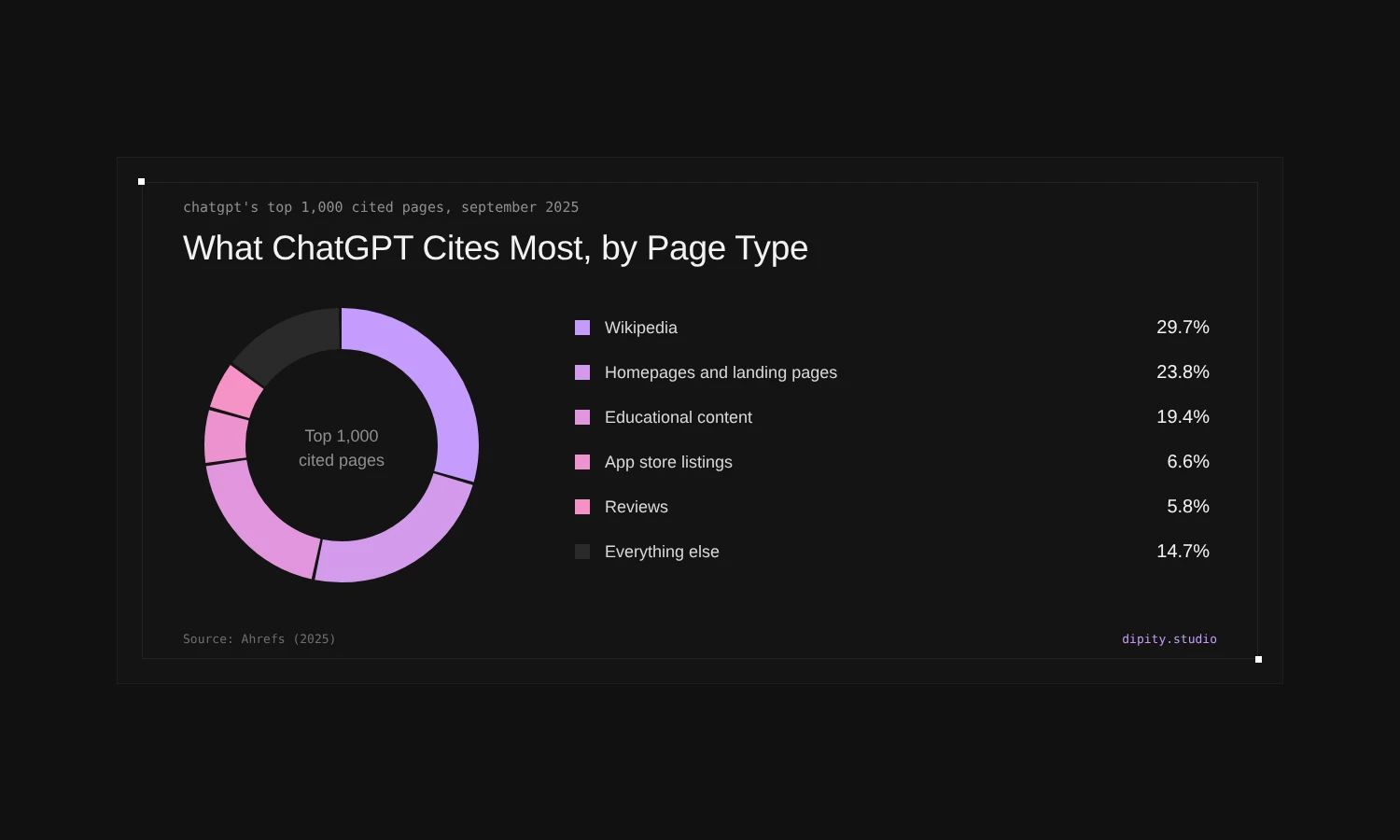
Your homepage is on the list too. Treat it as a citable page, then spend outreach time on the third-party sources you can move.
Add specific statistics, short expert quotations and named sources. Write each section as a direct answer to one buyer question. Keep pages updated and show the date. Publish honest comparison and "best of" pages for your category. Put every key fact in visible text, because schema alone has shown little measurable lift in AI citations.
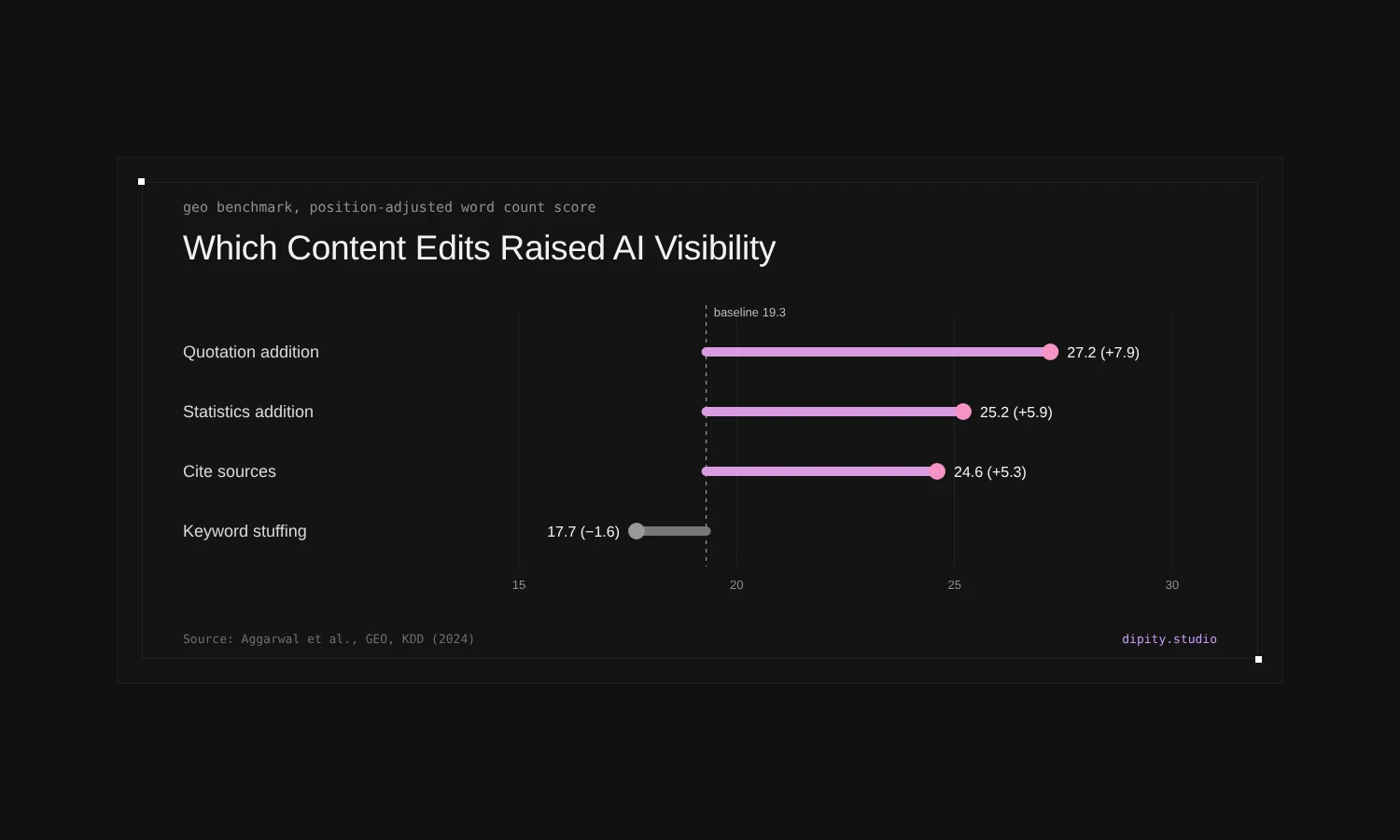
The academic baseline comes from the GEO paper by researchers at Princeton and partners, presented at KDD 2024. On its benchmark, adding quotations lifted a visibility score from 19.3 to 27.2. Adding statistics reached 25.2, and citing sources reached 24.6. Keyword stuffing dropped the score to 17.7. The test ran in a simulated engine on pages already retrieved, so read it as a writing rule.
Format matters for B2B categories too. Ahrefs reviewed 26,283 source URLs behind ChatGPT answers and found "best X" blog lists made up 43.8% of cited page types. Of the 1,100 blog lists used as sources, 79.1% had been updated in 2025. The author's advice was blunt. SaaS companies should publish their own "best" lists, and keep them useful and transparent.
Freshness shows up again here. Ahrefs analyzed 17 million citations and found AI assistants cite content 25.7% fresher than what ranks in organic search. ChatGPT showed the strongest preference for newer pages. Google AI Overviews showed almost none.
Schema deserves a reality check. Ahrefs tracked 1,885 pages that added JSON-LD against 4,000 control pages from August 2025 to March 2026. Adding schema produced no major citation uplift on any platform tested. The same piece notes that AI systems fetching pages directly read only visible HTML. Keep schema for Google rich results and entity clarity, and never hide facts inside it.
None of this works if the page answers the wrong question. Start from the prompts your buyers type, then write the page that answers them best.
Engines name brands that other people talk about. Recent press coverage, reviews on G2, honest community answers and long-form video all feed the sources AI engines read. Mentions and citations are separate wins. You want your name inside the answer and your page in the source list.
Journalism gets weight, and it decays. Muck Rack found journalism makes up 27% of cited sources, and more than half of those citations come from articles published within the past 12 months. One launch story from two years ago will not carry you. A steady drip of coverage will. Our guide on when a B2B startup should invest in PR covers timing and budget.
Being named is a different outcome from being linked. BrightEdge found ChatGPT mentions brands 3.2 times more often than it cites them. "Best" queries produced 4.8 brand mentions on average, double the baseline. Semrush's 2026 AI Visibility Index found the overlap between brands mentioned and domains cited on Gemini can be as low as 30%.
The source mix also depends on the question type. Yext studied 6.8 million citations on location-based queries and found 86% came from sources brands manage or strongly influence, such as websites and listings. Forums like Reddit made up just 2%. For local and factual lookups, your own pages and listings carry the load. For "best tool for" questions, third-party voices dominate.
Picture a seed-stage data observability startup. It has a solid site and zero reviews. Its founder has never appeared on a podcast. When a buyer asks Perplexity for the best observability tools for a small data team, the engine pulls from G2, two Reddit threads and a newsletter roundup. The startup appears in none of them, so it appears nowhere in the answer.
Video is where founders have the most open room. We make the case in why your face is the best go-to-market channel for an AI startup.
Track how often your brand appears across many runs of the same prompt, not where it ranks in a single answer. AI responses change almost every time. Pair a prompt panel with referral traffic from chatgpt.com and perplexity.ai, plus a self-reported attribution field. Review the numbers monthly and act on trends.
Answers are unstable by design. SparkToro ran 2,961 prompts 60 to 100 times each across ChatGPT, Claude and Google's AI tools. The same brand list came back less than 1% of the time. Rand Fishkin warned that any tool reporting an AI "ranking position" is "full of baloney." The stable metric was visibility percentage, meaning the share of runs that named the brand.
Most teams are still guessing. Semrush found 45% of marketing leaders cannot accurately measure brand visibility in AI answers. Only 9% have tools that track every relevant metric. a16z's Zach Cohen and Seema Amble frame the new metric as reference rates, meaning how often a model cites or uses your brand as a source.
Referral traffic is small but measurable. Conductor's 2026 AEO and GEO Benchmarks Report found AI referrals made up 1.08% of all website traffic across ten industries. Information technology led at 2.80%. ChatGPT sent 87.4% of all AI referral traffic.
A spreadsheet and an hour a month is enough at seed. Buy a tracking tool once your prompt list passes fifty.
Spend week one measuring, week two fixing your own pages, week three earning third-party mentions and week four publishing founder video. Then rerun the same prompts and compare. One founder and one marketer can run this plan in a few hours a week. The goal is a baseline and three new sources talking about you.
Early teams win here by being specific. Incumbents rarely publish honest comparison pages or answer niche questions in public. Gartner's research supports the specific angle. Its January 2026 survey found that consumers who changed how they search most often moved to more specific terms.
Expect small numbers at day 30. The baseline and the source map are the real prize, because they tell you where to spend month two.
Citation sources swing month to month, most studies report correlation rather than cause, and engines still cite thin pages. A tactic that works in August can fade by October. Build on reputation that survives a platform change, and treat every single tactic as a bet you will re-test.
Platform swings are real. Search Engine Journal reported Promptwatch data showing Reddit's share of ChatGPT search citations fell from an average of 3.83% to 0.52% in August 2026, an 86.4% relative drop. Digiday also reported Scrunch data showing YouTube citations fading by around 43% within a month.
Quality filters are weak. The same Ahrefs listicle study found 35% of cited "best" lists came from low-authority domains. That gap will close as engines tighten their filters, and spammy lists will be the first to go. The ACL 2024 finding that models overlook credibility cues points the same way. Engines reward relevance today and will likely add stronger trust signals later.
Human buyers still check. The same Gartner survey found two-thirds of consumers continue past Google's AI Overview instead of stopping at the summary. A mention gets you onto the shortlist. Reviews, a credible founder and a clear site keep you there.
The durable move is the one that worked before AI search existed. Be the company experts, customers and reporters talk about. Most founders know this and stall on doing it every week. Sera, Dipity's AI Head of Content, interviews your executives by phone, webcam, chat or text and turns those answers into LinkedIn posts, blogs and video scripts in each leader's voice. Your team approves every piece before it goes out. Try Sera free for 7 days and run your first 30-day plan with a steady content engine behind it.
Ready to try it? See Sera pricing, from $50 per month, or Book a Demo to watch Sera interview an executive and draft in their voice.
Perplexity runs a live search on most prompts, so a new page or mention can show up within days of being indexed. ChatGPT search also retrieves live pages. Brand mentions that come from the model's training data take much longer to change. Expect early movement in 30 days and clearer trends after 90.
It helps most on Perplexity, where 28.6% of cited URLs rank in Google's top 10 according to Ahrefs. ChatGPT and Gemini overlap with Google's top 10 far less. Strong SEO still helps, but third-party mentions and fan-out coverage matter more.
Add it for Google rich results and entity clarity. A 2026 Ahrefs study found adding JSON-LD produced no major citation uplift in ChatGPT, AI Mode or AI Overviews. Put every important fact in visible page text.
Paid placements barely register as cited sources. Muck Rack found paid and advertorial content made up 0.3% of AI citations. Ads inside chatbots are a separate product from organic citations.
Visibility rate, meaning the share of repeated prompt runs that name your brand. SparkToro found answers rarely repeat, so single-run rankings mislead. Pair it with AI referral traffic and a self-reported source field.
Aggarwal, P., Murahari, V., Rajpurohit, T., Kalyan, A., Narasimhan, K., and Deshpande, A. (2024). GEO: Generative engine optimization
Ahrefs. (2025). 67% of ChatGPT's top 1,000 citations are off-limits to marketers
Ahrefs. (2025). Do self-promotional "best" lists boost ChatGPT visibility? Study of 26,283 source URLs
Ahrefs. (2025). New study: AI assistants prefer to cite "fresher" content (17 million citations analyzed)
Ahrefs. (2025). Only 12% of AI cited URLs rank in Google's top 10 for the original prompt
Ahrefs. (2026). We tracked 1,885 pages adding schema. AI citations barely moved.
Andreessen Horowitz. (2025). How generative engine optimization (GEO) rewrites the rules of search
BrightEdge. (2025). ChatGPT brand mentions vs. citations: What triggers visibility
Chen, M., Wang, X., Chen, K., and Koudas, N. (2025). Generative engine optimization: How to dominate AI search
Conductor. (2025). The 2026 AEO / GEO benchmarks report
Digiday. (2026). In graphic detail: LLMs keep citing YouTube in search results
Fang, H., Tao, S., Chen, N., Chang, K., and Sakai, T. (2025). Do large language models favor recent content? A study on recency bias in LLM-based reranking
G2. (2025). Does G2 get ranked in AI LLM search?
Gartner. (2026). Gartner survey finds only one-third of consumers say GenAI rivals search engines
Muck Rack. (2026). Generative Pulse: Earned media consistently drives AI citations, holding at 84%
Profound. (2025). AI platform citation patterns
Search Engine Journal. (2026). AI recommendations change with nearly every query: SparkToro
Search Engine Journal. (2026). Why Reddit's ChatGPT citation drop isn't fully explained
Semrush. (2026). Semrush releases expanded 2026 AI Visibility Index, analyzing 126 million AI search prompts
Wan, A., Wallace, E., and Klein, D. (2024). What evidence do language models find convincing?
Yext. (2025). AI doesn't rank, it cites. And 86% of its sources are brand-managed

Looking for further details?






Our experienced team values clarity and craftsmanship, excelling in production systems.