Your AI Executive Assistant
Executive Thought Leadership on Autopilot
Sera_01: Semantic Executive Resource Engine
Built for AI Search Visibility
Your Voice, on Every Channel

AI Insights_
As AI content floods feeds, a real founder on camera becomes scarce and trusted. The data on video and faces, the Cluely warning, and a weekly video system.
September 24, 2026
8 Min Reads
Morgan Von Druitt
Founder video go-to-market works because a real face is the one asset a competitor cannot generate with a prompt. Graphite's research found AI-generated articles passed human-written articles in volume on the web in November 2024. Meanwhile, Wyzowl's 2026 video report says 85% of people have been convinced to buy a product or service by watching a video. At Dipity, we built Sera so founders show up on camera and in writing without taking on a second job.
Seed and Series A startups have no brand equity. No logo recall. No decade of customer stories. All you have is a founder with a point of view and a face buyers learn to recognize.
Your competitors run the same models you do. Same AI-written posts. Same topics. Same tone. HubSpot's 2026 State of Marketing data says about 94% of marketers plan to use AI in their content creation this year. Text is a commodity. Your face and your voice are not.
Below: the data on video and faces, the LinkedIn mechanics, the Cluely warning, and a weekly system. For the bigger shift, read why founders are becoming the product.
Trust drops. Your buyers assume content is synthetic until you prove otherwise. Anything which only looks AI-made loses credibility and pricing power. A real founder on camera, speaking in an unscripted voice, is the clearest signal a human built the product. Scarcity drives the value.
The written feed flipped fast. Originality.ai data reported by eWeek found over 54 percent of longer English-language LinkedIn posts are likely AI-generated. Most long text your buyer scrolls past now comes from a model.
Buyers notice. A 2026 Gartner survey found 50% of U.S. consumers would rather give their business to brands which avoid GenAI, and 68% frequently wonder whether the content they see is real. Raptive research covered by Adweek found trust drops by nearly 50% when an article feels AI-generated, even when a human wrote the piece.
Video is heading the same direction. Wistia's 2025 State of Video report found 41% of teams used AI for video creation, up from 18% in 2024. Wyzowl reports the share of marketers seeing good video ROI fell to 82%, down from an all-time high of 93% the year before. Generic video no longer stands out. A real founder on camera does.
Signals buyers read as human:
The flood of AI content raises the price of anything provably human. Founder voice is the moat. Our guide to a hybrid AI content strategy for B2B SaaS shows you how to use AI for production without losing the human signal.
Yes, and by a wide margin. Buyers pick short video over articles, ebooks, and sales calls when learning about a product. Short-form video ranks as the top ROI format for marketers. Clips under one minute hold attention best. Publish short video and you meet buyers where their attention already sits.
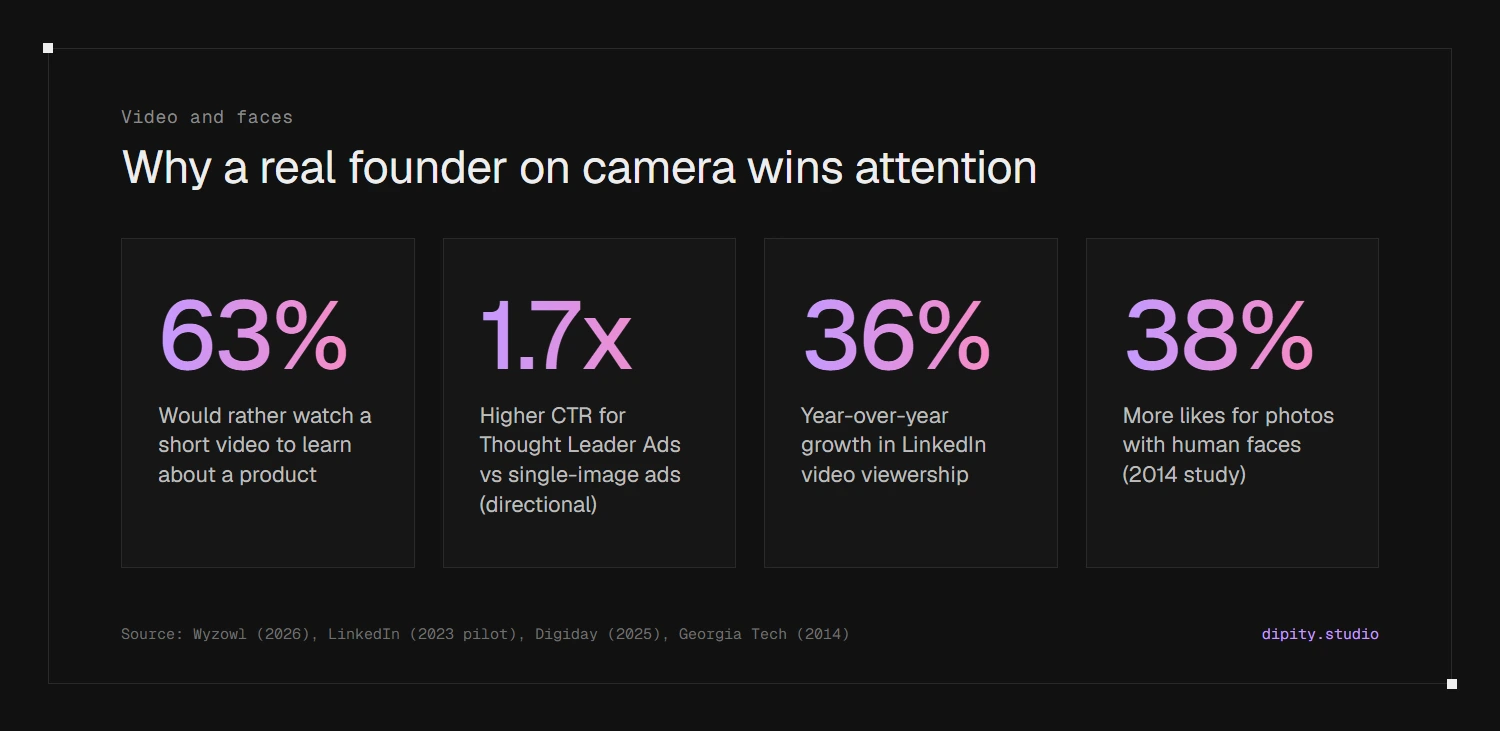
The Wyzowl data leaves no room for debate. Asked how they want to learn about a product or service, 63% said a short video. Text articles pulled 12%. Infographics pulled 7%. Sales calls pulled 5%. Webinars pulled 4%.
The results confirm what buyers say. HubSpot ranks short-form video (49%), long-form video (29%), and live-streaming video (25%) as the top three ROI-driving content formats. A LinkedIn and Ipsos survey of 1,500 senior B2B marketers found teams with mature video strategies are 2.2x more likely to say their brand is well trusted.
Length matters as much as format. Follow these rules for every founder clip:
Buyers told you how they want to learn. Give them short founder clips. Stop betting the quarter on text alone.
People trust people they recognize. Photos with faces pull more likes and comments than photos without them. Trust keeps shifting toward known individuals and away from institutions. Your startup has no brand to trust yet. Your face does the work a logo does for an incumbent.
The mechanism is old and well documented. A 2014 Georgia Tech and Yahoo Labs study of 1.1 million Instagram photos found pictures with human faces were 38 percent more likely to receive likes and 32 percent more likely to attract comments. The data is more than a decade old. Treat the study as evidence of how attention works, not as a current benchmark.
Trust data points the same direction. The 2026 Edelman Trust Barometer found employees trust their own CEO at 66 percent, while business overall sits at 64 percent trust among the general population. This is employee data. Read the finding as a directional signal. Trust flows to people you know.
A point of view from a known person opens doors. Research from Edelman and LinkedIn found 90% of decision-makers and C-suite executives are "moderately or very likely to be more receptive" to outreach from a company producing consistent thought leadership. We break down what buyers reward in B2B thought leadership.
Guillaume Moubeche of lemlist shows this model in practice. He built his company in public on YouTube, LinkedIn and Twitter. In a Product Hunt interview, he said he grew the company to around $10M in ARR, then sold 20% in a $30M cash-out deal. His own words: "Building in public helped me get more people to trust me, get noticed in my industry, get more users to buy my product."
You are the brand until the brand exists. Founder-led content as a growth channel lays out how to turn this into a repeatable program.
LinkedIn is pushing video hard. Posts from people beat posts from company pages. Video viewership grew fast year over year, and LinkedIn's own pilot data shows Thought Leader Ads beating standard single-image ads on clicks and engagement. Get on camera as a founder and you ride both trends at once.
The numbers back this up. Digiday reported total video viewership on LinkedIn rose 36 percent year over year between late October 2024 and late January 2025. Video creation grew at twice the rate of other post formats over the same stretch.
Paid distribution follows the same logic. Thought Leader Ads let a company sponsor a post from a person's profile. LinkedIn's Thought Leader Ads two-pager reports a 1.7x higher click-through rate and 1.6x higher engagement rate against other single-image ad campaigns. LinkedIn labels this 2023 pilot data as directional, so treat the numbers as a signal, not a guarantee.
Lenovo ran the cleanest documented test. The company promoted posts from named executives and the CEO as Thought Leader Ads. According to Lenovo's Shorty Awards entry, the campaign delivered 6x higher engagement rates versus LinkedIn's historical benchmarks and a 63% increase in campaign click-through rates. The CEO's post hit a 7.79% engagement rate. Lenovo is an enterprise, not a startup. The pattern still applies to you. Executive voices outperformed the platform's own benchmarks.
Organic video builds your audience. Thought Leader Ads target the accounts you want. See why CEO LinkedIn content converts higher than company pages.
Your face amplifies everything you say. True or false. Cluely's founder-fronted launch video pulled huge attention and a $15 million Series A. Months later, the CEO admitted a revenue figure he shared publicly was a lie. Visibility buys attention. Only truth turns attention into trust buyers keep.
Cluely launched with what TechCrunch described as "a slick but polarizing launch video." Co-founder and CEO Roy Lee fronted the clip. The company raised "a $15 million Series A led by Andreessen Horowitz."
Then the story turned. In March 2026, TechCrunch reported the $7 million in annual recurring revenue Lee shared the prior summer was, in the outlet's words, "a lie." Every number you say on camera becomes a public promise. When the promise breaks, the same reach spreads the damage.
Use these rules before you hit record:
Authority beats activity. Attention is cheap in 2026. Credibility is the scarce asset. Your face carries both, so guard the second one.
Record one long conversation a week. Cut everything else from the recording. A 30-minute interview produces a week of short clips, posts and quotes. The founder talks. A system handles transcription, clipping, drafting and scheduling. Nothing goes live without founder approval. One hour of founder time buys a week of presence.
Most founders quit video because they treat every post as a separate production. Scripting, retakes, editing. Each one eats an afternoon.
Interviews beat scripts. A sharp question pulls out the voice you use with customers. Those answers become clips, posts, quotes. Capture once. Publish many times.

The weekly rhythm:
Playbooks beat heroics. Sera runs this loop: interviews by chat, text, phone, webcam or Google Meet, a knowledge base your company owns, drafts in your voice for LinkedIn, X and your blog. For the rest of your tooling, see the minimum viable stack for seed to Series A founders.
Yes. Ahrefs found YouTube mentions are the top signal for brand visibility across ChatGPT, AI Mode and AI Overviews. Your founder video on YouTube serves double duty as a go-to-market channel and as source material for AI answers. The link is a correlation, not proof of cause. Publish for buyers first.
Ahrefs went big. Research reported by The Next Web covered 75,000 brands. YouTube mentions (a brand name in a video title, transcript or description) showed a Spearman correlation of about 0.737 with AI visibility. The figure held across all three platforms.
Transcripts are the real asset here. Every founder interview on YouTube puts your company name, your category terms and your point of view into text AI systems read.
One recording now feeds your LinkedIn audience and the answer engines. Read how AI search is rewriting B2B discovery and our guide to answer engine optimization.
Book one 30-minute recorded interview this week. Pick the question buyers ask most, answer the question on camera, and cut three clips under a minute. Approve them, post them on LinkedIn, and repeat next week. Consistency beats polish, and truth beats hype.
AI-written text floods every feed. Buyers tune the noise out. A founder on camera every week, with real numbers and real opinions, becomes the most trusted asset an early-stage company owns.
Sera, the AI head of content from Dipity, runs this loop for you. Sera interviews you, builds a knowledge base your company owns, learns your voice, and drafts LinkedIn, X and blog content, with Studio for images and video. Nothing publishes without your approval. Start with Sera or see how the Dipity product works. Pair founder video with an authority content engine and every recording keeps paying off.
Yes. At seed and Series A, you are the brand. Buyers trust a face they recognize. Your company has no logo equity yet. Start with one weekly recording. Grow from there.
Founder content reaches decision-makers before a sales call ever happens. Outreach lands warmer. The lemlist founder credits building in public with more trust, more visibility, and more buyers. Track replies, inbound demos, and deal mentions of your content. Measure the effect yourself.
Keep most clips under 60 seconds. Engagement drops fast as length grows. Save long recordings for YouTube and source material. One idea per clip. No more.
Yes, once you have organic posts with proven engagement. LinkedIn's own pilot data favors Thought Leader Ads over single-image ads. LinkedIn calls the data directional, so treat the numbers as a signal, not gospel. Start small. Sponsor only your best clip each week. Compare cost per click against your company page ads.
Content which feels AI-made loses trust, even when a human made the piece. Use AI for transcription, editing, and drafting. Keep the face and voice real. Buyers reward proof of a human. An avatar removes the proof.
Adweek. (2025). Suspected AI content halves reader trust and hurts ad performance
Digiday. (2025). LinkedIn's video push appears to be working in 2025
Edelman. (2026). 2026 Edelman Trust Barometer reveals trust is in peril as society slides from grievance into insularity
Edelman and LinkedIn. (2024). Reach beyond the ready: B2B thought leadership research from LinkedIn and Edelman
eWeek. (2024). Study reveals over 50% of LinkedIn posts now machine-generated
Gartner. (2026). Gartner marketing survey finds 50% of consumers prefer brands that avoid using GenAI in consumer-facing content
Georgia Institute of Technology. (2014). Face it: Instagram pictures with faces are more popular
Graphite. (2025). More articles are now created by AI than humans
HubSpot. (2026). 2026 marketing statistics, trends and data
LinkedIn. (2023). LinkedIn Thought Leader Ads product two-pager
LinkedIn Marketing Solutions. (2025). 2025 B2B marketing benchmark: The video + influence effect starts with trust
Product Hunt. (2023). An interview with lempire founder Guillaume Moubeche
Shorty Awards. (2025). Lenovo's LinkedIn campaign showcases the power of thought leadership ads
TechCrunch. (2025). Cluely, a startup that helps 'cheat on everything,' raises $15M from a16z
TechCrunch. (2026). Cluely CEO Roy Lee admits to publicly lying about revenue numbers last year
The Next Web. (2026). YouTube mentions are the top signal for AI brand visibility
Vidyard. (2025). Video in business benchmark report
Wistia. (2025). Wistia's 2025 State of Video Report shows use of AI in video production more than doubled over last year
Wyzowl. (2026). Video marketing statistics 2026

Looking for further details?






Our experienced team values clarity and craftsmanship, excelling in production systems.