
Your AI Executive Assistant
Executive Thought Leadership on Autopilot
Sera_01: Semantic Executive Resource Engine
Built for AI Search Visibility
Your Voice, on Every Channel

Marketing Insights_
Earned media drives most AI citations. Here are the PR triggers, a $500 founder-run stack, and a pitch playbook for B2B startups.
September 19, 2026
8 Min Reads
Morgan Von Druitt
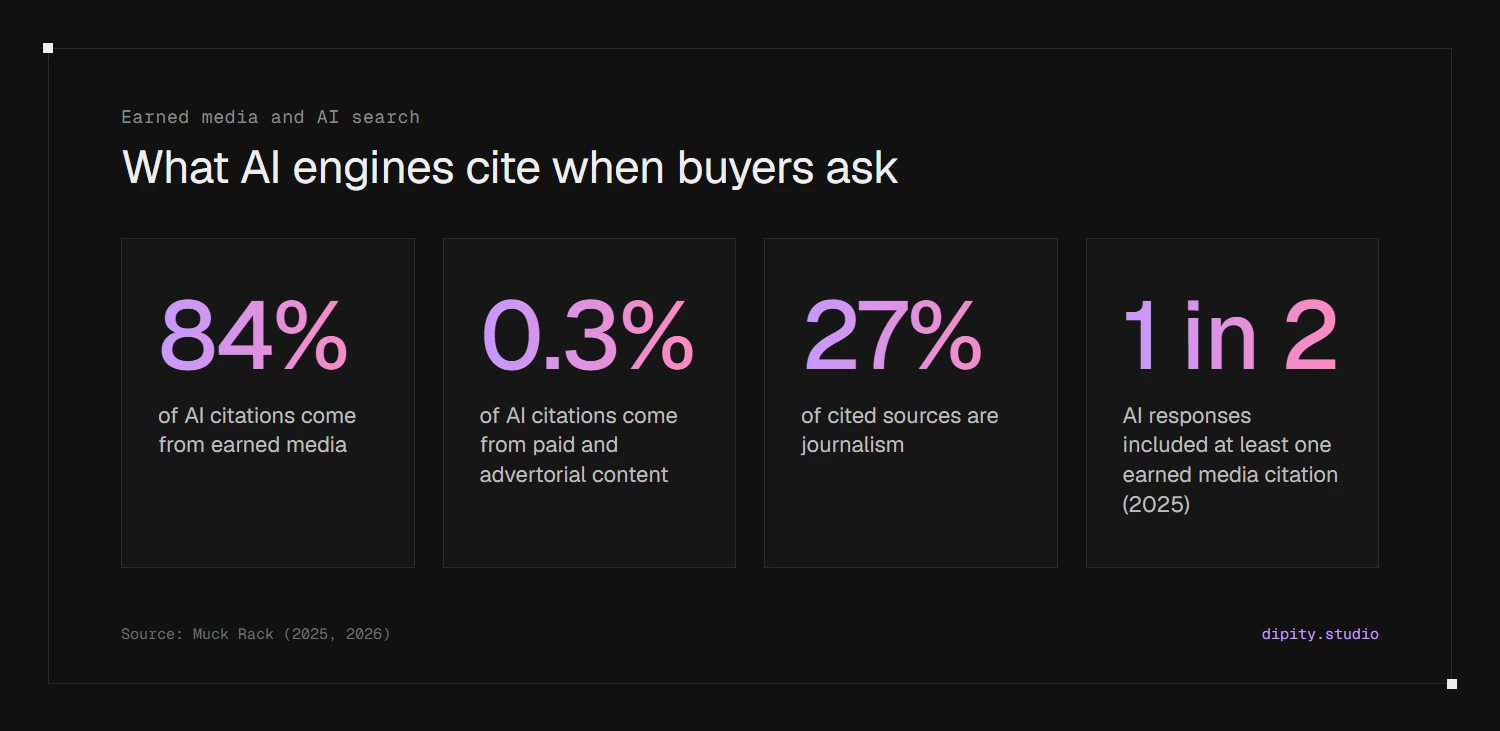
You need PR the moment your deals depend on being known before a buyer ever talks to you. For most B2B teams, the moment arrives right after early founder-led sales. Muck Rack's 2026 Generative Pulse study found earned media accounts for 84% of all AI citations. Paid and advertorial content accounts for 0.3%. At Dipity, we treat PR as discovery infrastructure. This guide covers the triggers, a $500 monthly stack, and a pitch playbook built on what journalists say they want.
For years, you filed PR under ego. A logo bar of outlets on your homepage. A funding announcement nobody read. A retainer nobody defended well in a board meeting. Most seed-stage CEOs skipped the spend, and they were right to.
Then the math changed. Buyers started asking AI engines for vendor lists. Those engines pull answers from press coverage, and a startup with zero earned media is a startup the machines never mention. AI search is rewriting B2B discovery, and PR sits at the center of the rewrite.
B2B startup PR in 2026 is a distribution decision, not a vanity decision. The rest of this guide shows you when to pull the trigger, what to buy, and how to run the whole process in a few hours a week.
Large language models build answers from sources they trust. Those sources are overwhelmingly press coverage. Buying a placement barely registers. Earning a story in a publication your buyers read puts your name inside the answers ChatGPT, Claude, and Gemini return when a prospect asks who solves their problem.
Muck Rack analyzed more than 25 million links from ChatGPT, Claude, and Gemini responses across 17 industries. Journalism alone makes up 27% of cited sources. Across three editions of the study going back to July 2025, earned media ranged from 82% to 89% of citations. The pattern held for a full year. Treat this as structural.
The first edition, released by Muck Rack in July 2025, found half of total AI responses included at least one earned media citation. The same study reported advice-seeking and opinion-based prompts trigger more dynamic citations. Encyclopedic queries fall back on older training data. Your buyers ask advice questions. A prompt like "which expense tool fits a 50-person startup" sends the engine hunting for fresh commentary.
Edelman sees the same mechanism with consumers. Among the 55 percent who use generative AI platforms, Edelman's 2025 brand trust report found 91 percent use them for shopping in some way. Edelman states what shows up in AI is "fueled by earned." The sample is consumers, not B2B buyers. The mechanism still points one direction.
Ramp shows the play in practice. The expense management startup publishes a monthly Ramp AI Index built from customer spend data. Axios reported "Anthropic surpassed OpenAI in business adoption for the first time in April, according to Ramp's latest AI Index." Ramp earned a named mention in a top-tier AI market story through proprietary data. No paid placement involved. Stories like this one are exactly the kind of source AI engines cite.
PR stopped being vanity the day buyers started asking machines for shortlists. Treat earned coverage as the fuel your answer engine optimization strategy runs on.
Put money into PR when one of three triggers fires. You closed a funding round worth announcing. Your category hit a news moment and you hold the data. Or deals keep going to competitors buyers already knew. Before those triggers, founder-led sales does the heavy lifting. After them, invisibility costs you pipeline.
Buyers build a shortlist before you ever get a meeting. The 6sense 2025 Buyer Experience Report, vendor research drawn from nearly 4,000 B2B buyer responses, found "Ninety-five percent of the time, the winning vendor is already on the Day One shortlist." Four out of five deals still go to the pre-contact favorite. If buyers never heard your name, you lost before the RFP landed.
Buying groups keep growing. Forrester's State of Business Buying, 2026 puts the typical buying decision at 13 internal stakeholders and nine external influencers. Analysts, reporters, and peers all shape the deal. Your sales rep will never meet most of them.
A seed-stage company with ten design partners needs no press strategy. You win those deals in person. Once you sell to buying groups, the math flips. These signals tell you when:
No trigger, no spend. One trigger, start the founder-run stack below. Two or more, and PR belongs next to your other category creation bets in the budget.
Yes. Put yourself forward before you hire anyone. People trust a named CEO more than a faceless company. Reporters want a source with a point of view and a phone number. A founder with proprietary data is the most citable asset an early startup owns.
Trust follows people, not logos. The 2026 Edelman Trust Barometer surveyed nearly 34,000 respondents across 28 countries and found trust in "My CEO" at 66 percent. Business remains the only institution seen as both ethical and competent.
Self-published claims get discounted. Edelman's 2025 Trust Barometer found 63 percent say telling whether news came from a respectable source is getting harder. A quote in a credible outlet carries weight your own blog never will. Third-party validation is the whole point.
Carta shows how this compounds. Their data team, including head of insights Peter Walker, feeds statistics to journalists who attribute them to Carta by name. TechCrunch reported "In 2024, 966 startups shut down, compared to 769 in 2023, according to Carta," a 25.6% increase, and quoted Walker directly. Data plus a named human produced earned media. Carta became the default authority in startup-economy coverage.
Your voice is the moat. Founders are becoming the product. Your PR plan should put your face and your numbers in front of every reporter on your beat.
PR on a $500 monthly budget works when the founder supplies the time and the data, and the money buys tools. Spend on a media database or alerts tool and an occasional wire release. Everything else, from intro emails to pitches, runs on founder hours and proprietary numbers.
Agency pricing stays opaque. Clutch's PR firm pricing guide, which reflects marketplace listings and reviewed projects rather than a formal survey, shows most U.S. PR services average $100 to $149 per hour. PR projects reviewed on Clutch range from under $10,000 to over $200,000, and monthly packages run from a few hundred dollars to over $10,000. No rigorous survey publishes startup retainer ranges.
Journalists ask for cheap behavior. Cision's 2025 State of the Media report, based on more than 3,000 journalists in 19 markets, found 85% say the best way to build a relationship is to introduce yourself via email. Seventy-two percent still cite press releases as the most useful resource PR teams offer. Neither costs you a retainer.
Your target list should reach past tier-one outlets. Muck Rack's 2025 journalism research found one in three journalists now self-publish independently. Newsletter writers and creator-journalists often cover a niche beat better than a national desk.
Here is the minimum viable PR stack:
The source library is where most founders stall. Sera interviews executives by chat, text, phone, webcam, or Google Meet, stores the answers in a knowledge base your company owns, and drafts LinkedIn, X, and blog content in each leader's voice for approval before publishing.
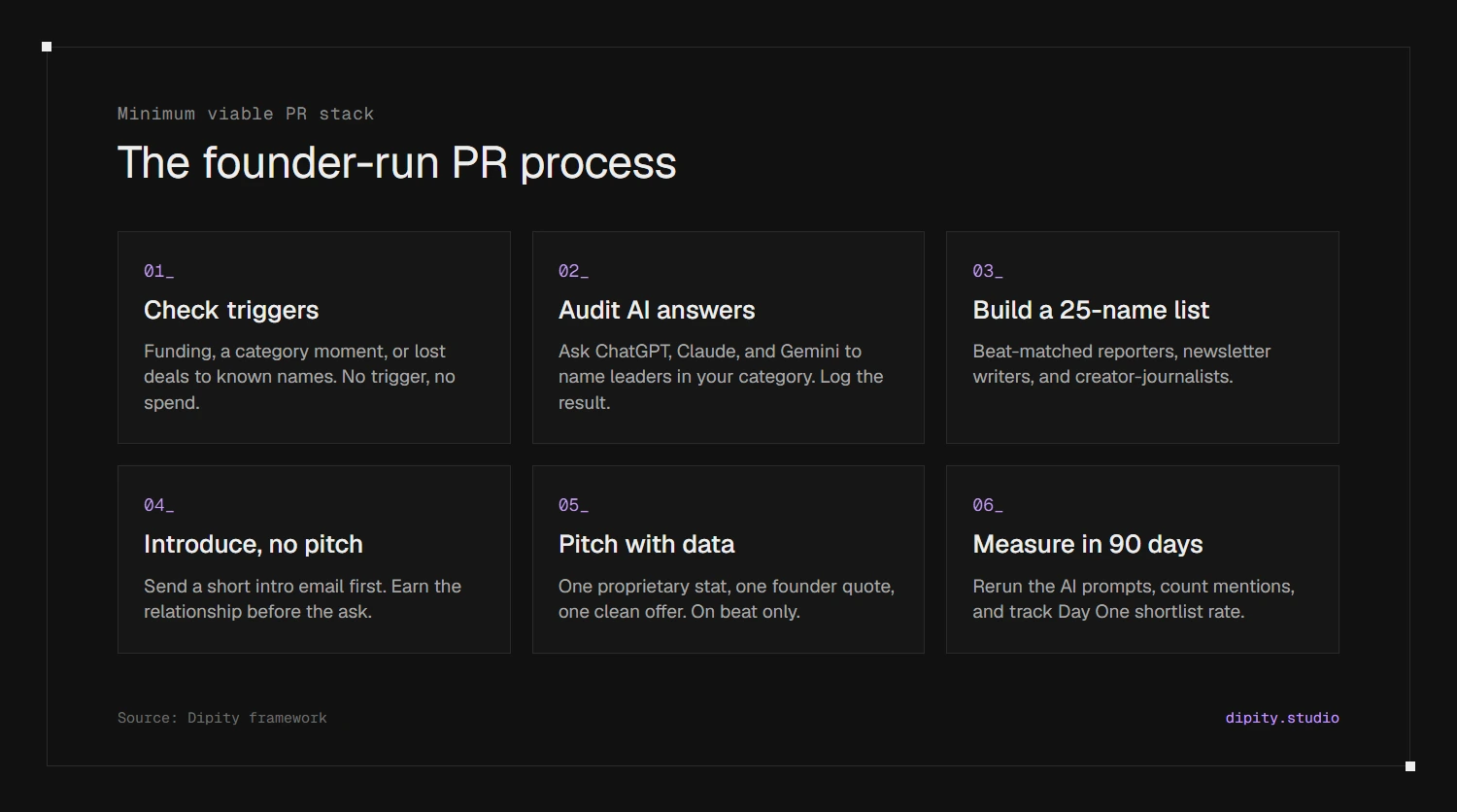
Playbooks over heroics. A written weekly routine and a tight tool budget belong in the same minimum viable stack as the rest of your go-to-market systems.
Pitch fewer reporters. Stay on beat. Lead with a specific number and a founder quote ready to paste. Journalists still build stories from pitches, and they delete anything off-beat on sight. Relevance decides everything. Almost nobody in PR fully customizes a pitch.
Pitching works. Muck Rack's 2026 State of Journalism report, drawn from 897 journalist responses, found 86% say at least some of their stories originate from PR pitches. The same report found 88% immediately disregard pitches missing their beat. Both numbers point to one rule. Match the beat or lose the reporter.
Here's what the professionals get wrong. In Muck Rack's State of PR 2025, 72% of PR pros cited low journalist response rates and 62% pointed to shrinking media lists within relevant beats. Only 11% say they fully customize each pitch. The rest send some version of a template. You write your own pitch, and you stand out by default.
Build every pitch on this structure:
Ten on-beat pitches with original data match how journalists say they work. Two hundred blasts ignore every rule in the research.
Stop counting clips. Measure AI mentions, shortlist presence, and inbound quality instead. Run the same category prompts through ChatGPT, Claude, and Gemini before and after each push. Watch for your name in the output. Note which sources the engines cite. Pay attention to whether new prospects show up already knowing who you are.
PR teams are shifting fast. Muck Rack's State of PR Measurement 2025 found 78% of PR pros say tracking AI-generated mentions is important to their work. 67% believe visibility within LLMs will soon become a core part of standard PR measurement. Only 7% are extremely confident in the data they share. PR ROI has always been hard to prove. AI prompts give you a cheap before-and-after test.
Authority beats activity. Pair these numbers with your entity authority work. Search engines and AI models need a clear path from every mention back to your company.
Ask three AI engines to name the leaders in your category. If your company is missing and one trigger has fired, build a 25-name beat list, send intro emails with no pitch attached, and publish one proprietary data point this month. Measure AI mentions again in 90 days.
No agency. No five-figure retainer. You need a founder willing to hold opinions in public, a data asset worth quoting, and a weekly routine. The budget covers tools. The founder covers everything else.
The hardest part is turning founder knowledge into quotable material on demand. Sera solves this. Interviews capture your positions, a knowledge base stores them, and a voice profile keeps every draft sounding like you. Pair your PR routine with founder-led content as a growth channel, and every story you earn gets amplified on LinkedIn and X.
Build the source library behind your PR. Start with Sera or walk through the system on the Dipity product page.
Start after you've done early founder-led sales. For most B2B startups, this lands around seed to Series A. Look for a trigger: a funding round, a category news moment, or deals lost to better-known competitors. Before you hit one of those, direct sales beats press.
Retainer pricing is opaque. No rigorous survey publishes startup ranges. Clutch marketplace data shows packages from a few hundred dollars to over $10,000 a month. Run a founder-led stack on $500 a month until PR proves out as a channel.
Spend your $500 on a media database or alerts tool and an occasional wire release. Everything else runs on your time: a beat-matched list, intro emails, proprietary data, and a library of founder quotes. Tools cost money. Relevance costs attention.
Yes. Muck Rack's studies of ChatGPT, Claude, and Gemini responses show earned media makes up the large majority of AI citations. Paid content barely registers. Coverage in outlets your buyers read is the most direct path into AI answers.
Put the founder forward first. Edelman's research shows people trust a named CEO more than an abstract company. Reporters want a source with opinions and data. Hire PR help once your founder-run process produces coverage and demands more hours than you have.
6sense. (2025). The B2B buyer experience report for 2025
Axios. (2026). Anthropic and OpenAI workplace AI adoption, according to Ramp's AI Index
Azevedo, M. A. (2025). 2025 will likely be another brutal year of failed startups, data suggests
Cision. (2025). Cision's 2025 State of the Media report reveals a tipping point for trust, technology, and PR-journalist partnerships
Clutch. (2026). PR firm pricing guide
Edelman. (2025a). 2025 Edelman Trust Barometer reveals high level of grievance towards government, business and the rich
Edelman. (2025b). 2025 Edelman Trust Barometer special report: Brand trust, from we to me
Edelman. (2026). 2026 Edelman Trust Barometer reveals trust is in peril as society slides from grievance into insularity
Forrester. (2026). Forrester: The state of business buying, 2026
Muck Rack. (2025a). Muck Rack study: Generative AI relies heavily on earned media and journalism
Muck Rack. (2025b). New Muck Rack study: AI and automation are top priorities for PR professionals
Muck Rack. (2025c). New Muck Rack report finds one in three journalists now publish independently
Muck Rack. (2025d). 61% of PR pros are tracking or planning to track AI mentions and 93% say AI will impact measurement
Muck Rack. (2026a). Earned media still drives 84% of AI citations. Here's what that means for PR
Muck Rack. (2026b). Muck Rack's 2026 State of Journalism report finds 82% of journalists use AI
Ramp. (2026). Ramp AI Index

Looking for further details?






Our experienced team values clarity and craftsmanship, excelling in production systems.