

What Is the 500-Blog Category Creation Framework for Early-Stage Founders?
How one AI startup published 500 blogs, earned 3 Forbes articles in 6 months, and established a multibillion-dollar category.

What Is the 500-Blog Category Creation Framework for Early-Stage Founders?
Before founding Dipity, I ran the content & product marketing motion inside an AI decision-intelligence company that coined a category term nobody had ever searched, and six months later Forbes was writing about the category by name. At Dipity we build AI envoys, context-saturated agents like Sera who make this framework runnable without the war-room staffing it originally took, because the playbook itself is reproducible. This is the full walkthrough: the architecture, the production system, and the compounding math behind 500 blogs, three Forbes articles, and a multibillion-dollar category narrative.
What Did the 500-Blog Motion Actually Produce?
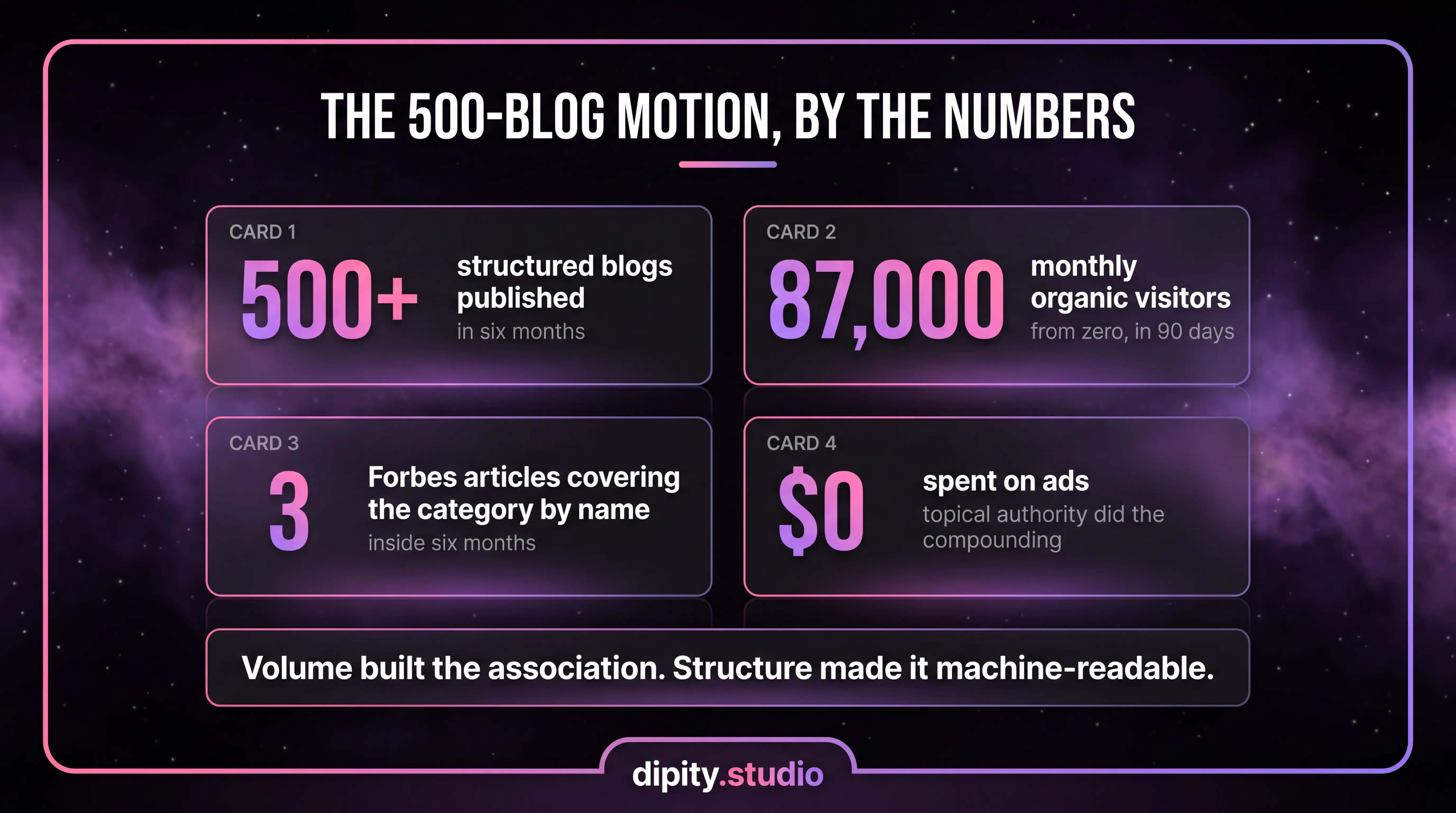
Zero to roughly 87,000 monthly organic visitors in 90 days, three Forbes articles inside six months, and a coined term the market and the machines both adopted. The company was building in a space with no vocabulary, so we manufactured the vocabulary: a trademarked category term, a thesis explaining why the old solution class had run out of era, and 500+ blogs published in six months teaching the market to see the problem our way, all with zero ad spend. The tell that it worked wasn't traffic; it was the coined term ranking for adjacent AI long-tail queries we never targeted, meaning search engines had fused our invented language into the established knowledge graph.
The media coverage followed the same logic. Journalists don't cover features, they cover shifts, and by the time tier-1 press looked at the space, our content was the reference material defining it. Per HBR's research, category creators capture the dominant share of category value; the 500-blog motion is what capturing looks like as a work plan.
And while algorithms have changed since then, it genuinely did not matter that the outputs were mostly AI-generated at this scale. We were publishing twenty-odd blogs per day, which required each piece to be completed on a twenty-minute clock from prompt to publication. We had the protocol so dialed in that we were able to hop on a call with a Fortune 100 exec that we were trying to recruit and show how we could write and publish a blog that showed up on Google's overview and outranked them within 30 minutes. This saturation of industry terms happened around blog 200
How Does Topical Authority Compound?
Each new post in a cluster raises the citation odds of every post already in it, which is why volume behaves like capital rather than labor. Search and answer engines evaluate territory coverage: a domain answering forty interlinked questions about a topic outranks forty scattered domains answering one each, and the effect intensified in the AI-search era, where the answer layer, now on 82% of B2B tech queries per BrightEdge, prefers sources that resolve a subject completely. Ahrefs' funnel data shows what the citations pay: AI-sourced visitors at 0.5% of traffic and 12.1% of signups.
Compounding is also why the front-loaded sprint beats the slow drip for category creation specifically. A new term needs the knowledge graph to see density fast, before the vocabulary settles without you. Six months of saturation established associations a two-year drip would have ceded to whoever moved first.
What's the Content Architecture Behind the Framework?
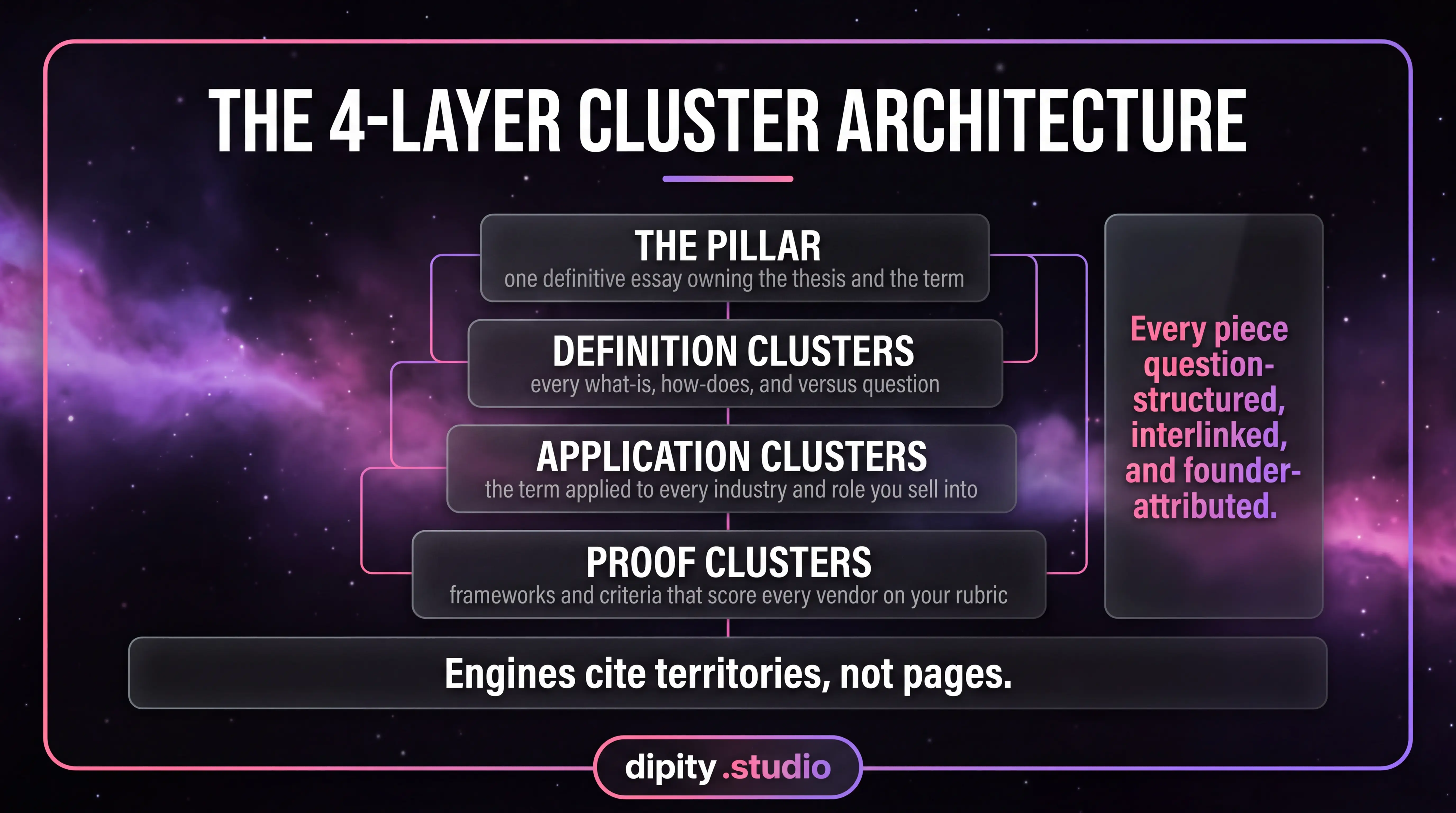
A pillar-and-cluster tree where the coined term sits at the root and every branch answers an adjacent question in the buyer's existing language. The architecture had four layers, and the layering did more work than the volume:
✦ The pillar: one definitive essay owning the thesis, what changed, why the old class fails, what the new class must do, and the term itself.
✦ Definition clusters: every "what is," "how does," and "versus" question in both the new vocabulary and the old vocabulary it succeeds, bridging buyer language to category language.
✦ Application clusters: the term applied to every industry, role, and use case the ICP touches, which is where the adjacent long-tail rankings came from.
✦ Proof clusters: frameworks, maturity models, and evaluation criteria that quietly score every vendor, including incumbents, on rubrics we authored.
Every piece was question-structured with direct answers and schema, interlinked to the pillar, and attributed, the same AEO discipline the answer engines now pay for in citations.
What Production System Makes 500 Blogs Possible?
Extraction plus manufacturing: expert thinking captured at the source, then systematized into structured output, which is precisely the pattern AI agents have since made cheap. The original motion ran on brute discipline, editorial templates, a claims library, a production calendar that treated content like a factory SKU. Running the same play today, the manufacturing layer is agentic: at Dipity, Sera holds the category thesis, vocabulary, claims rules, and voice as permanent context, and one founder interview a month feeds the cluster tree continuously. The founder's cost drops to roughly 90 minutes a week; the architecture, not the founder, carries the volume.
The quality bar is what keeps volume from becoming slop, and it's non-negotiable: every piece answers a real question completely, carries sourced claims, and reads in the founder's voice. Engines deduplicate generic content and buyers discount it; 500 thin posts build nothing but a penalty. The framework scales substance, or it scales nothing.
What Is Category Succession Content?
Content that frames your category as the natural next chapter of the one your buyers already trust, so adoption feels like progress instead of betrayal. The succession move shaped every cluster: we never told the market its existing tools were stupid; we told it they were right for an era that had ended, then named what comes next. Succession framing recruits the incumbent category's believers instead of triggering their defense, hands journalists their favorite story shape, per Forbes' own analysis of category creation, the story is always the shift, and pre-writes the buyer's internal pitch to their boss. The strategic version of this argument lives in creating a category before incumbents steal it.
In practice, succession content is a recurring column in the cluster tree: "the evolution of X," "why X worked and what broke," "from X to [your term]." It's the connective tissue between the market's old mental model and your new one, and it's the content genre founders most often forget to write.
How Do You Replicate This With a Smaller Budget?
Shrink the category until saturation is affordable, then run the identical architecture at that scale. The 500-blog number fit a broad horizontal category; a vertical AI startup coining a term for, say, logistics procurement needs perhaps 60 to 100 pieces for the same saturation effect inside its niche, one deep question-structured post a week plus clusters, sustained for two or three quarters. The valuation data says the prize scales anyway: category-defining narratives are a large component of the 84% AI premium, and investors price the narrative at your niche's scale, not the internet's.
The non-negotiables survive the shrink: thesis before term, saturation within the chosen scope, question-first structure, founder attribution, and cadence without gaps. Budget changes the radius. It doesn't change the physics. If you're still weighing whether to coin at all, run the coin-vs-compete decision framework first; for the strategic foundations, start with the category creation primer.
Frequently Asked Questions
Was the traffic growth really ad-free?
Yes, zero paid amplification. The growth mechanism was topical authority compounding across the cluster architecture, which is reproducible and auditable in any analytics account running the same motion.
How large was the team behind the original 500 blogs?
A small content operation running factory discipline. Today the same output shape runs on an agentic manufacturing layer with one founder's monthly recording as input, which is the part that changed the economics for early-stage teams.
Do the three Forbes articles matter more than the rankings?
They compound each other. Tier-1 coverage feeds the knowledge graph's confidence in the category entity, which feeds citations, which feed more coverage. Neither alone builds a category; the loop does.
What's the first deliverable if I start Monday?
The pillar essay. Thesis, term, succession story, evaluation criteria. Every subsequent piece links into it, so nothing else in the tree works until the root exists.
Want the framework mapped to your category? Book a demo and we'll draft your cluster tree from one conversation.
.svg)


Get weekly updates
*We’ll never share your details.
Follow us — @Dipity











Join Our Newsletter
Get a weekly selection of curated articles from our editorial team.