

How Do You Get Cited by ChatGPT, Perplexity, and Gemini Without Gaming Anything?
AI systems cite structured, authoritative, founder-attributed content. Here's the AEO playbook for B2B SaaS visibility.

How Do You Get Cited by ChatGPT, Perplexity, and Gemini Without Gaming Anything?
There's no submission form for the answer layer; citation is earned, and the earning follows patterns you can build against. At Dipity, we build AI Envoys, an agent class founder Morgan Von Druitt coined and productized, context-saturated agents like Sera who produce founder-attributed content structured the way answer engines prefer to cite, because we've been practicing AEO since before it had a name. The good news for founders: the machines reward substance over tricks. This is the playbook, and none of it requires gaming anything.
How Do AI Engines Choose What to Cite?
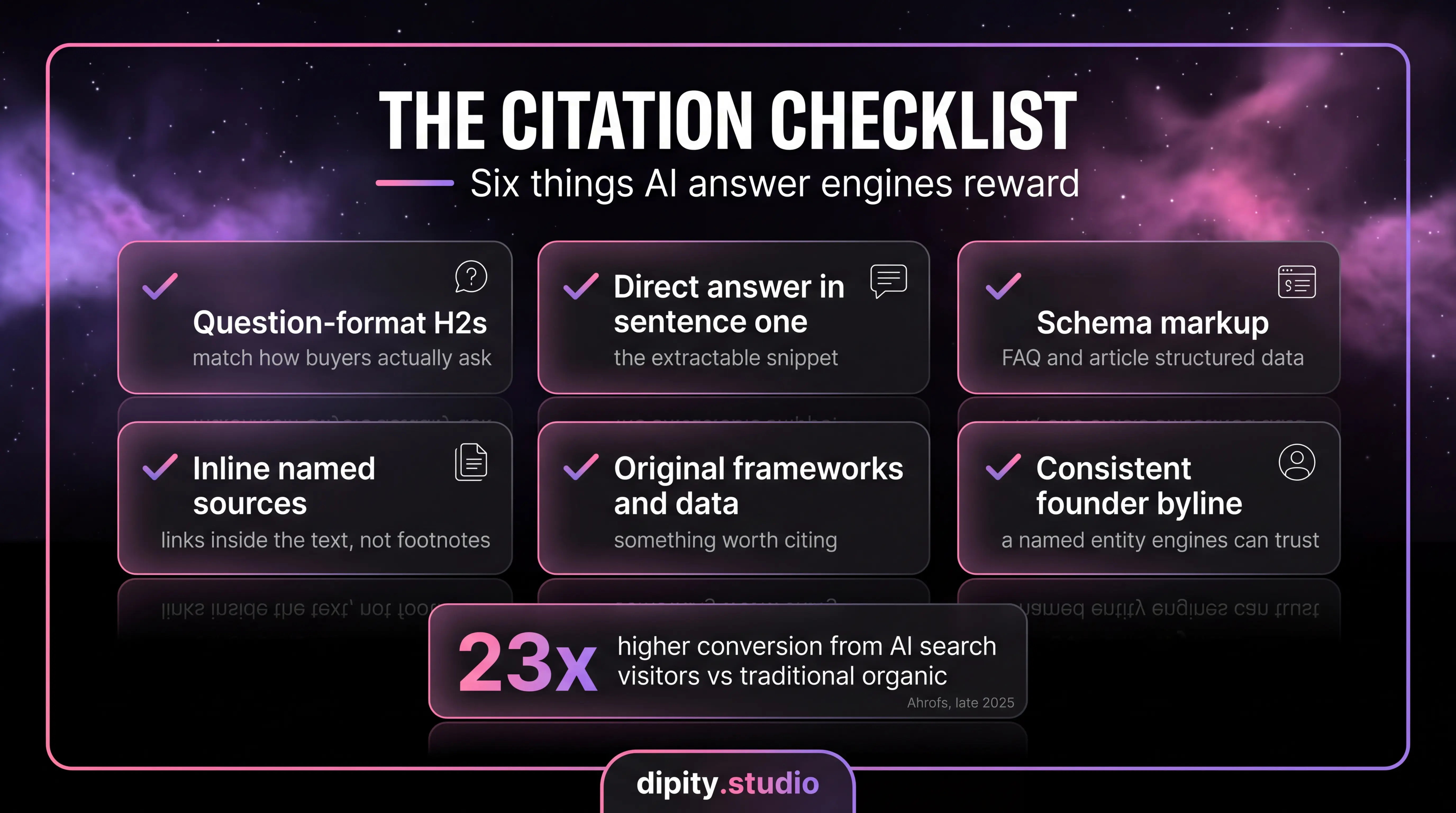
They cite sources that resolve a question completely, from entities they can verify, in structures they can parse. Answer engines assemble responses from crawled and ranked content, then attach citations to the passages doing the heaviest lifting. Three properties keep showing up in cited content: it answers a specific question directly rather than gesturing at it, it comes from a named author or organization with a consistent footprint, and it's structured so a machine can lift the answer cleanly, headings phrased as questions, first-paragraph answers, schema markup underneath.
The scale of the referee makes the patterns worth respecting. ChatGPT reached 800 million weekly active users by October 2025, Perplexity was processing roughly 780 million queries a month by mid-2025, and Google's AI Overviews appeared on 82% of B2B technology queries by February 2026, up from 36% a year earlier per BrightEdge's tracking. Forrester reports 89% of B2B buyers use generative AI for self-guided research. The answer layer is not a channel anymore. It's the lobby every buyer walks through. For the full picture of the shift, see how AI is changing search for B2B SaaS.
What Content Structure Earns Citations?
The direct-answer block: a question-phrased heading followed immediately by a complete, self-contained answer. This is the single highest-leverage AEO structure, and it's the same methodology running through every post on this blog. The engine's extraction job is trivially easy when your first paragraph under each H2 answers the H2, and trivially hard when the answer is smeared across twelve paragraphs of wind-up.
✦ Hold long-form depth: 1,800 to 2,300 words. Thin pages rarely earn citations; bloated ones dilute the extractable signal.
✦ Ship schema, Article at minimum, FAQPage for closing Q&A blocks, so the structure is machine-declared, not inferred.
✦ Cite primary sources inline. Engines weight content that itself cites well; sourced claims survive both the algorithm's screen and the
✦ Include original data, frameworks, or named experience. Engines deduplicate generic content; they cite what exists nowhere else.
Why Does Founder Attribution Matter to Machines?
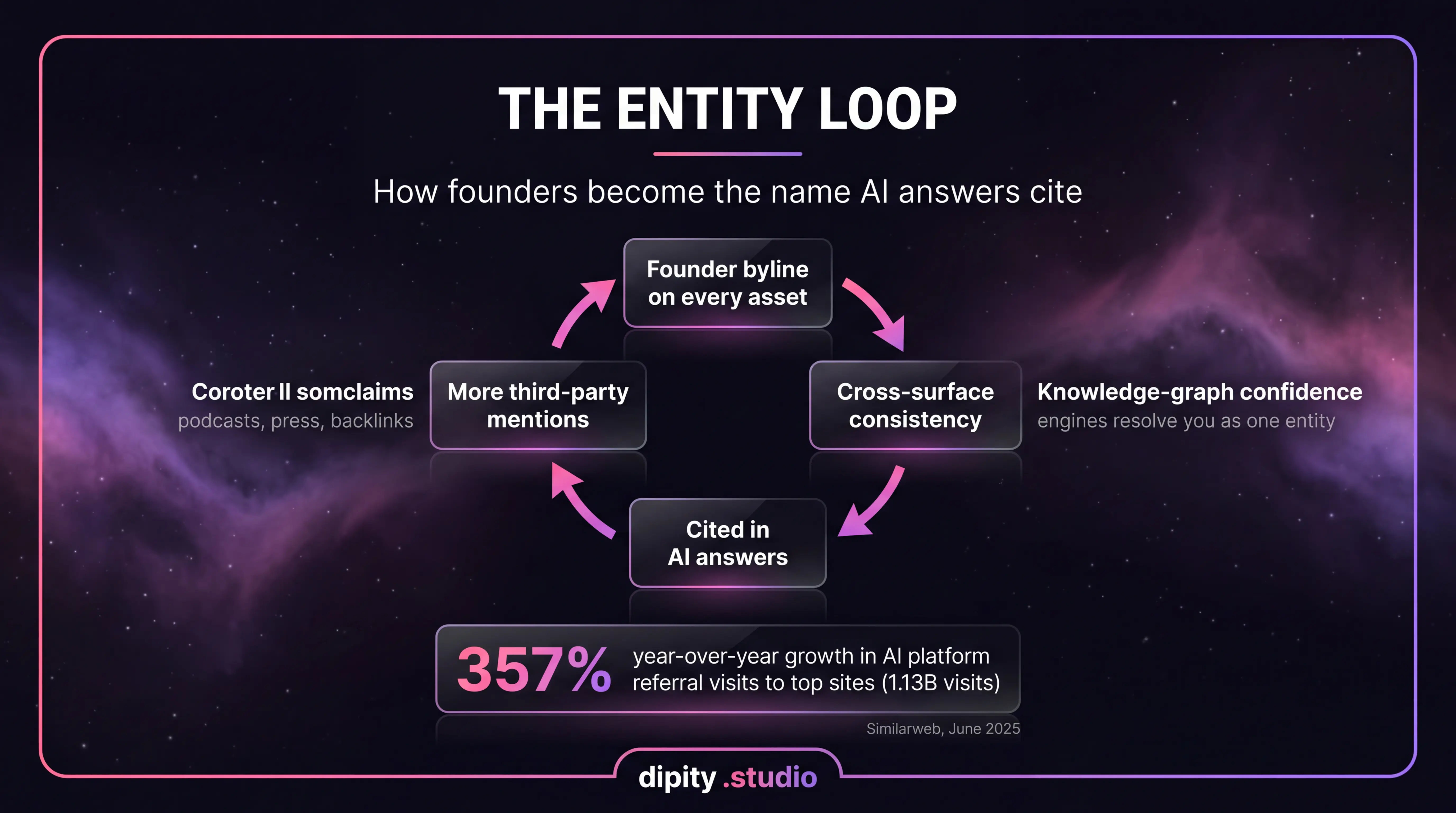
Because engines resolve entities, and a named founder with a consistent cross-surface footprint is a high-confidence entity in a way an anonymous brand blog never becomes. When the same name recurs across a blog, LinkedIn, podcasts, and third-party coverage, all saying compatible things about the same topics, the knowledge graph consolidates it into an authority on those topics. Queries in that territory then resolve toward the entity. This is the machine-side mirror of the human trust research: the 2024 Edelman-LinkedIn report found 73% of decision-makers trust thought leadership over marketing material as a capability signal, and thought leadership is, definitionally, attributed.
The practical move is to stop publishing as a logo. Byline the founder, keep the voice consistent, interlink the founder's surfaces, and let every third-party mention reinforce the same entity. Attribution is not vanity. It's how the graph decides who gets to be the answer.
What's the Topical Authority Play, and How Much Volume Does It Take?
Cover a territory so completely the engines treat you as its reference, which takes density, not luck. Single great posts get cited occasionally; owned territories get cited habitually. The motion Morgan Von Druitt ran before founding Dipity made the case at scale: 500+ structured blogs in six months around one category and its adjacent questions took the domain from zero to roughly 87,000 monthly visitors in 90 days, and made the site the default citation for the category's vocabulary, including long-tail queries we never explicitly targeted. The volume logic is the same one behind the category creation primer.
Volume alone isn't the lesson; architected volume is. Every piece answered a distinct question in the cluster, linked into the pillar, and carried the same entity attribution. For a Series A team, the same architecture at smaller scale, one deep question-structured post a week, tightly clustered, founder-bylined, builds citable territory in a niche within two quarters. The engines reward completeness within a scope more than raw page count across scopes.
What Doesn't Work, and What Gets You Ignored?
Everything that worked on 2015 Google and nothing that respects the reader. Keyword-stuffed pages, AI-generated slop with no attribution or original substance, fake "studies" with no methodology, parasite SEO on rented domains, and prompt-injection tricks embedded in pages all fail the same way: engines deduplicate, discount unverifiable entities, and increasingly filter low-provenance content. Worse than failing, some of it poisons the entity you're trying to build; a founder whose footprint includes junk teaches the graph exactly that.
The honest arbitrage is that substance is currently underpriced. Per Ahrefs' own funnel data, AI-search visitors were 0.5% of traffic but 12.1% of signups, a 23x conversion premium, and Semrush's 500-topic study found AI-sourced traffic converting at 4.4x traditional organic. Buyers arriving from citations arrive pre-convinced. You don't need tricks to win a channel where the referee prefers exactly the content you should be making anyway.
How Do You Measure AI Citation Progress?
Run a monthly citation audit, and track AI-sourced conversions separately from organic. The audit is manual and cheap: take your ten highest-intent category queries, run them through ChatGPT, Perplexity, Gemini, and Google with AI Overviews, and log who gets named, you, a competitor, or nobody. Month over month, that log is your visibility trendline on the surfaces that matter. On the analytics side, segment AI referral traffic and measure conversion rate against organic; expect the Ahrefs-style pattern, low volume, disproportionate signups, and defend the budget accordingly. Pair the tracking with the AI search visibility decision guide for the tool-by-tool version.
Leading indicators come first: branded queries ticking up, "heard about you from ChatGPT" appearing in discovery calls, your phrasing echoed in AI answers before your name is. Log those too. The channel compounds ahead of its own analytics.
Book a demo with Morgan Von Druitt and we'll show you who owns your category's answers today.
.svg)


Get weekly updates
*We’ll never share your details.
Follow us — @Dipity











Join Our Newsletter
Get a weekly selection of curated articles from our editorial team.