

When Should a Startup Coin a New Term vs. Compete in an Existing Category?
Coining a term is a bet. Competing in an existing category is a different bet. Here's how to decide which one fits your stage.

When Should a Startup Coin a New Term vs. Compete in an Existing Category?
Coining a term and competing in an existing category are both bets, and founders keep placing the wrong one because nobody handed them the decision framework. At Dipity, we build AI Envoys, a class of agent Dipity and founder Morgan Von Druitt pioneered, context-saturated agents like Sera who can run the publishing motion either bet requires, and we've operated on both sides: inside a company that coined its term, and alongside founders who won by dominating language that already existed. This is the honest comparison, including the moment that tells you your coined term is working.
What Does Coining a New Term Actually Buy You?
Ownership of the evaluation criteria, pricing power, and a narrative premium, if the market adopts the term. When buyers use your vocabulary, competitors get measured on a rubric you wrote, journalists cite you as the origin, and investors price you as a category definer rather than a participant. HBR's research frames the ceiling: category creators capture the dominant share of their category's value, and the strategic lineage back to Blue Ocean Strategy is the same idea: uncontested space beats contested space, when you actually reach it.
The price is market education, paid in advance and in full. Nobody searches a term that doesn't exist, so early demand capture is zero while you fund the teaching. The bet's payoff structure is venture-shaped: quarters of investment, a real chance the term never sticks, and an outsized prize when it does.
What Does Competing in an Existing Category Buy You?
Immediate demand, faster feedback, and cheaper distribution, at the cost of a permanent comparison. Existing categories come with buyers already searching, budgets already allocated, and evaluation criteria already understood; your job shrinks to positioning, occupying the most defensible corner of a frame the market already trusts. April Dunford's positioning discipline is the canonical playbook here, and it wins fast when your differentiation is real inside the current rules.
The tax is that incumbents write those rules. You'll be compared on their criteria, feature-matrixed against their strengths, and priced against their anchor. Per Forbes' category analysis, the companies that dominate platform shifts are disproportionately the ones that owned new language, but the survivors' graveyard is full of category creators too. Competing is the lower-variance bet: smaller ceiling, much higher floor.
What Signals Say You Should Coin the Term?
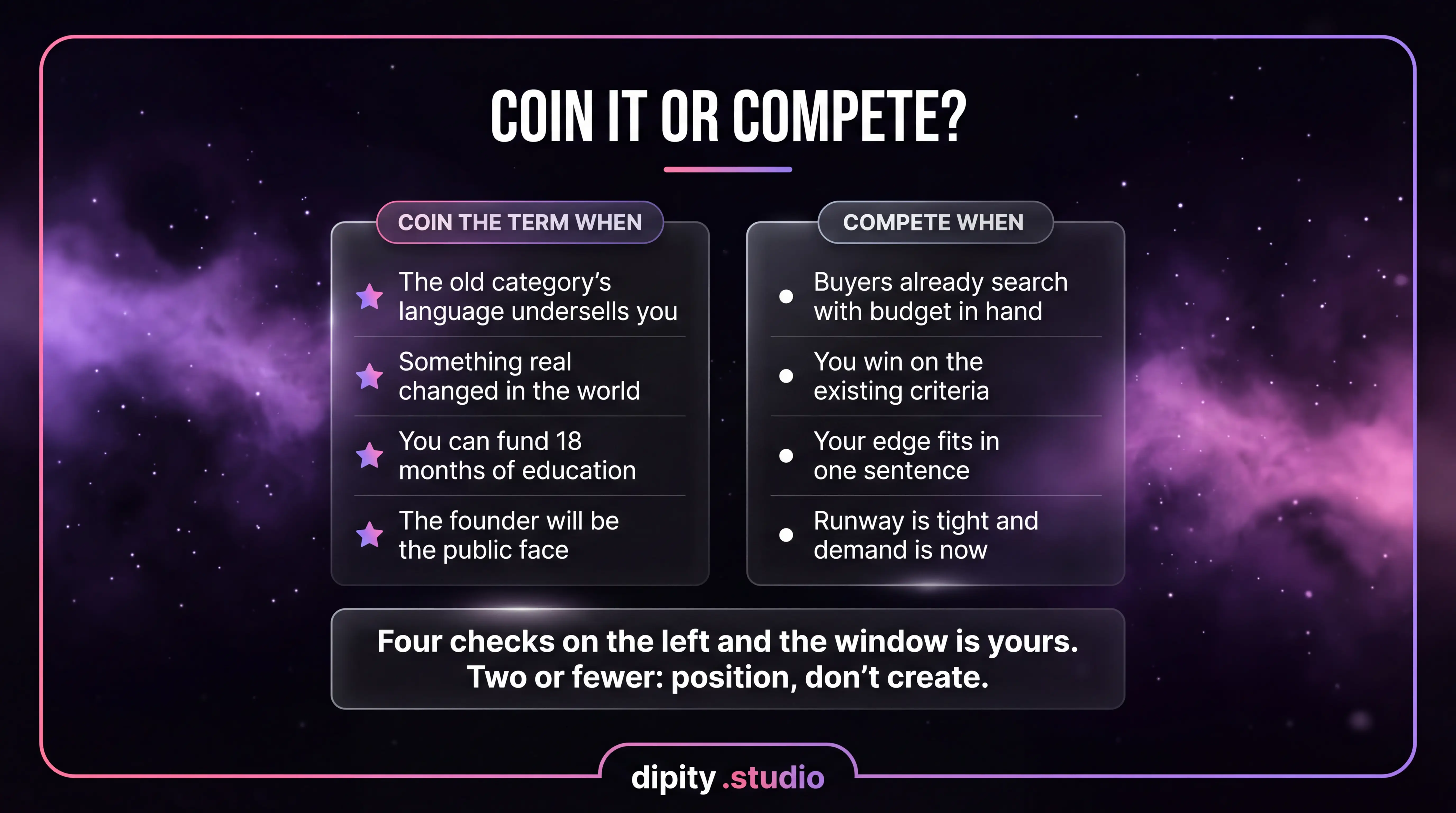
✦ Describing your product in the incumbent category's language makes it sound worse than it is; the frame itself is your enemy.
✦ Something real changed in the world, a technology shift, a buyer-behavior shift, that the current category predates and can't absorb.
✦ Your buyers describe their problem in phrases no existing category names; you'd be labeling recognized pain, not inventing it.
✦ You have runway and stomach for 18 months of publishing before the market claps; the AI valuation premium data shows what definers earn, but only after the education phase.
✦ The founder will show up publicly. Coined terms spread through evangelism, and evangelism has a face.
Score yourself honestly. Four or five checks and the window is yours. Two or fewer and you're about to fund a vocabulary lesson the market didn't order.
What Signals Say You Should Compete Instead?
✦ Buyers already search your solution class with budget attached; demand exists and waiting out an education phase burns it.
✦ You genuinely win on the category's current evaluation criteria; the frame flatters you.
✦ Your differentiation is legible in one sentence inside existing vocabulary.
✦ Runway is tight. Positioning pays this quarter; category creation pays in later rounds.
✦ The category leader is complacent, and per Edelman-LinkedIn's research, 70% of C-suite buyers have questioned an existing supplier after consuming a challenger's thought leadership. Displacement inside a category is a real, measurable motion.
Competing is not settling. Most category kings started as the sharpest positioner in someone else's category and coined their term after earning the audience to teach it to. Sequencing is allowed.
How Did the Coined-Term Bet Play Out in Practice?
The tell arrived in the search console, not the press. Inside the AI decision-intelligence company where Morgan Von Druitt ran this motion, the team published relentlessly around a trademarked term nobody searched, 500+ structured posts in six months, and the validation moment was the coined term starting to rank for adjacent AI long-tail queries we'd never targeted. The engines had fused our invented vocabulary to the established questions around it. From there the flywheel ran: category-level media coverage, including Forbes writing about the term by name, inbound using our language, and a narrative investors could repeat. The full motion is documented in the 500-blog framework.
The transferable lesson is what validated the bet: not the trademark, not the manifesto, but machine-confirmed association between the new term and existing buyer language. In the AI-search era that signal arrives earlier and matters more, because the answer layer, now covering 82% of B2B tech queries per BrightEdge's tracking, decides which vocabulary gets repeated to every future buyer who asks.
What's the Decision Framework in One Pass?
Ask three questions in order. First, does the existing frame help or hurt you? If describing yourself in current vocabulary undersells the product, the frame hurts, and coining moves up. Second, can you fund the education phase, in cash and founder attention, for 18 months? If not, compete now and revisit after the next round. Third, will the founder be the public face of the thesis? A no here vetoes coining regardless of the other answers, because unattended categories don't propagate.
Hybrid sequencing is the underused answer: position sharply inside the existing category to capture demand today, while the founder publishes the succession thesis that seeds tomorrow's term. The demand pays the bills; the thesis builds the option. When the adjacent-long-tail signal shows up, you exercise it. For the succession framing itself, see how to create a category before incumbents steal it; for the foundations, the category creation primer.

Frequently Asked Questions
Can a company do both at once?
Yes, deliberately: compete for existing demand at the product layer while the founder publishes the category thesis at the narrative layer. Keep the vocabularies distinct so buyers are never confused about what to type into a search box.
How long before a coined term shows traction?
With real publishing volume, expect the adjacent-long-tail ranking signal inside 6 to 12 months, and unprompted market usage in 18 to 24. Silence for the first two quarters is normal, which is exactly why underfunded coining attempts die.
What's the biggest coining mistake?
Naming before thesis. A term without an argument underneath it is jargon, and the market ignores jargon. The durable sequence is thesis, then name, then saturation.
Does the founder personally matter to this decision?
Decisively. Coined terms travel on founder evangelism; anonymous category creation almost never lands. If the founder won't be visible, compete.
Placing the bet either way? Book a demo with Morgan Von Druitt and see how one interview a month funds whichever publishing motion you choose.
.svg)


Get weekly updates
*We’ll never share your details.
Follow us — @Dipity











Join Our Newsletter
Get a weekly selection of curated articles from our editorial team.