
How Is AI Changing Search for B2B SaaS Companies?
AI search referrals grew over 10x in 8 months. B2B SaaS founders who ignore this shift lose pipeline they never knew existed.

How Is AI Changing Search for B2B SaaS Companies?
What Actually Changed in Search?
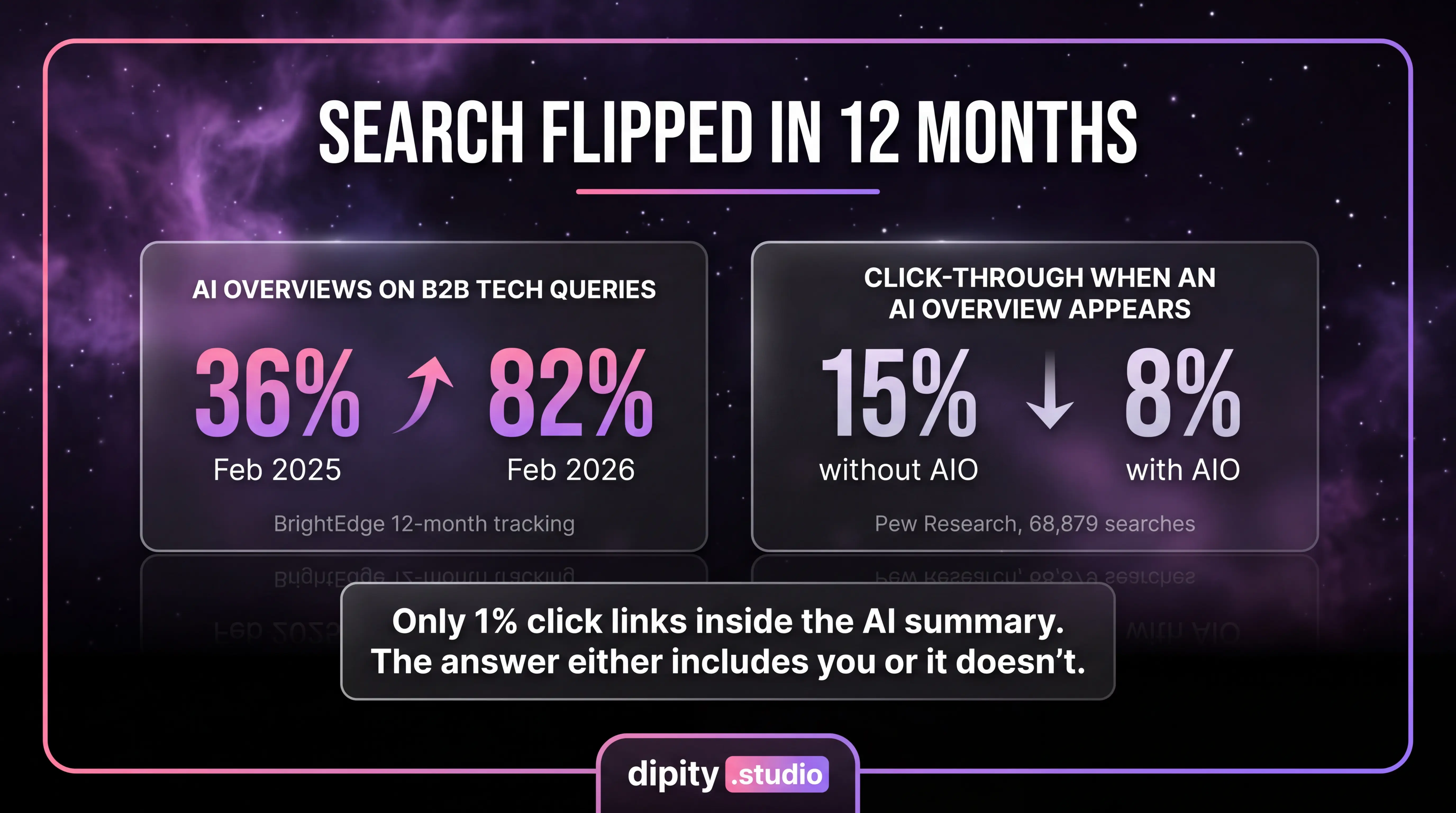
The answer layer took over the results page. Google AI Overviews appeared on 36% of B2B technology queries in February 2025; by February 2026, BrightEdge's twelve-month tracking put the figure at 82%. In one year, the default experience for a B2B buyer researching your category went from ten blue links to a synthesized answer with a handful of citations, and everything about how you earn attention changed with it.
The click data tells the story from the user's side. Pew Research Center's panel study of 900 US adults across 68,879 searches, covered in detail by Search Engine Land, found click-through drops to 8% when an AI Overview appears, against 15% without one, a 47% decline. Only 1% of users click links inside the AI summary itself. The old contract, rank well and collect traffic, has been renegotiated without your signature.
Where Did the Clicks Go, and Should You Panic?
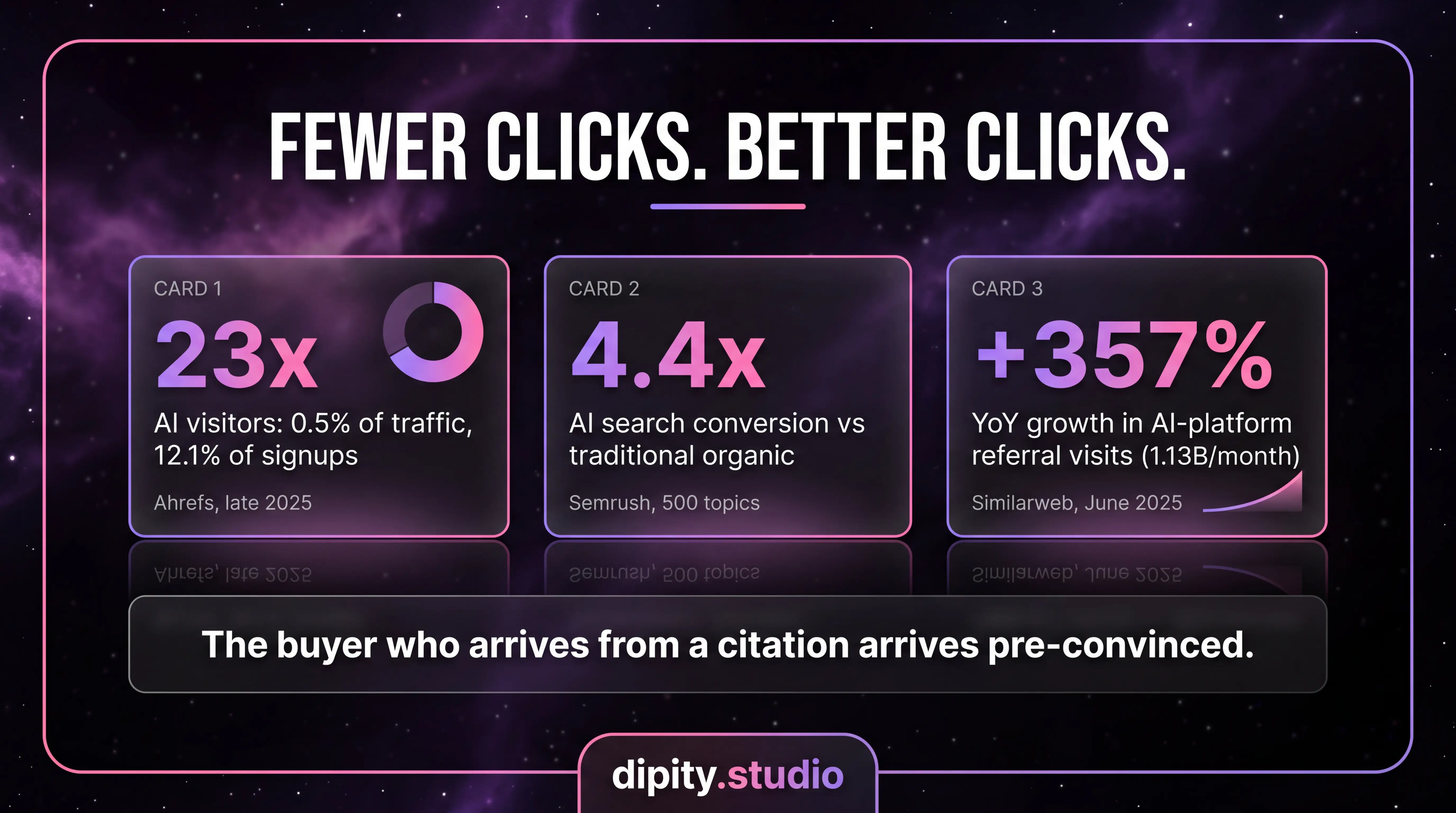
The clicks went into the answer, and no, but only if you understand what replaced them. Fewer visits are arriving, and the visits arriving are worth several times more. Ahrefs ran the numbers on their own funnel in late 2025: AI search visitors were 0.5% of total traffic but 12.1% of signups, a 23x conversion lift over traditional organic. Semrush's study across 500 high-value topics found AI search traffic converting at 4.4x traditional organic. Similarweb measured 1.13 billion referral visits from AI platforms to the top 1,000 sites in June 2025, up 357% year over year.
✦ AI Overviews on B2B tech queries: 36% in Feb 2025 → 82% in Feb 2026 (BrightEdge).
✦ CTR with an AI Overview present: 8% vs 15% without, per Pew's 68,879-search panel.
✦ AI visitors: 0.5% of traffic, 12.1% of signups at Ahrefs, a 23x conversion lift.
✦ 1.13B monthly AI-platform referral visits, up 357% YoY (Similarweb, June 2025).
The funnel changed shape. Fewer clicks, stronger clicks. The buyer who arrives from an AI answer already trusts the answer that sent them, and the vendor named in it inherits the trust. The vendor missing from it inherits nothing.
How Do B2B Buyers Research Vendors Now?
Across five surfaces, and mostly before you know they exist. Forrester reports 89% of B2B buyers have adopted generative AI as a self-guided information source across the purchase cycle, and their 2026 predictions put generative AI as a meaningful interaction in 30% of final-stage purchase decisions, ahead of analyst calls and product experts. 6sense's Buyer Experience research finds buyers fully define requirements 83% of the time before contacting a vendor, and Forrester adds 41% of buyers enter formal evaluation with a single preferred vendor already in mind.
Inside Dipity we call this the five-surface thesis. The modern B2B buyer triangulates a vendor across LinkedIn, Google and AI Overviews, podcasts, ChatGPT and Claude, and Perplexity and Gemini, and cross-references what each surface says about you. Scale makes the point on its own: ChatGPT reached 800 million weekly active users by October 2025, and Perplexity was handling roughly 780 million queries a month by May 2025. Your buyers didn't stop researching. They stopped researching where you were watching.
What Kind of Content Do AI Engines Cite?
Structured, authoritative, attributed content, and the pattern is consistent enough to build a playbook on. Answer engines preferentially cite pages organized as direct answers: question-phrased headings with self-contained answers in the first paragraph beneath them, schema markup, named authors with verifiable expertise, original data or frameworks, and citations to primary sources. They punish the opposite: generic, unattributed, keyword-stuffed content with nothing a machine or a human would quote. The full playbook is in how to get cited by ChatGPT, Perplexity, and Gemini.
Founder attribution is the underweighted variable. AI engines resolve entities, people with names, roles, and consistent footprints across surfaces, more confidently than anonymous brand blogs, and a founder whose name recurs across posts, podcasts, and cited articles becomes the citable authority for a category query. This was the mechanism behind the motion Morgan ran at an AI decision-intelligence company before founding Dipity: 500+ structured blogs in six months, zero to roughly 87,000 monthly visitors in 90 days, with the coined category term ranking across adjacent long-tail queries. The engines rewarded density, structure, and a named voice. They still do.
What Should a B2B SaaS Founder Do This Quarter?
Audit the five surfaces, then build the citation footprint on the two you can move fastest. Run your own category queries through ChatGPT, Perplexity, and Google with AI Overviews on, and record whether you, your competitors, or nobody gets named. Most founders discover a competitor owns the answer layer for a category they believe they lead. That audit takes an afternoon and reframes the entire content budget; the full tooling rundown is in the AI search visibility decision guide.
✦ Restructure your highest-intent pages into question-first sections with direct answers, schema, and named authorship.
✦ Publish weekly long-form content in the 1,800 to 2,300 word range; thinner pages rarely earn citations.
✦ Put the founder's name on the work and keep the voice consistent across surfaces; entity recognition compounds.
✦ Track AI-sourced conversions separately. Per the Ahrefs data, low volume with 23x conversion is a feature, not a bug; measure it or you'll cut the budget that's quietly filling pipeline.
The window matters more than the tactics. Answer engines are consolidating their citation habits now, and the founders establishing named-entity authority in 2026 are compounding a surface the previous cohort never had. Waiting a year doesn't cost you a year. It costs you the settling of the answer layer. The founder-visibility side of that same story starts with what founder silence actually costs.
Frequently Asked Questions
Is SEO dead for B2B SaaS?
No, it mutated. Rankings still matter because AI engines draw from ranked, crawlable content, but the output changed from a click to a citation. Optimizing for the click alone leaves you visible in a shrinking channel and invisible in the growing one.
How do I show up in ChatGPT and Perplexity answers?
Density, structure, and attribution. Publish consistently on the topics you want to be cited for, structure content as direct answers with schema, and keep a named founder attached to the work. Citation is earned through footprint, not submitted through a form.
Is AI search traffic really worth it at 0.5% of visits?
At Ahrefs that 0.5% produced 12.1% of signups. Volume metrics undervalue the channel precisely because the buyer arrives pre-convinced. Measure revenue per visit and the picture inverts.
Do AI Overviews affect brand queries too?
Increasingly, yes. When a buyer asks an assistant "is [your company] legit," the answer synthesizes whatever footprint exists. A thin footprint means the machine writes your reputation from scraps. A dense founder-attributed footprint means you wrote it yourself.
.svg)


Get weekly updates
*We’ll never share your details.
Follow us — @Dipity











Join Our Newsletter
Get a weekly selection of curated articles from our editorial team.