


What do the Founders Who Are Winning Have in Common?
Founder-led growth is the single clearest differentiator among early-stage startups competing for investor attention, talent, and pipeline. Out of 1,500 applicants to the Founder Institute's latest cohort, 50 were accepted, a 3.3% acceptance rate. Of those 50, Morgan Von Druitt and Dipity are ranked the #1 startup in the cohort. According to research from Forbes, the most successful startups have founders who are actively the face and voice of their brand.
What Does a 3.3% Acceptance Rate Tell You About the Competitive Floor?
The Founder Institute accepted 50 founders out of 1,500 applicants, and less than 40% of those accepted will graduate. The competitive floor is not your product. The competitive floor is your ability to stand out before anyone sees the product. That is the entry condition for a program designed to produce three unicorns from each cohort.
When 97% of applicants get filtered out, the surviving 3% are not differentiated by idea quality alone. They are differentiated by how they present, how they communicate, and how much signal they have already built around themselves as operators. The founders who made it through have a public record. They have a point of view. They look like someone worth betting on before anyone runs financial due diligence.
This is the part most founders skip. They treat visibility as a post-product activity, something to do after the MVP is live, after the first customers are onboarded, after the round closes. The data says the opposite. Research from Seedscope confirms that in 2026, investor evaluation starts with clarity, grit, and authenticity. Not a pitch deck.
- Acceptance rate as a proxy for signal density: When 1,500 founders compete for 50 spots, the ones who survive are the ones whose authority is visible before the interview.
- Graduation rate as a filter for consistency: Less than 40% of accepted founders graduate, which means even within the top 3.3%, the ones who keep showing up are the ones who win.
- Competitive floor is set by reputation, not features: Investors and program directors evaluate the founder first, the product second. Your profile authority is the biggest signal of your success when you're looking to raise or hire top talent.
The takeaway is blunt. If you are invisible when the selection committee Googles you, you are invisible when the investor Googles you too. Same filter, different room.
Dipity's approach to founder authority starts from this premise: the founder is the product the market evaluates first. Everything else follows.
Why Do the Top Founders Show Up Before the Meeting?
The founders in this cohort who are winning share one behavior: they build authority before the pitch, not during it. They treat every interaction, every investor meeting, every cohort session as a moment where the work was already done. The meeting is confirmation, not introduction.
This is not a personality trait. It is an operating decision. These founders decided, weeks or months before the cohort started, to build a public record of their thinking. Blog posts. LinkedIn content. X threads. Podcast appearances. By the time they showed up in the room, the people evaluating them had already formed an opinion.
Forum VC's investor meeting research reinforces this: sending materials ahead of time and building familiarity before the meeting separates founders who close from founders who chase. If an investor comes in without reading your deck, you are facing an uphill battle. But if an investor comes in already knowing your thesis because they read your last three LinkedIn posts, you are having a different conversation entirely.
The same dynamic applies inside an accelerator. When you present to a room of 50 founders, the ones who already know your name, your thesis, and your positioning are the ones who want to collaborate. The ones who have never heard of you treat you like background noise.
- Pre-meeting authority compresses the trust timeline: Instead of spending the first 15 minutes of a 30-minute meeting establishing credibility, the founder starts at "so here's what I need from you."
- Content becomes a screening mechanism: The right investors and partners self-select into your pipeline because your public content told them whether they belong there.
- Preparation is a public artifact, not a private exercise: Research from Clash breaks authority into three layers: owned content, searchable proof, and earned media. All three are visible before the meeting happens.
The founders running Sera understood this. They did not wait for the cohort to start before they started publishing. They showed up with signal already in the market.
What Does It Mean to Build Authority on the Right Channel?
Building authority on the right channel means choosing the surface where your buyers, investors, and talent spend their evaluation time, not the surface where vanity metrics are easiest to accumulate. For B2B SaaS founders, that surface is LinkedIn first, with X, blogs, and podcasts as compounding layers.
Impression farming is a surefire way to build a large audience that never wants to buy from you. The founders in this cohort who are winning are not chasing impressions. They are choosing the channel where the people who write checks, sign contracts, and accept job offers are paying attention.
CMSWire's 2026 analysis makes the distinction clear: what cuts through is not volume, it is clarity, relevance, and point of view. A founder who posts three times per week on LinkedIn with a clear thesis outperforms a founder who posts daily on Instagram with motivational quotes. The channel has to match the audience, and the content has to match the intent.
Here is the channel hierarchy that the top founders in this cohort are running:
- LinkedIn as the primary authority surface: This is where investors, partners, and enterprise buyers evaluate B2B founders. Averi's founder marketing research confirms that the most effective founders focus on 2 to 3 high-quality posts weekly rather than daily volume plays.
- Blogs as the long-form searchable layer: Blog content gets indexed by Google and cited by AI search tools like ChatGPT, Perplexity, and Gemini. This is not optional for founders who want to be found when someone searches their category.
- X as the real-time signal layer: Short-form takes, live reactions to industry news, and engagement with peers in the category.
- Podcasts as the depth layer: Long-form conversations where the founder's thinking is on display for 30 to 60 minutes. This is where trust compounds fastest, and it is the surface most founders ignore entirely.
Omnichannel presence makes the founder the inevitable choice. When a buyer sees you on LinkedIn, on X, in their podcast feed, and in search results, the question stops being "should I buy?" and becomes "when do I buy?"
The founders who picked one channel and went deep are outperforming the founders who spread thin across six channels and said nothing memorable on any of them.
How Do You Separate Signal Production from Content Production?
Signal production is the founder's job. Content production is the system's job. The founders who are winning in this cohort separated those two functions and stopped trying to do both. That is the operating decision that freed up 6 to 10 hours per week.
Here is the distinction. Signal production is the original thinking: the thesis, the contrarian take, the first-person experience, the pattern you noticed after your eighth sales call this month. Content production is the formatting, scheduling, distribution, repurposing, engagement loop, and analytics reporting that turns that signal into published assets across multiple surfaces.
Most founders try to do both. They record the thinking and then spend the next four hours turning it into a LinkedIn post, an X thread, a blog outline, and a newsletter section. By Wednesday they are exhausted and the content cadence collapses by Friday.
The founders running Sera in this cohort made a different choice. They record 10 to 30 minutes of their thinking, and Sera handles the production layer. The founder stays in the signal zone. The system handles everything downstream.
- Signal zone = founder's core competency: The founder knows the market, the customers, the product decisions, and the competitive dynamics. That knowledge is the raw material. Skyfeather Studios' research on scalable founder marketing confirms that strategy starts with diagnosis, not content production.
- Production zone = system's core competency: Formatting, voice-matching, scheduling, distribution, engagement tracking. This is where AI-native systems outperform human agencies because they hold the founder's full context without needing a biweekly interview to get caught up.
- The split eliminates the bottleneck: When the founder is both the signal source and the production engine, every competing priority (a customer call, a board meeting, a product fire) kills the content cadence. When the founder is only the signal source, the cadence survives because the production system does not have competing priorities.
Factua's 2026 analysis of first-party signal infrastructure reinforces this: your data infrastructure is the content strategy. The founders who built a system for capturing and converting their own signal outperform the founders who treat content as a separate creative exercise.
This is the split that turns a 10-hour-per-week content habit into a 30-minute recording session. The thinking does not change. The production overhead disappears.
Why Does Compounding Beat Viral Spikes Every Time?
Compounding content authority is the only durable growth lever for early-stage founders because viral spikes generate attention without trust, and attention without trust does not convert. The founders winning in this cohort are playing the compounding game, not the virality lottery.
The math is simple. A viral post gets 50,000 impressions in 48 hours and then disappears. A consistent weekly cadence of 3 posts gets 2,000 impressions per post, but after 12 weeks that founder has 36 published artifacts, a searchable body of work, and a growing network of people who recognize their name and thesis. Forbes' research on founder-led category leadership confirms it: a steady flow of high-quality content creates a flywheel effect that makes the founder's name synonymous with expertise in their category.
The viral spike is seductive because the numbers look big. But the compounding approach is what builds the infrastructure that makes fundraising, hiring, and selling easier every single month.
- Compounding builds a searchable body of work: Every post, blog, and podcast episode becomes a permanent artifact that investors, prospects, and candidates find when they search the founder's name or category. Growth loop research from The VC Corner shows that loops create defensible compounding returns where every piece of content helps generate the next interaction.
- Viral spikes create attention debt: A founder who goes viral once is expected to go viral again. When they don't, the audience perceives a decline. Compounding content never creates that expectation because the value is in the consistency, not the peak.
- Trust compounds, attention does not: Image Group's 2026 analysis makes a distinction the market often misses: the market in 2026 is sophisticated enough to distinguish between a founder who is performing authority and one who has earned it. Earned authority comes from compounding. Performed authority comes from spikes.
The founders in this cohort who are winning did not go viral. They showed up every week. They published a thesis. They engaged with their peers. They let the compounding do what compounding does, which is look boring for 90 days and then look inevitable for the next 90.
What Does Dipity's #1 Ranking in the Cohort Prove About This System?
Dipity is ranked #1 in the Founder Institute cohort, and the proof is in the operating model: a bootstrapped solo operator running the same system being sold to clients, producing results in the highest-stakes environment possible, which is the founder's own runway. This is not theory. This is boots on the ground Proof that this works.
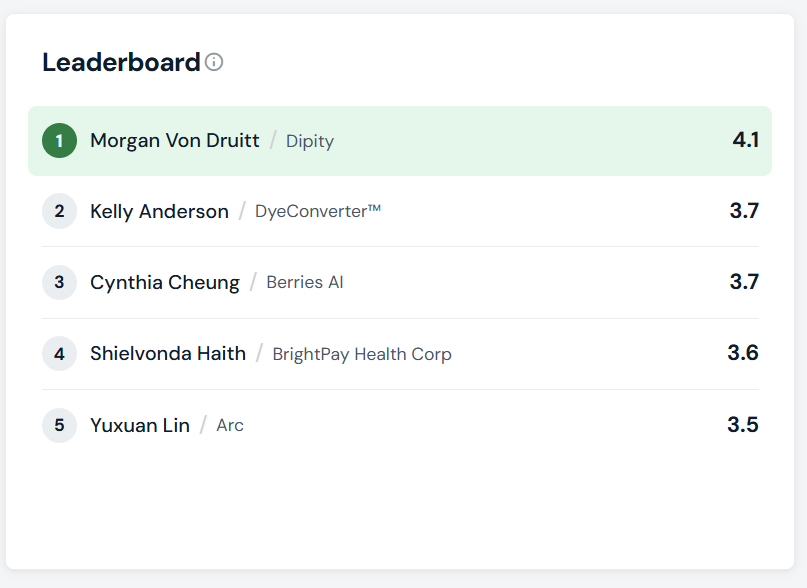
The argument for founder-led growth is easy to make from a consulting slide deck. It is harder to make when your own company's survival depends on whether the system works. Dipity is making that argument from the second position, not the first. Bootstrapped, tight runway, every dollar accounted for, and still ranked #1 in a cohort of 50 companies selected from 1,500 applicants.
That is the difference between a vendor who sells you a framework and an operator who lives inside the framework every day. The system works because it has to work. There is no safety net.
- Bootstrapped operator credibility: Dipity is not a well-funded agency with a cushion. The system that Sera runs for clients is the same system running Dipity's own growth. If the content does not produce pipeline, the company does not survive. That pressure tests every assumption.
- #1 ranking validates the thesis: When the most selective founder program in the market ranks a company #1, and that company's entire thesis is "founder authority drives everything downstream," the ranking itself becomes proof of the thesis.
"Your profile authority is the biggest signal of your success when you're looking to raise or hire top talent. The founders who understand this build the signal before they need it. The founders who don't understand it are still wondering why their inbox is quiet.", Morgan Von Druitt, Founder, Dipity
The founders running Sera are not running it because they were told to. They are running it because they watched it work in real time, on the #1 ranked startup in their own cohort.
How Do You Start Building This System Today?
You start by separating your signal from your production, choosing the right channel for your buyer, and committing to consistency over virality. The system is simple. The discipline is hard. And the cost of waiting is compounding against you every week you stay silent. Founder silence is the most expensive line item on the cap table.
If you are a funded B2B SaaS founder and your LinkedIn profile has not been updated in three months, you are losing deals you do not know you were in. Prospects are evaluating you against competitors who show up in their feed every week. Investors are Googling your name and finding nothing. Candidates are checking your profile and choosing the founder who looks like they are building something worth joining.
The founders in this Founder Institute cohort who are winning did four things:
- They showed up before the meeting, with a public body of work that preceded every pitch and every introduction.
- They built authority on the right channel, choosing LinkedIn and blogs over vanity platforms.
- They separated signal production from content production, recording their thinking in 10 to 30 minutes and letting Sera handle everything downstream.
- They compounded rather than spiked, choosing consistency over virality and letting the flywheel build over weeks and months.
The system does not require 10 hours per week. It requires 10 to 30 minutes of your thinking, recorded in your own voice, converted into a full content cadence across every surface where your buyers, investors, and future employees are paying attention.
Dipity exists to make this separation permanent. Sera holds your voice, your context, your thesis, and your positioning, and produces content that sounds like you wrote it because the signal came from you. The production came from the system.
Frequently Asked Questions
What is the Founder Institute's acceptance rate and why does it matter for founders?
The Founder Institute accepted 50 founders out of 1,500 applicants in this cohort, a 3.3% acceptance rate. Less than 40% of those accepted will graduate. This matters because the selection criteria mirror what investors evaluate: clarity of thesis, public credibility, and communication ability. Founders who pass this filter have already demonstrated the kind of authority that fundraising requires.
How do the top founders in the cohort produce content without spending 10 hours a week?
The founders running Sera separated signal production from content production. They record 10 to 30 minutes of their original thinking, and the system converts that into LinkedIn posts, X threads, blog content, and newsletter material. The founder stays in the signal zone. The system handles formatting, scheduling, and distribution. This eliminates the production bottleneck that kills most founders' content cadence by week three.
Why does compounding content authority outperform viral posts for B2B founders?
Viral posts generate attention without trust. A single viral post gets high impressions for 48 hours and then disappears. Compounding content builds a searchable, permanent body of work that investors, prospects, and candidates find when they search the founder's name or category. Trust compounds over time. Attention does not. After 12 to 16 weeks of consistent publishing, the compounding founder's cumulative authority surpasses the viral founder's peak.
What does Dipity's #1 ranking in the Founder Institute cohort mean for potential clients?
It means the system is pressure-tested in the highest-stakes environment: the founder's own runway. Dipity is bootstrapped and running the same Sera system being sold to clients. If the content does not produce pipeline, the company does not survive. The #1 ranking in a cohort selected from 1,500 applicants validates that founder authority, built through consistent content, is the differentiator, not product features or funding size.
Works Cited
Averi. (2025, October). How to run founder-led marketing for startups
Clash. (2026, June). How to build authority as a founder: The credibility stack
CMSWire. (2026, February). Signal vs. noise: Why content marketing must say less and mean more
Factua. (2026, March). Your data infrastructure is the content strategy: Why first-party signals beat original thinking alone
Forbes. (2025, March). Founder-led growth: Building category leadership and lasting trust
Forbes. (2025, April). Founder-led marketing: Your secret weapon for startup success in 2025
Forum VC. (n.d.). How to nail your first meeting with a potential investor
Image Group. (2026, April). The business asset that determines everything
Seedscope. (2025, December). What investors want in 2026: The new rules for startup success
Skyfeather Studios. (2026, June). Founder-led marketing strategy that scales
The Founder Institute. (n.d.). Core program
The VC Corner. (2025, July). Growth loop playbook: Top startups
Buyer Stage: MOFU
.svg)


Get weekly updates
*We’ll never share your details.
Follow us — @Dipity











Join Our Newsletter
Get a weekly selection of curated articles from our editorial team.