

How Does CEO Reputation Affect Startup Valuation?
CEO reputation accounts for 44% of company valuation. Here's how funded SaaS founders turn that into a fundraising advantage.

How Does CEO Reputation Affect Startup Valuation?
Your valuation is a story with numbers attached, and a measurable share of the story is you. At Dipity, we build AI Envoys, a class of agent Dipity and founder Morgan Von Druitt pioneered, context-saturated agents like Sera who turn a founder's thinking into the public reputation investors end up pricing, and the pricing is not a metaphor. The research puts hard percentages on CEO reputation's share of company value, and the venture data shows narrative premiums paid in real term sheets. Here's the evidence, the live math, and how founders convert it before the next round.
How Much of Company Value Is Reputation?
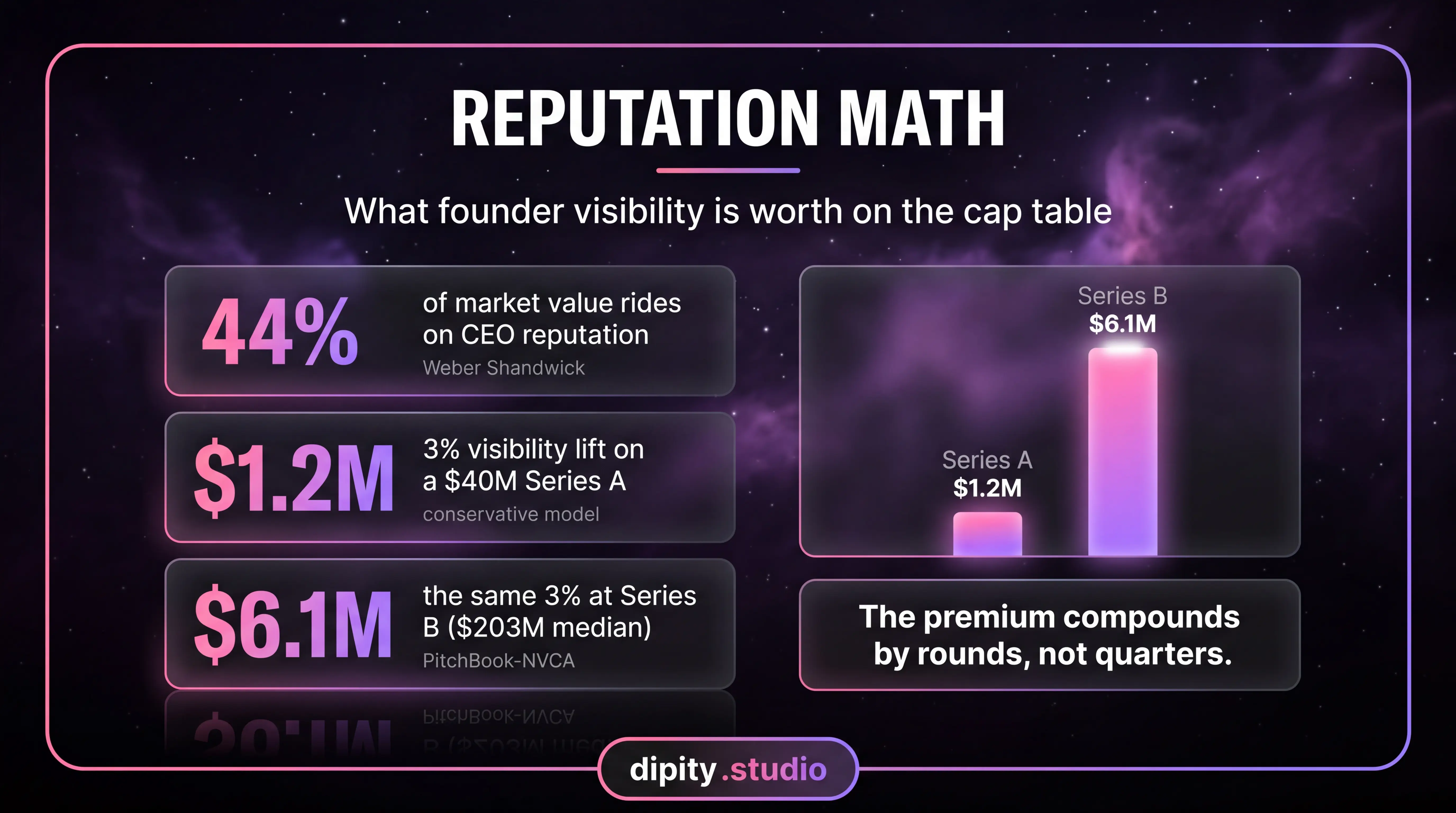
The benchmark figure is 44%. Weber Shandwick's CEO Reputation Premium study, surveying 1,700 senior executives across 19 countries, found executives attribute 44% of their company's market value to the reputation of the CEO. Their follow-up research raised the stakes: 63% of market value attributed to overall corporate reputation, with the CEO's share of that reputation rising over time. These are executive-attributed figures rather than regression coefficients, and they've held up as the anchor numbers in reputation research for a decade because every subsequent study lands directionally in the same place.
For a startup the mechanism is more direct than for the Fortune 500. A seed or Series A company has little revenue history and few hard assets; the valuation is substantially a bet on the founder's judgment, market read, and ability to attract talent and capital. Reputation isn't a halo on the asset. At early stage, it's most of the asset.
How Does Reputation Actually Reach the Cap Table?
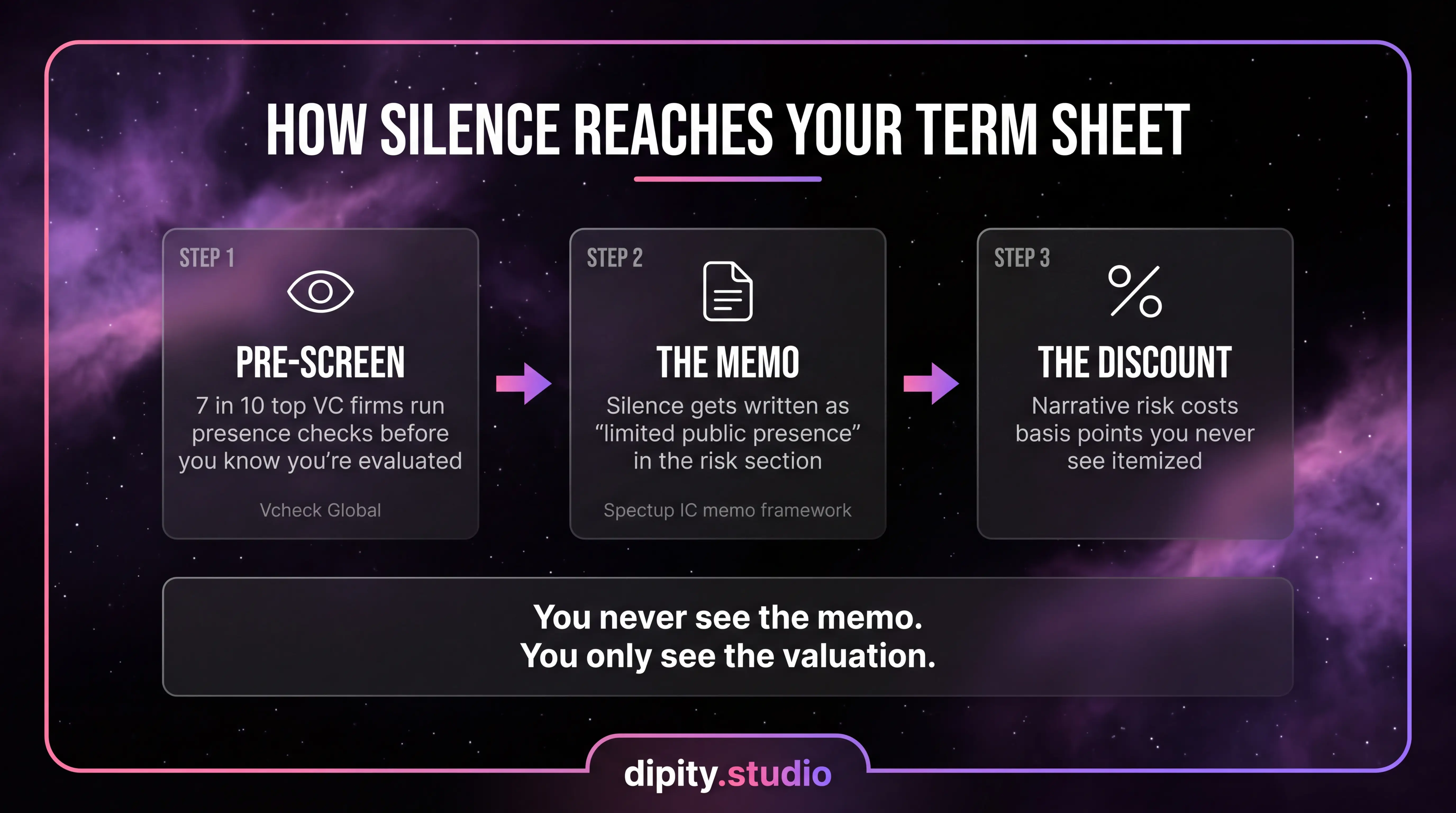
Through diligence that happens before you know you're in it. Per Vcheck Global, 7 out of 10 top-performing VC firms run deep-dive background and social presence checks as standard practice, and SignalX's due-diligence research shows investor evaluation starts at pre-screening, when high-level signals, founder background, market narrative, early traction, decide whether the conversation continues. Your LinkedIn, your published thinking, and your presence in AI-generated answers are all inputs to that screen.
What the screen finds gets written down. Spectup's anatomy of the VC investment memo shows every deal carries a risk section, and founders with no public narrative earn entries like "limited public presence" or "unclear distribution capability", language that costs basis points in the negotiation even when the deal proceeds. Reputation reaches the cap table as a discount you never see itemized. The full cost breakdown of founder silence runs deeper than the raise alone.
What's the Live Math on a Real Raise?
Run the conservative model on your own numbers. Take a $40M post-money Series A. Assume founder visibility moves the valuation by just 3%, far below the 44% attribution in the reputation research, and modest against observed narrative premiums. That's $1.2M of enterprise value, attached to whether the founder is publicly legible. Carry it forward: at the Series B median pre-money of $203M in the PitchBook-NVCA Venture Monitor, the same 3% is $6.1M.
✦ $40M × 3% = $1.2M at Series A. $203M × 3% = $6.1M at Series B.
✦ Category narrative premiums are visible in market data: AI-category Series A pre-money at $78.0M vs $42.4M non-AI, an 84% gap (PitchBook-NVCA), corroborated across stages by Carta.
✦ The founder's time cost to defend the 3%: roughly 90 minutes a week under a systematized publishing motion.
The 84% AI premium deserves a beat of attention. It doesn't attach to model weights; it attaches to companies investors believe are defining a category, and category belief is manufactured in public, by a founder with a thesis, over quarters. The premium is the market paying for narrative. The question is whose.
Why Do Investors Price Narrative at All?
Because narrative predicts the things investors can't yet measure: distribution instinct, talent gravity, and the next round's ease. The 2024 Edelman-LinkedIn B2B Thought Leadership Impact Report found 75% of decision-makers researched a product they weren't considering because thought leadership surfaced it, and 60% of buyers will pay a premium to work with organizations articulating a clear vision; investors read those same signals as evidence the founder can generate demand without buying every dollar of it. On the talent side, LinkedIn Talent Solutions reports 62% of job seekers research companies on social media before applying, meaning the founder's footprint pre-filters the hiring funnel too.
There's also a defensive read. Forrester finds 41% of B2B buyers enter evaluations with a preferred vendor already chosen, and the preference forms during self-guided research. An investor pricing your company is pricing its odds of being that pre-chosen vendor, and the visible founder is the leading indicator they can check from their desk.
How Do You Build the Reputation Premium Deliberately?
Morgan Von Druitt's instruction is to treat it as an 18-month compounding program that ends at your next raise, not a sprint that starts when the deck does. The sequence that works: publish the category thesis first, the single asset diligence checks, buyers cite, and journalists quote. Hold a weekly cadence across the surfaces where evaluation happens, LinkedIn plus a question-structured blog at minimum, expanding toward podcasts and the AI-answer layer, where Ahrefs' data shows visitors converting at 23x their traffic share. Keep the voice verifiably yours; ghostwritten conviction reads as neither. The founder-led growth playbook lays out the full 13-week arc.
Then instrument it like the financial asset it is: citation presence on category queries, inbound that references your thinking, and the qualitative tell that the premium is forming, investors repeating your language back to you in first meetings. When your vocabulary shows up in their questions, the narrative is doing the negotiating before you enter the room. Some founders take it further and treat visibility as an obligation to the company; that's the fiduciary case for founder authority.
Frequently Asked Questions
Is the 44% figure causal?
It's executive attribution, not regression, and honest usage says so. The direction is corroborated across a decade of reputation research and visible in venture premiums; the precise coefficient matters less than the materiality it establishes.
Does founder reputation matter more at early or late stage?
Earlier. With thin operating history, the founder is the majority of the investable story; by Series C, systems and metrics dilute the founder's share. The compounding, though, rewards starting early.
Can strong metrics substitute for founder visibility?
Metrics get you evaluated; narrative gets you preferred. With 41% of buyers and many investors forming preference pre-conversation, invisible founders enter every process from behind, whatever the dashboard says.
How long before reputation work shows up in a raise?
Two to three quarters of consistent publishing typically produces the leading indicators, citations, inbound, vocabulary echo. Starting 30 days before the raise is too late; the diligence snapshot is already taken.
Want your reputation math run on your actual round size?
Book a demo with Morgan Von Druitt and we'll price the silence together.

.svg)


Get weekly updates
*We’ll never share your details.
Follow us — @Dipity











Join Our Newsletter
Get a weekly selection of curated articles from our editorial team.