

How Do You Create a New Category as an AI-Native Startup Before Incumbents Steal It?
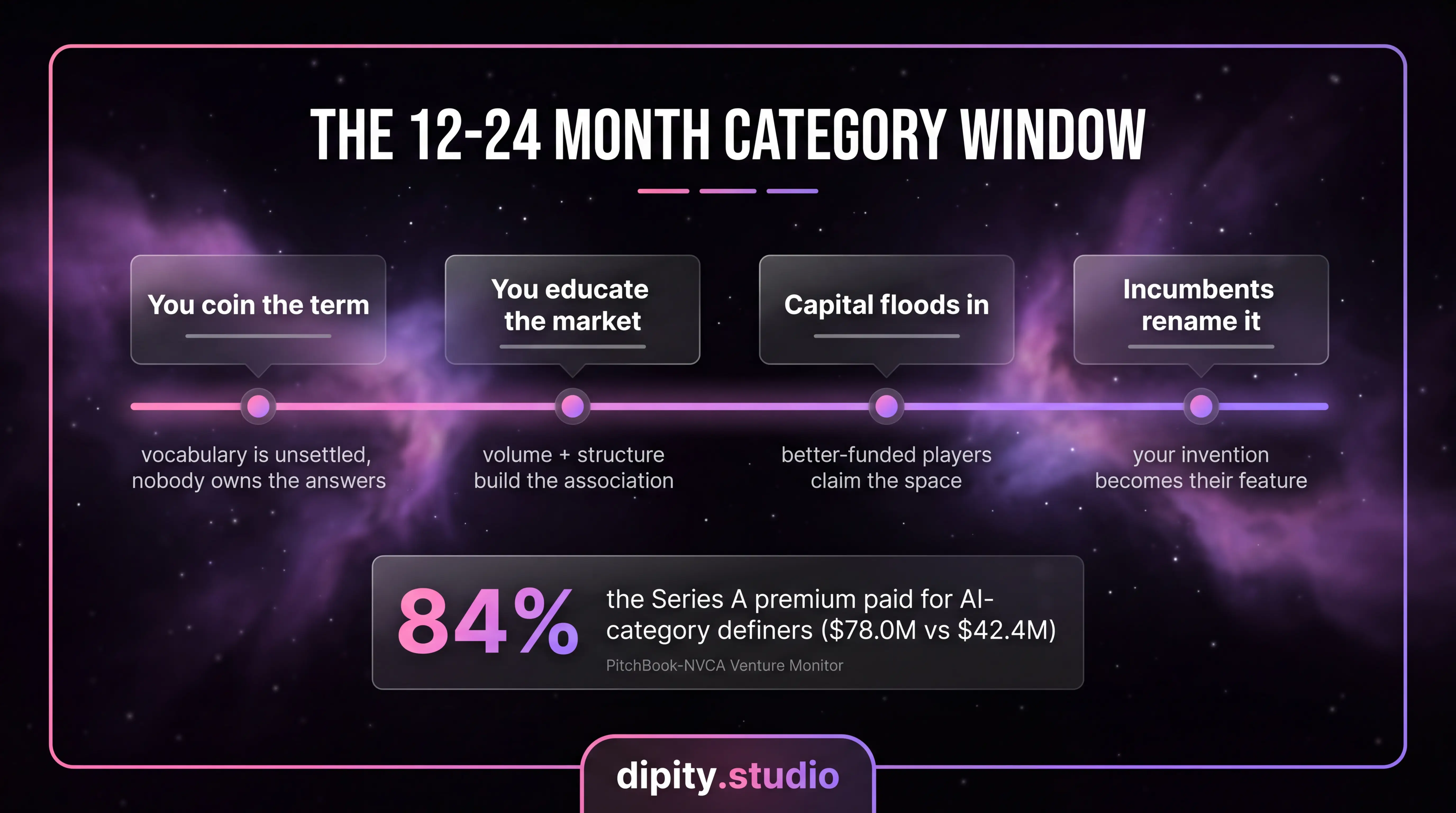
You have 12–24 months before incumbents flood your category with capital and call your invention their feature. Move now.

How Do You Create a New Category as an AI-Native Startup Before Incumbents Steal It?
Every AI-native founder is racing a clock most of them haven't noticed: the 12 to 24 months before incumbents flood the space with capital and rename your invention as their feature. At Dipity, we build AI Envoys, the agent class founder Morgan Von Druitt coined and pioneered, context-saturated agents like Sera who produce the publishing volume category creation demands, because we ran this exact race inside an AI decision intelligence org and watched a coined term become a market before the giants arrived. Here's the motion, the sequencing, and the parts founders consistently get wrong.
Why Is the Category Window Only 12 to 24 Months?
Because capital follows clarity, and the moment your category proves demand, better-funded players will claim its vocabulary. The pattern repeats every platform shift: a startup names a new problem, educates the market at its own expense, and then watches an incumbent bolt the language onto a feature announcement backed by a marketing budget the startup will never match. Your protection window is the period when you're the only one publishing the thesis, and the market's mental model of the category is still soft.
The prize data explains why the race is worth running anyway. The PitchBook-NVCA Venture Monitor put median Series A AI pre-money at $78.0M against $42.4M for non-AI peers, an 84% premium, and Carta's data shows the AI premium widening with stage. Those premiums concentrate on companies investors credit with defining a space. HBR's research makes the general case: category creators capture the dominant share of their category's value. The window is short because the prize is real.
What Is Category Succession, and Why Does It Beat Category War?
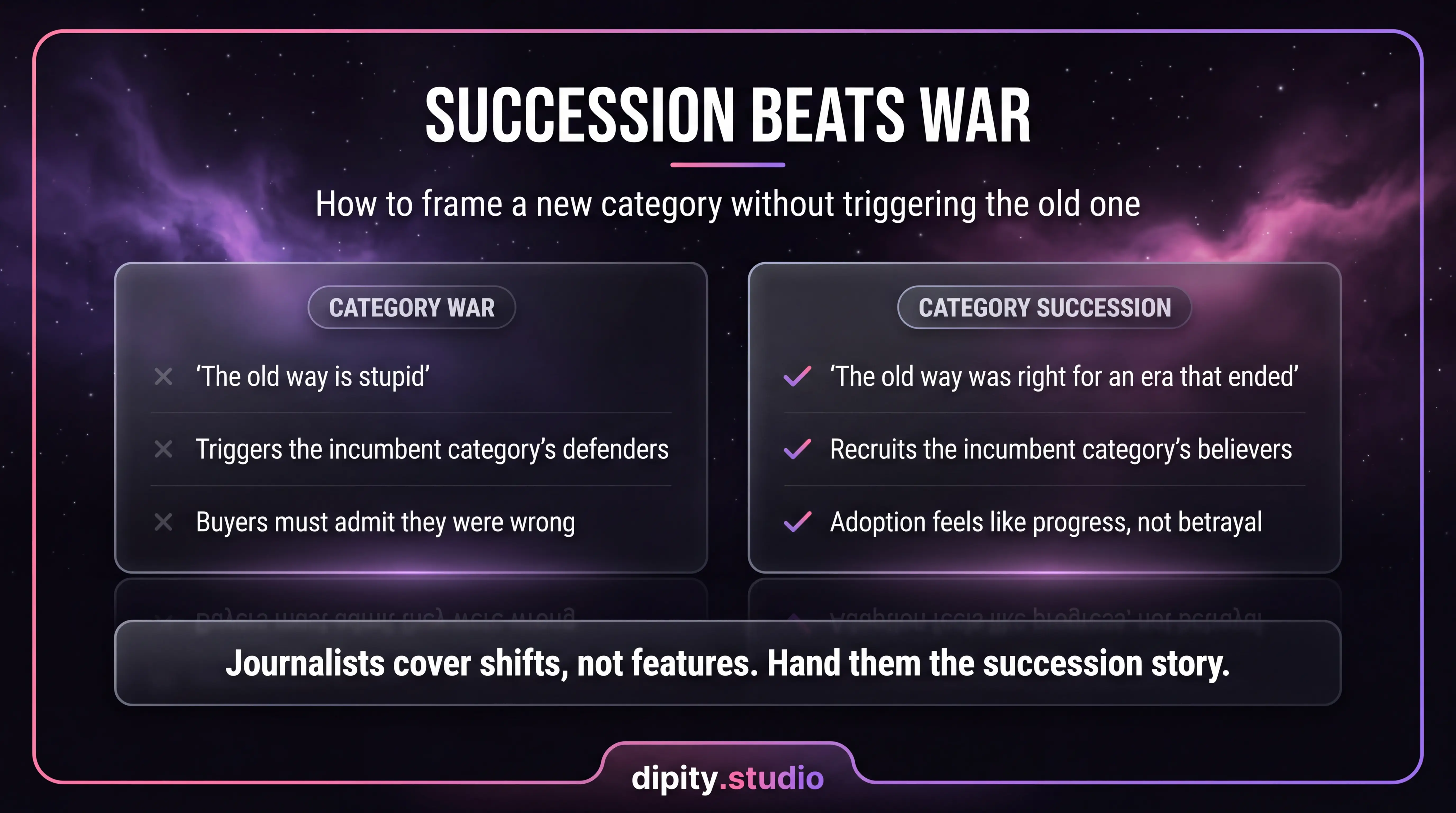
Category succession is positioning your new category as the natural next chapter of an existing one, rather than declaring war on the incumbent frame. Telling the market its current category is stupid triggers defense; telling it the current category was right for its era and the era just ended recruits believers. The succession story gives buyers a graceful way to adopt your language: they weren't wrong before, the world changed, and your term names what comes next.
This is also the framing journalists reward. Tier-1 media doesn't cover features and rarely covers "better"; it covers shifts. As Forbes' analysis of category creation notes, durable category stories are built on a change in the world, not a change in a product. Succession framing hands the press its own headline: the old way is ending, here's the name for what replaces it, and here's the founder who saw it first.
How Do You Find and Validate the Category Term?
Derive it from the thesis, then validate it against the long-tail. The strongest category names fall out of a sharp articulation of what changed and what the new solution class must do; they describe the buyer's problem in language the buyer instantly recognizes, and they leave room for an ecosystem to exist inside them. Naming before thesis produces jargon. Thesis before naming produces vocabulary.
Validation is where the AI-search era changed the playbook. When we ran this motion at an AI decision-intelligence company, the tell wasn't the trademark, it was the moment the coined term began ranking for adjacent AI long-tail queries we'd never explicitly targeted. Search engines had connected our term to the established vocabulary around it, which meant the knowledge graph now considered the term a real entity in the space. That's the modern validation signal: not "do people search the term yet" but "do the engines associate your term with the queries your buyers already run."
What Publishing Architecture Does a New Category Need?
Saturation with structure: a pillar essay carrying the full thesis, and a cluster architecture answering every adjacent question in the market's existing language. One manifesto convinces nobody; the market adopts vocabulary it encounters everywhere it looks. The motion Morgan Von Druitt ran produced 500+ blogs in six months, grew organic traffic from zero to roughly 87,000 monthly visitors in 90 days without ad spend, and earned tier-1 coverage including Forbes writing about the category by name. Volume built the association; structure made it machine-readable. The full architecture is broken down in the 500-blog framework.
✦ One pillar essay owns the thesis: what changed, why the old class fails, what the new class must do.
✦ Clusters answer adjacent questions in the buyer's current vocabulary, bridging their language to yours.
✦ Every piece is question-structured with direct answers and schema, because the citation layer now decides who defines terms; AI Overviews appeared on 82% of B2B tech queries by February 2026, up from 36% a year prior (BrightEdge).
✦ The founder's name rides every asset. Categories get evangelized by people; entity recognition compounds to the named human.
Publishing volume without this structure is noise. Structure without volume is a whisper. The category goes to whoever sustains both.
How Do You Defend the Category When Incumbents Arrive?
By owning the evaluation criteria before they show up, and welcoming them when they do. An incumbent adopting your vocabulary is late-stage validation; buyers now ask "who invented this," and the publishing trail answers. Your defense assets are the ones volume built: the ranking footprint for the term and its long-tails, the founder's name fused to the category in the knowledge graph, and the buyer-education content, frameworks, maturity models, how-to-evaluate guides, that quietly scores every vendor on criteria you wrote.
The criteria layer is the underrated moat. When your content taught the market what "good" looks like, the incumbent's feature launch gets measured against your rubric, and rubrics are hard to dislodge; they live in buyers' heads and procurement docs, not on your website. Combine it with succession framing and the incumbent's entry reads as confirmation of your thesis rather than competition for it. That's the end state worth racing for: a market where even your competitors' announcements market your category. If you're still deciding whether the race is yours to run, start with the category creation primer and the coin-vs-compete decision framework.
Frequently Asked Questions
How much content does category creation actually require?
Enough for saturation in your niche, which varies with its breadth. The motion described here used 500+ posts in six months for a broad horizontal category; a narrow vertical category has a lower saturation threshold. The constant is cadence: weekly minimum, sustained for quarters.
Should we trademark the category term?
Protect the asset if you want the option, but adoption creates the category, not the filing. Some of the strongest categories are unowned phrases; the winner is whoever the market and the machines associate with the idea.
What if an incumbent starts using our term?
Celebrate publicly, then out-teach them. Their adoption validates the category, and your publishing trail plus founder attribution keeps you the cited origin. The risk isn't theft; it's being out-published in your own vocabulary.
Can we create a category without a visible founder?
Rarely. Categories spread through evangelism, and evangelism needs a face. A logo asserting a new market reads as marketing; a founder arguing a thesis reads as conviction.
Racing your own 24-month window? Book a demo with Morgan Von Druitt and see how Sera transforms interviews into category-defining content.
.svg)


Get weekly updates
*We’ll never share your details.
Follow us — @Dipity











Join Our Newsletter
Get a weekly selection of curated articles from our editorial team.