

What Did 24 Founders Teach Me About Why CEOs Don't Post?
I pitched to 50 founders building companies in real time. Every one of them had the same content bottleneck. Here's what I saw.

What Did 24 Founders Teach Me About Why CEOs Don't Post?
I spent a Founder Institute cohort pitching alongside 50 founders who were building companies in real time, and every single one of them had the same bottleneck I'd built Dipity to solve. At Dipity, we build AI Envoys, the agent class founder Morgan Von Druitt named and pioneered, context-saturated agents like Sera who turn founder thinking into founder-voice content, so I walked into the room assuming I'd have to explain the problem. I didn't. The room explained it to me, in more detail than any market research could have. This is what those working founders taught me about why CEOs don't post.
What Happened When I Pitched a Room Full of My Exact ICP?
Something rare in early-stage sales: total problem recognition. Founder Institute puts you in front of founders at the most honest stage of company-building, pre-polish, mid-struggle, everything on the line. When I described the founder who knows visibility matters, believes in it, and still hasn't posted in four months, heads nodded around the room. Not politely. Personally. Every founder in the room was my ICP, and the lesson I took wasn't about my pitch, it was about the shape of the problem.
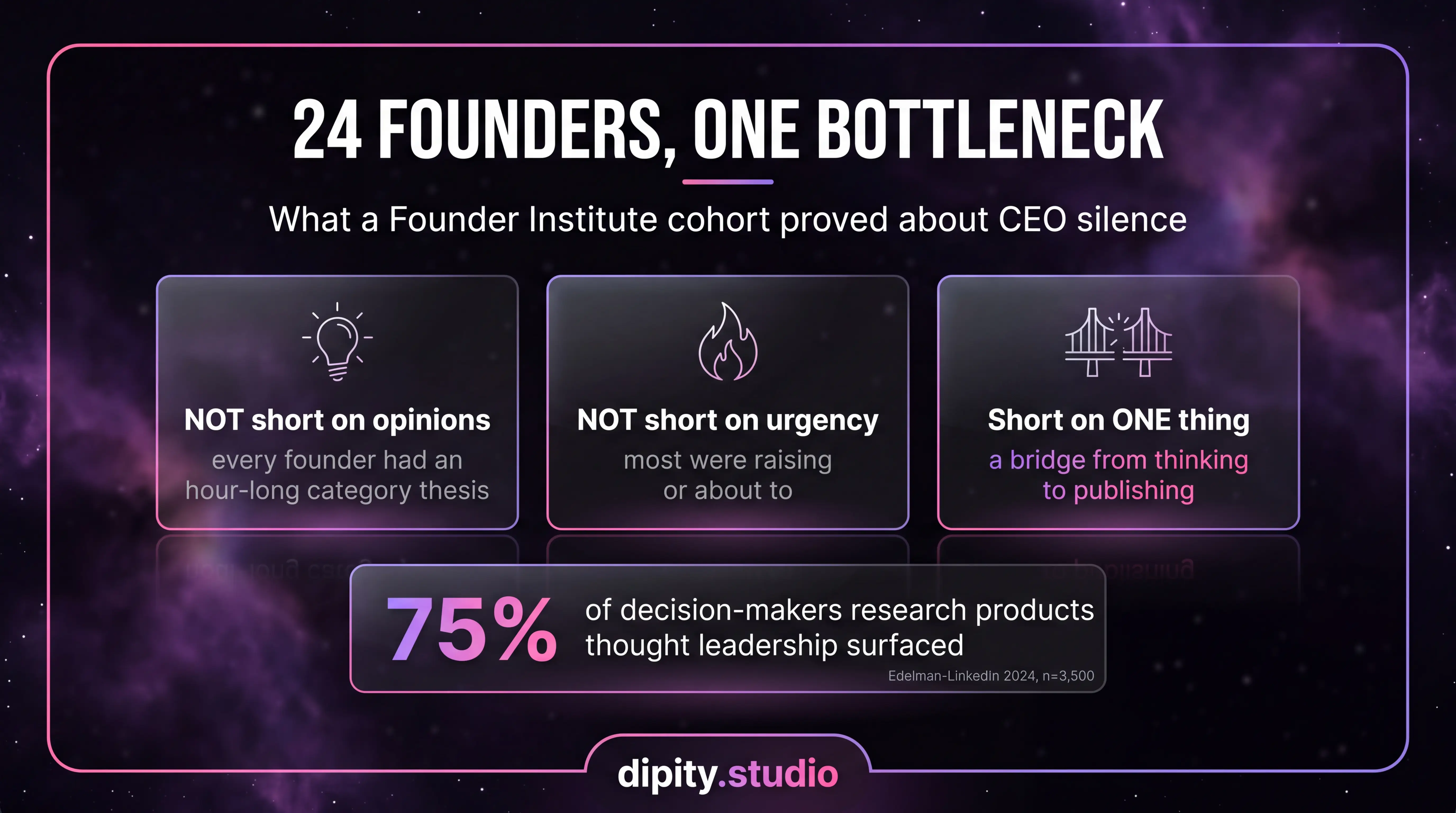
What made it striking is what these founders were not short on. They weren't short on opinions; every one of them had a category thesis they could argue for an hour. They weren't short on urgency; most were raising or preparing to. They were short on exactly one thing: a bridge between what they knew and what the market could see. That gap is the business Dipity is in, and I've never had it demonstrated 24 times in one room before.
Is the Real Bottleneck Time, Fear, or Something Else?
It presents as time, occasionally as fear, and it's structurally neither: it's a missing production system. Time was the reason every founder gave first, and the math behind it is legitimate; the manual version of founder content costs eight to twelve hours a week, and a pre-seed founder doesn't have them. A few named the deeper flinch, the discomfort of being publicly wrong before the product proves them right. But when I asked what they'd do if publishing cost 90 minutes a week instead of ten hours, the objections dissolved in real time. Nobody defends silence at 90 minutes. The 90-minute system is exactly that reframe, operationalized.
The research says the bottleneck is worth breaking regardless of which form it takes. Per the 2024 Edelman-LinkedIn B2B Thought Leadership Impact Report, 75% of decision-makers have researched a product they weren't considering because a piece of thought leadership put it on their radar. The founders in the room weren't debating whether visibility works. They were rationing it against a labor cost nobody told them was optional.
Why Is "I'll Post After We Ship" Backwards?
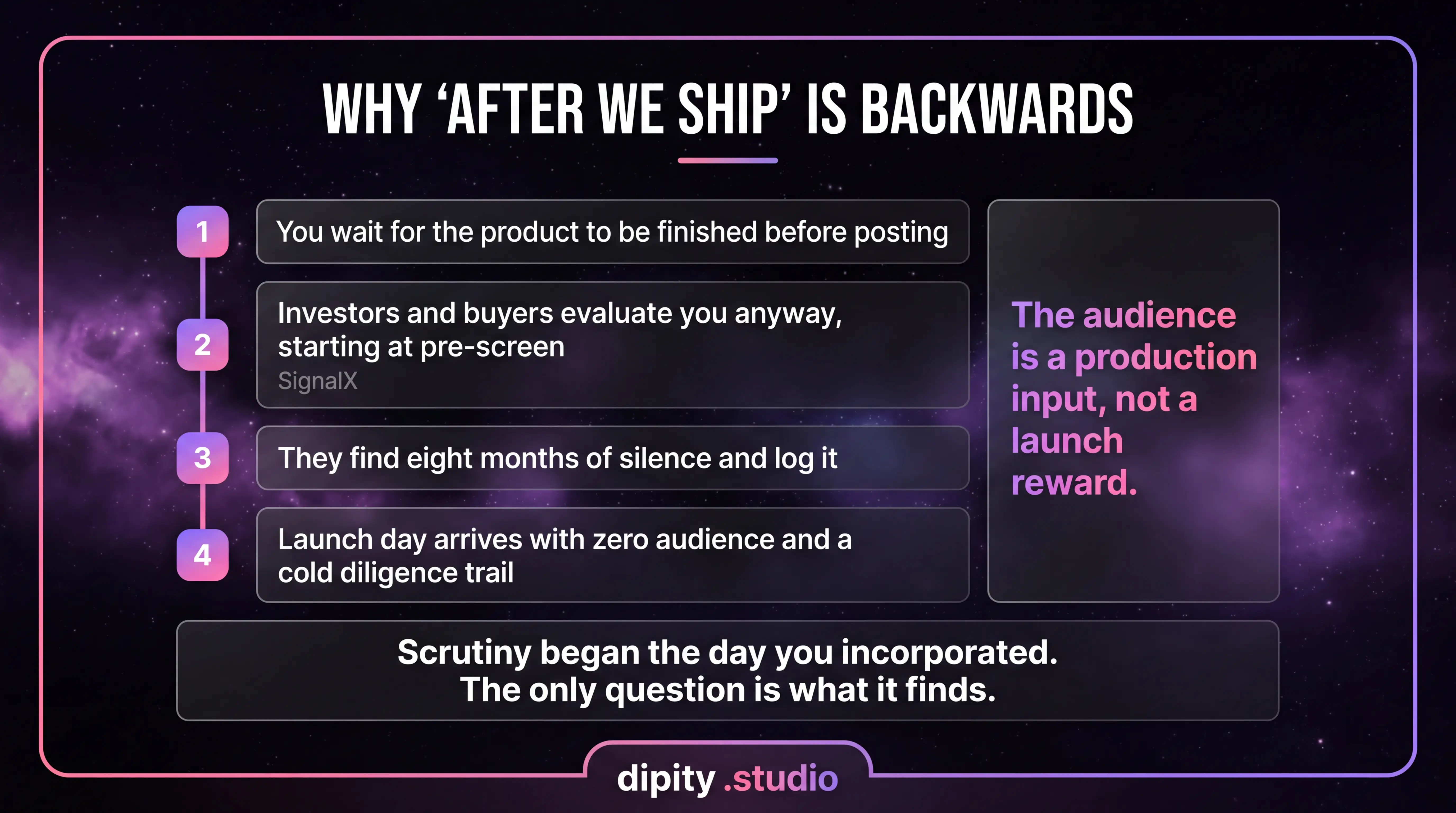
Because the audience is a production input, not a launch reward. The belief shift I watched happen inside the cohort, in others and honestly in myself, is that selling starts before the product is finished. The founders making the fastest progress weren't waiting for permission from a finished build; they were pitching, pre-selling, and publishing their thesis while the product was still wet. The ones waiting for "done" were accumulating silence that reads, from the outside, exactly like death.
The diligence data makes waiting actively expensive. Seven out of ten top-performing VC firms run deep-dive background and social presence checks as standard practice, per Vcheck Global, and SignalX's research shows evaluation begins at pre-screening, long before a formal process starts. Ship day is not when scrutiny begins. Scrutiny began the day you incorporated; the only question is what it finds.
What Does the Data Say These Founders Are Leaving on the Table?
A measurable share of valuation, receptiveness, and trust. Weber Shandwick's CEO Reputation Premium research, 1,700 executives across 19 countries, attributes 44% of company market value to CEO reputation. Roughly 90% of decision-makers say they're more receptive to outreach from companies producing strong thought leadership, and 73% treat thought leadership as a more trustworthy capability signal than marketing materials, per Edelman-LinkedIn. The full valuation mechanics are in how CEO reputation affects startup valuation.
✦ 24 founders, one bottleneck: production capacity, not conviction.
✦ 44% of market value rides on the CEO's reputation, and silence builds none of it.
✦ 7 in 10 top VC firms check your public presence before you know you're being evaluated.
✦ 75% of buyers discover vendors through thought leadership they weren't searching for.
Read that list the way an investor would. The cost of not posting never appears on a burn report, which is exactly why it compounds unchallenged.
What Did I Change at Dipity Because of That Room?
Two things: I stopped explaining the problem and started proving the system, and I rebuilt the offer around the objection I actually heard. Nobody in that room needed the "founder visibility matters" lecture; the market has internalized it. What they needed was proof the workload could collapse from ten hours to ninety minutes without the output sounding like a robot wearing their name. So the demo became the pitch: record ten minutes of founder thinking, show the week of content it becomes, let the voice fidelity make the argument.
The second change was conviction about who this is for. Watching 24 companies form in real time confirmed the pattern the Carta pre-seed data implies at scale: tens of thousands of newly funded founders enter this exact window every year, each with a thesis worth publishing and no system to publish it. The bottleneck is universal. The founders who break it first inherit the category conversations the silent ones forfeit.
How Should a Founder Start Posting This Week?
Record the rant you already give privately. Every founder in that cohort had a ten-minute answer to "what does everyone get wrong about your market?" delivered fluently over coffee. That rant is the first week of content; it needs a microphone, not a copywriter. Publish the thesis before it feels ready, hold a cadence smaller than you think you need but never zero, and let a system carry everything downstream of your voice.
The unfair advantage of starting now is contrast. Most of your competitors are exactly where that room was: convinced, capable, and silent. Per Edelman-LinkedIn, 70% of C-suite buyers have questioned an existing supplier after consuming a competitor's thought leadership. Someone in your category is going to be the voice the other 23 wish they'd been. The seat is open.
The pattern Morgan Von Druitt took away from those 24 pitches was consistent: the bottleneck is never conviction, it is a production system that survives a busy week.
Frequently Asked Questions
What is Founder Institute?
A global pre-seed accelerator where founders build and validate companies in a structured cohort. Its value for this story: it concentrates the exact founder profile, early, technical, time-poor, conviction-rich, into one room.
Isn't it smarter to focus entirely on product before marketing?
Product focus and public presence aren't in conflict; the founder builds while a system publishes. Waiting means your diligence footprint and buyer research trail both stay empty exactly when investors and early customers check them.
What should a pre-launch founder even post about?
The problem, not the product: your category thesis, what the incumbents get wrong, what you're learning building in the space. Pre-launch content builds the audience the launch will need.
How do I know if my content bottleneck is production or conviction?
Answer one question: if publishing cost 90 minutes a week, would you do it? A yes means the bottleneck is production, and production is solvable this month.
Want the 90-minute version of founder-led content? Book a demo with Morgan Von Druitt and see the bridge those founders were missing.
.svg)


Get weekly updates
*We’ll never share your details.
Follow us — @Dipity











Join Our Newsletter
Get a weekly selection of curated articles from our editorial team.