
What Is the Founder-Led Growth Playbook That Takes You From Zero Authority to Inevitable Choice?
A step-by-step system for funded B2B SaaS founders who need pipeline, talent, and investor attention from their own content.

What Is the Founder-Led Growth Playbook That Takes You From Zero Authority to Inevitable Choice?
Authority works like a lighthouse: it doesn't chase ships, it makes itself impossible to navigate around. At Dipity, founder Morgan Von Druitt pioneered the AI Envoy, a new class of context-saturated agents like Sera who run the production side of exactly that motion, and this post is the full playbook we run, from a founder with zero public authority to the vendor buyers arrive already preferring. It's a system with phases, ratios, and a scorecard, not a posting habit. Here's the whole thing.
What Outcome Is the Playbook Built For?
Becoming the inevitable choice: the founder buyers, candidates, and investors have already encountered, trusted, and shortlisted before any conversation starts. The behavioral basis is measured: 6sense finds buyers define requirements 83% of the time before contacting a vendor, and Forrester reports 41% enter formal evaluation with a preferred vendor already chosen. The playbook's job is making you that pre-chosen vendor across every surface the research happens on.
Draw the contrast sharply: this is authority building, not impression farming. Impression farming optimizes for reach and engagement spikes, follower counts that photograph well and convert nothing. Authority optimizes for the moment a real buyer, with budget, asks a real question and your name is the answer. Per the 2024 Edelman-LinkedIn report, 75% of decision-makers research products thought leadership surfaced, and 60% pay premiums to vendors with articulated vision. Farm impressions and you harvest applause. Build authority and you harvest pipeline.
What Is the Authority Equation?
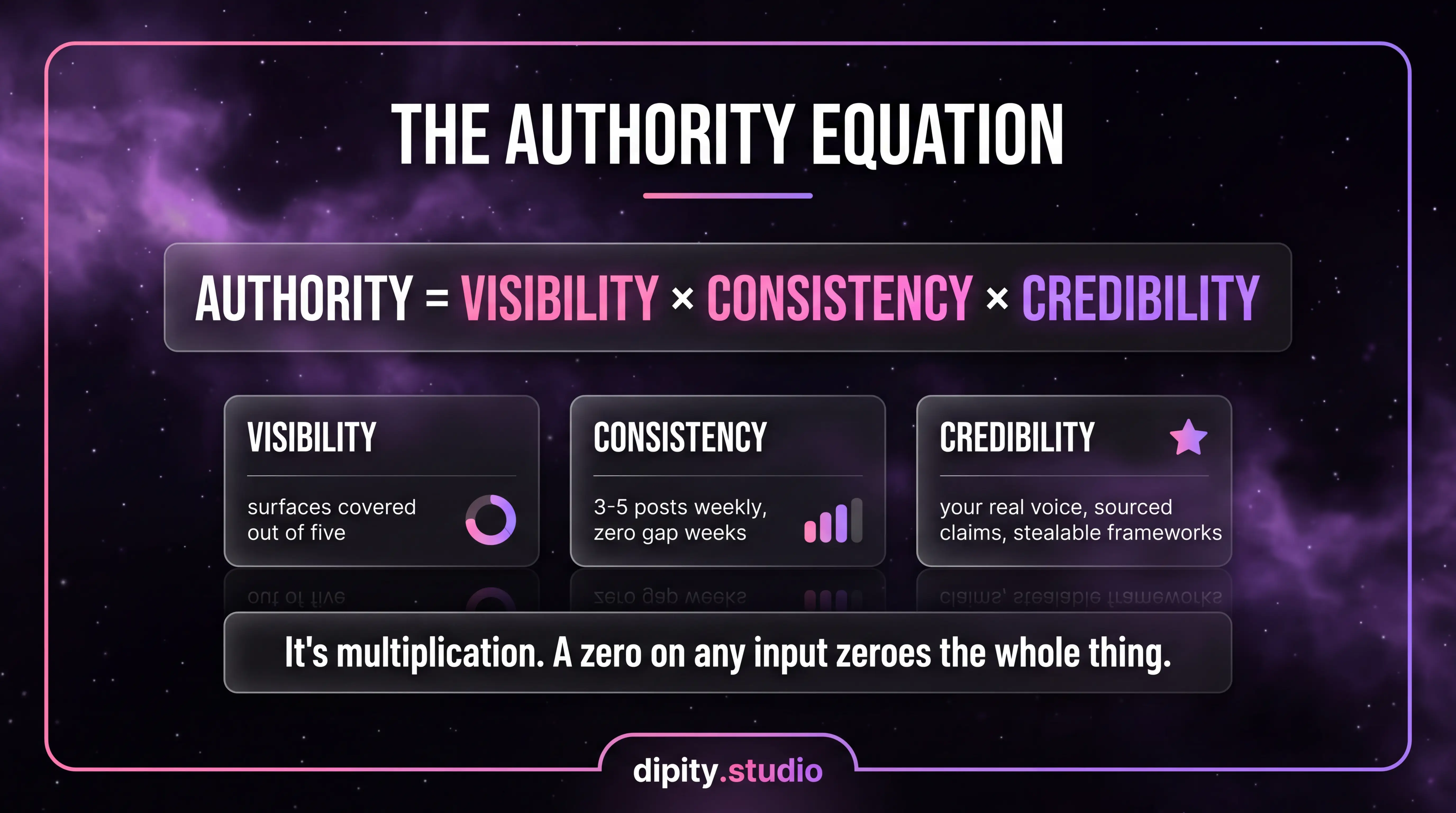
Authority = Visibility × Consistency × Credibility, and the multiplication is the point: a zero on any input zeros the whole. Visibility is surface coverage, how many of the five buyer-research surfaces you're present on. Consistency is cadence the algorithm and the human both reward, posts per week and unbroken weeks. Credibility is whether the content carries your real voice, sourced facts, and frameworks worth stealing. A founder posting brilliantly once a quarter zeros consistency. A daily poster of unsourced hot takes zeros credibility. The equation is diagnostic: score each input 1 to 10, and your weakest number is your working priority.
✦ Visibility: active surfaces out of five (LinkedIn, Google/AI Overviews, podcasts, ChatGPT, Perplexity).
✦ Consistency: 3 to 5 founder posts weekly plus one long-form piece, sustained without gaps.
✦ Credibility: founder-attributed voice, inline-sourced claims, original frameworks; Metricool's data shows the personal account out-engaging company pages 2.60% to 1.74%, and credibility is why.
What Happens in Phase 1: Establish Authority (Weeks 1–4)?
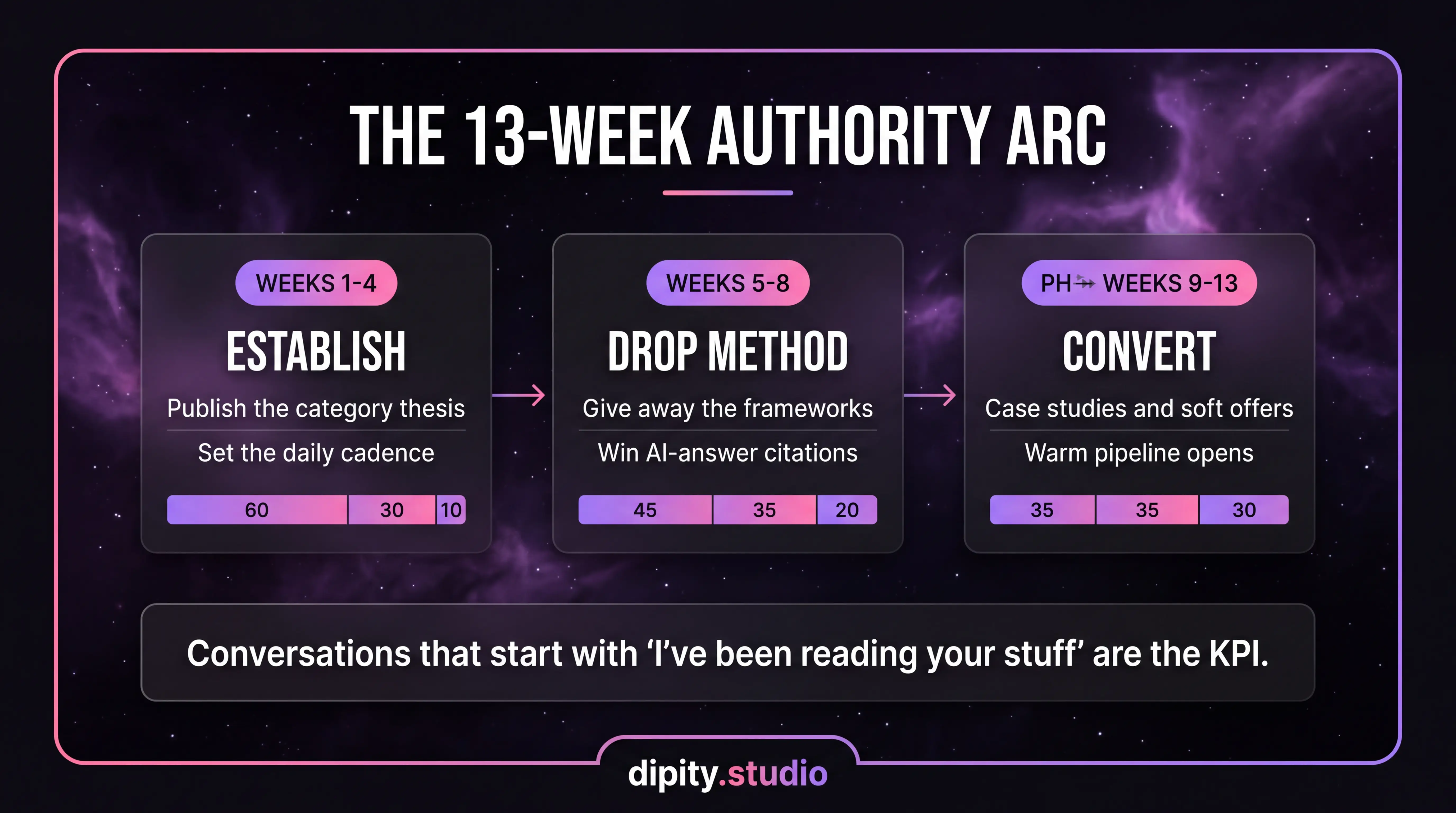
You publish the category thesis and set the cadence, weighted 60% top-of-funnel, 30% middle, 10% bottom. Phase 1's deliverables: the thesis piece, why your category exists, why now, what everyone gets wrong, published on your blog and serialized on LinkedIn; the daily rotation running (hot takes, frameworks, data points, teardowns, behind-the-scenes); and the recording pipeline live, one 30 to 45 minute founder interview feeding everything downstream. The 60/30/10 ratio is deliberate: you're earning attention before you're spending it, and audiences smell a pitch arriving before trust does. If you're inventing new vocabulary along the way, pair this phase with the category creation primer.
The scorecard in Phase 1 is leading indicators only: profile visits, follows from ICP-shaped humans, first inbound comments referencing your ideas. Revenue metrics stay off the wall for four weeks on purpose. The buyers are watching before they're talking; per Vcheck Global, so are the investors.
What Happens in Phase 2: Drop Methodology (Weeks 5–8)?
You shift to 45% TOFU, 35% MOFU, 20% BOFU and start giving away the how. Phase 2 is where most founders flinch, because it means publishing the frameworks, the teardown of how you'd solve the buyer's problem, the criteria for evaluating vendors like you. Publish them anyway: methodology is what converts respect into shortlisting, and per Edelman-LinkedIn, 70% of C-suite buyers have questioned an existing supplier after a competitor's thought leadership made them look. Your methodology posts are that competitor's bad quarter.
This is also the phase where the blog earns its AI-search keep. Question-structured long-form with schema starts winning citations on category queries, the layer now covering 82% of B2B tech questions per BrightEdge, and Ahrefs' funnel data shows what those citations are worth: AI-sourced visitors at 23x conversion versus their traffic share. The full citation mechanics live in how to get cited by ChatGPT, Perplexity, and Gemini. Phase 2's scorecard adds citation presence and inbound conversations that quote your frameworks back at you.
What Happens in Phase 3: Convert (Weeks 9–13)?
The mix moves to 35/35/30 and the offer finally shows up in public. Phase 3 adds explicit bottom-funnel assets: the case study with named numbers, the behind-the-scenes of client work, the direct soft offer riding a Friday post. Because two phases of trust preceded it, the offer reads as availability rather than desperation, and the pipeline it opens is pre-warmed; conversations start at "I've been reading your stuff," which is a different sales cycle than cold discovery. First Page Sage's CAC benchmarks quantify the difference: $647 per customer via thought-leadership-led acquisition against $1,980 for outbound.
Phase 3's scorecard is the real one: content-sourced pipeline dollars, sales-cycle length on content-sourced deals versus cold, and the investor tell, your language appearing in their questions. When your vocabulary shows up in a term sheet conversation, the lighthouse is lit.
What Breaks the Playbook, and How Do You Keep It Running?
Three failure modes account for nearly every collapse: the founder outsources the voice, the content goes thin, or the cadence dies in a busy month. The voice failure is fatal because credibility zeros the equation; systems can extract and manufacture, but the opinions have to be yours, and buyers audit. The thinness failure kills slower: content without a claim, a mechanism, a number, or a named example builds reach without authority, impression farming in a nicer outfit. The cadence failure is structural, and its fix is architectural: one monthly recording as input, an extraction system carrying production, the founder's cost capped at roughly 90 minutes weekly, small enough to survive a launch, a raise, or a bad quarter. That architecture is the subject of building founder-led growth without 10 hours a week.
Kept running, the motion compounds by rounds, not quarters: the same published trail that warms buyers pre-answers investor diligence and pre-filters candidates, per LinkedIn Talent Solutions 62% of job seekers research companies socially before applying. One motion, three funnels. That's the playbook. Morgan Von Druitt runs this arc at Dipity on his own founder brand, which is the only endorsement of it worth much.
Frequently Asked Questions
How long until founder-led growth produces pipeline?
Leading indicators inside 30 days, first content-sourced conversations typically by weeks 6 to 10, meaningful pipeline attribution by the end of the 13-week arc. The compounding continues for years; the arc is the ignition, not the engine's lifespan.
Can I run the playbook in less than 90 minutes a week?
Below about 90 minutes, voice fidelity and review quality decay. The floor is the monthly recording plus daily micro-approvals; everything else is delegable to the system.
What if my category already has a loud founder?
Run the playbook into the gap they're ignoring, a surface, a buyer segment, a sharper thesis. Displacement data favors challengers who show up: 70% of C-suite buyers have reconsidered incumbents over content.
Do I need all five surfaces from day one?
No. LinkedIn plus the weekly blog covers Phase 1; podcasts and the AI-answer layer join in Phases 2 and 3. Four of five surfaces inside 90 days is the standard.
.svg)


Get weekly updates
*We’ll never share your details.
Follow us — @Dipity











Join Our Newsletter
Get a weekly selection of curated articles from our editorial team.