

How Do You Build a Founder-Led Growth Strategy Without Spending 10 Hours a Week on Content?
You're burning 10 hours a week on hooks, drafts, and scheduling. There's a system that gives you the output without the grind.

How Do You Build a Founder-Led Growth Strategy Without Spending 10 Hours a Week on Content?
The reason most founder-led growth strategies die is not conviction, it's the ten hours a week the default version demands. At Dipity, we build AI Envoys, the agent class founder Morgan Von Druitt named and productized, context-saturated agents like Sera who carry the production load so the founder only supplies the thinking, because we watched too many founders quit the most valuable channel they had over a workload problem. The fix is structural, not motivational. Here's the system that separates the work only you have from the work anyone, or anything, else should be doing.
How Much Time Does Founder Content Actually Take?
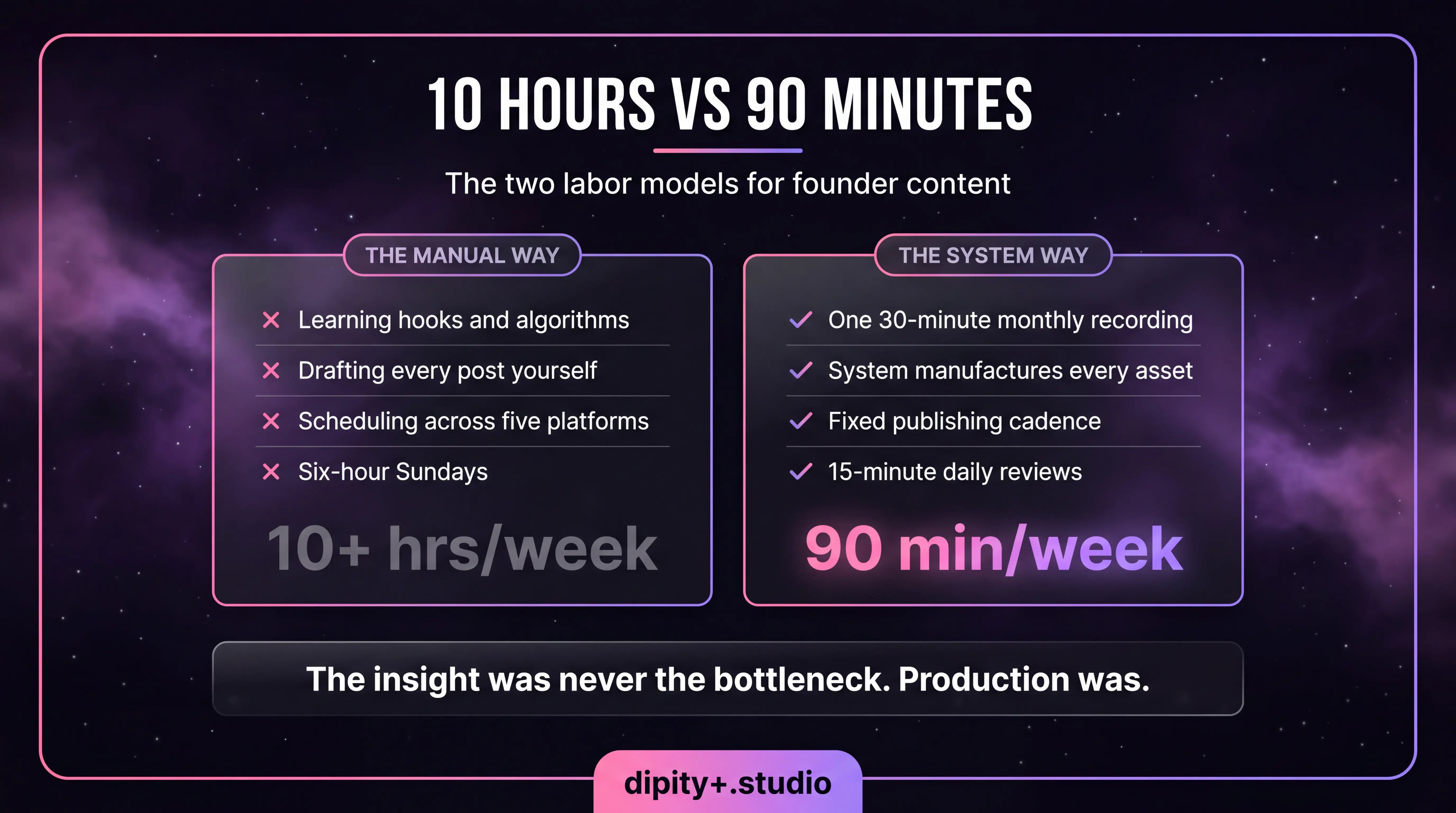
Done the default way, eight to twelve hours a week, and that's why it fails. The default version has the founder learning hooks, studying the LinkedIn algorithm, drafting posts, resizing graphics, and scheduling across platforms, usually in a six-hour Sunday block stolen from family or sleep. That workload competes directly with product and fundraising, so it loses, and the feed goes dark right as the compounding was supposed to start. That dark feed has its own price tag; we ran the full math on what founder silence costs.
The economics say the channel is worth saving. First Page Sage's CAC benchmarks across roughly 120 B2B firms put Thought Leadership SEO at $647 per acquired customer against $1,980 for outbound SDRs, and organic channels average $942 against $1,907 for inorganic. The problem was never the ROI. The problem is a labor model where the most expensive person in the company does the least leveraged part of the job.
What's the Difference Between the Insight Problem and the Production Problem?
The insight problem is whether you have a point of view worth publishing; the production problem is turning it into assets on a cadence. Founders conflate the two, then price the whole activity at the cost of the production grind. But if you're running a funded B2B SaaS company, the insight problem is already solved. You articulate your category thesis on every board call, every standup, every investor update. The thinking exists. It's the extraction and manufacturing that's missing.
This distinction is the entire strategy. Production, drafting, formatting, distribution, repurposing, is a commodity process that systems handle. Insight is a monopoly only you hold. A founder-led growth strategy that has the founder doing production is a strategy that pays monopoly wages for commodity work, and it collapses the first week a launch or a raise eats the calendar.
What Does a Founder-Led Growth System Actually Look Like?
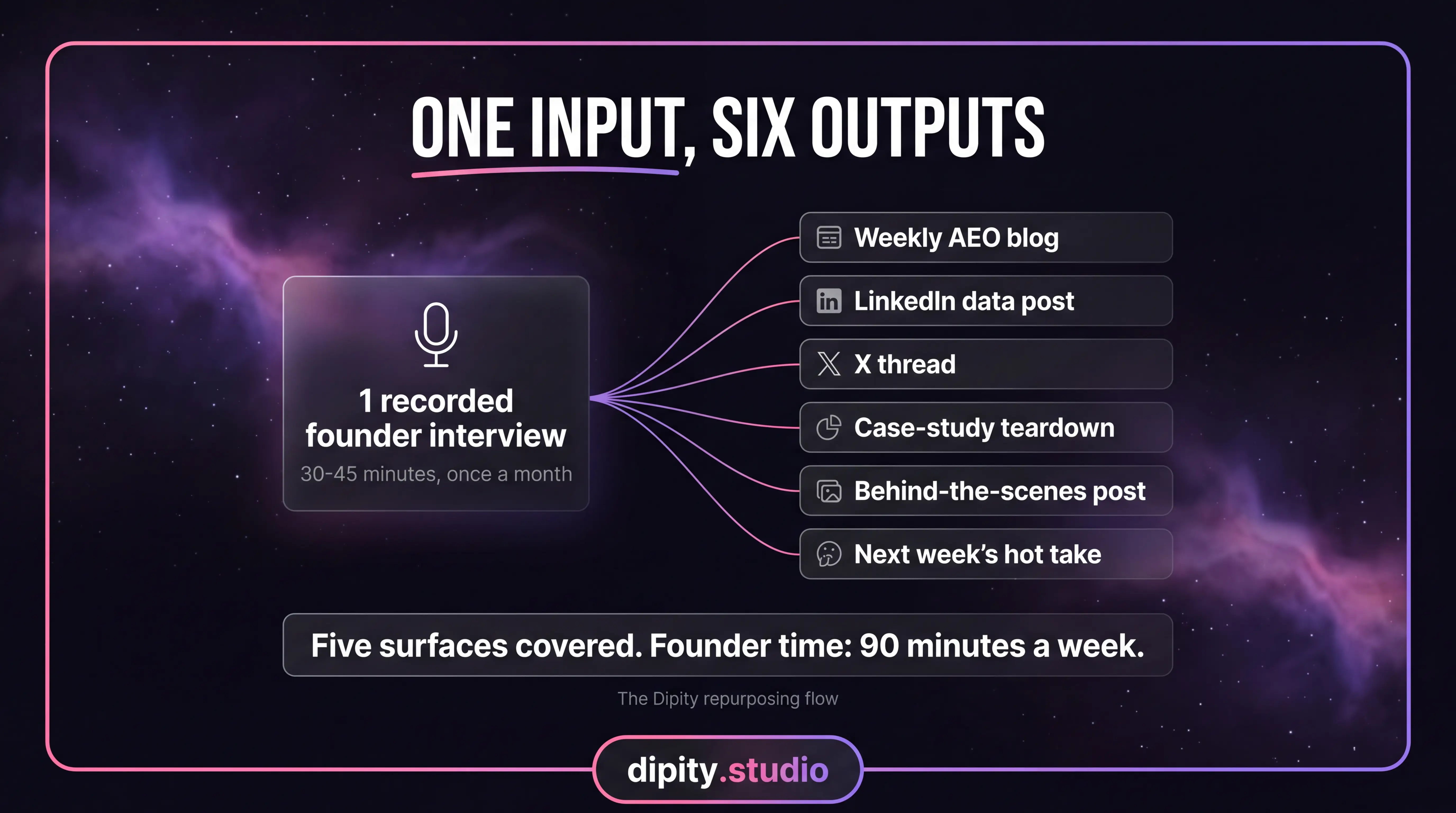
One recorded input feeding every surface through a repurposing engine. The founders who sustain this motion for years are not writing daily; they're speaking on a schedule and letting the system manufacture. At Dipity, the operating pattern Morgan Von Druitt designed is one 30 to 45 minute founder interview a month at the input layer, and downstream of it, a week-by-week cascade:
✦ A weekly question-first blog carries the deep argument and earns the AI-search citations.
✦ The blog's headline stat becomes a LinkedIn data post and an X thread the same week.
✦ The case study inside it becomes Thursday's teardown post.
✦ The behind-the-scenes detail becomes Friday's process post and a short-form video script.
✦ The contrarian framing becomes next Monday's hot take.
One input, six outputs, five surfaces. The math on why five surfaces matter is unforgiving: 6sense's buyer research shows buyers define requirements 83% of the time before contacting a vendor, and they cross-reference LinkedIn, Google and AI Overviews, podcasts, ChatGPT, and Perplexity before you ever hear their name. Coverage without founder burnout is exactly what the system exists to produce.
What Should the Founder Still Own?
The voice, the point of view, and the fifteen minutes of final say. Everything else delegates, but these three don't, and the research explains why. The 2024 Edelman-LinkedIn B2B Thought Leadership Impact Report found 73% of decision-makers rate thought leadership a more trustworthy basis for judging a company than its marketing materials, and the trust attaches to the human. Outsource the opinions and buyers smell the ghostwriter; the trust premium evaporates while the invoice stays.
The line to hold: systems extract, edit, schedule, and distribute. The founder supplies conviction, reacts to drafts, and kills anything off-voice. That's a review function, not a writing function, and review functions fit inside a founder's calendar. Fifteen minutes a day of approvals sustains what ten hours of solo production couldn't.
How Do You Keep the Cadence Without Burning Out?
Fix the calendar, not the willpower. Cadence survives when the founder's contribution is scheduled like a board meeting: one monthly deep interview, one weekly fifteen-minute review block, and nothing else on the founder's plate. Batching is the trick that makes it feel light; a single hour of recorded thinking, prompted well, contains ten to fifteen distinct content seeds, which is a month of material extracted in one sitting.
The platform data rewards exactly this shape. Personal profiles generate 2.75x more impressions and 5x more engagement than company pages, and Metricool's 2026 study of 673,658 posts puts personal-profile engagement at 2.60% against 1.74% for company pages. Consistency at three to five posts a week from the founder's own account beats brilliance published sporadically from the brand's, and consistency is a systems property, not a personality trait.
What Results Should You Expect, and When?
Leading indicators inside 60 to 90 days, economic outcomes across quarters. The early signals are profile visits, inbound DMs that reference your content, sales calls opening with "I've been reading your stuff," and your name appearing in AI-generated answers for category queries. The lagging outcomes are the ones the research quantifies: roughly 90% of decision-makers report being more receptive to outreach from companies producing strong thought leadership, and 70% of C-suite leaders have questioned an existing supplier because of a competitor's content, per Edelman-LinkedIn.
Set expectations like an operator: the channel compounds by rounds, not by weeks. The founders who win it are the ones whose system removed every reason to stop. Ten hours a week is a reason to stop. Ninety minutes isn't. When you're ready for the full arc, phase by phase, the founder-led growth playbook is the next read; if the bottleneck is your ops stack itself, start with marketing operations for the founder running everything.
Frequently Asked Questions
How many hours a week does a systematized founder-led growth motion take?
Roughly 90 minutes: a monthly 30 to 45 minute interview amortized weekly, plus daily micro-reviews of drafts. The system absorbs the other eight-plus hours the manual version demanded.
Should the founder write their own posts?
The founder should source every idea and approve every word, but drafting is production work. What can't be delegated is the point of view; what shouldn't be founder-time is formatting and scheduling.
Which surface should a time-poor founder prioritize first?
LinkedIn plus a weekly question-structured blog. LinkedIn compounds relationships now; the blog builds the AI-search citation footprint that pays later. The other surfaces feed off those two.
Can a ghostwriter deliver the same result?
A ghostwriter covers one surface and carries voice-fidelity risk; buyers discount content that doesn't sound like the founder. Extraction systems keep the voice yours because the source material is literally your speech.
Want the 10 hours back without going dark? Book a demo with Morgan Von Druitt and watch one recording become your week of founder-voice content.

.svg)


Get weekly updates
*We’ll never share your details.
Follow us — @Dipity











Join Our Newsletter
Get a weekly selection of curated articles from our editorial team.