

Why Is Founder Silence Costing You More Than Your Highest-Paid Engineer?
Heads-down founders look dead from outside. Learn why the cost of not posting outweighs the time you think you're saving.
.png)
Why Is Founder Silence Costing You More Than Your Highest-Paid Engineer?
Your highest-paid engineer costs you around $200K a year, and you know exactly what you get for it. Your silence costs you more, and it never shows up on a P&L. At Dipity, we build AI Envoys, the agent class founder Morgan Von Druitt named and pioneered, context-rich agents like Sera who turn a founder's recorded thinking into a public narrative, and the first conversation with every founder starts in the same place: the invisible line item. This is the math on what not posting is costing you.
What Is Founder-Led Growth?
Founder-led growth is a go-to-market motion where the founder's public voice, their posts, essays, podcast appearances, and point of view, functions as the company's primary demand engine. Instead of renting attention through ads or hiring a content team to speak for a logo, the founder publishes as themselves, and the trust compounds into pipeline, talent, and investor attention. It works for a reason buyers will tell you to your face: people trust people. The 2024 Edelman-LinkedIn B2B Thought Leadership Impact Report, a study of roughly 3,500 management-level professionals across seven countries, found 73% of decision-makers judge an organization's thought leadership as a more trustworthy basis for assessing capability than its marketing materials.
The mechanics show up in the platform data too. Personal LinkedIn profiles generate 2.75x more impressions and 5x more engagement than company pages, and Metricool's 2026 study of 673,658 posts puts personal-profile engagement at 2.60% against 1.74% for company pages, while company-page organic reach fell 60% to 66% between 2024 and 2026. The founder's account is not a nice-to-have next to the brand account. In 2026, it is the account.
What Does Founder Silence Actually Cost?
Founder silence costs a measurable share of company value, customer acquisition efficiency, and cycle time, and each one is quantified in tier-1 research. Start at the top of the stack. Weber Shandwick's CEO Reputation Premium study, built on 1,700 senior executives across 19 countries, attributes 44% of a company's market value to the CEO's reputation. Their 2020 follow-up pushed corporate reputation's share of market value to 63%.
Now run the conservative version of the math. Take a $40M post-money Series A. Assume founder visibility moves valuation by 3%, a fraction of what the reputation research implies. The lift is $1.2M. At the Series B median pre-money of $203M reported in the PitchBook-NVCA Venture Monitor, the same 3% compounds to $6.1M. A senior engineer is expensive. Silence is more expensive, and unlike the engineer, it ships nothing.
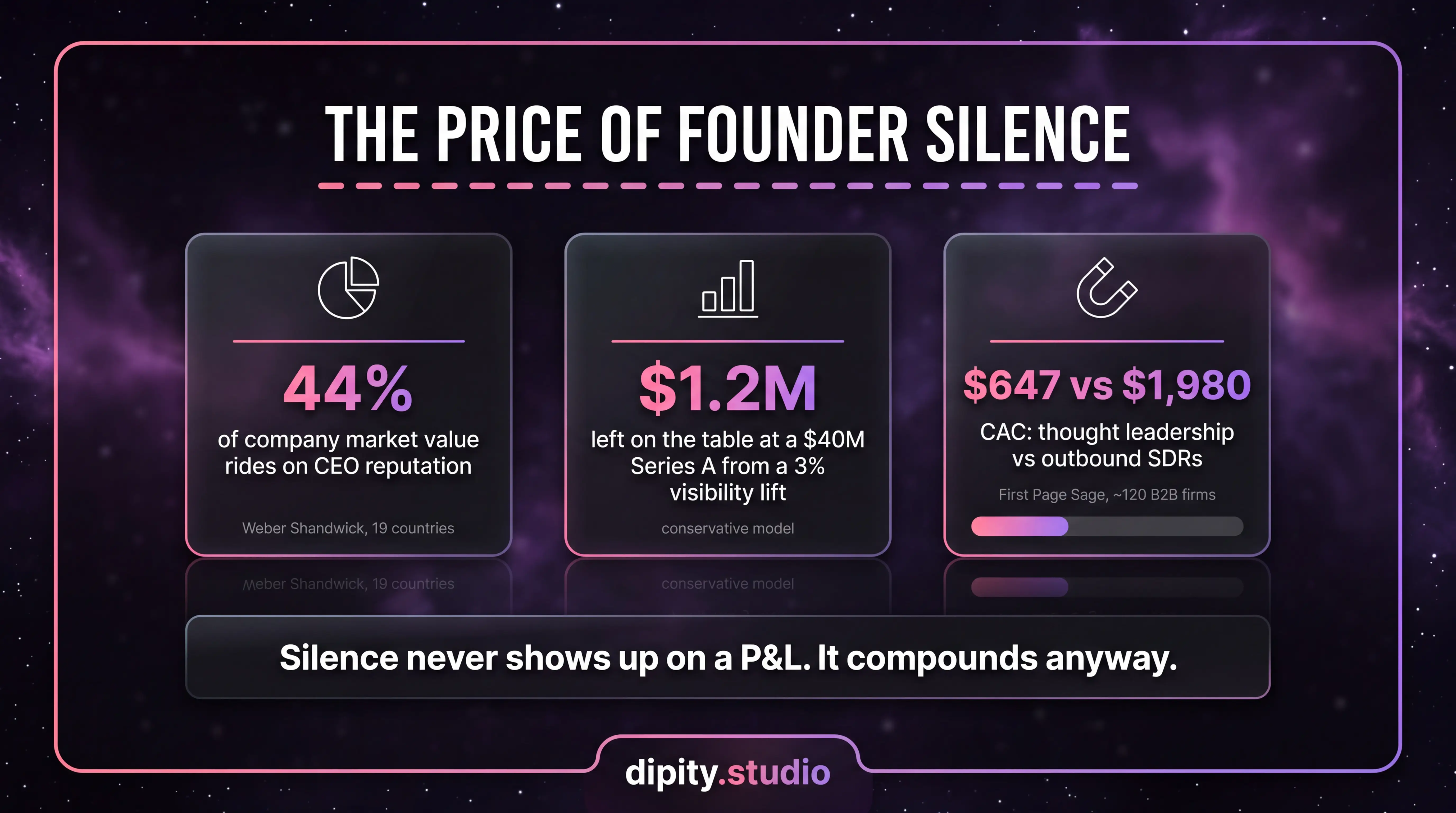
✦ 44% of company market value tracks to CEO reputation, per Weber Shandwick's 19-country executive study.
✦ Thought Leadership SEO acquires customers at $647 against $1,980 for outbound SDRs, per First Page Sage's CAC-by-channel benchmarks across ~120 B2B firms.
✦ Organic channels average $942 per acquired customer against $1,907 for inorganic. Silence forces you onto the expensive side of the table.
✦ 75% of decision-makers say thought leadership led them to research a product they were not previously considering, per Edelman-LinkedIn. Silence removes you from consideration sets you never knew existed.
Why Does a Heads-Down Founder Look Dead From the Outside?
Because the buyer finishes most of the evaluation before you know it started, and an empty feed reads as an empty company. 6sense's Buyer Experience research finds B2B buyers fully define their requirements 83% of the time before speaking with a vendor, and Forrester reports 89% of B2B buyers now use generative AI as a self-guided research source across the purchase cycle. Your prospects are triangulating you across five surfaces, LinkedIn, Google and AI Overviews, podcasts, ChatGPT and Claude, Perplexity and Gemini, and they are doing it in a room you were never invited into.
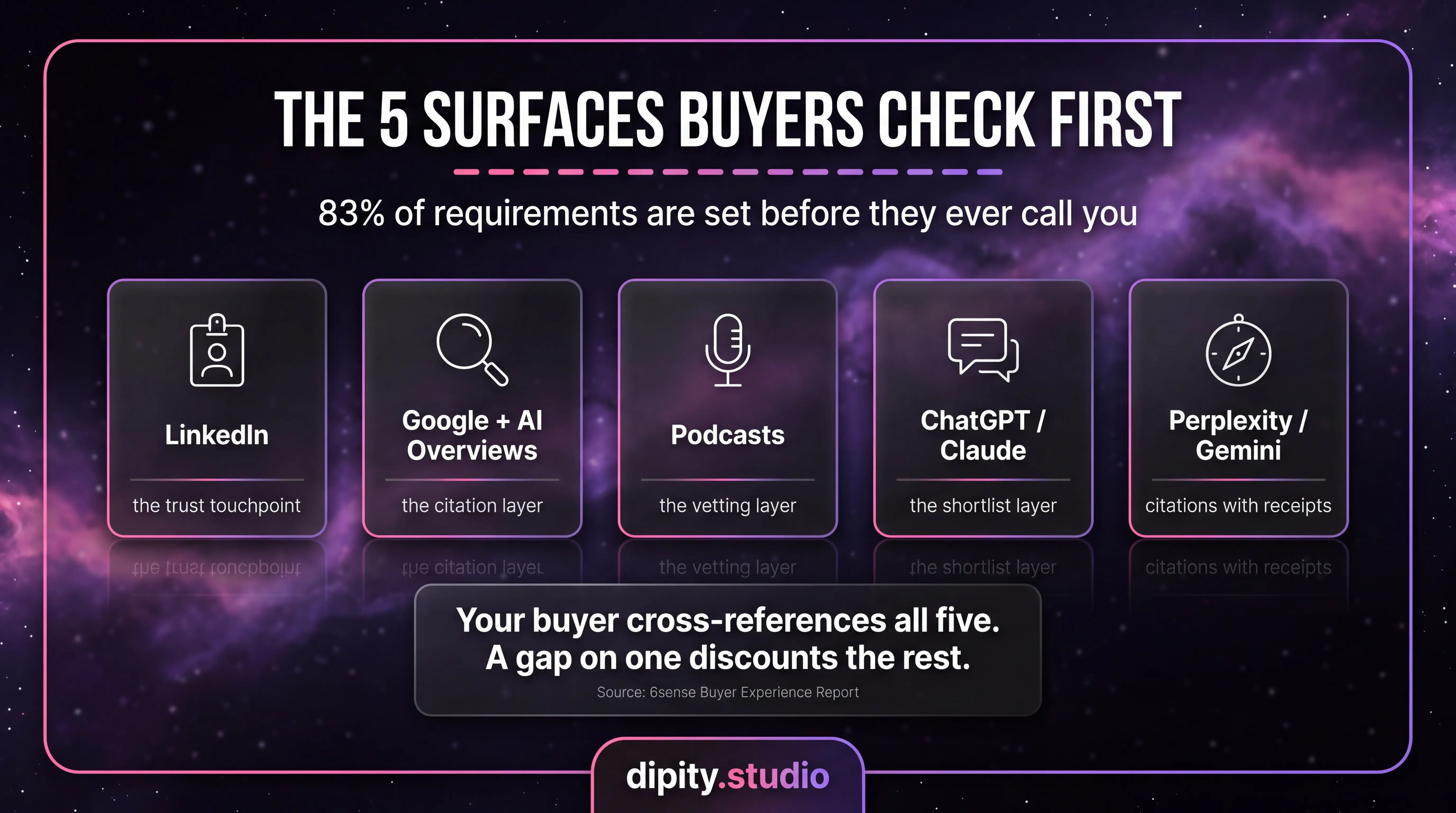
The same pre-screening happens with capital. Seven out of ten top-performing VC firms now run deep-dive background and social presence checks as standard diligence, per Vcheck Global, and SignalX's due-diligence research shows the process starts at pre-screening, long before a data room opens. Inside Dipity we call this the heads-down paradox: the founder doing the most building looks, from the outside, like the founder doing the least. You are shipping every day. The buyer, the candidate, and the partner meeting all see eight months of silence.
Why Don't Most Founders Post?
Time, and a category error about where the work lives. The founders we talk to picture content as a production job: learning hooks, studying the algorithm, writing five posts on a Sunday. Paul Graham's advice to do things that don't scale gets read as permission to skip distribution entirely, when the essay argues the opposite: the unscalable thing early founders should do is talk to the market in their own voice. Morgan Von Druitt, Dipity's founder, puts the stakes bluntly: "82% of startups fail due to leadership and management issues, not product problems. Founder invisibility isn't a personality trait. It's a strategic failure."
Here is the reframe the data supports. The production problem, drafting, formatting, scheduling, distribution, is a solved operational problem. The insight problem was never a problem at all. You already have a point of view about your category; you share it on every board call and standup. What is missing is the system between your head and the feed. That gap is a process gap, not a talent gap, and process gaps are the cheapest kind to close.
What Do the Numbers Say About Founder-Led Growth Working?
The pattern is visible at every scale where the receipts are public. Lenny Rachitsky built a solo founder-led media motion into 1.2M+ Substack subscribers and a seven-figure business. Tyler Denk built Beehiiv in public to $20M+ ARR and a $33M Series B, with the build-in-public motion working as GTM, recruiting, and fundraising narrative at once. Karri Saarinen's founder-led design narrative at Linear anchored an $80M Series C at a $1.25B+ valuation and became the company's recruiting magnet against Stripe and Figma. None of them are louder than their competitors. They started earlier and never stopped.
The receptiveness data explains why the motion converts. Per Edelman-LinkedIn, roughly 90% of decision-makers are more receptive to outreach from companies producing strong thought leadership, 70% of C-suite leaders have questioned an existing supplier after consuming a competitor's thought leadership, and 60% of buyers will pay a premium to work with organizations articulating a clear vision. Founder-led growth is not a brand exercise. It is displacement, pricing power, and warm pipeline wearing a brand exercise's clothes.
How Do You Start Without Becoming a Full-Time Creator?
Separate insight extraction from content execution, then put the extraction on a calendar. The founders who sustain this motion are not writing more than you. They are recording once and letting a system carry production: one 30 to 45 minute interview a month becomes blogs, LinkedIn posts, X posts, and podcast prep across every surface the buyer checks. Your job shrinks to the one input nobody else has, your thinking, on a cadence the algorithm and the human reader both reward.
✦ Week 1: record your category thesis. Why this product, why now, why you. Ten minutes of conviction beats two hours of polish.
✦ Weeks 2 to 4: publish across at least two surfaces at a fixed cadence. Consistency is the variable; brilliance is optional.
✦ Days 30 to 90: expand to four of the five surfaces. This is the minimum footprint the modern buyer cross-references.
✦ Ongoing: measure inbound conversations that open with "I've been reading your stuff." That sentence is the KPI.
This is the exact system Morgan Von Druitt built Dipity to run. Sera interviews you, holds your voice and context, and turns one recording into a week of founder-attributed content while you stay heads-down on product. The two jobs were never in conflict. The brain is the asset. Production is the commodity.
Frequently Asked Questions
Is founder-led growth the same as personal branding?
No. Personal branding optimizes for audience size. Founder-led growth optimizes for revenue outcomes: lower CAC, shorter cycles, stronger rounds, inbound talent. The overlap is the founder's voice; the difference is what you measure.
How long before founder-led content shows results?
Expect early signal, profile visits, inbound conversations, AI-answer citations, inside 60 to 90 days, and compounding economic results across quarters. The research is unambiguous on direction: buyers reward visible founders with consideration they never grant invisible ones.
Does founder-led growth work if the founder is technical and hates writing?
It works best for exactly that founder, because the moat is the thinking, not the prose. Extraction systems exist so the founder talks and the system writes. What no system replaces is the point of view.
What should a founder post first?
The category thesis. Why your product exists, why now, and what everyone else in the market gets wrong. It is the single asset buyers, candidates, and investors all check for, and its absence is the loudest silence of all. Start with the full founder-led growth playbook, understand how AI search changed the buyer's path, and if you're inventing new vocabulary, read the category creation primer.
Ready to see the invisible line item on your own cap table?
Book a demo with Morgan Von Druitt and watch one recording become a week of founder-voice content.

.svg)


Get weekly updates
*We’ll never share your details.
Follow us — @Dipity










Join Our Newsletter
Get a weekly selection of curated articles from our editorial team.