

What Is Category Creation in Startups and Why Does It Matter Now?
Category creators don't compete on features. They set the terms of evaluation. A primer for AI-native SaaS founders.

What Is Category Creation in Startups and Why Does It Matter Now?
The most expensive place to compete is inside someone else's category, playing by evaluation criteria an incumbent wrote years before you incorporated. At Dipity, we build AI Envoys, the new class of context-saturated agent pioneered by Dipity and founder Morgan Von Druitt, agents like Sera who turn a founder's category thesis into the publishing volume a new category demands, because we've run this motion from the inside and watched a coined term become a market. This is the primer: what category creation is, why the window for AI-native founders is open right now, and what it costs to walk through it.
What Is Category Creation?
Category creation is the strategy of defining a new market problem and its solution class rather than positioning as a better option inside an existing one. Instead of arguing you're a superior CRM, you name the thing buyers didn't know they needed, teach the market to see the problem your way, and become the default answer to a question you introduced. The strategic lineage runs through Blue Ocean Strategy, Kim and Mauborgne's Harvard Business Review framework for making competition irrelevant by creating uncontested market space, and through HBR's later research arguing category creation is the ultimate growth strategy, with category creators capturing outsized shares of the value in their markets.
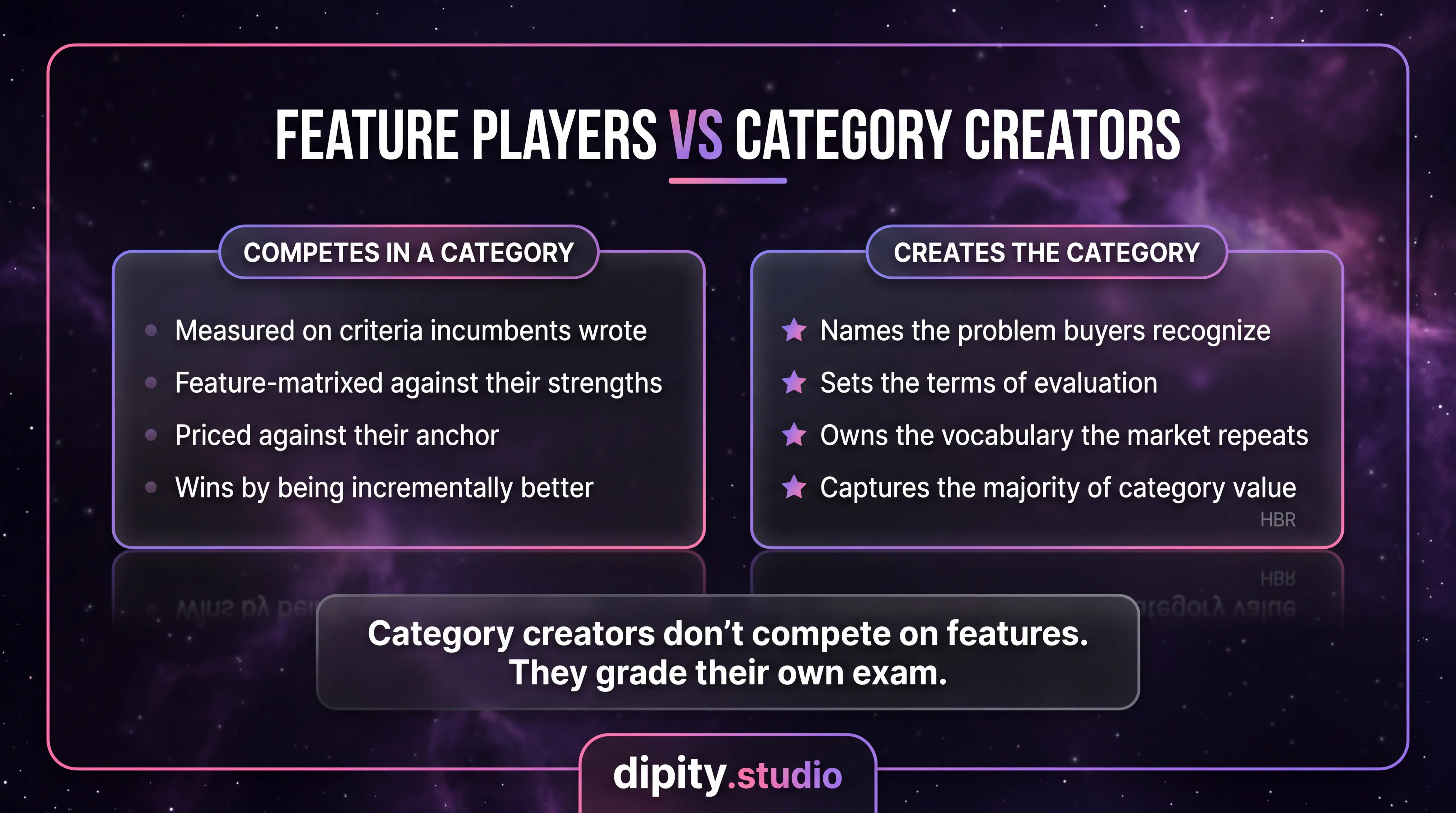
The practical definition is sharper: category creators don't compete on features, they set the terms of evaluation. When the buyer adopts your vocabulary, your framework for the problem, and your criteria for what "good" looks like, every competitor gets measured against a ruler you manufactured. That's the entire game. Not a better mousetrap; a new question where you're the only complete answer.
Why Does Category Creation Matter Right Now for AI-Native Startups?
Because the AI market is in its naming phase, and naming phases are short. Every genuinely new technology wave produces a window where the vocabulary is unsettled, buyers are actively looking for language to organize their confusion, and no incumbent owns the answers. AI-native SaaS is in that window today. The valuation data shows what the market pays for category clarity: the PitchBook-NVCA Venture Monitor put median Series A pre-money for AI companies at $78.0M against $42.4M for non-AI peers in Q1 2026, an 84% premium, and Carta's market data shows the AI premium widening at every later stage.
Premiums like those don't attach to features. They attach to narratives, and specifically to companies investors believe define a category rather than rent space in one. As Forbes' 2026 analysis of category creation argues, the durable winners of platform shifts are disproportionately the companies who owned the language of the shift. The window for AI-native founders is roughly 12 to 24 months before capital floods every niche and incumbents rename your invention as their feature. The vocabulary is being settled now, with or without you.
What Does a Category Creator Actually Do Differently?
Four things, consistently and in public. The mechanics are less mysterious than the mythology suggests.
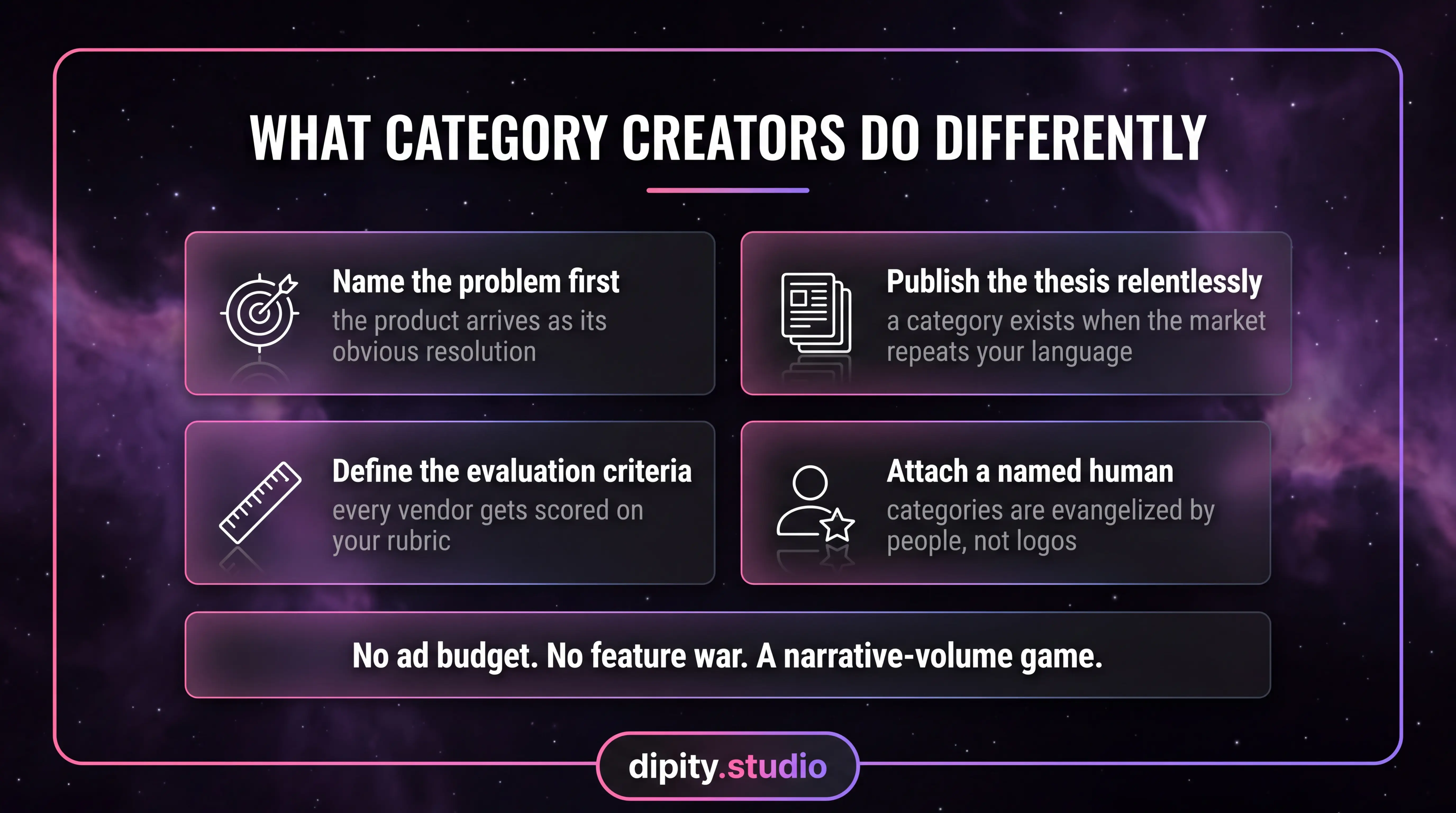
✦ They name the problem before naming the product. The category term describes a pain the buyer recognizes instantly, and the product arrives as its obvious resolution.
✦ They publish the thesis relentlessly. A category exists when the market repeats your language back to you, and repetition requires volume: essays, blogs, talks, posts, all carrying the same conceptual spine.
✦ They define the evaluation criteria. Frameworks, maturity models, and "how to buy" content teach the market to score every vendor, including the incumbents, on the creator's terms.
✦ They attach a named human to the story. Categories get evangelized by people, not logos. The founder's face and conviction carry the narrative until the market carries it for them.
Notice what's absent: a bigger ad budget, a feature war, a pricing race. Category creation is a narrative-volume game, which is precisely why founder-led publishing is its natural engine, and why the founders who won't show up in public almost never mint categories.
What Does Category Creation Look Like in Practice?
Here's one from inside. Before founding Dipity, Morgan ran product marketing at an AI decision-intelligence company that was inventing its own category, complete with a trademarked term nobody had ever searched for. The playbook was volume plus structure: 500+ blogs published in six months, every one architected around the category term and its adjacent questions, growing organic traffic from zero to roughly 87,000 monthly visitors in 90 days with no ad spend. The coined term started ranking for adjacent AI long-tail queries, tier-1 media coverage followed with Forbes writing about the category by name, and the company's narrative moved from "startup with a product" to "creator of a multibillion-dollar category." The full walkthrough lives in the 500-blog category creation framework.
The lesson worth stealing is the sequencing. The term came first, the content architecture taught search engines and humans what the term meant, the density made the company synonymous with it, and the media coverage arrived because journalists write about categories, not features. None of it required the market's permission. Category creation is the one GTM motion where you grade your own exam, then teach everyone else the rubric.
When Should a Startup Not Create a Category?
When demand already exists and your edge is real inside the current frame. Category creation is expensive: it means funding market education before harvesting demand, and it takes quarters of consistent publishing before the language sticks. If buyers already search for your solution class with budget in hand, and you win on the criteria they already use, positioning inside the existing category is the faster, cheaper play; April Dunford's positioning work remains the canonical guide for exactly that decision. Founders also underestimate the commitment: a category half-evangelized is a confusing product story, which is worse than a clear one inside an old category. The full decision framework is in when to coin a term vs. compete in an existing category.
The honest test is a pair of questions. Does describing your product in the incumbent category's language make it sound worse than it is? And are you prepared to publish the thesis for 18 months without the market clapping? Two yeses and the window is yours. One no and you should position, not create.
How Does a Founder Start a Category Creation Motion?
Write the thesis before the term. The durable categories start with a sharp articulation of what changed in the world, why the old solution class stopped fitting, and what the new class must do, and the name falls out of the thesis. From there, the motion is a publishing operation: a pillar essay carrying the full argument, a content architecture answering every adjacent question in the buyer's language, a founder showing up on every surface repeating the spine of the idea, and the discipline to keep the vocabulary consistent until the market adopts it. In the AI-search era the payoff surface is bigger than Google alone; see how AI is changing search for B2B SaaS.
This is the machine Dipity operates. Sera holds the founder's category thesis, vocabulary, and proof points as permanent context, then produces the volume, blogs, posts, frameworks, all in the founder's voice, that teaches the market the new language. One founder, one thesis, structured saturation. That's how terms become categories. Morgan Von Druitt is running it on Dipity's own category right now: the AI Envoy, a new class of context-saturated agent, pioneered and named in public.
Frequently Asked Questions
How long does category creation take for a startup?
Expect 6 to 12 months of consistent publishing before the term shows ranking traction and inbound usage, and 18 to 24 months before the market uses the vocabulary unprompted. The motion above compressed the early phase with sheer volume: 500 blogs in six months moved the timeline dramatically.
Can a startup create a category without a trademarked term?
Yes. The trademark protects the asset but doesn't create the category. Adoption does. Some categories are phrases nobody owns; the winner is whoever the market associates with the idea, which is a publishing outcome, not a legal one.
Is category creation only for venture-backed startups?
No, but funding buys the runway market education requires. Bootstrapped category creators exist; they typically pick narrower categories where saturation is achievable with less volume.
What's the difference between category creation and positioning?
Positioning locates you advantageously inside an existing frame of reference. Category creation replaces the frame. Positioning is faster and cheaper; category creation, when it lands, is worth more, because per HBR's research the category creator captures the majority of the category's value.
Have a category thesis nobody's hearing? Book a demo with Morgan Von Druitt and see how one recorded interview becomes the publishing volume a new category needs.
.svg)


Get weekly updates
*We’ll never share your details.
Follow us — @Dipity











Join Our Newsletter
Get a weekly selection of curated articles from our editorial team.