

The Deflection That's Costing You the Deal
Focusing on product sounds like the move until nobody knows you exist.

The Deflection That's Costing You the Deal
The Deflection That's Costing You the Deal
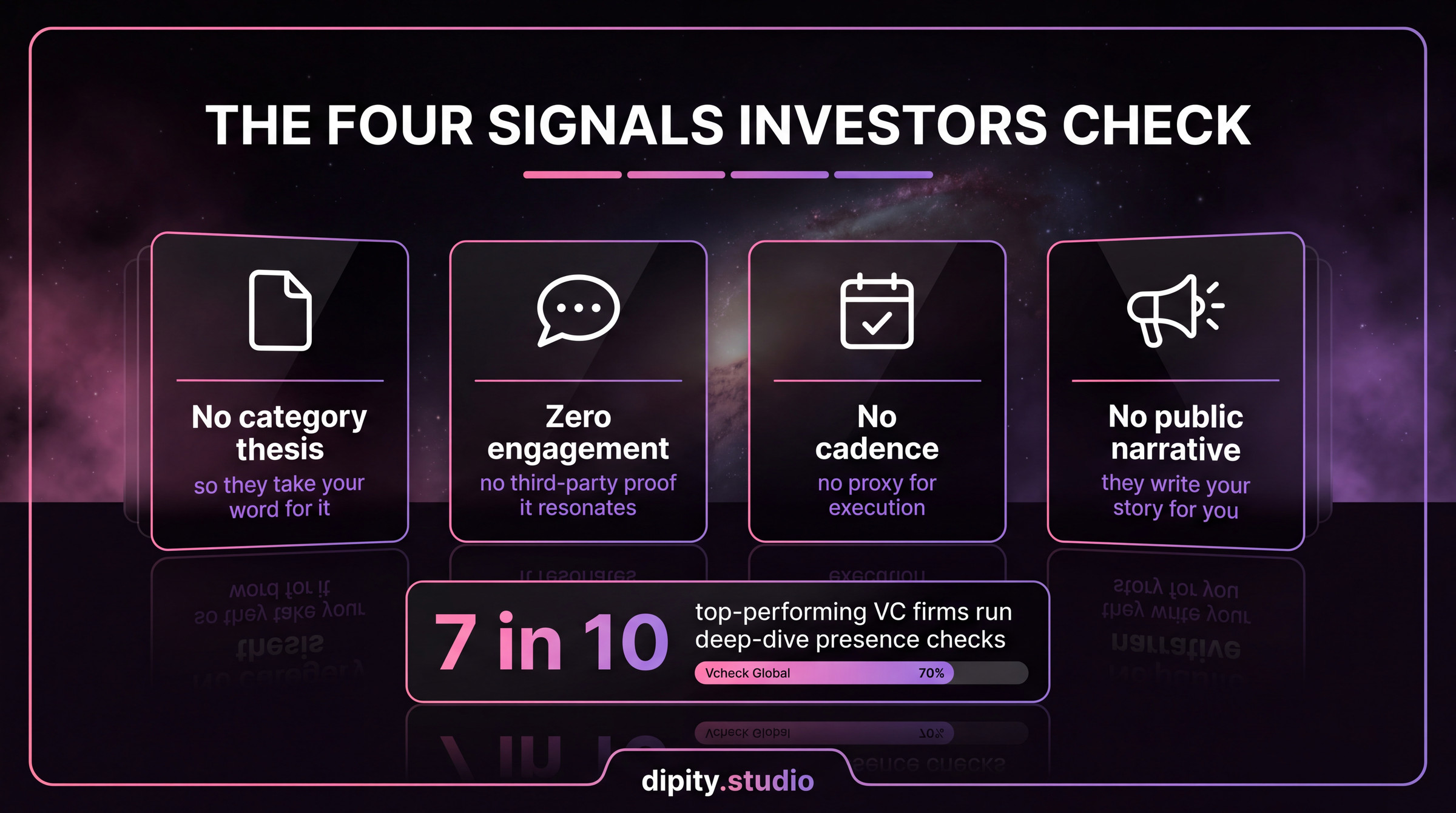
Founder-led content is the single highest-signal asset an investor evaluates before the partner meeting you never see. When a founder deflects with “I'm focused on building,” investors hear focus, but they log narrative risk. Research from Interdependence shows that founder visibility is now one of the most important growth channels for modern companies, and according to data from Vcheck Global, 7 out of 10 top-performing VC firms now conduct deep-dive background and social presence checks as standard due diligence. The deflection feels safe. The cost is invisible. And the deal dies in a room you were never invited to.
What Happens When You Tell an Investor “I Don't Have Time for Content”?
The investor nods. They call it focus. They say something like “totally get it, product-first is the right call.” Then they leave the meeting, open your LinkedIn, see eight months of silence, and write three words in their internal memo: “thin public narrative.” You never hear those three words. You never get to rebut them. The deal doesn't die in front of you. It dies in a partner meeting where your deck is on the screen and someone asks, “What's the founder's public presence look like?” and nobody has a good answer.
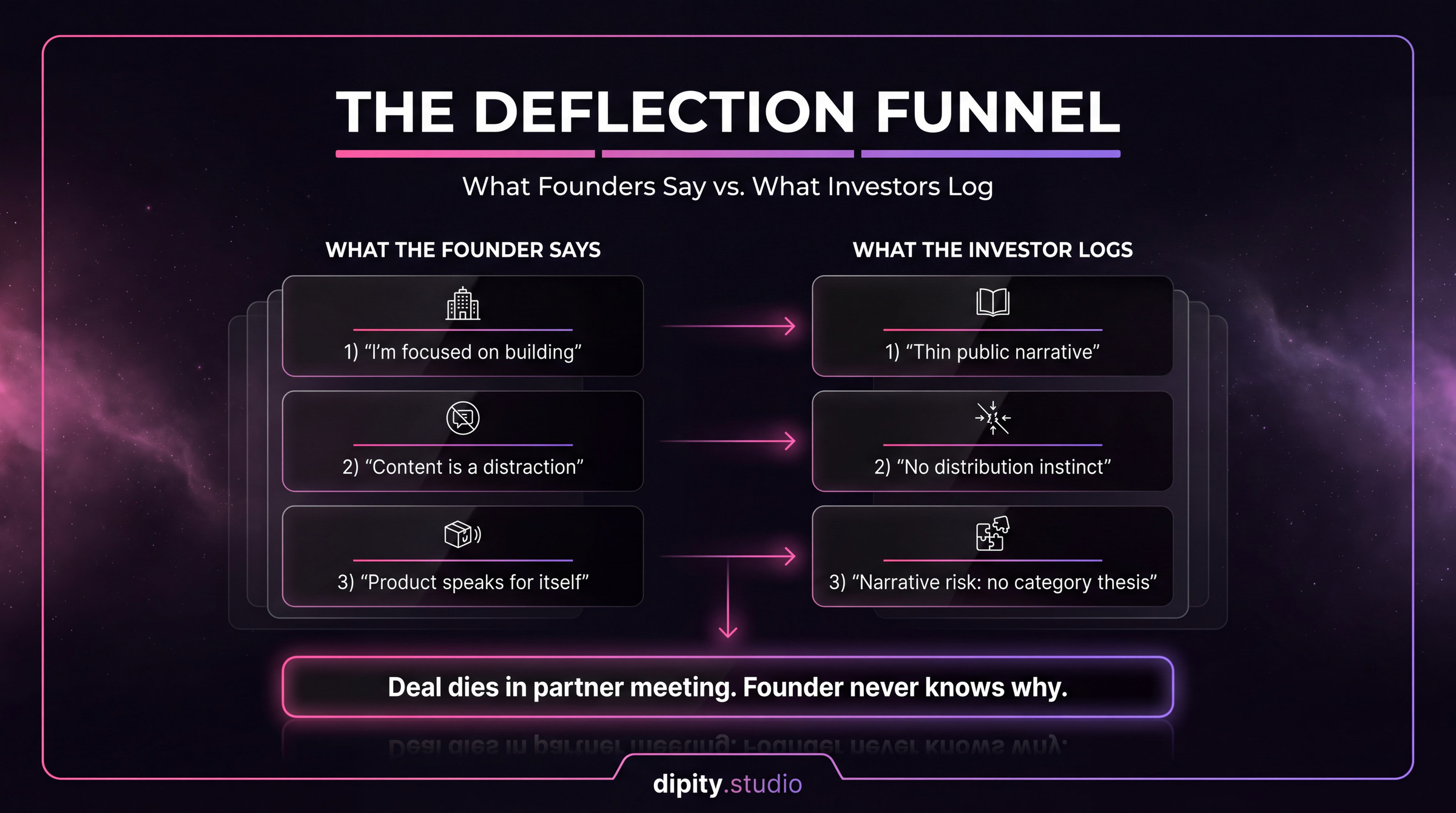
I've watched this happen. The founder walks out thinking they nailed the pitch. The investor walks out thinking the founder has no distribution instinct. Both people were polite. Only one of them was honest.
Here's the thing. The investor is not wrong to nod. They are giving you permission to prioritize the way you see fit. But permission and a pass are two different outcomes. The permission says “I respect your time.” The pass says “I don't see enough evidence that this founder will be the category voice we need them to be.”
According to research from SignalX, due diligence begins far earlier than most founders realize, often during pre-screening, long before a formal data room is shared. At that stage, investors assess high-level signals: founder background, market narrative, and early traction. Your LinkedIn profile is one of those signals. Your X account is one of those signals. Your blog is one of those signals. And when all three are empty, the signal is: this person is running on assumption.
What Do Investors See When They Check Your Profile?
VCs research founders on LinkedIn, X, and Google before taking a call. A strong founder presence shortens the path to institutional interest because it proves you are a serious, thoughtful operator before investors ever meet you. An empty profile does the opposite. It creates doubt where none needed to exist.
Research from the Azarian Growth Agency confirms that VCs use social media as a pre-due diligence tool, analyzing founder behavior like customer engagement, network building, and consistency of communication. They are not looking for viral posts. They are looking for evidence of thought. Evidence of conviction. Evidence that this founder has a point of view about their category and is willing to say it out loud.
Here's what an investor sees when they check your profile and find nothing:
- No category thesis published means the investor has to take your word for it that you understand the market. Your pitch deck says you do. Your profile doesn't confirm it.
- No engagement with your community means the investor has no third-party signal about whether people in your market respect your thinking. Zero comments, zero shares, zero proof of resonance.
- No consistency over time means the investor has no way to assess whether you follow through on commitments outside of product. Consistency of publishing is a proxy for consistency of execution.
- No public narrative means the investor has to build the story for you when they present your deal internally. And they won't build it as well as you would.
According to Under30CEO, your LinkedIn profile is often the first filter an associate at a VC firm runs before they ever decide to take the call — before a DM gets a reply, before a meeting gets booked. Your content is the proof of concept that makes the outreach credible. Without it, the outreach is an unsupported claim from a stranger.
Your profile authority is the biggest signal or precursor of your success when you're looking to raise or hire top talent. This is not about vanity metrics. This is about whether the person evaluating you finds confirmation or confusion when they go looking.
What Gets Written About You in the Partner Meeting You're Not In?
Every VC investment memo includes a risk section. The investment committee identifies risks whether you list them or not. The question is whether you've addressed them before they have to. A thin public narrative is a risk. An empty LinkedIn profile is a risk. A founder who says “I don't have time for content” is, in the IC memo, a founder who might not have distribution instinct.
Here's how the IC memo works, for founders who have never seen one. According to Spectup's research, an IC memo is an internal document a partner writes for the investment committee after a meeting goes well — the firm's internal analysis of whether you deserve their capital, written for partners who've never met you. Founders rarely see these memos. They are the output of the VC's due diligence process, not the input.
The memo has sections: the thesis, market opportunity, company and traction, team, competitive positioning, and risk and mitigations. The risk section is where your empty profile shows up. Not as “this founder doesn't post on LinkedIn.” That's too petty for a formal memo. It shows up as “founder has limited public presence and no established category narrative.” Or “unclear whether founder has distribution capability beyond product.” Or “thin narrative capital relative to competitors in this space.”
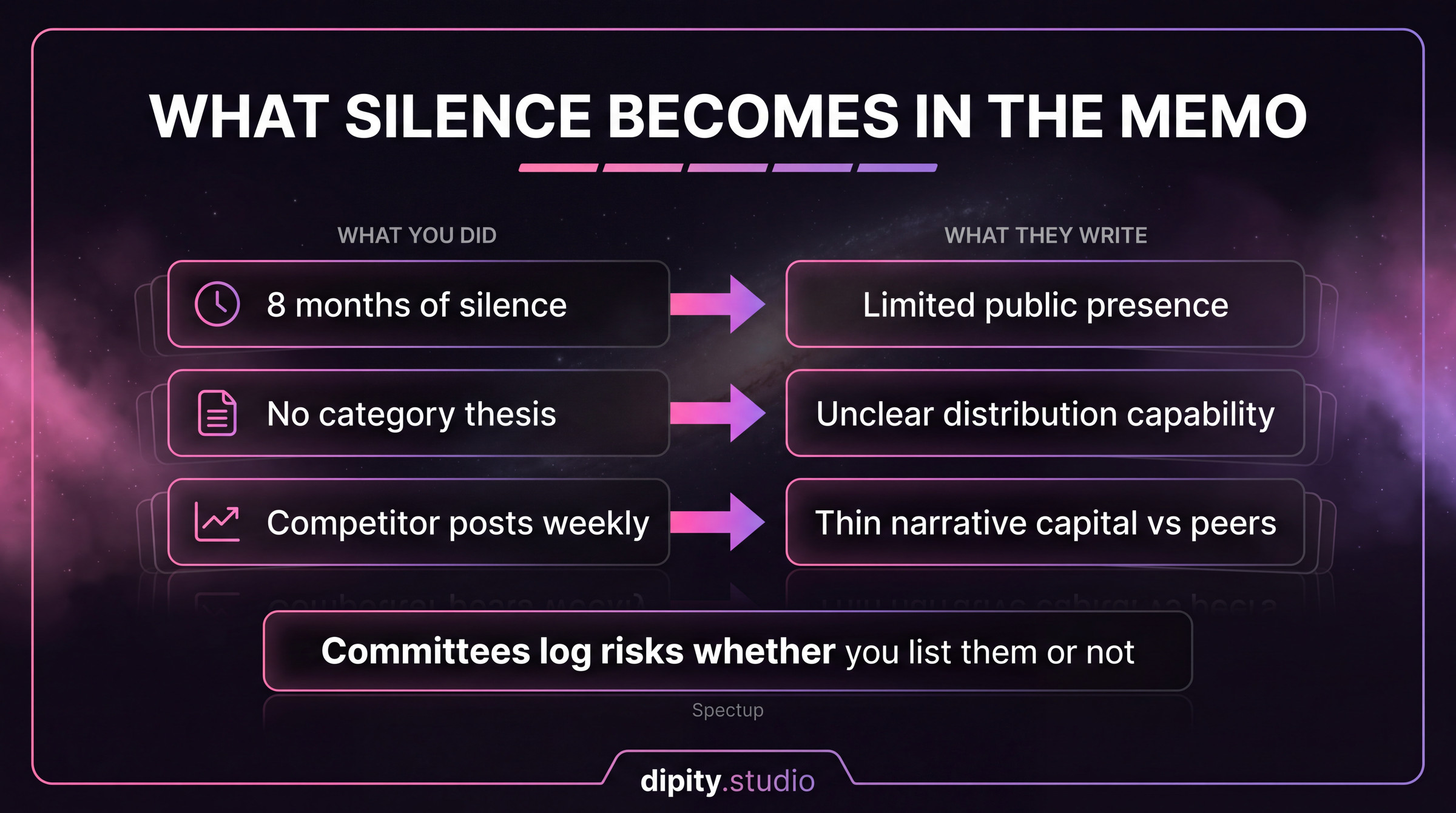
Research from Bambybig Agency defines narrative capital as the accumulated credibility, trust, and market perception a founder builds through consistent, strategic visibility. It compounds over time the same way financial capital does. When you skip content for 18 months, you're not saving time. You're spending narrative capital you haven't earned yet.
And here's the part that should keep you up at night: your competitor who IS posting, who IS publishing a thesis, who IS building narrative capital, gets the benefit of contrast. The investor doesn't evaluate your deal in isolation. They evaluate it against every other deal they've seen that quarter. A founder with a clear public narrative sitting next to a founder with no public narrative is not a fair fight. It was never going to be.
Why Is “I'm Focused on Building” a Trap and Not a Strategy?
The deflection feels strategic because it sounds disciplined. “I'm focused on the product” reads as prioritization. But the investor hears something else: this founder does not yet understand that the product and the narrative are the same job. The product does not sell itself. The category does not explain itself. The founder is the only person who ties the two together in public.
Founders from Interdependence's research confirm that founder visibility is not a vanity play. It is a trust strategy. Investors, customers, employees, and partners all want to know who is leading the company, not only what the company sells. That shift has turned founder visibility into one of the most important growth channels for modern companies.
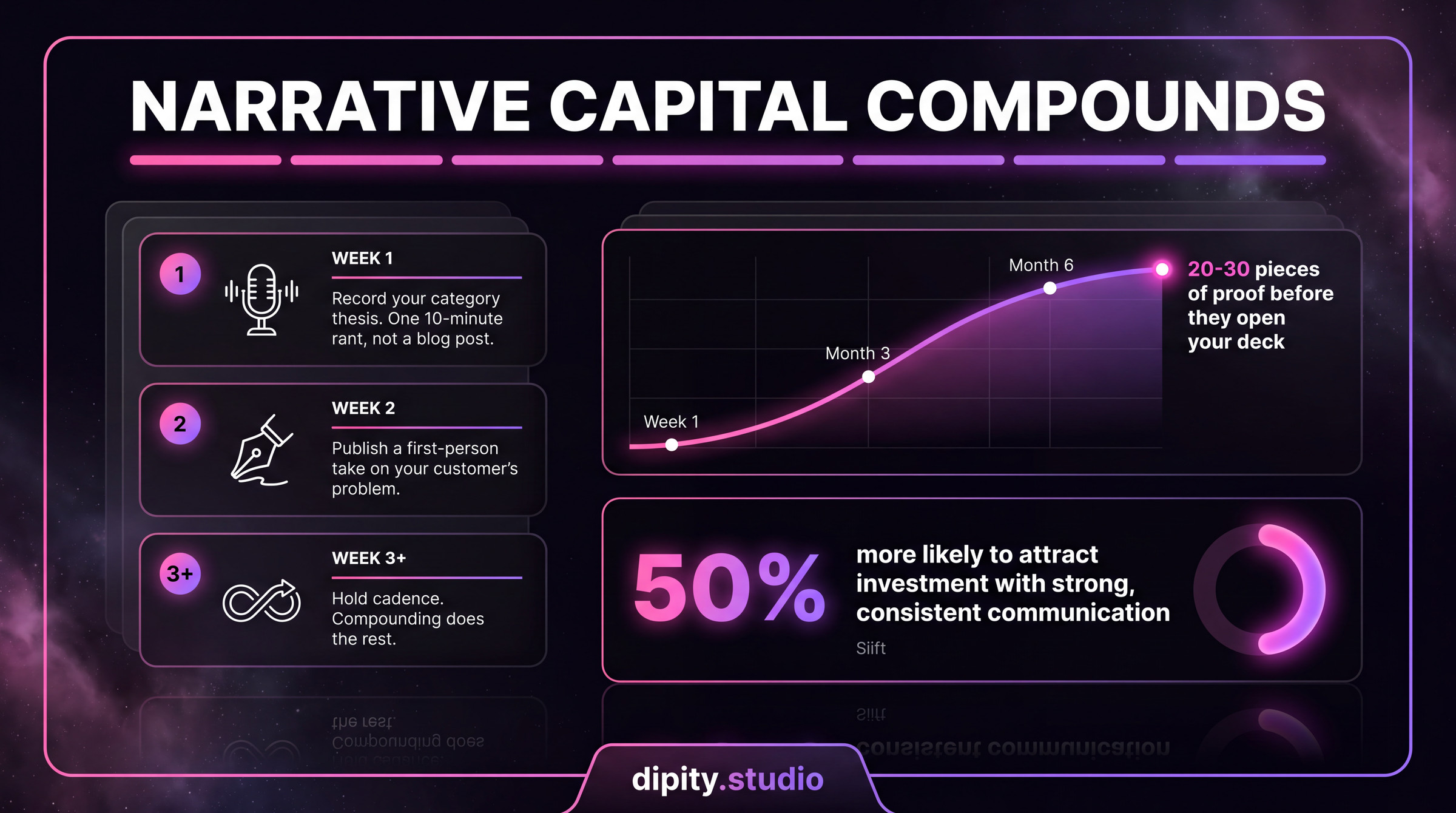
Research from Siift shows that entrepreneurs with strong communication skills are 50% more likely to attract investment and build lasting teams. That stat is not about being articulate in a pitch meeting. It is about the cumulative signal your communication sends across every surface where an investor evaluates you: your LinkedIn, your blog, your podcast appearances, your X feed, your comments on other people's posts.
The trap works like this:
- You tell the investor you're focused on building.
- The investor gives you permission to skip content.
- You leave the meeting thinking you've been given a pass.
- The investor opens your LinkedIn, sees silence, and logs it as a risk.
- The deal dies in the partner meeting. You never know why.
The permission they gave you is not the same as a pass. The permission was social courtesy. The pass was never theirs to give. It was always yours to earn.
Omnichannel presence makes the founder the inevitable choice. When an investor sees you on LinkedIn, in their podcast feed, in a blog that answers the same question they were about to ask, and in comments on posts from other founders in your category, the question stops being “should we invest?” and becomes “when do we invest?”
Are Product Focus and Public Presence in Conflict?
No. Two things are true at the same time: the technical founder should stay heads-down on product, AND they are required to show up publicly. These are not in conflict if you separate insight extraction from content execution. The value was never in the production. It was always in the brain.
This is the part most founders get wrong. They think “doing content” means learning hooks, mastering LinkedIn's algorithm, figuring out posting cadence, studying what font size works in carousel slides, and spending six hours on a Sunday writing five posts for the week. That's the production problem. And the production problem is the solved part.
The insight problem is different. The insight problem is: do you have a point of view about your category? Do you know why your product exists and why now? Do you have opinions about where your market is headed? Do you see patterns your competitors miss?
If you're a funded B2B SaaS founder building an AI-native product, the answer to all four of those questions is yes. You live inside those insights every day. You share them on calls with your co-founder. You share them in board updates. You share them with your engineering team on Monday standups.
The learning curve founders fear is a production problem, not an insight problem. You already have the insights. You already have the point of view. You already have the category thesis. What you don't have is the system that extracts those insights from your head and turns them into a consistent public narrative without requiring you to become a content creator.
That's what Dipity does. The only thing you do is record a ten-minute session where you share your thinking. That gets turned into LinkedIn posts, X posts, and blogs in your name and your voice. You stay heads-down on product. Your narrative compounds in public. Both things happen at the same time because they were never in conflict.
The best content is going to come from the founder themselves. But they need a framework that handles the production side while they run a company. The brain is the asset. Production is the commodity.
How Do You Fix the Narrative Gap Before the Next Raise?
Start by treating your public presence as a due diligence asset, not a marketing task. Investors will check your profile before, during, and after your conversations with them. The narrative you build now is the narrative they evaluate you on later. This is not a six-month project. It is a decision you make this week.
Research from Motto confirms that a sharp brand story turns an early idea into a movement, showing investors you see the problem with clarity, you own the solution, and you are the founder to lead it. That opens doors. It also closes them for your competitors who haven't done the work.
This isn't just about telling a good story once, either. Interdependence's research on strategic narrative argues that investors are now evaluating belief systems as much as balance sheets, and that founders who act as “narrative architects” — tying their data to a clear direction and purpose — earn a different kind of confidence than founders who just generate more content volume.
Here's what the fix looks like in practice:
- Week 1: Record your category thesis. Why does your product exist? Why now? Why you? This is not a blog post. This is a ten-minute rant. The production system turns it into five to seven pieces of content across surfaces.
- Week 2: Publish your first-person perspective on the problem your customers face. Not a product pitch. A founder perspective. The kind of thing that makes a prospect say “this person gets it.”
- Week 3 and beyond: Maintain cadence. The compound effect of consistent publishing means that by the time your next investor checks your profile, they find a body of work that answers their questions before they ask them.
The founders who succeed earlier are not louder. They started building visibility sooner. That's it. There's no secret formula. There's no viral hack. There's a system that separates insight extraction from content execution, and then there's consistency.
If you're raising in the next 6 to 12 months, your narrative capital starts compounding now or it doesn't compound at all. Dipity exists to make that compounding automatic. You bring the brain. We handle the production. Show. Your. Work.
Frequently Asked Questions
Do investors check LinkedIn before taking a meeting with a founder?
Yes. Research from the Azarian Growth Agency and multiple VC due diligence frameworks confirm that social media profiles are part of pre-screening. Associates at VC firms skim founder profiles in under 60 seconds to assess whether someone feels venture-backable. Your LinkedIn is often the first filter, not the last.
Is an empty LinkedIn profile a dealbreaker for fundraising?
It is not an automatic dealbreaker, but it is a risk signal that gets logged in internal memos. According to Vcheck Global, 7 out of 10 top-performing VC firms conduct deep-dive background and presence checks. An empty profile forces the investor to build your narrative for you, and they will never build it as well as you would.
How do technical founders build a public presence without becoming full-time content creators?
Separate insight extraction from content execution. The insights already exist in the founder's head. The production, which includes hooks, formatting, cadence, distribution, is a solved operational problem. A system like Dipity extracts founder thinking through short recording sessions and handles production, publishing, and distribution without requiring the founder to learn content creation.
How long does it take to build enough narrative capital to influence a raise?
Narrative capital compounds. Three to six months of consistent publishing builds a body of work that changes how investors evaluate you. Starting 30 days before a raise is too late. Starting six months before a raise means the investor finds 20 to 30 pieces of evidence that you understand your category, your customer, and your market before they ever open your deck.
Works Cited
Azarian Growth Agency. (2026, March). https://azariangrowthagency.com/vc-social-media/
Bambybig Agency. (2026, May). https://bambybig.agency/blog/what-is-narrative-capital
Interdependence. (2026, June). https://www.interdependence.com/founder-visibility-is-the-new-growth-channel/
Interdependence. (2025, November). https://www.interdependence.com/turning-insight-into-investor-confidence-the-power-of-strategic-narrative/
Siift. (2025, July). https://siift.ai/blog/business-communication-skills-for-aspiring-entrepreneurs-2025-en
SignalX. (2026, February). https://signalx.ai/venture-capital-due-diligence/
Spectup. (n.d.). https://www.spectup.com/resource-hub/vc-investment-memo
Under30CEO. (2026, February). https://www.under30ceo.com/linkedin-profile-signs/
Vcheck Global. (2024, June). https://vcheckglobal.com/the-shifting-nature-of-background-checks-in-venture-capital
Motto. (2025, October). https://wearemotto.com/blog/building-investor-confidence-through-clear-brand-led-narratives
Editor's note: dates above reflect what could be confirmed on each live page at fact-check time (2026-08-03); the Interdependence “strategic narrative” piece is corrected from December to November 2025 based on its on-page publish date.

.svg)







Get weekly updates
*We’ll never share your details.
Follow us — @Dipity










Join Our Newsletter
Get a weekly selection of curated articles from our editorial team.