

Does the Founder Move the Valuation? 44% of Market Value Says Yes.
Executives attribute ~44% of market value to the CEO. In 2025, buyers decide at 61% of the journey and the first vendor wins ~80%. Founder authority is a balance-sheet asset.
Does the Founder Move the Valuation? 44% of Market Value Says Yes.
Does the Founder Move the Valuation? 44% of Market Value Says Yes.
By Morgan Von Druitt, Founder, Dipity
TL;DR: Executives attribute roughly 44% of their company's market value and 45% of its reputation to the CEO's own reputation, per Weber Shandwick. In 2025, buyers make first contact at just 61% of the journey and the first vendor they call wins ~80% of the time, so the founder's visibility is deciding deals before sales ever picks up. Personal profiles out-earn the company page 5x on engagement, and 71% of hidden buyers evaluate you with little or no sales contact at all. Founder reputation isn't a vanity project - it's a balance-sheet asset that compounds into valuation, pipeline, and talent, and it decays the second you go quiet.
Most founders treat their personal brand like a nice-to-have. Something to get to after the roadmap, the raise, the next hire. I get it - posting on LinkedIn feels like the least CFO-approved thing you could possibly do with a Tuesday. But the data keeps saying the opposite of what your gut says, and it's not close. Your reputation isn't sitting off to the side of the business. It's inside the valuation. Let me show you the receipts.
Does the founder actually move the valuation, or is that just LinkedIn cope?
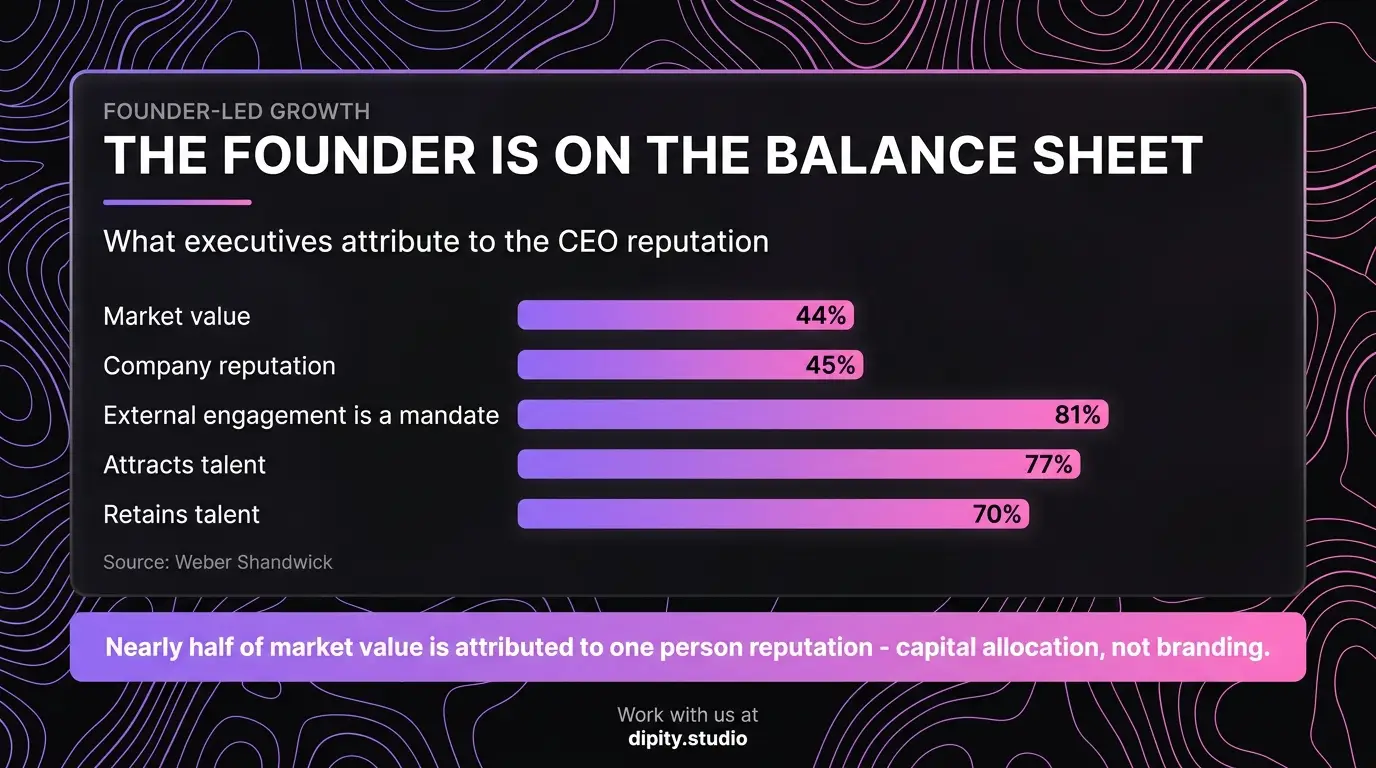
It moves it - by about 44%, according to the people who'd know. In Weber Shandwick's study The CEO Reputation Premium, conducted with KRC Research across more than 1,700 senior executives in 19 countries, executives attributed 44% of their company's market value to the reputation of their CEO. They also pinned 45% of the company's overall reputation on that same person. Read that again: the people running these companies believe nearly half of what the market thinks of them, and nearly half of what the market pays for them, traces back to one human.
That's not a soft branding metric. That's a line item. When almost half of market value is attributed to the founder's reputation, 'should I invest in my personal profile' stops being a marketing question and becomes a capital-allocation one. And it's not a one-off finding - 81% of those same executives said external CEO engagement is now a mandate for building company reputation, not a bonus. Eighty-one percent. The days when the strong-and-silent founder was a viable strategy are over. Silence used to read as gravitas. Now it just reads as absence.
Why does the founder matter more than the brand right now?
Because buyers have quietly decided that what you say is worth more than how famous you are. The 2025 Edelman-LinkedIn B2B Thought Leadership Impact Report found that 53% of decision-makers agree that if an organization produces high-quality thought leadership, it matters much less to them how well-known that organization is. Translation: strong founder content can beat brand recognition outright. You don't need to be the biggest name in your category. You need to be the sharpest voice in it.
This is genuinely good news if you're a seed-to-Series-B founder, because you are never going to out-spend the incumbent on brand. You can absolutely out-think them in public. The same report found that 95% of hidden decision-makers say strong thought leadership makes them more receptive to sales and marketing outreach. Ninety-five percent. Your founder content isn't competing with your pipeline - it's warming it. Here's how that stacks up:
• Ideas beat awareness. 53% say quality thought leadership matters more than how well-known you are, so a smaller brand with a loud founder can win the consideration set.
• Content is a receptiveness engine. 95% say strong thought leadership makes them more open to your outreach - your posts are doing pre-sales work while you sleep.
• Alignment is the real killer. Edelman also found more than 40% of B2B deals stall because of internal misalignment inside the buying group - and a clear founder POV is what gives your champion the language to sell you internally.
What's happening in the deal before you even know it exists?
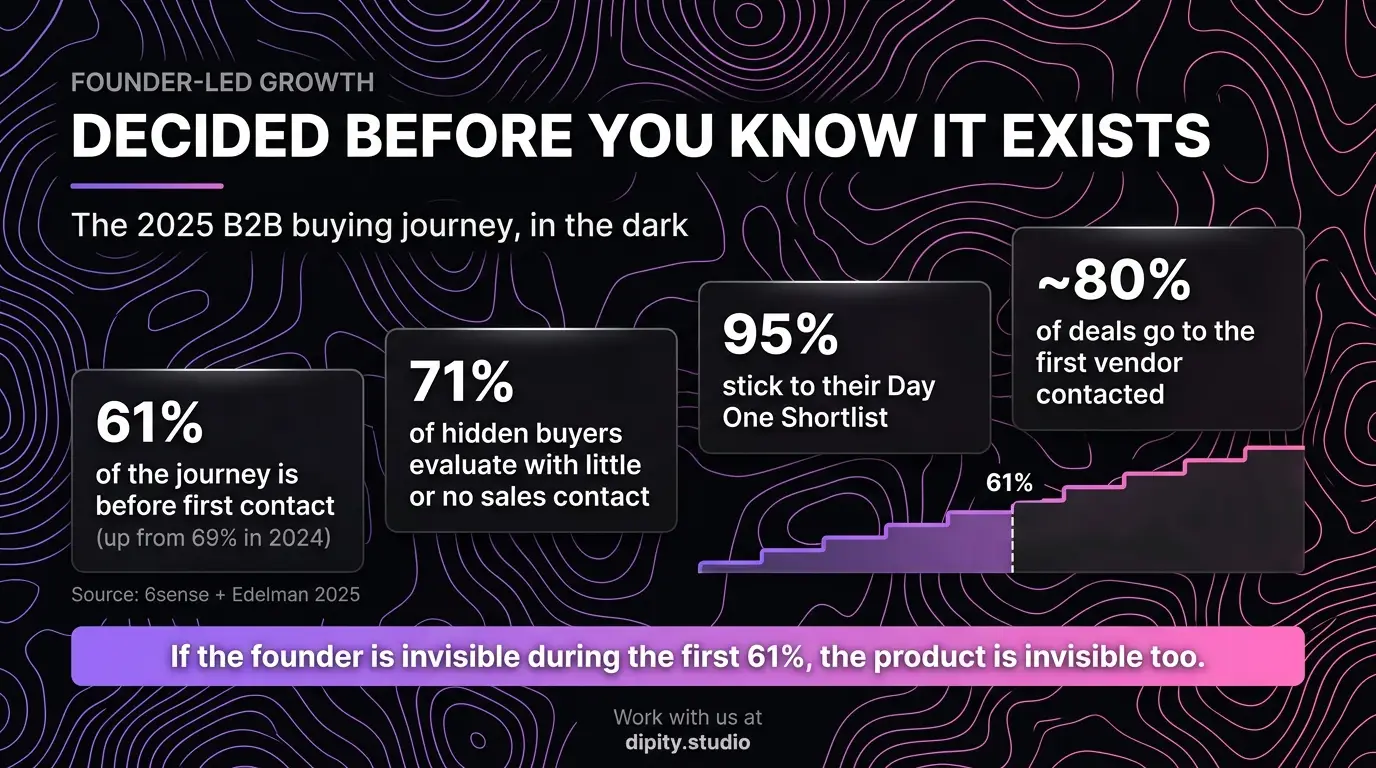
Almost all of it. This is the stat that should ruin a few sales leaders' week. 6sense's 2025 B2B Buyer Experience Report found that the point of first contact between buyer and seller has slid to 61% of the way through the buying journey in 2025 - it was around 69% just a year earlier. By the time a prospect fills out your form, they're nearly two-thirds done. They've researched, shortlisted, and mostly made up their mind. In the dark. Without you in the room.
And who wins that dark, un-witnessed process? The same report found the vendor buyers contact first wins roughly 80% of deals - eight out of ten. Buyers also stick to a 'Day One Shortlist' of vendors 95% of the time, meaning if you're not on the list before the conversation starts, you're basically not in it. So the entire game is: be the name they already trust when they surface. That trust doesn't get built by your SDR - it gets built by your founder showing up in the feed for months beforehand.
If 61% of the journey happens before first contact and the first vendor wins 80% of the time, then your founder's visibility isn't top-of-funnel. It's the whole funnel, running silently, for weeks, before anyone tells you a deal exists.
This ties the whole thing together. The Edelman 'hidden buyer' research found 71% of decision-makers say they have relatively little or no interaction with sales at all. They evaluate you entirely through your content and your reputation. If the founder is invisible in that window, the product is invisible too - and you never even get the data to know what you lost.
Should the founder post, or should the company page handle it?
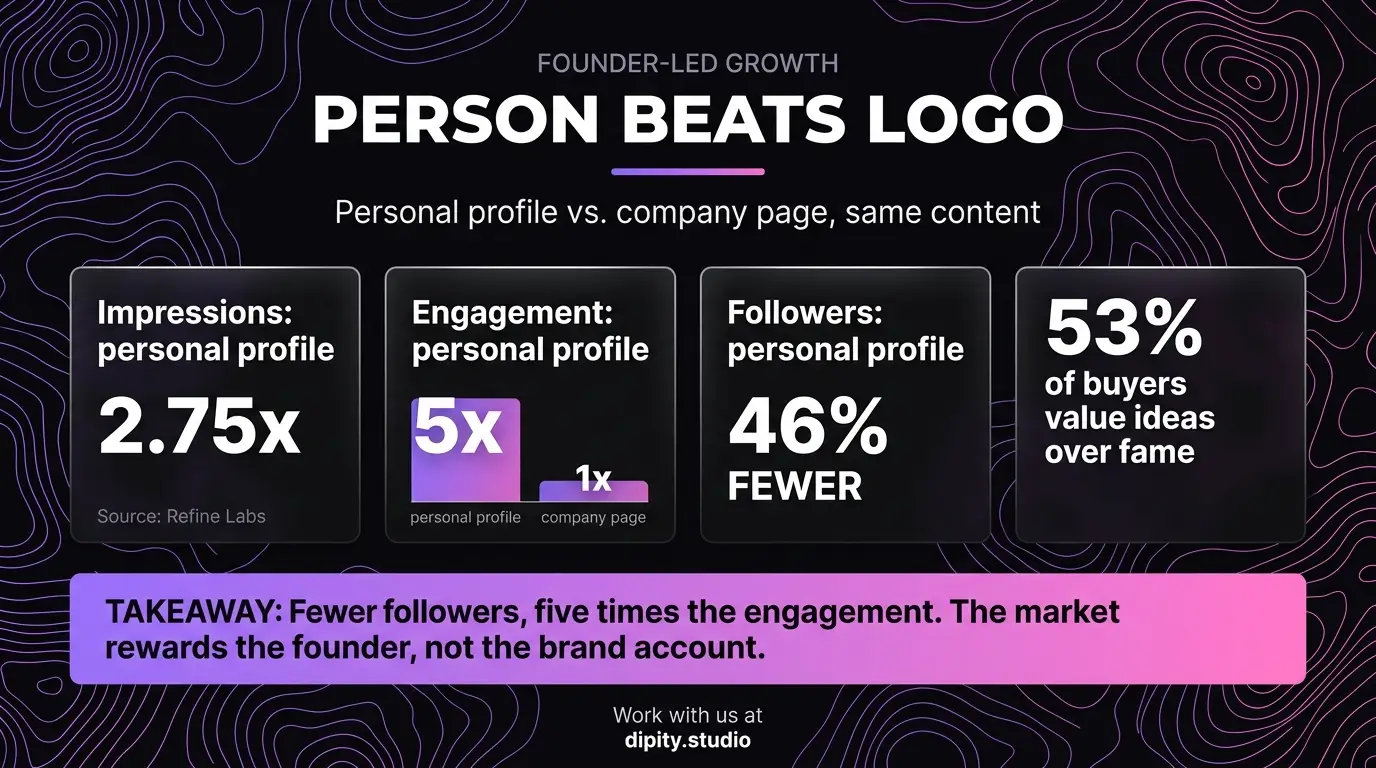
The founder, and it's not remotely close. Refine Labs ran the comparison directly and found that sharing through a personal profile drove 2.75x more impressions and 5x more engagement than the same content on the company page. And the kicker: those personal profiles had 46% fewer followers on average than the company page. Fewer followers, five times the engagement. The algorithm - and, more importantly, the humans on the other side of it - reward the person, not the logo.
This matches everything I've seen in the field. People don't want to have a relationship with a brand account that posts like a press release. They want to hear from the person who actually decided what to build and why. I scaled a client to 10M impressions in 8 months by leaning entirely into the founder's real voice - not a polished corporate mouthpiece, the actual opinions of the actual person - and the pipeline followed the attention. Here's the split that matters:
• Personal reach compounds. 2.75x more impressions from a personal profile, so the same idea travels almost three times as far in your name than in the company's.
• Personal trust compounds harder. 5x more engagement means people don't just see it, they reply, share, and remember - that's the relationship that puts you on the Day One Shortlist.
• Followers aren't the moat. Those profiles won with 46% fewer followers, so you don't need a huge audience - you need a real one that hears a real voice.
What does founder silence actually cost you?
Valuation, pipeline, and the people you're trying to hire - and unlike a bad ad campaign, this bill comes due quietly. Start with talent. Weber Shandwick found a strong CEO reputation both attracts and retains employees - 77% and 70% respectively. So the same reputation that moves your market value is also moving your recruiting funnel. When you're a seed-stage company fighting FAANG for a staff engineer, the founder's public credibility is one of the only edges you actually have. An invisible founder forfeits it.
Now the harder truth: reputation is an asset, but it's a decaying one. It's not a monument you build once. It behaves more like fitness than like a building - it responds to consistent work and it atrophies the moment you stop. The 61% point-of-first-contact number moved eight points in a single year, which tells you how fast buyer behavior shifts underneath you. If your voice was loud during your last raise and has gone quiet since, the compounding has already reversed. The market doesn't remember the founder who posted brilliantly for one quarter in 2024. It remembers the one who's in the feed this week. Here's what the silence quietly costs:
• Valuation drift. ~44% of market value is attributed to CEO reputation, so an unmanaged reputation leaves a huge chunk of your value to chance.
• Pipeline you never see. 71% of hidden buyers evaluate with little or no sales contact - if you're not visible, you're being cut in a room you were never invited to.
• Talent that picks the louder founder. 77% attraction and 70% retention ride on CEO reputation - silence sends your best candidates to a competitor who showed up.
How do you turn this into a balance-sheet asset instead of a New Year's resolution?
You install a system that runs the founder's real voice consistently, in the founder's own name - not a ghostwriter cosplaying as you. The reason most founders fail at this isn't laziness. It's that the two obvious options both suck. Doing it yourself means it dies the first busy week. Hiring a ghostwriter means a stranger posts bland, safe takes under your name, buyers smell it instantly, and you get the reach without the trust - which is the one thing that actually mattered.
That's the gap Sera closes. Sera is a founder-authority platform that installs your real voice, your ICP, your content pillars, and your competitive positioning - then runs the content engine across LinkedIn, X, and your blog in your own name. Not a generic voice. Yours. It's anti-ghostwriter by design, because the whole 44%, the whole 5x, the whole 80%-first-vendor advantage depends on the words sounding like they actually came from the person the market is betting on. We run it as a 14-day sprint today, and we're building toward self-serve. The point is simple: make the compounding automatic so it never goes quiet when you get busy - which, as a funded founder, is always.
Conclusion: Your reputation is already on the balance sheet - the only question is whether you're managing it
Here's the whole argument in one breath. Executives attribute ~44% of market value and ~45% of reputation to the CEO. Buyers make first contact at 61% of the journey and hand ~80% of deals to the first vendor they trust. 71% of them barely talk to sales at all, 53% weigh your ideas over your fame, and your personal profile out-earns your company page 5x. This isn't a case for 'doing more content.' It's a case that founder authority is a financial asset that's either compounding or decaying right now, today, whether or not you've decided to pay attention to it.
Buyers buy the founder first. When the founder's invisible, the product's invisible - and you never even get the data on what you lost. If you're a funded B2B SaaS founder ready to treat your voice like the asset it already is, come see how Sera installs it. Start at dipity.studio.
Frequently Asked Questions
Is the 44% market value stat still relevant if the Weber Shandwick study is a few years old?
The core finding - that executives attribute ~44% of market value and ~45% of reputation to the CEO - has held up, and the 2025 data only sharpens it. 6sense's 2025 report shows buyers deciding at 61% of the journey and the first vendor winning ~80% of deals, while Edelman's 2025 research shows 71% of buyers evaluating with little sales contact. The trend has moved toward the founder, not away.
I'm a small startup, not a public company. Does CEO reputation still matter to my valuation?
Arguably more. Public companies have decades of brand equity to lean on. You don't. 53% of buyers say strong thought leadership matters more than how well-known you are - which is precisely the lever a smaller company can pull to punch above its brand. At seed to Series B, the founder's reputation often is the brand.
Can't a ghostwriter just handle my founder content?
They can handle the volume, but they usually kill the thing that makes it work. The advantage in the data - 5x engagement on personal profiles, 95% more receptivity from strong thought leadership - comes from an authentic voice buyers trust. Generic ghostwritten posts get reach without trust. Sera is built to run your actual voice, which is the opposite approach.
How fast does founder authority actually pay off?
Faster than most expect on attention, slower on trust - and both compound. I scaled a client to 10M impressions in 8 months, but the pipeline effect builds as you keep showing up in that pre-first-contact window. Because 61% of the buying journey happens before you're contacted, the founders who start now are seeding deals they won't see surface for months.
What happens if I post consistently for a while and then stop?
The asset decays. Reputation behaves like fitness, not architecture - it responds to consistent work and atrophies without it. Buyer behavior shifted eight points in a single year (69% to 61% point-of-first-contact), so the market's attention resets fast. A founder who was loud last raise and quiet since has already lost most of the compounding. Consistency is the entire game, which is exactly why we built a system to protect it.
Works Cited
Weber Shandwick & KRC Research. (2015). The CEO Reputation Premium: A New Era of Engagement. Link
Weber Shandwick. (2015). 81% of Global Executives Report External CEO Engagement Is a Mandate for Building Company Reputation. Link
Edelman & LinkedIn. (2025). 2025 B2B Thought Leadership Impact Report. Link
Edelman. (2025). The Rise of the Hidden Buyer: Rethinking B2B Influence Beyond the Obvious. Link
6sense. (2025). The B2B Buyer Experience Report for 2025. Link
Refine Labs. (2024). Personal LinkedIn Profiles Outperform Company Pages with 5x More Engagement. Link

.svg)


Get weekly updates
*We’ll never share your details.
Follow us — @Dipity











Join Our Newsletter
Get a weekly selection of curated articles from our editorial team.