

When AI Makes Execution Free, Your Voice Becomes the Only Moat
AI inference cost fell 280x and half of new articles are now machine-written. When execution is free, the founder's voice becomes the only defensible moat left.

When AI Makes Execution Free, Your Voice Becomes the Only Moat
The 280x Collapse: When AI Makes Execution Free, Your Voice Becomes the Only Moat
By Morgan Von Druitt, Founder, Dipity
TL;DR: The cost of running a GPT-3.5-quality model fell from $20.00 to $0.07 per million tokens in about 18 months - a 280-fold collapse, per Stanford's 2025 AI Index. Organizational AI use jumped to 78% in 2024 from 55% a year earlier, and roughly 52% of newly published articles are now machine-written, according to Graphite. Meanwhile MIT found 95% of enterprise GenAI pilots delivered zero P&L impact, and Menlo Ventures clocked $37B in enterprise AI spend with only 16% of deployments qualifying as real agents. When execution goes to zero and the web fills with slop, the last scarce input is the founder's judgment, taste, and actual voice.
I've been building content engines for founders long enough to remember when 'make more content' was a real strategy. It isn't anymore. The economics that made content scarce - the hours, the writers, the cost per word - just got vaporized. And the moment something becomes free, it stops being valuable. That's not a hot take, that's supply and demand.
So here's the question I want to sit with in this post: if AI can now produce infinite competent-looking content for pennies, what's actually left worth paying for? I think the answer is uncomfortable for a lot of people, and freeing for the founders who get it. Let's walk through the numbers, because they tell a cleaner story than any opinion I could give you.
What actually happened to the cost of running AI?
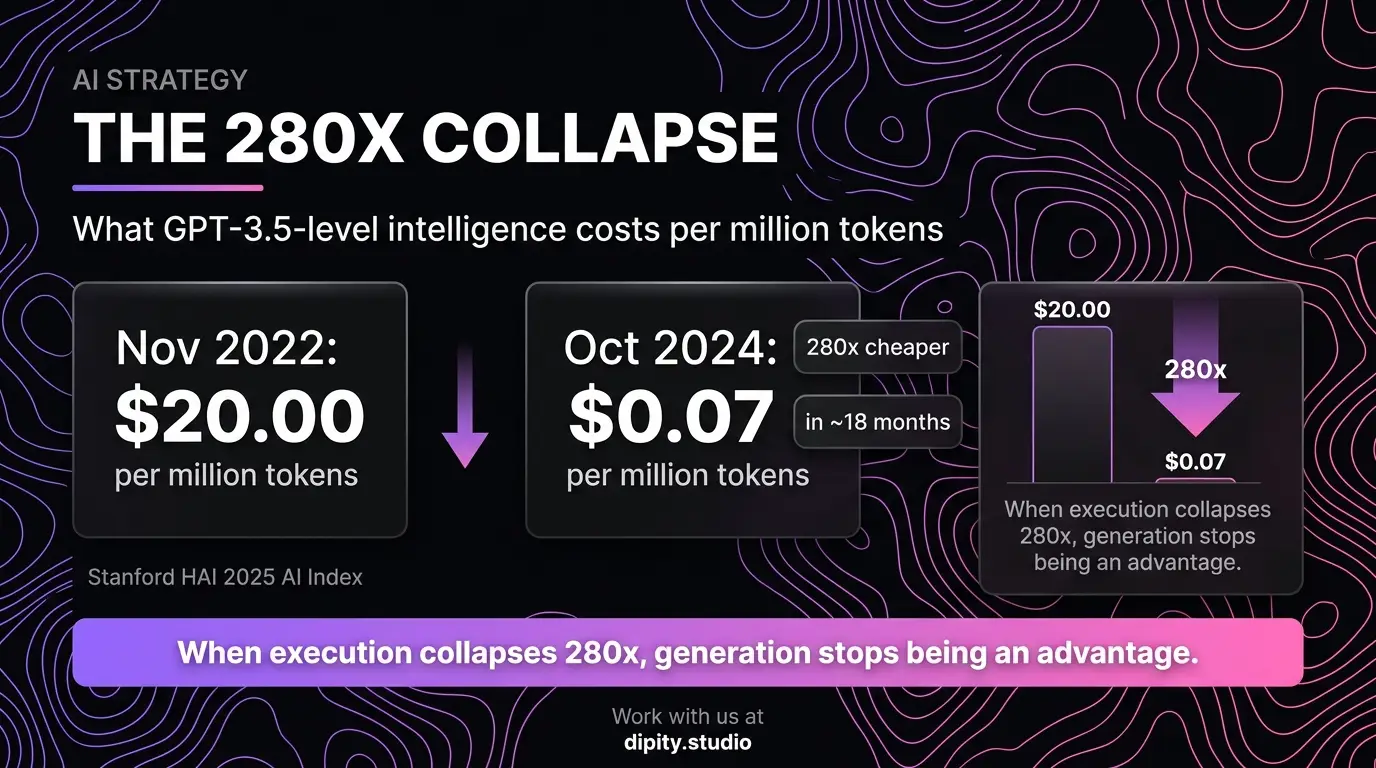
It fell off a cliff - roughly 280x in about 18 months. According to the Stanford HAI 2025 AI Index Report, the cost of querying a model that scores GPT-3.5 level on the MMLU benchmark (64.8% accuracy) dropped from $20.00 per million tokens in November 2022 to just $0.07 per million tokens by October 2024. Stanford calls it a 'more than 280-fold reduction in approximately 18 months.' Let me translate that: the intelligence that felt like magic when ChatGPT launched now costs about a third of a cent per thousand words to reproduce. The thing you were amazed by in 2022 is a rounding error in 2024.
And people noticed. The same report found that the share of organizations reporting AI use jumped to 78% in 2024, up from 55% the year before (Stanford breaks this and nine other findings down in its state of AI in 10 charts). So in a single year, adoption went from 'half of companies are dabbling' to 'almost everyone is in.' Cost collapsed, access exploded. Classic technology curve - except this curve is steeper than almost anything we've seen, and it's aimed straight at knowledge work.
Here's the part founders underprice: when the cost of doing a thing drops 280x, the thing itself becomes a commodity. Fast. The competitive edge never lives in the commodity. It lives in whatever the commodity can't replace.
So why is half the internet suddenly written by machines?
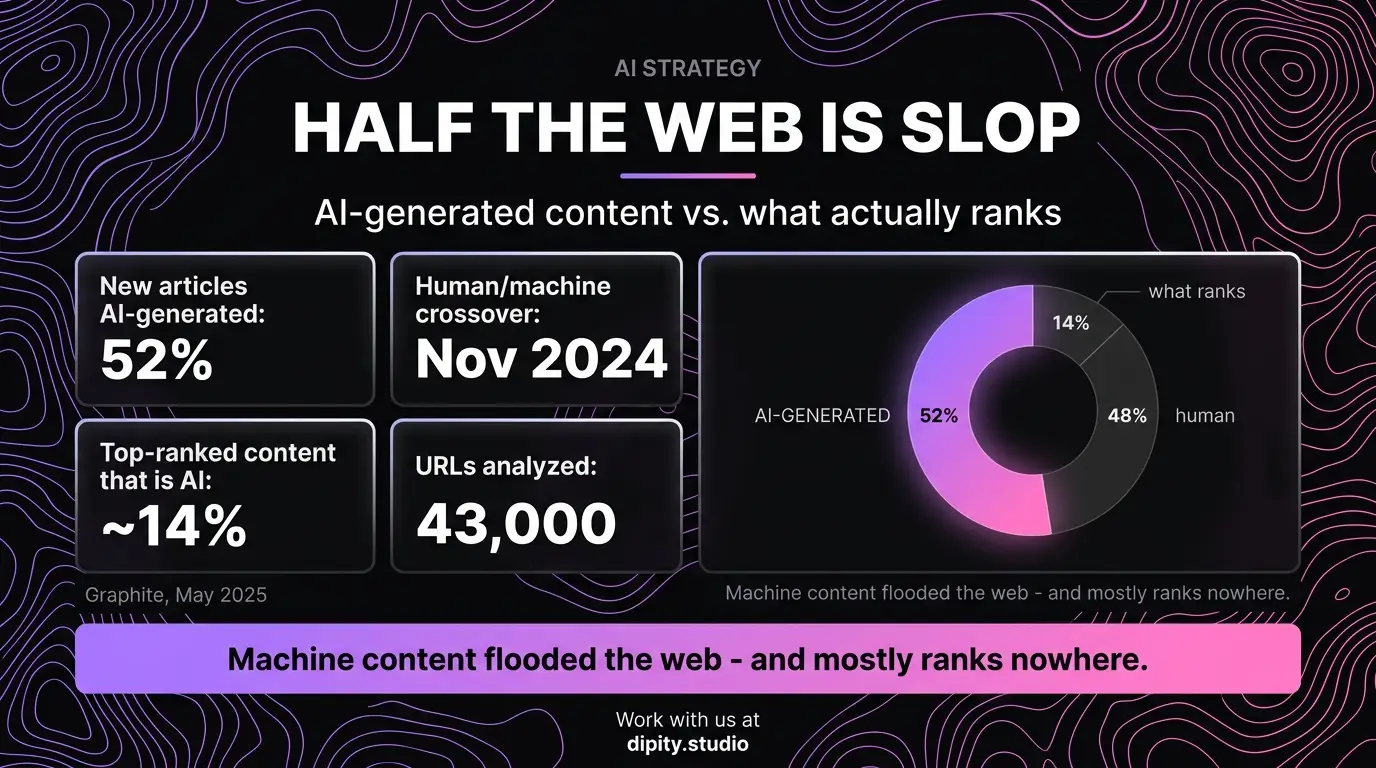
Because when producing an article costs pennies, people produce a mountain of articles. Research firm Graphite ran the numbers on 43,000 URLs pulled from Common Crawl and found that as of May 2025, about 52% of newly published articles on the web are AI-generated - and the crossover point, where machine-written content first surpassed human-written content, happened back in November 2024. You can read their full methodology in the original Graphite study, and I'd encourage it, because the nuance is the whole story.
The headline is 'half the internet is slop.' The footnote is the part that should change how you think. Graphite found that these AI-generated articles largely don't show up in Google or ChatGPT results - only around 14% of the highest-ranking content was flagged as AI-generated. In other words, the flood of machine-written content is real, and it's mostly invisible. It ranks nowhere. It converts no one. It's digital landfill produced at industrial scale.
That's the trap the cost collapse set. Cheap execution doesn't just let good operators move faster - it lets everyone carpet-bomb the internet with generic, voiceless, technically-fine content that no human asked for and no algorithm rewards. The web didn't get smarter. It got louder. And 'louder' is now free, which means 'louder' is worthless.
When execution costs nothing, doing more of it is not a strategy. It's noise with a publish button.
If content is basically free now, why is almost nobody winning with it?
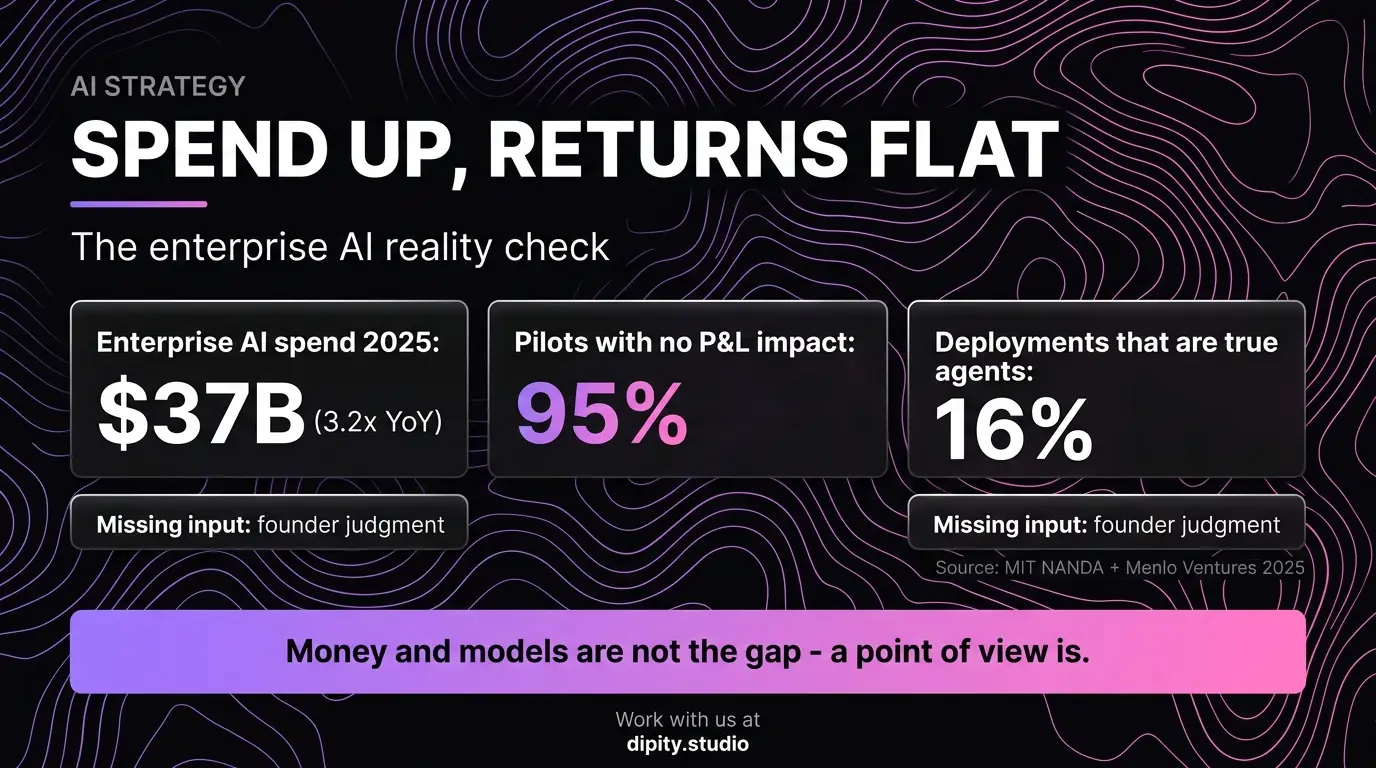
Because spending on AI and getting a return from AI turn out to be very different sports. MIT's Project NANDA published its 'State of AI in Business 2025' report and found that 95% of enterprise generative-AI pilots delivered no measurable P&L impact. Ninety-five percent. Not 'modest returns' - no measurable impact on the bottom line at all. Only about 5% of integrated pilots were pulling real value out the other end.
Now stack that against the money going in. Menlo Ventures' 2025 State of Generative AI in the Enterprise report pegged enterprise AI spend at $37B in 2025, up from $11.5B in 2024 - a 3.2x jump year over year, the fastest-growing software category they've ever tracked. And yet, when Menlo looked under the hood at all those 'AI agents' everyone's shipping, only 16% of enterprise deployments actually qualified as true autonomous agents. The rest were fixed-sequence workflows in a trench coat.
Put the three facts side by side and the picture snaps into focus:
• Cost went to zero. A 280x drop means anybody can generate anything, so generation itself carries no advantage - Stanford's own data.
• Volume exploded. Roughly 52% of new articles are machine-made, and most of it ranks nowhere - Graphite's finding, not a vibe.
• Returns didn't follow. 95% of enterprise pilots showed no P&L impact despite $37B in spend - MIT and Menlo, respectively.
The tools got cheaper and more powerful, adoption went vertical, and the results mostly flatlined. That's not a tooling problem. You can't buy your way out of it with a bigger model or a slicker agent. The missing ingredient is upstream of the technology entirely.
What's the one input AI genuinely can't fake?
You. Specifically, your judgment, your taste, and the actual point of view only you hold. Every model on earth is trained on the average of what already exists. That's what makes it fast, and it's also its ceiling. AI is a spectacular imitator of the median and a terrible source of conviction. It can remix every take that's already been published. It cannot originate the one you haven't said yet - the contrarian call you'd stake your reputation on, the specific way you see your market that nobody else does.
This is why the slop doesn't rank and the pilots don't pay off. Generic in, generic out. The 95% who got nothing didn't fail because the model was too weak - they failed because they pointed a powerful averaging machine at a problem that required a point of view, and averages don't move markets. The 5% who won had a human supplying judgment the machine couldn't.
For a funded B2B SaaS founder, this should feel like good news, because the scarce asset turns out to be the one thing you already own and no competitor can copy:
• Your judgment. The calls you make about what matters, what's overhyped, and where the market's about to go - that's a proprietary dataset that lives in your head.
• Your taste. Knowing what's good, what to cut, and what deserves a stake in the ground is exactly what the median-machine lacks by construction.
• Your voice. The specific way you'd explain your category to a smart friend is the thing buyers actually trust - and the thing AI flattens into mush the second you let it run unsupervised.
Cost collapsing 280x didn't make founder authority less valuable. It made it the only thing left that's still scarce. When everyone has the same infinite content machine, the differentiator can't be the machine. It has to be the person aiming it.
How do you put your voice to work without drowning in your own slop?
You use AI to amplify your authority, not to replace it - which is a design choice most tools get exactly backwards. The default move is to hand a model a topic and let it produce voiceless filler in your name. That's how you become part of the 52%. The right move is to make the founder's actual point of view the input the whole engine runs on, so scale amplifies your voice instead of diluting it.
That inversion is why I built Sera. Sera is a founder-authority platform: it installs your voice, your ideal customer profile, your content pillars, and your positioning, then runs the content engine in your name - as you, not as a nameless ghostwriter smoothing you into the median. It's deliberately anti-ghostwriter. The goal isn't to sound like 'a thought leader.' It's to sound like you, at a volume and consistency you couldn't hit alone.
And here's the part that compounds. Every time you feed Sera a real judgment call - what you believe, who you're for, what you refuse to say - that founder-intent data doesn't evaporate. It accumulates into a proprietary asset that gets more you over time. Your competitor can buy the same model you use. They cannot buy years of your accumulated intent. That's a moat that widens with every post, and it's the opposite of the disposable content clogging the other half of the web.
• Installed, not bolted on. Sera captures voice, ICP, pillars, and positioning up front, so the engine starts from your conviction instead of the internet's average.
• Published in your name. Anti-ghostwriter by design - the output carries your authority, because it's built from your judgment, not a generic template.
• Compounding moat. Founder-intent data stacks into a proprietary asset no competitor can replicate, because they don't have your point of view.
Today that runs as a 14-day sprint to stand the whole thing up. We're an AI-native company building for AI-native founders, and we're raising a $500K-$2M seed round to take Sera fully self-serve so any funded founder can install their authority without waiting on us. The bet underneath all of it is simple: in a world where execution is free, the founder's voice is the last defensible input, and it deserves infrastructure built around it - not a prompt box that averages it away.
Conclusion: The work doesn't save you, the category doesn't save you, only your voice does
Line the receipts up one more time. Inference cost fell 280x (Stanford). Adoption hit 78% (Stanford). Half of new articles are machine-made and most rank nowhere (Graphite). 95% of enterprise pilots returned nothing (MIT). $37B got spent and only 16% of it is real agents (Menlo). Every one of those numbers points the same direction: producing more stuff is no longer a strategy, because producing more stuff is now free, and free things don't win markets.
What's left is the input the machine can't manufacture. The work doesn't save you - anyone can generate the work now. The category doesn't save you - your category is filling with slop as we speak. Only your voice does. Your judgment, your taste, your specific, defensible point of view, put to work at scale and compounding into a moat.
If you're a funded founder and you'd rather use AI to amplify your authority than dissolve it into the 52%, come see what installing your voice actually looks like. Start at dipity.studio. Bring the point of view. We'll build the engine around it.
Frequently Asked Questions
Is the '280x cost collapse' figure real, or marketing spin?
It's real and it's primary-sourced. Stanford's 2025 AI Index Report states the cost of querying a GPT-3.5-level model (64.8% on MMLU) dropped from $20.00 per million tokens in November 2022 to $0.07 by October 2024 - a more than 280-fold reduction in roughly 18 months. It's Stanford HAI's own analysis, not a vendor claim.
Is half the internet really AI-generated now?
Roughly, yes - with a huge caveat. Graphite's study of 43,000 Common Crawl URLs found about 52% of newly published articles were AI-generated as of May 2025, with the human-vs-machine crossover happening in November 2024. But only around 14% of top-ranking content was flagged as AI-generated, so most of that machine-written volume ranks nowhere and reaches almost no one.
If 95% of enterprise AI pilots failed, why should I invest in AI content at all?
Because the failure wasn't the technology - it was pointing an averaging machine at problems that needed a point of view. MIT's NANDA report found 95% of pilots had no measurable P&L impact, but the 5% that worked had a human supplying real judgment. The lesson isn't 'avoid AI,' it's 'AI amplifies whatever you feed it, so feed it your voice, not a generic brief.'
How is Sera different from an AI writing tool or a ghostwriter?
An AI writing tool hands you a prompt box that averages you toward the median. A ghostwriter sounds like a ghostwriter. Sera installs your voice, ICP, pillars, and positioning and publishes in your name as you - and every judgment you feed it compounds into a proprietary founder-intent asset a competitor can't copy. It's a founder-authority platform, not a content faucet.
Who is Sera actually for?
Funded B2B SaaS founders, roughly seed through Series B, who have a real point of view and no time to publish it consistently. It runs today as a 14-day sprint, and we're raising a seed round to take it self-serve. If you'd rather use AI to sharpen your authority than dilute it, that's the fit.
Works Cited
Stanford Institute for Human-Centered AI (HAI). 'The 2025 AI Index Report' and 'AI Index 2025: State of AI in 10 Charts.' Inference cost fell from $20.00 to $0.07 per million tokens (280x, ~18 months); organizational AI use rose to 78% in 2024 from 55% in 2023. hai.stanford.edu/ai-index/2025-ai-index-report
Graphite. 'More Articles Are Now Created by AI Than Humans.' Analysis of 43,000 Common Crawl URLs; ~52% of new articles AI-generated as of May 2025, crossover in November 2024, ~14% of top-ranked content AI-flagged. graphite.io/five-percent/more-articles-are-now-created-by-ai-than-humans
MIT Project NANDA. 'The State of AI in Business 2025.' Finding that 95% of enterprise generative-AI pilots delivered no measurable P&L impact; reported via Fortune, August 18, 2025. fortune.com/2025/08/18/mit-report-95-percent-generative-ai-pilots-at-companies-failing-cfo
Menlo Ventures. '2025: The State of Generative AI in the Enterprise.' Enterprise AI spend of $37B in 2025 (up from $11.5B in 2024, 3.2x YoY); only 16% of enterprise deployments qualify as true autonomous agents. menlovc.com/perspective/2025-the-state-of-generative-ai-in-the-enterprise

.svg)


Get weekly updates
*We’ll never share your details.
Follow us — @Dipity











Join Our Newsletter
Get a weekly selection of curated articles from our editorial team.