

Almost Every SaaS Brand Is Invisible. Your Founder Is the Way to Get Noticed.
Only 6% of B2B SaaS brands call themselves “very distinctive” and 80% are beige. Category Kings take up to ~76% of the value. Here's why your founder is the way out.
Almost Every SaaS Brand Is Invisible. Your Founder Is the Way to Get Noticed.
The Beige Trap: Why Almost Every SaaS Brand Is Invisible, and Why Your Founder Is the Way Out
By Morgan Von Druitt, Founder, Dipity
TL;DR: Only 6% of B2B SaaS brands call themselves 'very distinctive,' and an audit of 100 SaaS and AI companies found 80% of them are generic or flat-out invisible. Meanwhile Category Kings capture up to ~76% of their category's total market value, and 95% of B2B buyers say a strong point of view makes them more receptive to you. The math is brutal and simple: in a sea of sameness, the fastest distinctive asset a startup owns is a human - the founder - and category ownership comes from that founder's contrarian point of view, not another feature list. That's the entire reason we built Sera.
I've read a lot of SaaS homepages this year. Most of them could be swapped, logo for logo, and nobody would notice. Same 'AI-powered platform.' Same 'trusted by teams at.' Same gradient. Same three-word hero. It's not that these companies are bad - it's that they've optimized themselves into a puddle of indistinguishable competence. And the data now says this out loud. So let's talk about how a market this beige actually happens, what the prize is for the one company that breaks out, and why the person most likely to break you out is already on your cap table.
Why does almost every B2B SaaS brand look exactly the same?
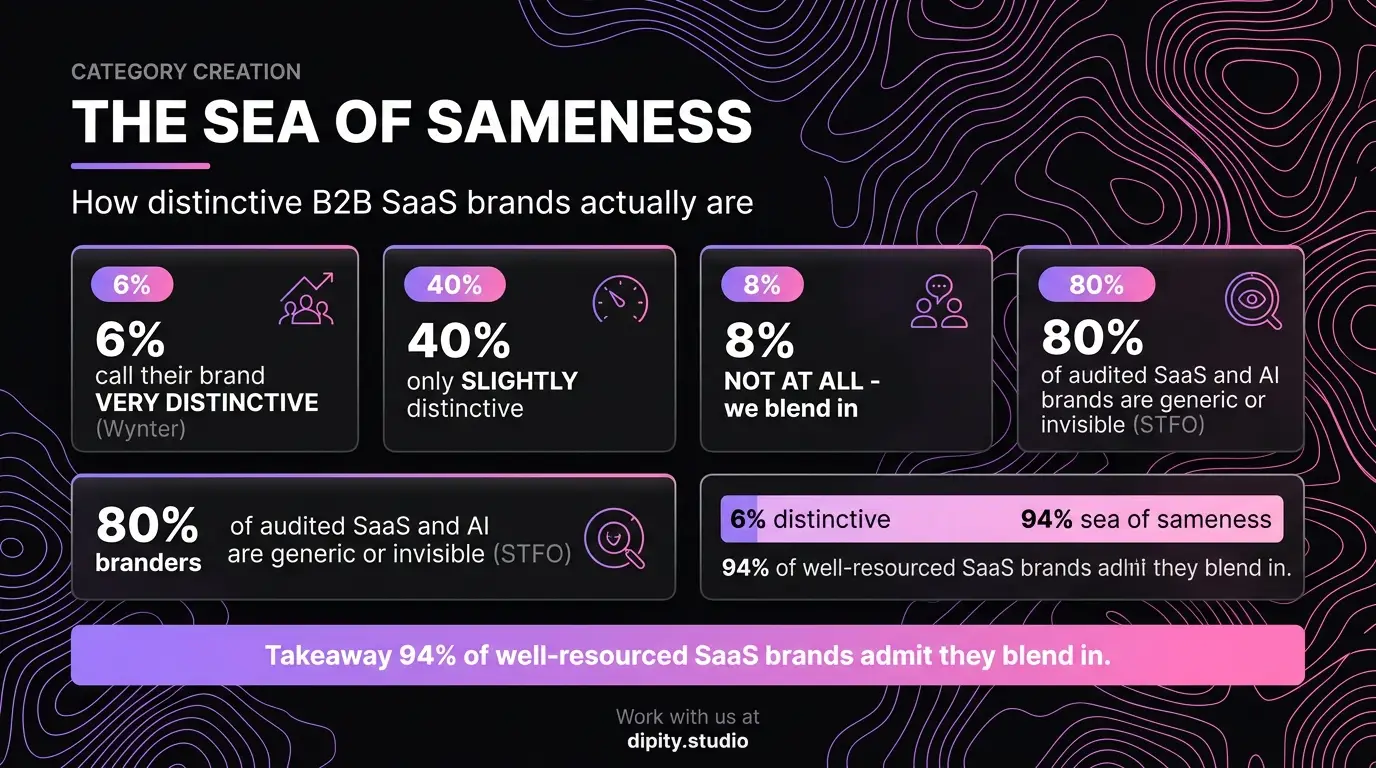
Because the people running these brands know they blend in, and they're doing it anyway. Wynter surveyed 100 B2B SaaS marketing leaders at companies doing $50M+ in revenue, and only 6% described their brand as 'very distinctive'. 40% admitted 'only slightly distinctive.' 8% said 'not at all distinctive - we blend in.' Wynter's own summary is that 94% are stuck in what they call the sea of sameness. These are the grown-ups. The ones with budgets, strategies and a head of brand. And 94% of them are treading water.
Then there's the audit that made me wince. STFO's State of B2B Brand Distinctiveness 2026 scored 100 B2B SaaS and AI companies across nine verticals on how recognizable their brand assets actually are. The verdict, in their exact words, is that '80% of the brands in the sample are beige as f*ck - either generic or plain invisible.' Out of 100 companies, exactly one - Wiz - scored in the 'ownable' band. One. That's not a rounding error, that's an industry.
Here's the part founders miss: sameness isn't a failure of effort. It's a failure of nerve. Every one of those beige companies made a hundred reasonable decisions - match the competitor, soften the claim, please the committee - and reasonable, stacked a hundred times high, is invisible.
What's the actual prize for the one brand that breaks out?
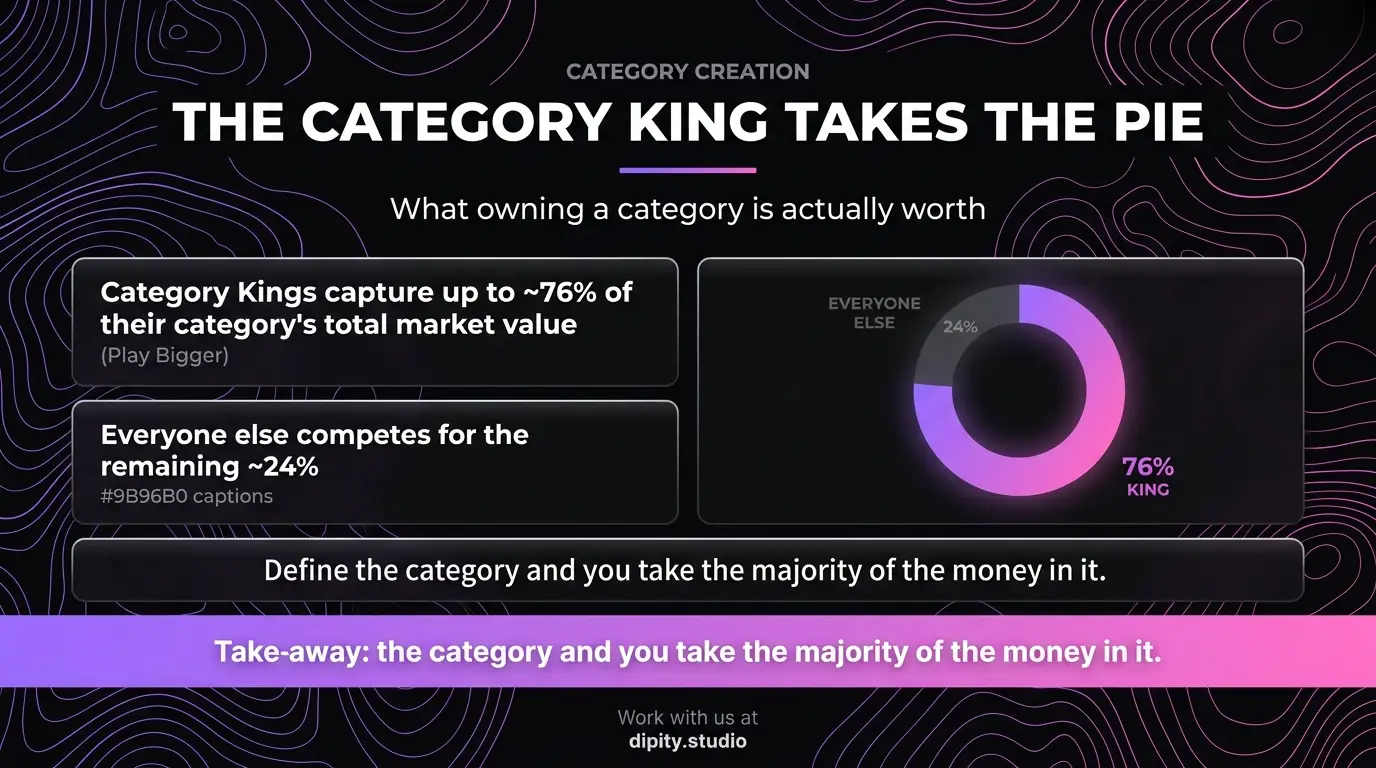
The company that defines and owns a category takes the overwhelming majority of the money in it. The team behind Play Bigger studied this and found that 'Category Kings' - the companies that create and dominate a market category - capture up to ~76% of that category's total market value. Not 76% more than average. 76% of the entire pie, leaving the remaining crumbs to be fought over by everyone who showed up to compete inside a category someone else designed.
Sit with that ratio for a second, because it reframes the whole game. If you're building yet another product inside an existing category, you are - by design - fighting for a slice of the ~24% that's left after the King eats. Better features won't fix that. A logo refresh won't fix that. Category positioning is the only lever that moves you from 'one of many' to 'the one.' And category positioning is not a design exercise. It's a point-of-view exercise.
Being the best option in a crowded category is a nice way to lose slowly. Being the only option in a category you named is how you win.
Why is the founder the fastest distinctive asset a startup owns?
Because the one asset your competitors literally cannot copy is the person who started the company. Back to that STFO audit: the single lowest-scoring category, after sound, was human identity. Only 14% of the audited companies managed even a passing score on having a recognizable human presence in their brand. Everyone's got a color palette - 86% scored fine on color, which is exactly why color differentiates no one. Almost nobody has a face, a voice, a person you'd recognize across the feed.
That's the whole opportunity, sitting in plain sight. Your competitor can clone your feature list by Friday. They can hire your designer and buy your ad inventory. They cannot become your founder. A human point of view is the one distinctive asset with a moat, and 86% of the market is leaving it on the table.
I've watched this work from the inside. I scaled a client to 10M impressions in 8 months by making the founder the main character - not the product, not the brand mascot, the founder. Same product, same category, same competitors. The only variable we changed was that we stopped hiding the human and started shipping their actual opinions. Here's why it compounds the way it does:
• Buyers buy the founder first. In early and mid-stage B2B, the founder's conviction is the product story - people back the person before they trust the roadmap.
• When the founder is invisible, the product is invisible. A category-defining idea needs someone to say it out loud and put their name on it, or it just floats around as anonymous 'content.'
• Founder authority compounds across everything. The same visible point of view that pulls pipeline also pulls talent and pushes valuation - it's one asset doing three jobs.
Doesn't category ownership come from the product, not the founder's personality?
No - it comes from a contrarian point of view, and a founder is how that point of view gets a heartbeat. Category creation is the act of publicly naming a problem the market hasn't named yet and taking a position on it that most people don't yet agree with. That's not a personality trait, it's an argument. And arguments need someone willing to be wrong in public to carry them. Feature lists don't do that. People do.
The buyers agree, and now there's hard data on it. The 2025 Edelman-LinkedIn B2B Thought Leadership Impact Report found that 95% of the 'hidden buyers' who quietly shape B2B decisions say strong thought leadership makes them more receptive to a company's sales and marketing outreach. Not 'aware of.' Receptive - as in, they've already decided you might be worth their time before your rep ever emails them. The same research found 53% of decision-makers say strong thought leadership matters more than brand recognition when they shortlist vendors, and 64% trust thought leadership content more than traditional marketing when they size up whether you actually know your stuff.
Read those three numbers together and the strategy writes itself. A point of view earns receptiveness. Receptiveness beats brand recognition at the shortlist. And it beats your polished marketing on trust. The founder isn't a vanity channel bolted onto the funnel - the founder's argument is the thing pulling qualified buyers toward you before sales gets involved. That's what a feature list can never do: a feature answers 'what does it do,' a point of view answers 'why does this even matter,' and only the second question creates a category.
How do you actually install a founder's point of view at scale?
You extract the real thing from the founder's head and run it consistently in their own name - which is exactly the problem we built Sera to solve. Most founders know they should be visible. Then reality hits: they can't post daily, they hate the 'personal brand' theater, and the alternative on offer is a ghostwriter cranking out generic LinkedIn wisdom that sounds like everyone else and fools no one. That's not distinctiveness. That's beige with a headshot.
Sera is the anti-ghostwriter. It's a founder-authority platform that installs your actual voice, your ICP, your content pillars and your competitive positioning, then runs the content engine - LinkedIn, X, the blog - in your own name. Not a persona. You, at a cadence you couldn't hit alone. Here's how it fits together:
• It captures the real voice, not a template. We hand-train each founder's Sera on how you actually think and argue, so what ships is your contrarian take, sharpened - not recycled thought-leadership sludge.
• It's built around your positioning. Sera works from your ICP and your category argument, so every post compounds one coherent point of view instead of scattering random hot takes.
• It runs the engine so you don't have to. Today we deliver it as a 14-day sprint that hand-trains your Sera, and we're raising a $500K-$2M seed to make it fully self-serve.
The thesis underneath all of it is the same one the data keeps confirming: buyers buy the founder first, and when the founder is invisible, the product is invisible right along with them.

Conclusion: Beige is a choice, and so is being the King
Let's put the numbers in one line. 94% of well-resourced SaaS brands admit they blend in. 80% of audited SaaS and AI companies are generic or invisible. Only 14% have a recognizable human in their brand. And the one company that owns its category takes up to ~76% of the value in it, partly because 95% of buyers are more receptive the moment you show a real point of view. The gap between beige and King is not budget. It's a founder willing to say something true, out loud, on repeat.
You already have the most distinctive asset in your market - it's you. The only question is whether your buyers ever get to meet you. That's the founder-invisibility problem, and it's the exact problem Sera exists to fix. If you're a funded B2B SaaS founder tired of being the best-kept secret in a beige category, come see what installing your voice actually looks like at dipity.studio. Your category is waiting for someone to name it. It should be you.
Frequently Asked Questions
What percentage of a category's value do Category Kings capture?
Research from the team behind Play Bigger found that Category Kings - the companies that create and dominate a market category - capture up to ~76% of that category's total market value. In practice that means the company that defines a category takes the overwhelming majority of the economics, while everyone competing inside a category someone else designed fights over what's left.
How many B2B SaaS brands actually consider themselves distinctive?
Very few. In Wynter's 2025 survey of 100 B2B SaaS marketing leaders at $50M+ companies, only 6% described their brand as 'very distinctive,' while Wynter concluded that 94% are stuck in a 'sea of sameness.' A separate STFO audit of 100 B2B SaaS and AI companies found 80% scored as generic or invisible, with just one company reaching the 'ownable' tier.
Why is founder-led marketing more effective than traditional brand marketing?
Because a founder is a distinctive asset competitors can't copy, and buyers respond to it. The 2025 Edelman-LinkedIn report found 95% of hidden buyers are more receptive to companies that publish strong thought leadership, 53% say it matters more than brand recognition at the shortlist stage, and 64% trust it more than traditional marketing. A founder's point of view is the most credible way to deliver that at the top of the funnel.
Isn't founder authority just a personal brand vanity project?
No. A personal brand for its own sake is vanity; founder authority is a category-ownership strategy. The goal isn't to make the founder famous - it's to publicly name and own a contrarian point of view that defines a category, which is what actually drives pipeline, attracts talent and supports valuation. The founder is simply the most believable person to carry that argument.
What is Sera and how is it different from a ghostwriter?
Sera is a founder-authority platform that installs your real voice, ICP, content pillars and competitive positioning, then runs your content engine on LinkedIn, X and your blog in your own name. Unlike a ghostwriter producing generic content that sounds like everyone else, Sera is trained on how you actually think and argue, so what ships is your genuine point of view at a cadence you couldn't sustain alone. It's delivered today as a 14-day hand-trained sprint.
Works Cited
S2G Investments. (2024). Becoming a Category King with the Play Bigger Team. Link
Play Bigger. (2024). The Category Contenders. Link
Wynter. (2025). B2B SaaS branding is stuck: 2025 survey findings. Link
STFO. (2026). The State of B2B Brand Distinctiveness 2026. Link
Edelman & LinkedIn. (2025). 2025 B2B Thought Leadership Impact Report. Link

.svg)


Get weekly updates
*We’ll never share your details.
Follow us — @Dipity










Join Our Newsletter
Get a weekly selection of curated articles from our editorial team.