

Why Founders Win AI Search by Being Quoted, Not Ranked
Gartner says search volume drops 25% by 2026 and 68% of searches are zero-click. Here's why founders win AI search by being the cited source, not by ranking.

Why Founders Win AI Search by Being Quoted, Not Ranked
The Cited-Source Era: Why Founders Win AI Search by Being Quoted, Not Ranked
By Morgan Von Druitt, Founder, Dipity
TL;DR: Gartner says traditional search volume drops 25% by 2026 as AI answer engines swallow the query. Pew found people click a link in only 8% of searches that show an AI summary, versus 15% without one, and SparkToro clocked US zero-click searches at 68% in early 2026. A Princeton study proved that adding citations, quotations, and statistics can lift a source's visibility inside AI answers by up to 40%, and Ahrefs' 75,000-brand study found branded mentions correlate with AI visibility far more than backlinks. The winning move isn't ranking anymore - it's being the source the machine quotes, and the fastest lever for that is authoritative content under a credible founder's name.
For twenty years the whole game was rank on page one and collect the click. That deal is quietly expiring. Buyers are asking ChatGPT, Perplexity, Gemini, and Google's own AI Overviews to just give them the answer, and the machine hands over a synthesized paragraph with a couple of tidy citations. Your job used to be showing up in the list. Now the list is optional, and most people never scroll to it. So the question I keep getting from founders is the right one: if nobody's clicking, how do we still get found? Let me walk through what the primary sources actually say - and why founder authority turns out to be the cheat code.
Is search traffic actually shrinking, or is this just AI hype?
It's shrinking, and the most conservative voice in the room called it first. This isn't a breathless LinkedIn take - it's Gartner, in a February 2024 press release, predicting traditional search engine volume will drop 25% by 2026 as AI chatbots and other virtual agents take over queries people used to type into a search box. Their analyst Alan Antin put it plainly: 'GenAI solutions are becoming substitute answer engines, replacing user queries that previously may have been executed in traditional search engines.' When Gartner - the firm that gets paid to be cautious - forecasts a quarter of your top-of-funnel evaporating, that's not hype. That's a memo.
And the behavioral data backs the forecast. Pew Research tracked 68,879 real Google searches from 900 US adults in March 2025. When an AI summary showed up, users clicked a traditional search result in just 8% of visits. When there was no AI summary, they clicked 15% of the time - nearly double. The AI answer doesn't just sit above your listing; it eats the reason to click it. Pew also found that after seeing an AI summary, 26% of people ended their session right there, versus 16% without one. The answer arrived, the curiosity closed, and the tab shut.

What does 'zero-click' mean for my funnel, exactly?
It means most of your searches never send anyone anywhere. SparkToro, working from Similarweb clickstream data, found that 68.01% of US Google searches ended without a click to the open web in the first four months of 2026. Less than a third of searches still send a click at all, and a chunk of those go to Google's own properties. Rand Fishkin's team has been tracking this for years, and the trend line only points one way. The search results page has quietly become the destination instead of the doorway.
Here's the part that should reframe how you think about content. The click was always a proxy. You never actually wanted the click - you wanted the buyer to associate your name with the answer to their problem. For two decades the only way to buy that association was to earn the click and hope your page did the rest. Now the AI does the summarizing for you, and the real prize is whether your company, your take, and your data are inside that summary. Being mentioned in the answer is the new page-one ranking. Being the cited source is the new featured snippet. The difference: a citation carries your credibility even when nobody clicks a thing.
Ranking was about being seen. The AI era is about being quoted. Those are not the same skill, and the old one is depreciating fast.
So how do you actually get quoted by an AI engine?
You give the model the raw materials it's structurally wired to reach for. This is where the research gets genuinely useful. A team out of Princeton - Pranjal Aggarwal, Vishvak Murahari, and colleagues - published 'GEO: Generative Engine Optimization' (arXiv 2311.09735), which went on to be accepted at KDD 2024. They built a benchmark of diverse real queries and tested which content tactics made a source more likely to be surfaced and cited inside generative-engine answers. The headline result: the right tactics boosted a source's visibility by up to 40%.
And the tactics that moved the needle weren't keyword tricks or backlink schemes. They were the hallmarks of content a credible human actually produces:
• Cite your sources. Content that references authoritative data got pulled into answers more often. The model trusts material that shows its work, the same way you'd trust a colleague who names their evidence.
• Add quotations. Direct quotes - from experts, from customers, from you - gave the engine a clean, attributable chunk to lift. Quotable text is literally easier to quote.
• Include statistics. Specific numbers made a page more citation-worthy, because a precise stat is exactly the kind of load-bearing fact an AI wants to anchor an answer around.
Read that list again. Citations, quotations, statistics - that's not an SEO checklist, that's a description of a founder who actually knows their market writing something with a point of view. The GEO paper accidentally proved that the content most likely to win AI visibility is the content ghostwritten fluff can't fake: original, specific, and sourced.

Why do branded mentions beat backlinks in the AI era?
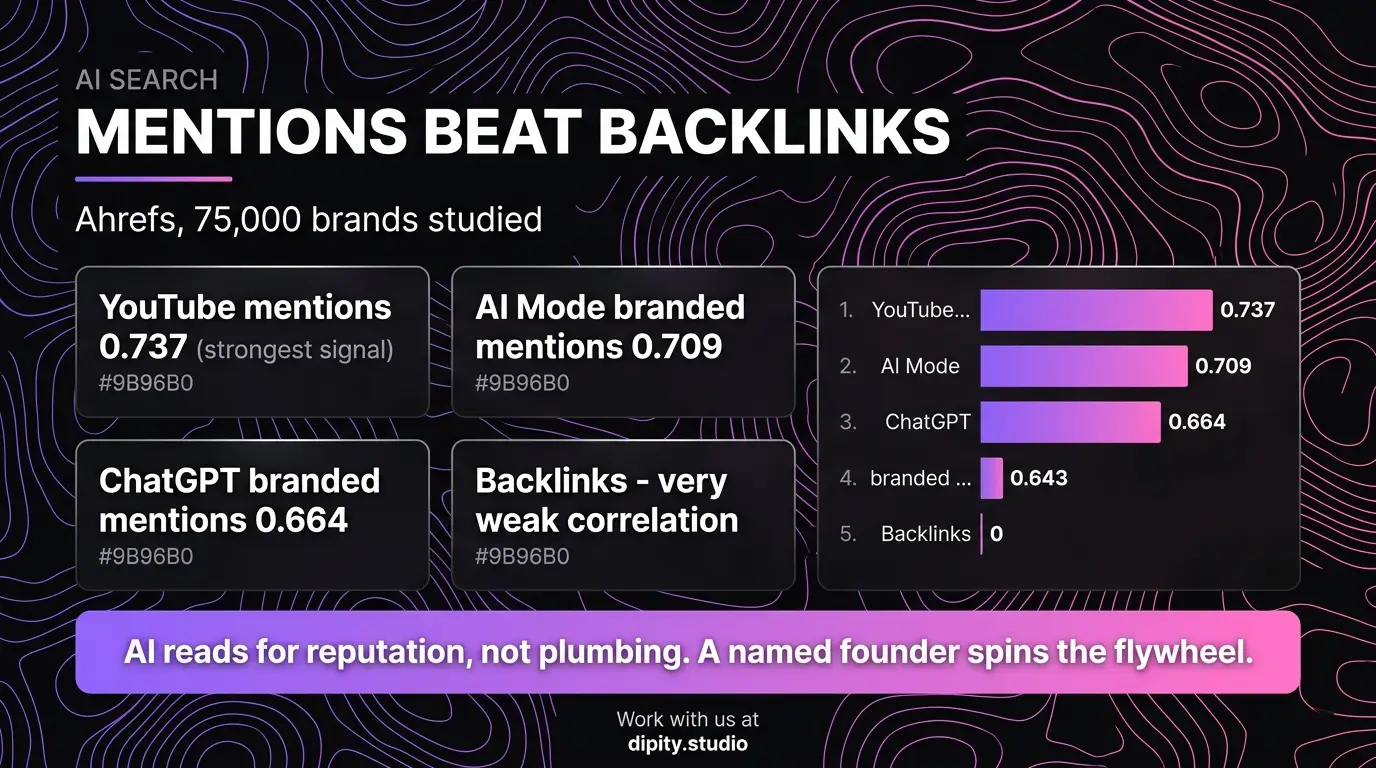
Because the machine is reading for reputation, not plumbing. The old SEO world ran on backlinks - who links to you was the currency of authority. Then Ahrefs studied 75,000 brands across ChatGPT, Google's AI Mode, and AI Overviews (published December 2025) and found something that should reallocate a lot of marketing budgets. Branded web mentions - people simply talking about your brand, linked or not - correlated strongly with AI visibility, in the range of 0.66 to 0.71 depending on the platform. Backlinks? The study found 'very weak' correlations by comparison. The signal that used to rule search barely registers with the answer engines.
It makes sense once you stop thinking like a 2015 SEO. A large language model builds its sense of who matters from how often, and how credibly, a name shows up across the text of the internet. It's pattern-matching on reputation. A hundred people referencing your founder's framework in podcasts, posts, and articles teaches the model that you're an authority. A hundred footer links do not. Ahrefs found the single strongest signal in their whole study was YouTube mentions, correlating around 0.737 - which is just another way of saying real humans, on the record, talking about you. Mentions are the new links, and you earn mentions by having something worth mentioning.
Where does the founder come into all of this?
Because every lever the research points to runs through a credible human name - and yours is the most credible one you've got. Stack up what the primary sources are telling us. Gartner says produce unique content that demonstrates expertise, experience, authoritativeness, and trustworthiness. Princeton says win citations with original quotes, sourced claims, and hard statistics. Ahrefs says branded mentions from real people beat mechanical link-building. There's a single person at your company who can satisfy all three at once without it ringing hollow: the founder.
Buyers in B2B SaaS have always bought the founder first - the conviction, the origin story, the specific reason you built this instead of that. AI engines have now industrialized that same instinct. They reward the named expert with a point of view because that's the content that reads as trustworthy and quotable. Which is exactly why the reflex most companies reach for - crank out anonymous, ghostwritten, corporate-voice content - is the wrong move at the worst possible time. That's the echo. It's generic, it cites nothing, it quotes no one, and it teaches the model precisely nothing about why you matter. Here's how founder authority maps to each finding:
• A named human clears the E-E-A-T bar. Gartner's advice to demonstrate expertise and experience is trivial when a real practitioner is the author and hard to fake when it's a faceless brand blog.
• A founder generates the quotable material by default. The Princeton tactics - quotes, stats, sourced claims - are just what it looks like when someone with real conviction and real data writes. You're not bolting them on; they fall out naturally.
• A consistent voice compounds into mentions. The Ahrefs signal - people talking about you - starts with a founder saying something distinct enough, often enough, that others repeat it. Reputation is a flywheel, and a name spins it faster than a logo.
This is the entire thesis behind what we built at Dipity. Sera is a founder-authority platform - it installs your actual voice, your ICP, your positioning, and your content pillars, then runs the engine across LinkedIn, X, and your blog in your name. Not a ghostwriter putting words in your mouth, but a system that captures how you actually think and scales it into the exact kind of original, sourced, quotable content the answer engines reward. Founder-intent data is the moat: the more Sera learns how you see your market, the harder your voice is to counterfeit - by a competitor or by a generic AI. We run it as a focused 14-day sprint today, and we're raising a seed round to take it self-serve.
Conclusion: Stop trying to rank. Start being the source.
The numbers all point the same direction. A 25% drop in search volume by 2026. An 8% click-through rate when an AI summary shows up. 68% of searches ending in zero clicks. The click is dying, and pouring more anonymous content into a ranking game that's disappearing is a great way to lose twice. The move that actually compounds is the one the research keeps circling back to: become the cited source inside the AI answer. Publish original, sourced, quotable content under a credible human name, get people talking about that name, and let the engines do what they now do - hand your point of view straight to the buyer, with your name attached, whether or not anyone clicks.
Your buyers are going to buy the founder first. The AI just made that true at scale and put a stopwatch on it. If you want your voice to be the one the machine reaches for when your buyer asks the question, come see how Sera does it at dipity.studio. Be the source, not the echo.
Frequently Asked Questions
Is SEO dead?
No, but its job description changed. Traditional ranking still matters for the searches that survive, but Gartner projects a 25% drop in search volume by 2026, and SparkToro puts zero-click searches at 68% in early 2026. The growth is in being cited inside AI answers, not in climbing to position one. Think of it as SEO's center of gravity shifting from 'get the click' to 'get quoted.'
What's the difference between SEO and GEO or answer-engine optimization?
SEO optimizes to rank a page so a human clicks it. GEO - Generative Engine Optimization, the term from the Princeton paper - optimizes so an AI engine surfaces and cites your content inside its generated answer. The Princeton team showed the right tactics can lift that visibility by up to 40%, and the tactics are things like adding citations, quotations, and statistics rather than chasing keywords.
Do backlinks still matter for AI visibility?
Far less than they used to. Ahrefs studied 75,000 brands and found branded mentions correlated with AI visibility in the 0.66 to 0.71 range, while backlinks showed 'very weak' correlations by comparison. Links aren't worthless, but if you're choosing where to spend, earning people to mention your name beats earning them to link to your footer.
Why should content be published under the founder's name instead of the brand?
Because every signal the answer engines reward runs through a credible human. Gartner emphasizes expertise and experience, Princeton rewards original quotable content, and Ahrefs shows mentions of real people carry the most weight. A named founder satisfies all three authentically; an anonymous brand blog struggles to fake any of them.
How does Dipity's Sera help with all this?
Sera installs your voice, ICP, positioning, and content pillars, then runs the content engine across LinkedIn, X, and your blog in your name - producing the original, sourced, quotable material that AI engines cite. It's the opposite of ghostwriting; founder-intent data is the moat, so the more it learns how you think, the more the output sounds like you and only you. We run it as a 14-day sprint today. Details at dipity.studio.
Works Cited
Gartner. (2024). Gartner Predicts Search Engine Volume Will Drop 25% by 2026, Due to AI Chatbots and Other Virtual Agents. Link
Aggarwal, P., Murahari, V., et al. (2024). GEO: Generative Engine Optimization (arXiv:2311.09735), KDD 2024. Link
Pew Research Center. (2025). Google users are less likely to click on links when an AI summary appears in the results. Link
SparkToro. (2026). In 2026, Less than One Third of Google Searches Still Send a Click. Link
Ahrefs. (2025). Top Brand Visibility Factors in ChatGPT, AI Mode, and AI Overviews (75k Brands Studied). Link

.svg)


Get weekly updates
*We’ll never share your details.
Follow us — @Dipity









Join Our Newsletter
Get a weekly selection of curated articles from our editorial team.