

$10K a Month for Strategy You Can't Ship: The Fractional CMO Gap Nobody Prices In
A fractional CMO averages $12K a month for strategy you still have to ship yourself. Here's why the execution gap stalls early-stage SaaS - and what to build instead.

$10K a Month for Strategy You Can't Ship: The Fractional CMO Gap Nobody Prices In
$10K a Month for Strategy You Can't Ship: The Fractional CMO Gap Nobody Prices In
By Morgan Von Druitt, Founder, Dipity
TL;DR: The average fractional CMO runs about $12,000 a month, and a common range is $4,000 to $20,000, per Go Fractional. For that you buy strategy and direction - not hands on keyboards. Meanwhile Gartner found 59% of CMOs say they don't have the budget to actually execute their strategy, and the median $1M-$3M SaaS runs on so few people there's nobody to hand the plan to. The fix isn't more strategy. It's a founder-authority engine that does the strategy and ships the content - which is exactly the execution layer fractional CMOs leave on the table.
Here's a scene I've watched play out more times than I can count. A funded founder, thin marketing team or none at all, signs a fractional CMO. Smart hire on paper. Six weeks later they've got a beautiful positioning doc, a messaging hierarchy, a content calendar, and a channel plan. Everyone nods. Then the CMO logs off, and the founder stares at a Google Doc titled 'Q3 Content Strategy' with zero posts written, zero videos shot, and zero minutes freed up in their week.
The strategy was never the missing piece. The shipping was. And nobody prices that in.
What are you actually buying for $10K a month?
You're buying a brain, not a pair of hands. A fractional CMO is a senior marketing leader who splits their time across a handful of companies. Per Go Fractional's 2026 rate data, the monthly retainer typically runs $4,000 to $20,000, the average lands around $12,000 a month ($144,000 a year), and the folks in that seat charge $150 to $500 an hour while working roughly 20 hours a week across all their clients combined. Not 20 hours on you. Across everyone.
Translate that: at $12K a month for a person spread across multiple accounts, you're renting a few hours a week of very expensive senior thinking. That thinking is genuinely good. The problem is what it produces - and what it doesn't.
• What you get. Positioning, ICP definition, messaging pillars, a channel strategy, a hiring plan, and someone senior to sanity-check your instincts in a founder's-getting-ahead-of-themselves kind of way.
• What you don't get. The actual LinkedIn posts. The actual blog articles. The actual X threads. The actual editing, scheduling, and showing-up-every-week that turns a strategy deck into pipeline.
• What that means. The deliverable is a plan. You're still the execution team. And you were already the execution team - that's why you went looking for help in the first place.

Why does the strategy never get shipped?
Because the plan assumes an execution capacity you don't have. This isn't a fractional CMO being lazy - it's structural. Their job ends where the doc ends, and someone downstream is supposed to build the thing. At a big company, that someone is a marketing team. At a seed-stage SaaS, that someone is you, at 11pm, after a full day of product and sales and hiring.
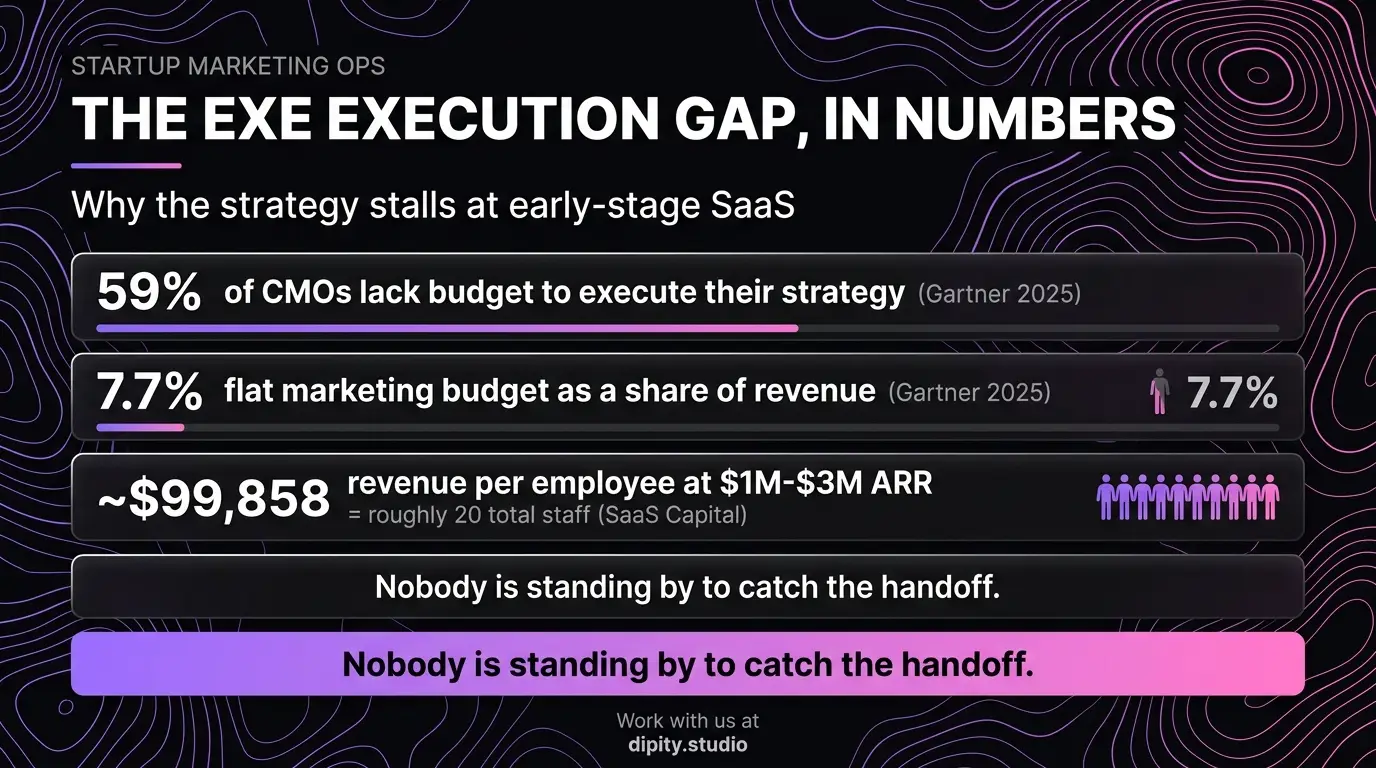
Gartner's 2025 CMO Spend Survey - 402 CMOs and marketing leaders, most at companies over $1 billion in revenue - found that marketing budgets have flatlined at 7.7% of company revenue, and here's the kicker: 59% of CMOs report they don't have enough budget to execute their strategy. Read that again. More than half of the people whose entire job is strategy admit they can't afford to ship it. And that's at billion-dollar companies with actual teams. Now shrink that down to your Series A.
How small does it get? Per SaaS Capital's 14th annual survey of more than 1,000 private SaaS companies, the median company in the $1M-$3M ARR band generates about $99,858 in revenue per employee. Do the math on a $2M ARR startup: that's a total headcount of roughly 20 humans - engineers, sales, support, ops, and you. Marketing in that world is frequently a fraction of one person. There's literally no one standing by to take the handoff.
The fractional CMO gap is the space between 'here's the plan' and 'here's the post that went live.' At a big company, a team fills it. At a startup, the founder falls into it.
So you pay $12K a month for a plan, and then you personally become the bottleneck that plan depends on. That's the gap nobody prices in - and it's exactly where early-stage marketing stalls.
Where's the highest-ROI marketing motion when you're capital-constrained?
It's content, not paid - and it's not close. When you can't outspend anyone, you have to out-teach them. Demand Metric's widely-cited research pegged content marketing at costing 62% less than traditional outbound while generating roughly 3x as many leads. Meanwhile Gartner's 2025 data shows paid media eating 30.6% of the average marketing budget - the single largest line item - which is a fine trade when you have budget to burn and a brutal one when you don't.
Paid is a faucet. The second you stop paying, the leads stop. Content is an asset. A post that lands keeps working while you sleep, and the next one compounds on top of it. For a founder with a runway measured in months, compounding is the only math that matters.
• Paid economics. You rent attention by the click, costs climb as you scale, and you own nothing when the campaign ends.
• Content economics. You build an asset once, it earns indefinitely, and it gets cheaper per result over time instead of more expensive.
• The catch. Content only compounds if it actually ships - consistently, in a real voice, week after week. Which loops us right back to the execution gap.
I've lived the upside of this. I scaled a client to 10M impressions in 8 months without a paid budget - purely on a consistent founder-voice content engine. Not because the strategy was galaxy-brained. Because we shipped, relentlessly, in a voice people trusted.
Why does the buyer actually reward founder authority?
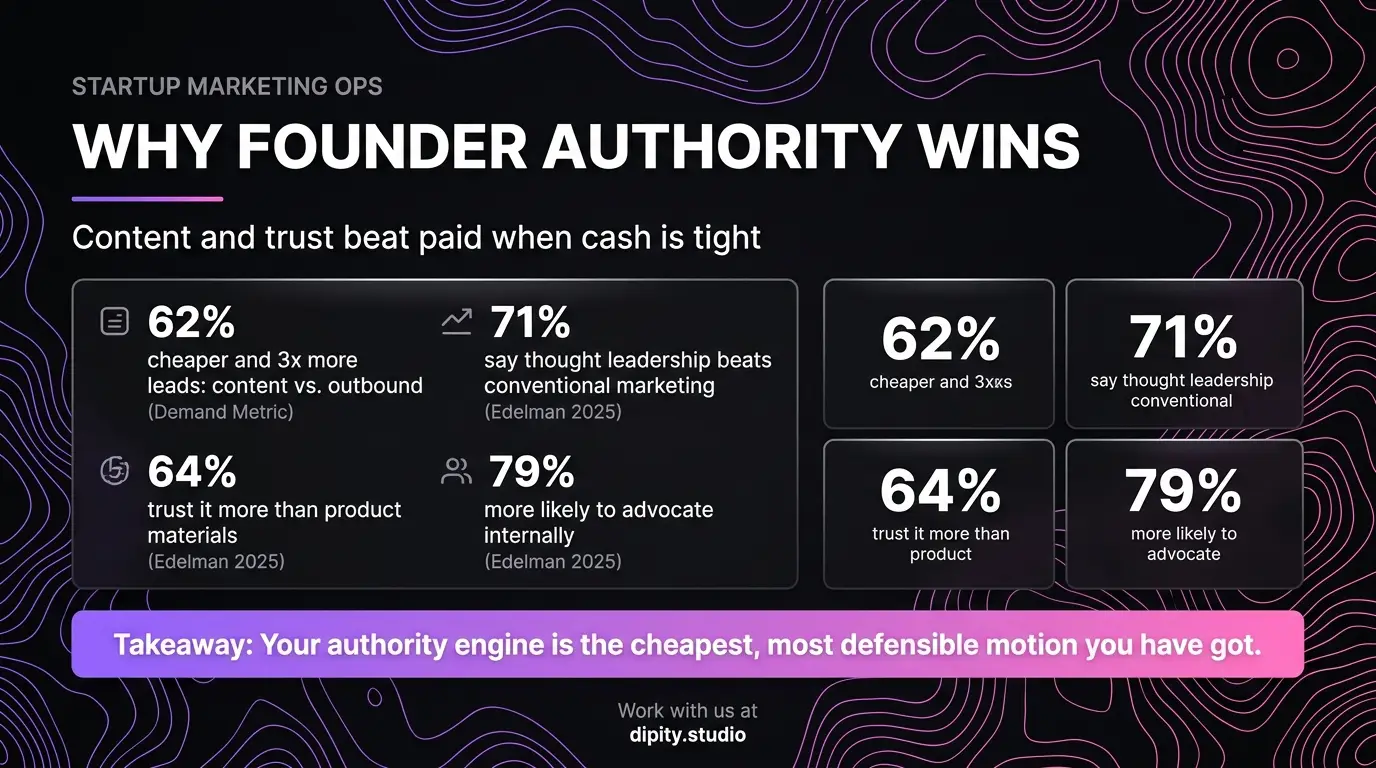
Because B2B buyers trust a person teaching them more than a company selling to them. The 2025 Edelman-LinkedIn B2B Thought Leadership Impact Report surveyed 1,934 global business executives, and the numbers are hard to argue with. 71% of decision-makers say thought leadership is more effective than conventional marketing or sales materials at demonstrating a vendor's potential value. 64% trust thought leadership content more than marketing materials and product sheets when assessing capabilities. 55% use it as part of their vetting process. And 79% say high-quality thought leadership makes them more likely to advocate for a company's proposal internally.
Translate the Edelman data into founder terms: your buyer is already deciding whether to trust you based on what you publish, whether or not you're publishing anything. Silence is a signal too - it just isn't the one you want.
• Trust transfers to the person. A founder who teaches their category earns more credibility than a logo that promotes itself, because the market can tell the difference between insight and a sales pitch.
• It's defensible. A competitor can copy your feature set and undercut your price. They can't copy your reputation or the years you spent building it in public.
• It shortens the deal. When 79% of buyers will go to bat for you internally because of what you've published, you've done the selling before the first call.
Here's the part that stings. This is the single motion a capital-constrained founder should be running - highest trust, lowest cost, most defensible - and it's precisely the layer a fractional CMO hands you a plan for and then walks away from.
So what should you build instead of renting strategy?
A founder-authority engine that does both jobs - the strategy and the shipping. The fractional CMO gap isn't a reason to skip marketing leadership. It's a reason to buy execution that comes with the strategy baked in, instead of strategy that leaves execution as your homework.
That's the entire reason I built Sera. It installs the foundational layer a good CMO would - voice, ICP, content pillars, positioning - and then it actually runs the engine. It produces and ships content in your name across LinkedIn, X, and your blog, on a cadence, week after week. Not a ghostwriter pretending to be you. Your voice, your point of view, your authority - operationalized.
• It's strategy plus execution. You get the positioning and pillars a fractional CMO would give you, and then the posts and articles get made and published - the part the retainer left on your plate.
• It's priced for a first-time funded founder. Director-level execution at a fraction of a $12K-a-month retainer or an agency, because the whole point is to fit a startup budget, not a billion-dollar one.
• It compounds. A 14-day sprint gets the engine running, and every week after that stacks more owned, trust-building assets under your name.
The founders who win the next few years won't be the ones with the prettiest strategy deck. They'll be the ones who actually showed up and shipped. Strategy you can't execute is just an expensive opinion.
Conclusion: Stop paying for the plan and start owning the engine
Let's put the whole chain together. A fractional CMO costs an average of $12,000 a month for strategy and direction. 59% of CMOs can't fund the execution of their own strategy. The median early-stage SaaS runs on ~20 people, so there's no team to catch the handoff. Content beats paid on cost and compounding. And 71% of your buyers trust a founder teaching over a company selling. Every arrow points to the same place: your own authority engine is the highest-ROI, most defensible move you can make - and it only works if someone actually ships it.
That's the gap Sera closes. Strategy and execution, in your voice, on a cadence, priced for where you actually are. If you're a funded B2B SaaS founder with a thin team and a full calendar, come see what it looks like to own the engine instead of renting the plan at dipity.studio.
Frequently Asked Questions
How much does a fractional CMO actually cost per month?
Per Go Fractional's 2026 rate data, the typical range is $4,000 to $20,000 a month, the average is about $12,000 a month ($144,000 a year), and rates run $150 to $500 an hour for roughly 20 hours a week spread across all of a CMO's clients - not 20 hours dedicated to you.
Is a fractional CMO worth it for an early-stage startup?
It depends on whether you have anyone to execute the strategy they produce. A fractional CMO delivers direction, positioning, and plans - not the actual content and channel work. If your marketing team is a fraction of one person, per SaaS Capital's ~$99,858-revenue-per-employee benchmark for $1M-$3M ARR companies, you'll likely end up executing the plan yourself.
Why doesn't strategy alone move the needle?
Because strategy needs execution capacity you may not have. Gartner's 2025 CMO Spend Survey found 59% of CMOs say they lack the budget to execute their strategy - and that's at large companies with real teams. A plan that never ships produces nothing.
Should I spend on paid ads or content marketing first?
When you're capital-constrained, content wins. Demand Metric found content marketing costs about 62% less than outbound while generating roughly 3x the leads, and it builds an owned asset that compounds - whereas paid stops the moment you stop paying and already eats 30.6% of the average marketing budget per Gartner.
Does founder thought leadership really drive B2B deals?
Yes. The 2025 Edelman-LinkedIn B2B Thought Leadership Impact Report found 71% of decision-makers say thought leadership beats conventional marketing at demonstrating value, 64% trust it more than product materials, and 79% are more likely to advocate internally for companies with high-quality thought leadership.
Works Cited
Go Fractional. 'Fractional CMO Salary 2026: Rates, Retainers & Cost Guide.' gofractional.com. https://www.gofractional.com/blog/fractional-cmo-salary
Gartner. 'Gartner 2025 CMO Spend Survey Reveals Marketing Budgets Have Flatlined at 7.7% of Overall Company Revenue.' May 12, 2025. gartner.com. https://www.gartner.com/en/newsroom/press-releases/2025-05-12-gartner-2025-cmo-spend-survey-reveals-marketing-budgets-have-flatlined-at-seven-percent-of-overall-company-revenue
SaaS Capital. '2025 Revenue Per Employee Benchmarks for Private SaaS Companies.' saas-capital.com. https://www.saas-capital.com/blog-posts/revenue-per-employee-benchmarks-for-private-saas-companies/
Demand Metric. 'Content Marketing ROI' research (content marketing costs 62% less than traditional marketing and generates ~3x the leads). demandmetric.com. https://www.demandmetric.com/
Edelman and LinkedIn. '2025 B2B Thought Leadership Impact Report.' edelman.com. https://www.edelman.com/expertise/Business-Marketing/2025-b2b-thought-leadership-report

.svg)


Get weekly updates
*We’ll never share your details.
Follow us — @Dipity











Join Our Newsletter
Get a weekly selection of curated articles from our editorial team.