

How Small Can a Software Company Get? Why 2026's AI Stack Lets 20 People Run What Took 200
Lean AI startups now generate $2M-$3M revenue per employee. Why 2026's AI stack lets 20 people run what took 200, with data from McKinsey, SaaStr, and Dealroom.

How Small Can a Software Company Get? Why 2026's AI Stack Lets 20 People Run What Took 200
How Small Can a Software Company Get? Why 2026's AI Stack Lets 20 People Run What Took 200
By Morgan Von Druitt · July 2026 · 8 min read
TL;DR A lean AI startup in 2026 runs on a fraction of the headcount its 2019 equivalent needed, and the outliers prove how far the compression goes: Dealroom's efficiency data shows Cursor generating roughly $3.3M in ARR per employee, with Midjourney near $2M and OpenAI at $1.5M. At Dipity, I run a full-stack marketing operation solo on an AI-agent stack, so this piece is written from inside the thesis, not from the bleachers.
Ten years inside AI product marketing taught me a rule that finally became visible to everyone in 2026: headcount was never the asset. Coordination was the cost. Software companies hired 200 people because information had to move through humans to become decisions. Agents collapsed that, and the org chart is collapsing behind it.
How Small Are the Winners Already?
Small enough to embarrass the old benchmarks. Cursor's maker Anysphere reached $1B ARR with roughly 300 people, Midjourney passed $500M in revenue with a team near 100 and zero venture capital, and Gamma crossed $100M ARR with about 50 people. Revenue per employee, not headcount, is the new scoreboard.
The named cases stack up fast. Dealroom's revenue-per-employee comparison puts Cursor at $3.3M per employee, Midjourney at $2M, OpenAI at $1.5M, with Anthropic, Runway, and Perplexity all at or above $1M. Product Growth's teardown of Midjourney documents the strangest data point of the whole cohort: roughly half a billion in revenue, no venture capital, no marketing department, and a team that stayed around 100 people. SaaStr's benchmark analysis says the quiet part out loud: $500K ARR per employee is the new $200K, and the best AI-native companies clear multiples of it.
For contrast, remember what "good" meant recently. Classic SaaS treated $200K to $300K of revenue per employee as healthy at scale. The AI-native cohort runs 5x to 15x that, which means:
- A 20-person company at $500K per employee is a $10M ARR company, the old bar for a 50-to-80-person org.
- A 20-person company at Cursor's efficiency is a $66M ARR company, the old bar for a few hundred heads.
- The gap between those two lines is stack design, not talent density or luck.
The ceiling on "how small" keeps dropping. The interesting question is what those companies stopped hiring for.
What Actually Changed in the Stack?
Agents turned coordination work into software. The 2019 company hired people to move information between people: project managers, ops coordinators, reporting layers, junior analysts. The 2026 stack routes that work through AI agents connected directly to the company's tools and data, so each remaining human runs a system instead of a task.
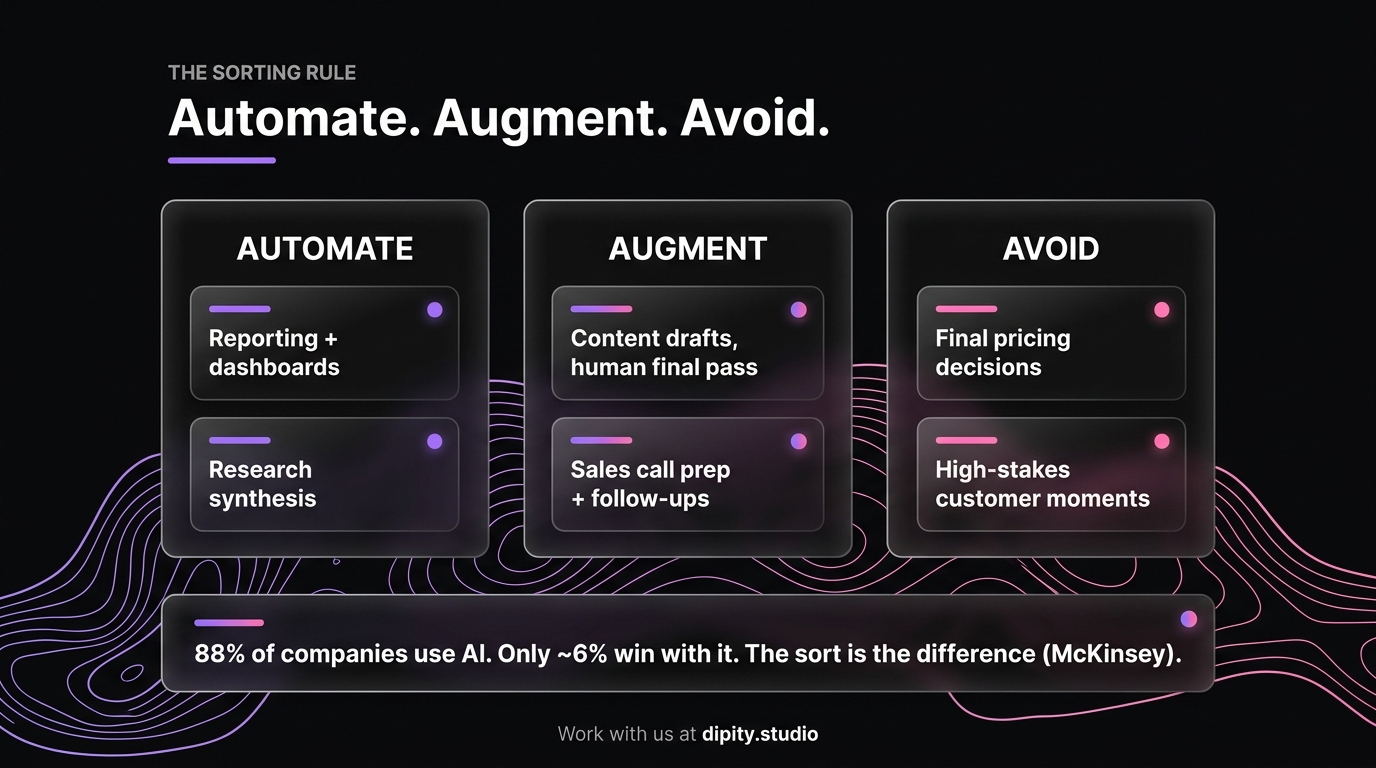
Adoption numbers show everyone has the ingredients; almost nobody has the recipe. McKinsey's State of AI research found 88% of organizations now use AI in at least one business function, yet only about 6% qualify as genuine AI high performers, and just 39% report any EBIT impact at all. Stanford's AI Index tracks the same pattern: roughly 70% of organizations use generative AI somewhere, and the value concentrates in the small group that redesigned workflows instead of sprinkling tools on old ones.
The 6% behave differently in a specific way: they sort every workflow into automate, augment, or avoid, then wire agents into the automate column permanently. I walk through that sorting exercise in my piece on how B2B SaaS startups should actually use AI. The lean company isn't the one using the most AI tools; it's the one that deleted the most coordination work.
My own operation is the live demo. Dipity runs research, drafting, distribution, reporting, and a daily news pipeline through an agent stack that I operate alone, work that a traditional agency staffs with six to ten people. That's not a brag about effort; it's an observation about what one operator plus a designed system replaces.
What Is the Math of a 20-Person Company?
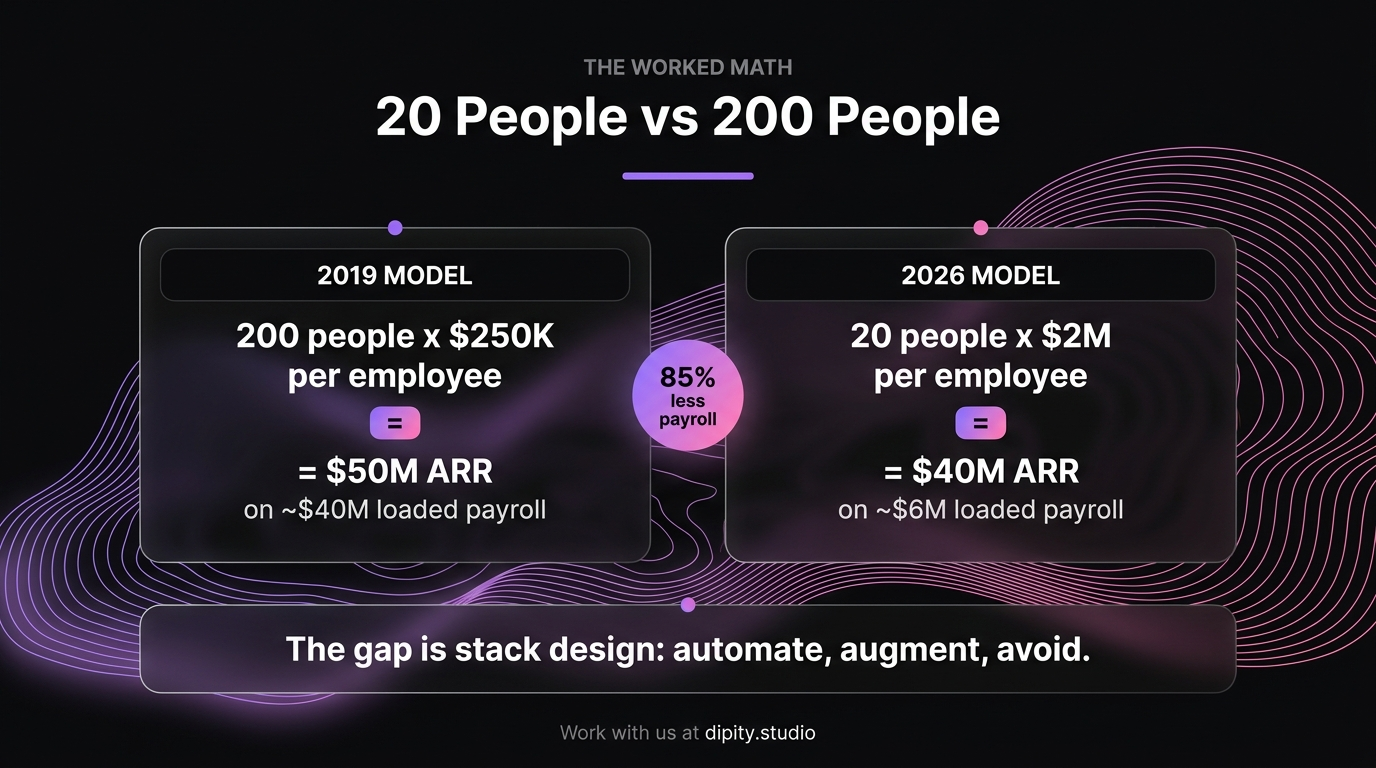
Take 20 people at the AI-native efficiency band and the math outruns the old 200-person org: 20 × $500K is $10M ARR at the floor, and 20 × $2M is $40M ARR at the Midjourney band. Payroll stays near $6M loaded, so the model breaks even where the legacy org just breaks.
Work it live. A 200-person software company at the classic $250K per employee books $50M ARR, and carries roughly $40M in loaded payroll at a $200K average. A 20-person AI-native company at $2M per employee books $40M ARR on about $6M of payroll. Nearly the same revenue, 85% less payroll, and every remaining hire is senior enough to own a whole system. That spread is the margin story behind the SaaStr benchmark shift, and it's why the boards of 2026 ask "why are we hiring?" where the boards of 2021 asked "why aren't we?"
The CEOs of the future are going to be able to run multimillion-dollar unicorns with very limited teams of less than twenty. The strategic consequence is bigger than cost. Small teams change what founders spend money on; capital goes to compute, distribution, and category position instead of middle management. Which raises the question of why the giants are sprinting the opposite direction.
Why Are Big Companies Going the Other Way?
Because their customers' org charts haven't collapsed yet. AWS committed $1B to a forward-deployed engineering unit that embeds engineers inside enterprise clients, and Microsoft launched a $2.5B Frontier unit with 6,000 staff doing the same. Incumbents are selling human glue to enterprises that adopted AI faster than they redesigned workflows.
The scale of these bets deserves attention. CNBC's reporting on AWS describes pods of five or six engineers dropped into clients on 45-day cycles to force agentic AI into production, starting with the NBA and Ricoh. Tech Startups' coverage of Microsoft's Frontier unit puts 6,000 people against the same problem. Both are admissions, priced in billions, that most enterprises own AI capability they cannot operationalize; the WRITER enterprise survey found 79% of organizations report challenges adopting AI, a double-digit jump over 2025.
Read the two directions as one market. Enterprises pay billions for embedded humans because their workflows predate agents. AI-native startups skip the retrofit entirely and build agent-first from day one. That asymmetry is the startup opening:
- Speed: a 20-person company redesigns a workflow in a week; a 20,000-person company schedules a steering committee.
- Cost structure: your COGS assume agents; theirs assume coordination layers they're now paying consultants to remove.
- Story: "we run the way software will run" is a sales and recruiting narrative incumbents cannot tell honestly.
Speed is the most important thing right now in the era of AI, and small is currently the fastest shape a company takes.
What Breaks First on a Tiny Team?
Resilience, support depth, and enterprise optics, in that order. The lean model concentrates risk in single humans, strains under high-touch support, and gets side-eyed by procurement teams that read headcount as stability. Copying the model without naming these trade-offs is how founders get hurt.
I run the lean model and I'll name its failure modes plainly:
- Bus factor. When one person owns a whole system, one resignation or one bad month owns you back. Document systems as if you're handing them off, agents included.
- Support depth. Agent-tiered support holds until a top customer needs a human at 2am. Price high-touch tiers accordingly or decline that segment honestly.
- AI spend discipline. Token costs compound quietly; enterprises have burned annual AI budgets in months. Cap spend per workflow and review it like payroll, because it is payroll now.
- Procurement optics. Enterprise buyers still equate headcount with durability. Counter with uptime history, SOC 2, references, and a founder whose public record makes the company feel bigger than its payroll.
- Judgment bottlenecks. Agents multiply output, not taste. Every low-judgment hire you skip raises the judgment load on the humans left.
None of these kill the thesis. They define its operating discipline, and the discipline is the moat, since McKinsey's 6% number says most companies never build it.
Where Does the Founder Fit in a 20-Person Company?
At the front, permanently. When the org chart shrinks, the founder's public voice becomes the company's largest remaining asset: the distribution channel, the recruiting engine, and the trust layer that procurement and capital check. The lighthouse of any company has to be their CEO.
The stakeholder cascade explains why. Prospects follow the founder before booking demos; buyers today are buying based off of the CEO or founder they have on their social feed, then getting curious about the product. Peers cite the founder's frameworks, which compounds reach. The best in the industry flock to a company whose founder has already shown the work, which solves recruiting at exactly the moment every hire is critical. Investors and enterprise buyers use the founder's public record as the diligence layer a big org chart used to provide. I've written about the mechanics in why your face is the best go-to-market channel, and the lean company raises the stakes on all of it.
That's the pairing the tiny-team era rewards: an agent stack that compresses operations, and a founder authority system that compresses trust-building. The Sera Implementation Sprint installs the second one in two weeks, then runs on a few founder hours per week alongside whatever you're building. Talk to me at dipity.studio; I'll show you the stack I run solo. Where do you feel stuck?
Frequently Asked Questions
What is a lean AI startup?
A company designed around AI agents handling coordination, production, and reporting work, so a small senior team runs systems instead of tasks. The practical signature is revenue per employee at $500K or above, versus the $200K-$300K classic SaaS benchmark.
Is the 20-person unicorn actually realistic?
The trend line points there. Cursor hit $1B ARR with roughly 300 people, Gamma crossed $100M with about 50, and Midjourney passed $500M with around 100 and no venture capital. Each cohort of AI-native companies does more revenue with fewer people than the one before it.
Why do most companies fail to get this efficiency from AI?
McKinsey's data shows 88% of organizations use AI while only about 6% get high-performer results, and 79% report adoption challenges per WRITER's 2026 survey. The failure mode is sprinkling tools on old workflows instead of redesigning them; the winners sort every workflow into automate, augment, or avoid and rebuild around the answer.
What are the biggest risks of running a tiny team?
Bus factor on key humans, support depth for high-touch customers, unmanaged AI token spend, and enterprise procurement teams that read low headcount as risk. All four are manageable with documentation, pricing discipline, spend caps, and a strong public founder record.
Does a small team make founder visibility more important or less?
More. With no big org chart to signal stability, the founder's public authority becomes the trust layer for buyers, recruits, and investors simultaneously. The founder is the largest marketing asset a 20-person company owns.
Sources
- CNBC — AWS commits $1B to embed AI engineers inside customers
- Dealroom — Revenue per employee: AI startups set a new efficiency bar
- McKinsey — The State of AI global survey
- Product Growth — How Midjourney hit $500M ARR with zero VC
- SaaStr — $500K ARR per employee is the new $200K
- Stanford HAI — The AI Index report
- Tech Startups — Microsoft launches $2.5B Frontier unit with 6,000 staff
- WRITER — Enterprise AI adoption in 2026 survey

.svg)


Get weekly updates
*We’ll never share your details.
Follow us — @Dipity










Join Our Newsletter
Get a weekly selection of curated articles from our editorial team.