
Why Do VCs Fund Loud Founders?
Accelerator acceptance rates fell below 1% in 2026. Why VCs fund visible founders, how the visibility screen works, and how to pass it in six months.

Why Do VCs Fund Loud Founders?
The Visibility Screen Behind 2026 Accelerator Admissions
By Morgan Von Druitt · July 2026 · 8 min read
TL;DR If you're researching how to get into Y Combinator or a16z Speedrun in 2026, the honest answer starts with a number: acceptance rates at both now sit near or below 1%, and the founders clearing that bar usually arrive already visible. Harvard Business Review's survey of nearly 900 VCs found only 10% of funded deals arrive cold from company management; the rest travel through networks that visible founders build and invisible founders don't. At Dipity, we call this the visibility screen, and it filters who gets seen long before anyone judges who's good.
I'm writing this from inside the screen, not above it. Dipity was accepted into Founder Institute's summer 2026 cohort, 50 companies deep, and the application asked for the same thing every serious program now asks for: proof that the market already listens when the founder talks. My published work did more of the lifting than my deck did. That experience is the backbone of this piece.
How Selective Did Accelerators Actually Get in 2026?
Brutally selective. Y Combinator's recent batches accepted roughly 1% of applicants, with the Summer 2025 batch reported near 0.6%, and a16z Speedrun's acceptance rate runs under 0.4%. Thousands of fundable companies get filtered before a partner reads past the first line.
The volume math explains the squeeze. Y Combinator draws tens of thousands of applications per cycle for batches of 140 to 200 companies, and YC's own application guidance shows the Fall 2026 deadline landing July 27 with decisions by late August. HubSpot's guide to getting into YC pegs the acceptance rate between 1.5% and 2% in a normal cycle, and recent cycles have run tighter. On the venture side, a16z's Speedrun program reports a sub-0.4% acceptance rate for its SR007 cohort, which opens in San Francisco July 27 with checks up to $1M per company.
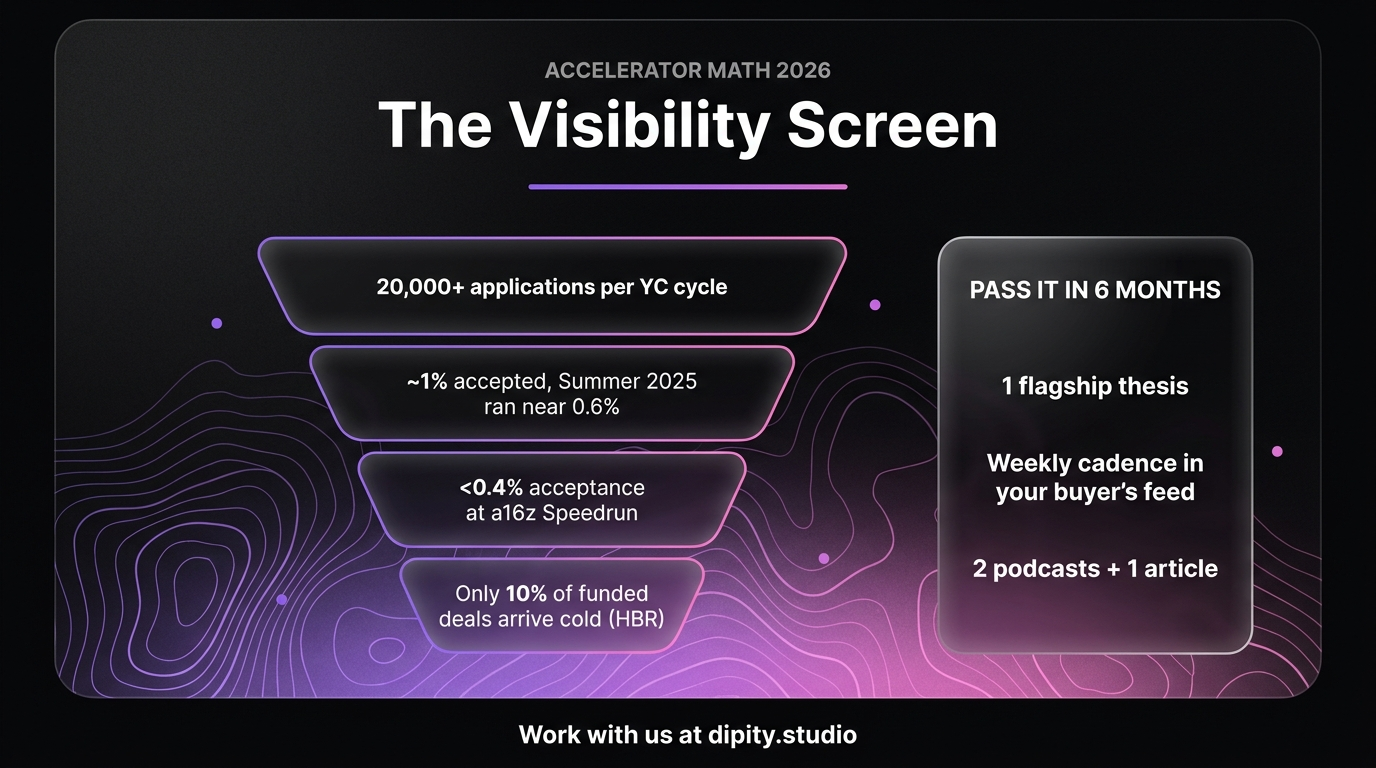
Sit with what a sub-1% rate means mechanically. Reviewers spend minutes per application, then hours only on the few that survive. At that ratio, the deciding factor is rarely the quality gap between application 200 and application 2,000; it's which founders arrive with evidence a reviewer recognizes in the first pass:
- Traction artifacts: users, waitlists, revenue, shipped product.
- Distribution artifacts: an audience in the ICP, a newsletter, a community.
- Recognition artifacts: press mentions, podcast appearances, peers who vouch unprompted.
Two of those three are visibility assets. That's not an accident.
Why Do Networks Decide Who Gets Seen?
Because that's how deal flow physically works. VCs source over 30% of deals through professional networks, another 20% through other investors, and almost 30% through their own hunting. Only 10% of funded deals arrive cold. Visibility is what puts a founder inside those network paths.
These numbers come from the most rigorous study we have of VC behavior. The Gompers, Gornall, Kaplan, and Strebulaev research published in Harvard Business Review, with the full dataset in the NBER working paper, mapped where funded deals originate: professional networks, investor referrals, portfolio company referrals, and proactive self-generation dominate, while cold inbound from management produces roughly one funded deal in ten.
Attention follows the same gradient. Papermark's 2024-2025 pitch deck dataset found decks arriving through warm introductions hold investor attention for 4 minutes 18 seconds versus 2 minutes 31 seconds for cold sends. Warmth nearly doubles your hearing time before a human decides anything about your company.
Here's the part founders miss: "network" no longer means golf. When a partner follows your posts for six months, you're in their network. When an investor reads a white paper and uses that as the segue into a cold DM, that's the network forming in public. Publishing is how founders without pedigree manufacture the warm path that pedigree used to buy.
What Is the Visibility Screen, and Is It Fair?
The visibility screen is the informal filter where reviewers, scouts, and partners check what the market already knows about you before judging what you claim. It rewards founders who show their work in public. Fair or not, it's rational: public evidence is cheaper to verify than private claims.
To be precise about what the screen is not: YC states the application is judged on its own merits, and a warm intro is not required to get in. Take them at their word. The screen operates a level deeper, in what your public record proves. A founder who built in public arrives with verifiable users, retention claims a reviewer confirms in two clicks, and a distribution asset the program knows compounds post-batch.
The build-in-public cohort keeps proving the mechanic. Tyler Denk's writing on beehiiv's growth shows a founder using transparent build-in-public content as the company's compounding acquisition channel, from newsletter posts straight into product signups and investor familiarity. By the time a founder like that applies to anything, the diligence is pre-done in public. Investors reward it because verification cost is the hidden tax on early-stage investing, and visible founders lower it.
The Edelman-LinkedIn thought leadership research confirms the same psychology on the buyer side: 75% of decision-makers research an organization after encountering strong thinking from its people. Partners are decision-makers. The screen is the same; only the transaction differs.
Does "Loud" Mean Chasing Followers?
No, and the distinction decides whether visibility helps or hurts you. Loud means a clear position, published consistently, in front of the specific people who allocate capital and buy products. Impression farming is a surefire way to build a large audience that never wants to buy from you.
I score founders on a simple equation: Authority = Visibility × Consistency × Credibility. The inputs multiply, so a zero on any one of them zeros the whole thing. A million impressions of recycled viral formats scores high on visibility and zero on credibility, which nets zero. A founder with 8,000 followers in the exact right ICP and a clear category position closes more deals, and clears more screens, than a founder with 80,000 followers and no category.
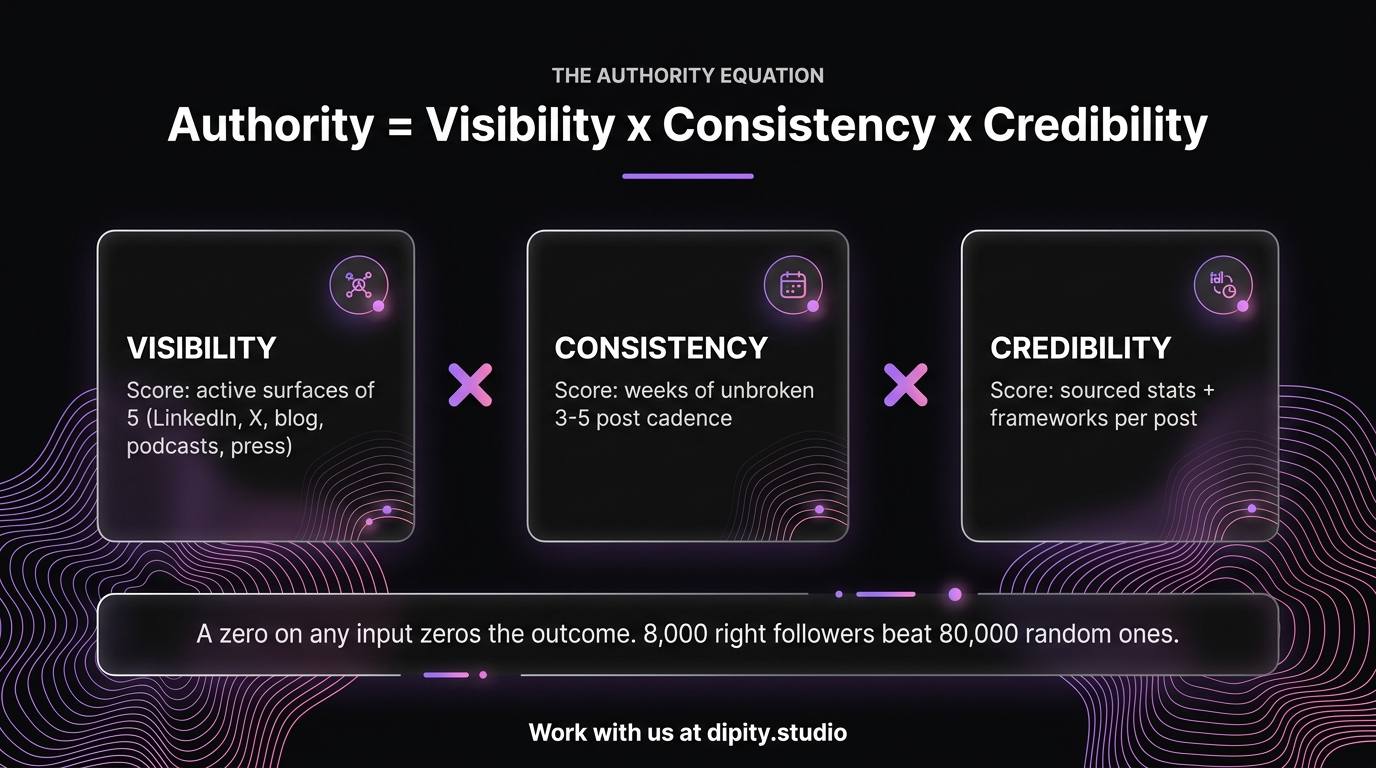
What the screen actually rewards looks like this:
- A position: one contrarian, defensible thesis about your market, repeated until the market associates it with your name.
- A cadence: 3 to 5 substantive posts a week, held for months. Consistency reads as operational discipline, the exact trait reviewers extrapolate to company-building.
- Receipts: sourced numbers, named outcomes, shipped work. Show. Your. Work.
- A room: presence where your reviewers actually read. For AI founders that's X and LinkedIn; for others it might be a trade community.
Viral-format recyclers lack legitimate substance and aren't teaching anything, and partners pattern-match that instantly. Depth beats reach on every screen worth passing.
How Do You Pass the Visibility Screen in Six Months?
Publish a flagship thesis, hold a weekly cadence in your buyer's feed, and stack third-party proof: two podcasts, one contributed article, and visible engagement with the community you're applying into. Six months of that puts you in the 10% of applicants a reviewer already recognizes.
Here's the sequence, the same one I ran before Dipity's Founder Institute acceptance:
- Month 1: plant the flag. Publish the pillar piece stating your category thesis with sourced data. Everything else links back to it.
- Months 2-3: run the cadence. Three to five posts a week in the founder's real voice. Document what you're building and what it's teaching you; build-in-public content doubles as diligence material.
- Months 3-4: enter the rooms. Comment thoughtfully and daily where partners, scouts, and alumni of your target program spend time. Recognition compounds faster in replies than in posts.
- Months 4-5: borrow authority. Two podcast appearances and one contributed article put third-party corroboration into your search results.
- Month 6: apply loud. Your application now links to a living public record instead of asserting claims into a void.
The math on effort: roughly five founder hours a week, or about 130 hours across six months. Set that against what it buys at a sub-1% acceptance gate and it's the highest-yield 130 hours on your calendar. My piece on why your face is the best go-to-market channel shows how the same system keeps paying after the batch.
The trade-off, named honestly: this adds a level of transparency that not every founder is going to be comfortable with, and many, especially technical founders, are not going to be as comfortable being in the spotlight. The muscle builds with reps, and lower-stakes formats exist for building it.
What Should You Do Before the July 27 Deadlines?
Both YC's Fall 2026 batch and a16z Speedrun's SR007 close applications July 27, 2026. If you're applying, spend the remaining weeks making your public record corroborate your application, because that's the screen your reviewer runs first.
Your profile authority is the biggest signal or precursor of your success when you're looking to raise or hire top talent. The data stack tells one story: ten percent of funded deals arrive cold per HBR, warm decks earn double the reading time per Papermark, and acceptance rates sit below 1% at the top programs. Every one of those filters bends toward founders the market already sees. Loud, done right, is a diligence asset.
The Sera Implementation Sprint installs the whole system in two weeks: voice, category position, cadence, and the engine that runs on a few founder hours a week. Talk to me at dipity.studio before your application window closes. Make them the inevitable choice.
Frequently Asked Questions
Do you need a warm introduction to get into Y Combinator?
No. YC judges applications on their own merits and says so publicly. What helps is verifiable evidence: users, revenue, shipped product, and a public record that corroborates your claims in the first two minutes of review.
What is the acceptance rate for Y Combinator and a16z Speedrun in 2026?
YC's recent batches run near 1%, with Summer 2025 reported around 0.6% against tens of thousands of applications. a16z Speedrun reports a sub-0.4% acceptance rate for its SR007 cohort. Both programs' current application deadlines land July 27, 2026.
Does building in public actually improve funding odds?
It improves the two inputs the data says matter: network reach (only 10% of funded deals arrive cold per HBR's VC survey) and verification speed (public traction is cheaper for investors to confirm than private claims). Beehiiv's growth under Tyler Denk is the canonical case of build-in-public compounding into acquisition and investor familiarity.
How many followers does a founder need before applying?
There's no threshold, and follower count is the wrong metric. A founder with 8,000 followers concentrated in their ICP and a clear position outperforms one with 80,000 and no category. Reviewers check who engages with you, not how many.
Isn't founder visibility just a distraction from traction?
Traction and visibility feed each other. Distribution is traction for most B2B products, and the same publishing motion that passes the screen generates users and pipeline. The founders who treat visibility as a channel rather than a hobby get both.
Sources
- a16z — Applications for a16z Speedrun SR007 are now open
- Tyler Denk — Big desk energy: beehiiv build-in-public essays
- Edelman-LinkedIn — B2B Thought Leadership Impact Report
- Harvard Business Review — How Venture Capitalists Make Decisions
- NBER Working Paper 22587 — How Do Venture Capitalists Make Decisions?
- HubSpot for Startups — Getting into Y Combinator
- Papermark — Pitch deck metrics report 2024-2025
- Y Combinator — Apply to the Fall 2026 batch

.svg)


Get weekly updates
*We’ll never share your details.
Follow us — @Dipity










Join Our Newsletter
Get a weekly selection of curated articles from our editorial team.