

Why Your Face Is the Best Go-To-Market Channel for an AI Startup
How founders under $20M ARR turn a public voice into the cheapest, fastest, and most defensible source of pipeline they have.

Why Your Face Is the Best Go-To-Market Channel for an AI Startup
Why Your Face Is the Best Go-To-Market Channel for an AI Startup
By Morgan Von Druitt · Updated May 2026 · 8 min read
TL;DR Founder-led growth is a go-to-market motion where the founder is the primary distribution channel — publishing the point of view, taking the early sales calls, and building the company’s trust asset from the front. It works because B2B trust now travels through people faster than through logos: Edelman’s 2025 Trust Barometer found trust now ranks alongside price and quality as a reason buyers choose a brand. For a startup under $20M ARR, a founder with a public voice is usually the cheapest and most defensible pipeline you have.
I will say the unpopular part first: the outbound playbook most seed-stage startups inherited is decaying in real time. Cold sequences get ignored, ad costs climb, and buyers route around anything they cannot independently verify. What is quietly compounding in its place is simpler and older — a founder who shows up in public, says something true about the problem, and builds a pipeline of warm, self-educated buyers. At Dipity, founder-led growth is the first motion I reach for with nearly every client under $20M ARR. Here is what it actually is, why it works so well right now, and how to run it as a real channel instead of a vanity project.
What Is Founder-Led Growth?
Founder-led growth is a go-to-market motion in which the founder is the company’s primary brand asset, content engine, and demand channel — typically from pre-seed through early Series B. Instead of leaning first on a marketing team, paid acquisition, or an outsourced SDR motion, the founder publishes the point of view, joins podcasts, takes the early sales calls, and builds direct relationships with buyers, investors, and press. It is not “the founder being loud on LinkedIn.” It is the deliberate use of the founder’s voice as distribution infrastructure — and because that voice is also the delivery vehicle for a market category, I treat founder-led growth as the engine behind real category creation.
The distinction I most often have to draw for founders is between this motion and its lookalike — founder-themed marketing, where a founder is visible but the company still runs on traditional channels underneath. The table below is how I tell them apart.
If three or more of the left-hand statements are true, you already have a founder-led motion — you may simply not be measuring it yet. If the right-hand column describes you, you have a traditional marketing motion with a visible founder attached, which is a very different and far less defensible thing.
Why Does Founder-Led Growth Work So Well in 2026?
Founder-led growth is outperforming paid and outbound for one structural reason: buyers no longer trust channels they cannot verify. Edelman’s 2025 Trust Barometer found that 80% of people trust the brands they actually use, and — for the first time — that trust now ranks alongside price and quality as a reason buyers choose a brand. In B2B, that trust is delivered through humans a buyer can see, follow, and message directly. At a company under $20M ARR, the founder is almost always the most credible human in that chain, because the product and the operator are still indistinguishable to the market.
The evidence that this converts is strong, and it is recent. The 2025 Edelman-LinkedIn B2B Thought Leadership Impact Report found that 79% of decision-makers are more likely to advocate internally for a company that produces strong thought leadership, and that 23% said thought leadership directly led them to buy a product they had not previously considered. The 2024 edition found 60% of decision-makers will pay a premium to work with an organization whose thinking they respect. Yet only 15% of buyers rate the thought leadership they actually encounter as very good — and that gap is the entire opportunity. The bar is low and the payoff is already priced in.
Our own data points the same direction. In the State of Founder-Led Startup Growth playbook we published this year, founder profiles drove roughly 7x the conversion rate of company pages across the engagements we studied. The reason is durability: a founder’s content keeps working long after it is posted. A strong post, newsletter, or podcast appearance gets indexed, shared, and — increasingly — cited by AI engines when a buyer asks about your category, a shift I unpack in our companion piece on how AI search is rewriting B2B discovery. None of this means logos are dead. It means that at the early stage, the fastest way to borrow trust is to lend the company your face.
When Should a Founder Commit to This as a Primary GTM Channel?
Not every founder should run this motion, and pretending otherwise is how founders end up resenting it. It demands a specific mix of time, temperament, and willingness to be publicly imperfect. The founders I have watched succeed share three traits: they hold strong opinions about the problem they are solving, they can write a coherent paragraph without a ghostwriter, and they will commit at least 45 minutes a day to content and conversation for nine months before judging the results. The five-factor screen below is what I use with clients to decide whether founder-led growth should be the primary channel or a supporting one.
Hit four of five and the channel is worth a genuine six-month commitment before you evaluate it. Hit two or fewer and the smarter move is to invest in a head of content or a fractional CMO while the founder builds the muscle in lower-stakes formats. Founder-led growth rewards fit, not force.
How Do You Structure a Founder-Led Growth Engine That Scales?
A founder-led engine that survives a busy quarter has four moving parts: a content cadence, a distribution stack, a capture system, and a measurement layer. In my experience most founders nail the first and neglect the other three, which is why they burn out after six months of posting with nothing in the pipeline to show for it. The goal is not to become an influencer. It is to build a compounding pipeline asset that keeps producing when the founder takes a week off.
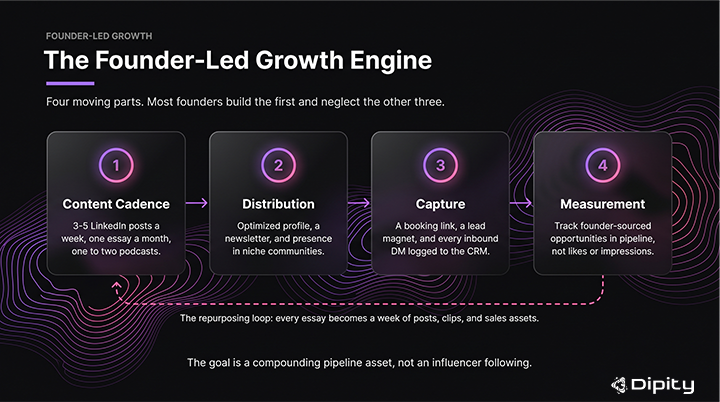
A few specifics from how I build this in practice. The cadence that works for most B2B founders is three to five LinkedIn posts a week, one long-form essay or newsletter a month, and one or two podcast appearances a month — consistency and specificity beat raw volume. The capture system is where founders quietly lose money: a booking link in the profile header, a genuine lead magnet in the featured section, and a standing rule that every inbound DM is logged. That last part is plumbing, and it is exactly what our minimum viable marketing stack guide exists to set up — a founder-led motion with no CRM behind it is just a leaky bucket with good lighting.
The multiplier that makes a 45-minute daily commitment realistic is repurposing. One deliberate long-form essay should never stay one essay — it should fan out across the week into the formats your buyers actually scroll.
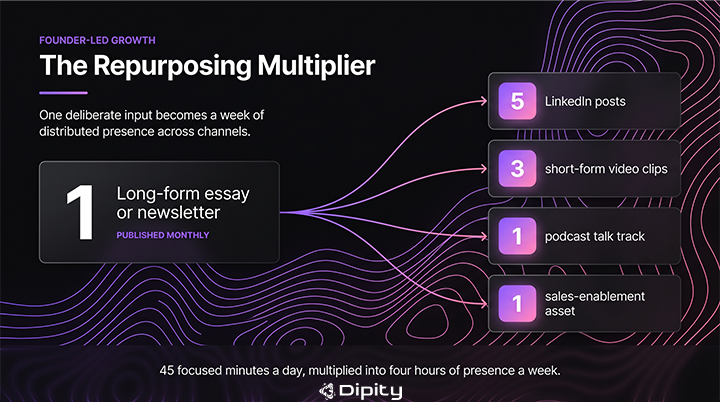
The founders who scale this fastest treat content as a product, not a chore. They keep a running file of buyer objections, customer quotes, and internal debates, and they ship from that file every day. The measurement layer keeps them honest: the north-star metric is founder-sourced opportunities in the CRM, never likes or impressions.
What Are the Most Common Mistakes Founders Make?
Founder-led growth looks simple from the outside and punishes founders who treat it that way. The three failure modes I see most are inconsistency, over-polishing, and writing for the wrong room. Founders who post sporadically never trigger the trust signals that compound; founders who over-edit end up sounding like a press release; and founders who write for other founders instead of buyers end up with an audience that will never purchase. This matters more now because organic reach is tighter than it used to be — LinkedIn algorithm analysis published in 2025 found organic reach down roughly 50% year over year, with company-page reach hovering near 1%, which is itself the strongest argument for leading with a person, not a logo.
The specific traps I coach founders away from:
- Publishing generic advice — “5 tips for building a startup” — instead of specific lessons from your own last 30 days.
- Outsourcing your voice to a ghostwriter before you have defined what you actually believe.
- Treating LinkedIn as a broadcast channel; the pipeline lives in the comments and DMs, not the post itself.
- Ignoring distribution — a great post shared cold usually dies, while the same post seeded into three communities compounds.
- Chasing virality — for founders under $20M ARR, most viral posts attract the wrong audience and pollute the pipeline signal.
One trap deserves its own sentence: do not let AI write your founder content. Ghostwritten or model-generated founder posts are detectable, and they corrode the exact trust the motion depends on — which is why I list it as a clear “avoid” zone in our AI strategy guide. The compounding here is real but back-loaded; for most founders it starts to accelerate around month nine. The ones who quit at month three were never going to see the payoff. The ones who treat a public voice as five-year infrastructure almost always do.
Frequently Asked Questions
How long does founder-led growth take to generate pipeline?
In my experience, founders see their first measurable inbound DMs and demo requests within 60 to 90 days of consistent posting, with meaningful compounding around month nine. Expecting pipeline inside the first 30 days is the single most common reason founders quit too early.
Does founder-led growth work on X, or only on LinkedIn?
Both, but the audiences differ. LinkedIn skews toward B2B buyers and operators; X skews toward founders, engineers, and media. Most AI startups under $20M ARR see better pipeline conversion on LinkedIn and better investor and recruiting signal on X.
Can a founder outsource founder-led content to a ghostwriter?
Partially. You can outsource editing, repurposing, and scheduling — but the raw point of view has to come from the founder. Ghostwritten founder content is almost always identifiable to buyers, and it erodes the trust the entire motion is built on.
How much does founder-led growth cost compared with paid acquisition?
The direct cost is usually $0 to $3,000 a month in tools and a part-time content operator. The real cost is founder time — roughly six to eight hours a week. For most seed and Series A startups, the customer-acquisition math favors founder-led growth by a wide margin.
Is founder-led growth still effective after a company hires a CMO?
Yes. A good CMO scales the system around the founder rather than replacing the founder’s voice. Companies that go “founder-quiet” after hiring a CMO typically see pipeline decay within two quarters.
Sources
- Edelman — 2025 Trust Barometer, Special Report: Brand Trust
- Edelman & LinkedIn — 2025 B2B Thought Leadership Impact Report
- Edelman & LinkedIn — 2024 B2B Thought Leadership Impact Report
- McKinsey — “Five Fundamental Truths: How B2B Winners Keep Growing”
- Brunswick Group — Connected Leadership Report
- Richard van der Blom — LinkedIn Algorithm Insights Report 2025
- Dipity Digital — The State of Founder-Led Startup Growth 2026

.svg)


Get weekly updates
*We’ll never share your details.
Follow us — @Dipity











Join Our Newsletter
Get a weekly selection of curated articles from our editorial team.