

How B2B SaaS Startups Should Actually Use AI
A real AI strategy is not a tool list. It is a set of sharp decisions about where AI creates leverage across your product, GTM, and operations — and where it quietly destroys trust.

How B2B SaaS Startups Should Actually Use AI
How B2B SaaS Startups Should Actually Use AI
By Morgan Von Druitt · Updated May 2026 · 8 min read
TL;DR An AI strategy for a B2B SaaS startup is the deliberate set of decisions about where AI creates leverage across product, go-to-market, and operations — and where it does not. Adoption is no longer the story: McKinsey found 88% of organizations now use AI in at least one business function, yet only about 6% are genuine “AI high performers.” The startups winning with AI are the ones making sharp trade-offs about which workflows to automate, which to augment, and which to leave alone.
Every founder I meet has heard some version of “you need an AI strategy.” Most of the time what they actually have is a pile of tools, a few saved ChatGPT prompts, and a vague commitment to “use AI more.” That is not a strategy — it is a subscription list. A real AI strategy is a short document that tells your team where to press the accelerator, where to press the brake, and how to know whether the bets are working. Here is what one actually looks like for a B2B SaaS startup under $20M ARR: where the leverage genuinely lives, where it does not, and how to measure the difference.
What Is an AI Strategy, and Why Does a Seed-Stage Startup Need One?
An AI strategy is a written set of decisions about where AI gets used inside the company, what outcomes it is expected to produce, and how performance will be measured. It usually spans three domains: product (how AI shows up in what you sell), go-to-market (how AI accelerates marketing, sales, and customer success), and operations (how AI compresses internal work like reporting, hiring, and finance). It does not need to be long — most good ones I see fit on two or three pages and get reviewed quarterly.
The reason this matters now, rather than “when we get to Series B,” is that adoption has already become table stakes — and adoption is not the same as advantage.
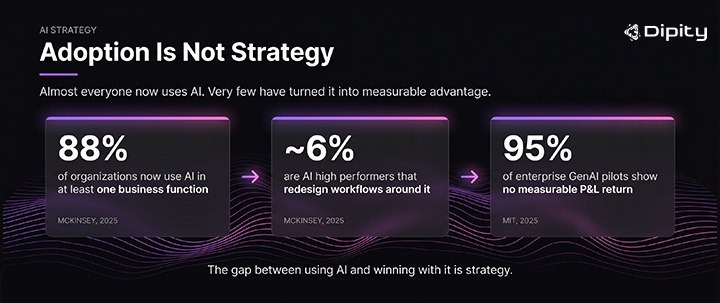
Figure 1. Almost every company now uses AI. Very few have turned it into measurable advantage.
Those three numbers tell the whole story. Nearly every company uses AI; almost none have turned it into measurable advantage. McKinsey’s State of AI research found that while 88% of organizations now use AI in at least one function, only around 6% qualify as “AI high performers,” and just 39% report any EBIT impact at all. A strategy is what moves a company from the first group toward the second. Without one, you get a dozen half-finished experiments and no institutional memory. For a seed or Series A startup, that document is also a hiring and investor signal: strong operators judge employers partly on how thoughtfully they use AI internally, and investors notice when the pitch deck is AI-first but the CRM is still a mess.
How Are B2B SaaS Companies Actually Using AI in 2026?
Adoption data for 2026 is no longer a novelty signal; it is a baseline expectation. Stanford’s AI Index reports that roughly 70% of organizations now use generative AI in at least one business function, and McKinsey found 92% of companies plan to increase AI investment over the next three years. But the companies gaining real leverage are not the ones using the most tools — they are the ones using AI in a few focused, repeatable workflows where volume and consistency genuinely matter.
Two of those rows carry a catch worth naming. AI-assisted content production is genuine leverage, but a draft is not a published asset — it still has to earn citations and trust, which is its own discipline I cover in our piece on how AI search is rewriting B2B discovery. And the internal-operations row is where I see the quietest, most reliable wins: AI compressing the reporting and ops work that sits on top of the marketing stack. The gap between companies that adopt AI and companies that get value from it is widening every quarter — and it is a gap of focus, not budget.
What Should Be Included in a Real AI Strategy Document?
A useful AI strategy document answers four questions in plain language: what we will use AI for, what we will not, who owns each workflow, and how we will measure impact. It should be specific enough that a new hire could read it in ten minutes and know which tools they are cleared to use, which data they may feed those tools, and which decisions still require a human. Most AI strategies I review fail not for lack of ambition but for lack of specificity. Here is the six-part structure I use when I build one from scratch.
The workflow map is the heart of the document — and the artifact founders most often skip. It is simply every meaningful workflow sorted into three buckets, so that everyone on the team knows the rule before they reach for a model.
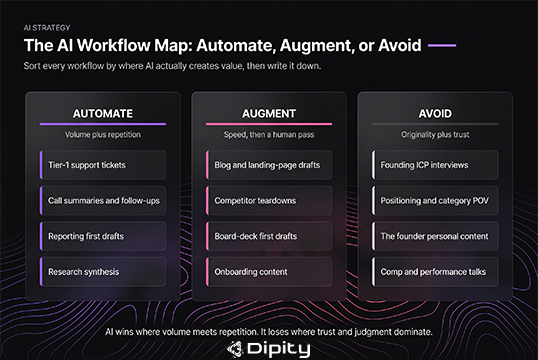
Startups that write this document and revisit it quarterly consistently outperform the ones running AI experiments with no central frame. The document forces trade-offs, and the trade-offs are the strategy.
Where Should Early-Stage Founders NOT Use AI?
The harder, more valuable half of an AI strategy is defining the no-go zones — and the most mature AI postures I see are the ones most willing to say “not here.” This is not caution for its own sake; it is pattern recognition. Gartner predicted that at least 30% of generative-AI projects would be abandoned after proof of concept by the end of 2025, and MIT’s research found that 95% of enterprise generative-AI pilots delivered no measurable return. A great deal of that waste is simply AI pointed at work it was never going to do well. The avoid zones I tell founders to write down explicitly:
- Founding ICP interviews — use AI to transcribe and synthesize, never to conduct them. Early pattern recognition needs human nuance.
- Strategic positioning and category work — AI drafts; it does not originate a point of view, and the market can tell.
- The founder’s personal content — ghostwritten AI posts are detectable and erode the trust the channel runs on.
- Compensation, hiring, and performance conversations — human-only territory, for legal and cultural reasons.
- Customer crisis and escalation — use AI for the internal summary, never the customer-facing reply.
- Code shipped to production without review — the productivity gain is real; the review step is not optional.
- Financial reporting and board materials — accelerate the draft, but verify every number by hand.
Two of those deserve emphasis because they connect directly to how an early-stage company wins. Positioning is an “avoid” because an AI-generated point of view is, by construction, an average of everything already published — and an average is the opposite of a defensible category position. The founder’s content is an “avoid” for the same reason it is so valuable: a founder-led growth motion is built on a voice buyers believe is real. The consistent pattern is that AI earns its keep where volume, repetition, and pattern-matching dominate, and loses badly where originality, trust, and judgment do.
How Do You Measure the ROI of Your AI Strategy?
Measuring AI ROI is genuinely hard, because the biggest returns show up as avoided hires, faster cycle times, and compounded output rather than as line items in a P&L. Most startups under-measure AI impact, which makes it hard to justify continued investment — or to spot an experiment that is quietly failing. HBR’s recent research found that most firms struggle not because the technology fails but because AI is used alongside existing work instead of being built into how the work gets done. The fix is to pick three to five measurable outcomes a quarter and track them with the same rigor you apply to pipeline.
One framing I give every founder: adoption is a leading indicator and impact is a lagging one, so watch both. A team at 30% tool adoption has a culture problem no dashboard will fix; a team at 85% adoption with no measured hours saved has a workflow-design problem. Wharton’s research is encouraging here — 75% of business leaders report positive ROI from their AI investments — but that average hides enormous variance, and the variance is explained by exactly the discipline this document is about. Without measurement, every AI tool looks like it is working, right up until the renewal date.
Frequently Asked Questions
What is the difference between an AI strategy and an AI policy?
An AI strategy defines where and why AI gets used to create business value. An AI policy defines the rules and guardrails for how it gets used — data privacy, tool approval, compliance. Most startups need both, but the strategy comes first.
How much should an early-stage startup spend on AI tooling?
Typically 1–3% of annualized revenue at seed and Series A, ramping toward 3–5% by Series B as the stack matures. For a $2M ARR company, that is roughly $20K–$60K a year across tools and services.
Do I need a “head of AI” role at a seed-stage startup?
Almost never. At seed and early Series A, AI strategy is owned by the founder or COO. A dedicated AI role makes sense at Series B and beyond, once the surface area justifies the headcount.
Which AI tools should a new B2B SaaS startup prioritize in 2026?
For most teams: one general-purpose assistant, one coding assistant, one call-intelligence tool, and one marketing-workflow AI. That set is usually enough to capture the majority of the available leverage.
How often should we update our AI strategy?
Quarterly reviews at minimum, with ad-hoc updates whenever a major model release or regulatory change meaningfully shifts the landscape. The pace of change is too fast for an annual review to keep up.
Sources
- McKinsey — The State of AI (88% adoption; ~6% high performers)
- Stanford HAI — 2026 AI Index Report
- MIT (Project NANDA) — The GenAI Divide: State of AI in Business 2025
- Gartner — 30% of generative-AI projects abandoned after proof of concept
- Harvard Business Review — Overcoming the Organizational Barriers to AI Adoption
- McKinsey — Superagency in the Workplace (92% plan to increase AI investment)
- Wharton — Accountable Acceleration (75% of leaders report positive AI ROI)

.svg)


Get weekly updates
*We’ll never share your details.
Follow us — @Dipity











Join Our Newsletter
Get a weekly selection of curated articles from our editorial team.