

Why Are Founders Becoming the Product? What Chamath Taking the CEO Seat at 8090 Signals for Startup Positioning
Founders are becoming the product. What Chamath taking the CEO seat at 8090's $135M Series A signals for startup positioning, with data on founder personal brand.

Why Are Founders Becoming the Product? What Chamath Taking the CEO Seat at 8090 Signals for Startup Positioning
Why Are Founders Becoming the Product? What Chamath Taking the CEO Seat at 8090 Signals for Startup Positioning
By Morgan Von Druitt · July 2026 · 8 min read
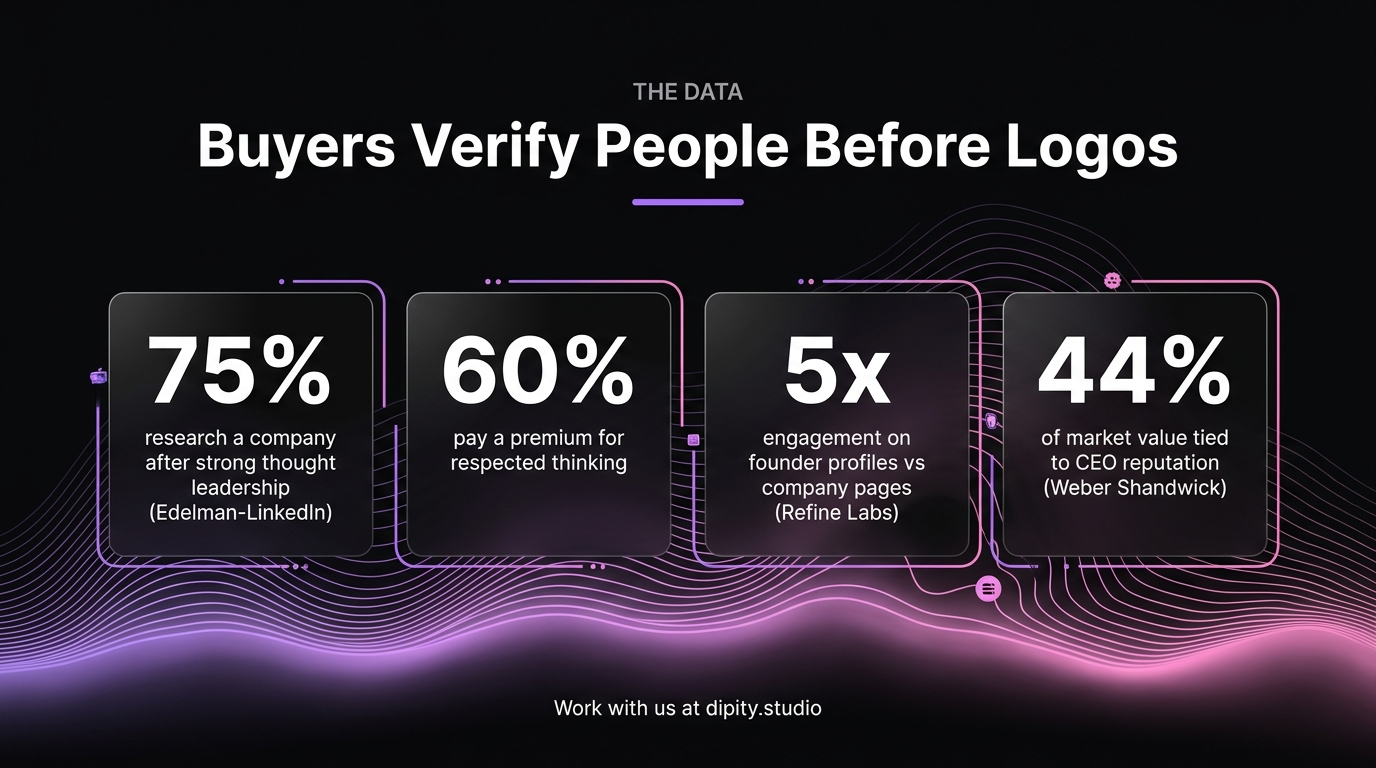
TL;DR Founders are becoming the product because buyers, investors, and now AI search engines verify people before they verify logos, which makes the founder personal brand a priced asset instead of a vanity project. Research from Edelman and LinkedIn found 75% of decision-makers say strong thought leadership pushed them to research a company they weren't considering, and 60% will pay a premium to work with a company whose thinking they respect. At Dipity, we build founder authority systems for seed-to-Series-B B2B SaaS and AI founders, and the 8090 round is the clearest top-of-market confirmation of that thesis we've seen this year.
I watched this deal make the rounds over a holiday weekend, when almost nothing else was breaking, and the pattern jumped out immediately. The product wasn't the headline. The founder was. That inversion is worth 2,000 words of your time, because the same repricing happening at the nine-figure level reaches seed and Series A diligence faster every quarter.
What Happened at 8090, and Why Should Founders Care?
8090, a 2024-founded enterprise AI startup, raised a $135M Series A led by Salesforce, and the story every outlet ran was Chamath Palihapitiya taking the CEO seat, his first operating role since Facebook. The founder was the headline. The product was the subhead. That inversion is the entire lesson.
Crunchbase News logged the round as one of the week's ten biggest in the US. The Next Web led with Chamath's name in the headline, not the "Software Factory" platform the company sells, and SiliconANGLE's coverage followed the same shape. Salesforce didn't write that check for a governed multi-agent development platform alone; those exist in bulk right now. They wrote it for a founder whose distribution, conviction, and public track record de-risk the go-to-market before a single sales hire.
Here's the beat structure worth studying:
- The person carried the news. Coverage volume followed the founder's name recognition, not the product category.
- The person carried the valuation. A company founded in 2024 landed a nine-figure Series A partly priced on operator reputation.
- The person carried the strategic investor. Salesforce gets a hedge on the future of software creation, anchored by a founder they've watched operate in public for 15 years.
- The person carried the talent story. Recruiting into a company led by a known operator costs less and moves faster than recruiting into a logo nobody has met.
You don't need Chamath's profile for this pattern to work in your favor. You need the same mechanic at your scale: a founder the market recognizes before the pitch starts.
Why Are Buyers Buying Founders Before Products?
Buyers moved first, before VCs did. B2B purchase decisions now start with a person the buyer trusts, follows, or gets cited to them by an AI assistant. The product evaluation happens after the founder evaluation, and founders who stay invisible lose deals they never knew they were in.
The data on this is consistent across every serious study of B2B buying behavior. The Edelman-LinkedIn B2B Thought Leadership Impact Report found 75% of decision-makers say thought leadership led them to research a product they weren't previously considering, and 60% will pay more to work with a company whose point of view they respect. In plain terms: three out of four buyers let a person's thinking open the door, and more than half will pay extra once it does.
The channel data points the same direction. Forrester's buyer research now ranks social media as the second most meaningful information source for B2B buyers, behind only generative AI search. Both of those surfaces favor named humans over corporate pages; Refine Labs found personal LinkedIn profiles generate 2.75x more impressions and 5x more engagement than company pages.
As I tell every founder who pushes back on this: buyers today are buying based off of the CEO or founder they have on their social feed. Then they get curious about the product. Not the other way around.
The uncomfortable part is what happens when you opt out. A buyer who lands on a founder profile showing eight months of silence assumes the company is dying. Founder silence is the most expensive line item on the cap table, and it never shows up in your books.
What Does "Founder as Product" Mean for Positioning?
Treating the founder as the product means the founder's point of view, not the feature set, is the unit of differentiation. Features get cloned in a quarter. A founder's lived pattern recognition, published consistently, is the one asset a competitor with more funding cannot copy.
This is where positioning work has moved in 2026. With foundation models compressing build time, most seed-stage products in a category converge on similar capability within months. What doesn't converge is the story of why this founder, with this specific scar tissue, is the inevitable person to fix this problem. Weber Shandwick's CEO Reputation Premium research put a number on it years ago that still anchors the field: global executives attribute 44% of their company's market value to the reputation of the CEO. Run that math on a $40M seed-stage valuation and you're looking at roughly $17.6M of enterprise value riding on how the market perceives one person.
A worked example from my own book. I helped a bootstrapped AI decision intelligence startup coin and push a category term, "artificial general decision making," and we scaled that founder-attributed position to 10M impressions in 8 months (client-reported). Prospects started arriving at demos already using the founder's language for the problem. Nobody asked for a feature comparison sheet. The category succession content did the selling before the call.

That's the positioning shift the 8090 round confirms from the top of the market: build the founder position first, and the product inherits it. I break down the full motion in my piece on why your face is the best go-to-market channel.
How Do AI Search Engines Accelerate This Shift?
AI assistants compress the buyer journey into a handful of cited answers, and they cite entities they recognize: named people with consistent positions across multiple surfaces. A founder with one thin LinkedIn page is invisible to that layer. A founder present on five surfaces becomes the citation.
When a buyer asks ChatGPT, Claude, Perplexity, or Gemini who solves a problem, the answer draws on what those systems find repeated and corroborated: bylined articles, podcast transcripts, interviews, posts, and press. Forrester's finding that generative AI search is now the top information source for B2B buyers means this layer sits in front of your funnel whether you optimize for it or not. I unpack the mechanics in how AI search is rewriting B2B discovery.
The omnichannel logic here is simple, and it's the same one I install with every client:
- LinkedIn gives the position a home base and a feed presence.
- X gives it velocity and reach into the AI-native cohort.
- The blog gives AI engines a citable, structured source of record.
- Podcasts give it a voice and a transcript corpus the models ingest.
- Tier-1 media gives it third-party authority the models weight heavily.
Omnichannel presence makes the founder the inevitable choice. When a buyer sees you on LinkedIn, on X, in their podcast feed, and in tier-1 media, the question stops being "should I buy?" and becomes "when do I buy?"
How Do You Install This Without Losing Build Time?
The founder-as-product motion runs on roughly 4 to 5 hours of founder time per week when the system underneath it is built right. The founder supplies raw insight; the system handles structure, distribution, and reporting. Time cost is the most common objection and the weakest one.
Most founders picture this as a second job. It isn't, when the input is designed around how founders already think. The only thing they have to do is record a ten-minute rant session where they share their insights, and that gets transcribed into formal LinkedIn posts and X posts or blogs in their name and their voice. One recording becomes a week of output; one strong blog atomizes into a carousel, a thread, a newsletter segment, and a podcast pitch angle.
Here's the math I walk founders through. Five focused hours a week, held for 26 weeks, builds a founder position on five surfaces. Compare the cost basis against a $160K loaded content hire who writes for the company page, the surface Refine Labs data shows underperforms the founder profile by 5x on engagement. The founder input is smaller than most board-prep cycles, and it compounds instead of expiring.
The trade-off, and I name it every time: this adds a level of transparency that not every founder is going to be comfortable with. You will reel in your losses publicly and revel in your wins. Founders unwilling to be disagreed with in public should build that muscle in lower-stakes formats first.
How Should You Respond to the 8090 Signal This Quarter?
Start by auditing the founder's five surfaces this week, then commit to one pillar piece and a 90-day publishing cadence. The 8090 round shows capital pricing founder authority at the top of the market; the same repricing reaches seed and Series A diligence faster every quarter.
The lighthouse of any company has to be their CEO. The playbook is not complicated: pick the category term you want to own, publish the flagship point-of-view piece, and show up on a fixed cadence for 90 days before you judge anything. Buyers verify people. Investors verify people. AI engines cite people. The companies winning 2026 stopped fighting that reality and built the person into the product story.
That's what the Sera Implementation Sprint installs: your voice, your category position, and the operating cadence, in two weeks, then the engine runs on a few founder hours per week. Talk to me at dipity.studio, and I'll show you the exact system. Make them the inevitable choice.
Frequently Asked Questions
Does founder-led positioning only work for famous founders like Chamath?
No. Recognition is relative to your buyer pool, not the general public. A founder with 8,000 followers in the exact right ICP and a clear category position closes more deals than a founder with 80,000 followers and no category. The mechanic that priced 8090's round works at seed scale; the audience is smaller and so is the bar.
Isn't this a distraction from building product?
The product doesn't save you if nobody frames the problem your way. Once buyers evaluate you against a category-creator competitor, the product comparison happens after the founder comparison. Four to five founder hours per week is the real cost when a system handles production and distribution.
What if the founder is a poor writer or hates being on camera?
Route around it. Strong talkers go podcast-first and voice-note-first; the writing gets built from transcripts in their voice. I personally struggle with being on camera, and text-first surfaces carried Dipity's growth without it.
How is a founder personal brand different from a company brand?
The company brand is what you claim; the founder personal brand is who the market believes. Buyers, journalists, and AI engines treat a named person with a consistent published position as more verifiable than a logo, which is why founder profiles out-earn company pages on reach and engagement.
How long before founder-led positioning shows results?
Expect leading indicators (titled buyer comments, profile visits, inbound DMs) inside 60 to 90 days and pipeline attribution in six to nine months. The buyer effect is real but it compounds; a quarter of silence resets more than a quarter of progress.
Sources
- Crunchbase News — The week's 10 biggest funding rounds
- Edelman-LinkedIn — B2B Thought Leadership Impact Report
- Forrester — Social media takes center stage in B2B buying
- Business Wire — 8090 raises $135M Series A
- Refine Labs — Personal profiles vs. company pages research
- SiliconANGLE — 8090 nabs $135M funding round
- The Next Web — Chamath's AI coding startup 8090 raises $135M
- Weber Shandwick — The CEO Reputation Premium

.svg)


Get weekly updates
*We’ll never share your details.
Follow us — @Dipity











Join Our Newsletter
Get a weekly selection of curated articles from our editorial team.