
How AI Search Is Rewriting B2B Discovery
Buyers now get their answers from ChatGPT, Perplexity, and Google’s AI Overviews — often without a click. Here is how to make sure your startup is the source the engines cite.

How AI Search Is Rewriting B2B Discovery
How AI Search Is Rewriting B2B Discovery
By Morgan Von Druitt · Updated May 2026 · 8 min read
TL;DR The new search landscape is a hybrid of traditional Google, Google’s AI Overviews, and conversational engines like ChatGPT, Perplexity, and Gemini — where buyers increasingly get a synthesized answer with no click. AI platforms drove 1.13 billion referral visits to the web’s top sites in June 2025, up 357% in a year, and Gartner expects traditional search volume to fall 25% by 2026. For B2B startups, the new game is getting cited by the engines, not just ranked by them.
For a decade, the SaaS SEO playbook never really changed: rank a blog post, capture the click, convert the click. I built campaigns on it, and for a long time it worked. It is now breaking at the top. Buyers ask ChatGPT, Perplexity, or Google’s AI Mode the questions they used to type into a search bar, and those engines answer in full paragraphs with a handful of citations. The startup that gets cited lands on the buyer’s shortlist. The one that does not is effectively invisible — regardless of where it ranks on page one. Here is how I explain the shift to founders: what actually changed, how the engines decide whom to cite, and what to do about it in the next 90 days.
What Is the “New Search Landscape,” and How Is It Different From SEO?
The new search landscape is the fractured set of channels where buyers now discover and evaluate vendors: traditional Google results, Google’s AI Overviews and AI Mode, conversational engines like ChatGPT, Perplexity, Gemini, and Claude, and the AI assistants now embedded inside tools like Slack and Notion. The core difference from classic SEO is blunt — the answer, not the link, is now the product. When a buyer asks “what are the best AI SDR platforms for seed-stage startups,” the engine synthesizes a direct answer from several sources and shows a small handful of citations. The buyer rarely needs to click anything at all.
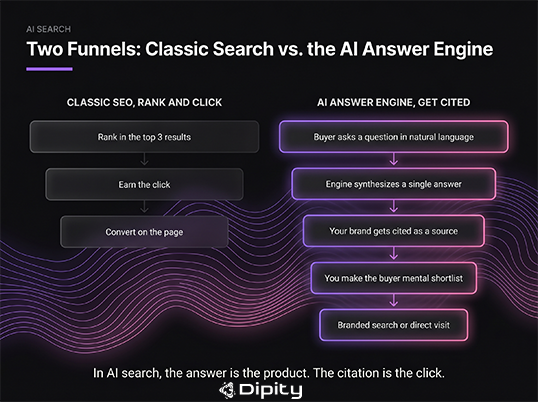
I keep those two funnels side by side for clients because the difference is not cosmetic — it changes the job. In classic SEO you optimized to win a click. In AI search you optimize to win a citation inside the synthesized answer, which earns you a place on the buyer’s mental shortlist long before they ever visit your site. The practical implication is that you are no longer optimizing for one search engine; you are optimizing for a distributed set of models that crawl, synthesize, and cite differently, and you need to measure your presence across all of them.
Why Is AI Search Traffic Worth More Than Traditional Organic Traffic?
When AI search does send a visitor to your site, that visit tends to be worth more than a classic organic click, because it is pre-qualified. By the time a buyer clicks through from ChatGPT or Perplexity, the engine has already answered their first question, surfaced two to five candidate vendors, and signaled that yours is worth a closer look. That collapses the messy top of the funnel into a single, high-intent visit.
It also explains why the click itself is getting rarer. Pew Research found that when Google shows an AI summary, users click a traditional search result in just 8% of searches — versus 15% when no summary appears — and that only 1% of users click a link inside the AI summary itself. The takeaway is not “traffic is dying.” It is that the value is moving upstream: being the source the engine paraphrases is now worth more than being a link further down a page that fewer people reach.
The other reason AI traffic outperforms is that it arrives from a conversation, not a keyword. When a buyer asks Perplexity “which AI observability tools support OpenAI function calling and are SOC 2 compliant,” the resulting visit comes from someone who has already defined their requirements in plain language. A single well-placed citation on a high-intent question like that can do more for pipeline than a month of broad-keyword blog traffic. So the metric founders should watch is shifting: sessions still matter, but citation share — how often the engines name you when your buyer asks — is becoming the leading indicator of pipeline.
Which AI Search Engines Should a B2B Startup Prioritize in 2026?
Founders under $20M ARR cannot chase every engine at once, so prioritization matters. ChatGPT is the reach leader by a wide margin — OpenAI reported it reached 800 million weekly users in late 2025 — and Similarweb data showed ChatGPT drove more than 80% of AI referral traffic to the web’s top sites in mid-2025. But reach is not the same as return per citation. The sequence below is the one I recommend for most B2B AI and SaaS startups.
A realistic 90-day target is to earn a handful of Perplexity citations, secure AI Overview placement on the pages where you already rank, and make your core content genuinely quotable for ChatGPT. That sequence compounds faster than trying to appear everywhere at once with a thin presence.
How Do AI Engines Decide Which Sources to Cite?
Citation logic is still evolving, but the pattern across ChatGPT, Perplexity, and Google’s AI Overviews is now clear enough to act on. Google’s own guidance on optimizing for AI search is refreshingly direct: the engines surface content that is genuinely helpful, reliable, and people-first, that demonstrates first-hand experience and a unique point of view, and that is organized clearly enough for both a human and a model to follow. Google also says plainly what does not work — there is no magic markup, no “llms.txt” file, and no benefit to chasing inauthentic mentions. The checklist below is what I actually audit on a client site.
Two of those rows deserve a note. Cross-platform consensus is built fastest through founder content, guest posts, and podcast appearances — the same compounding asset I describe in our guide to founder-led growth. And the first-hand-experience row is the quiet headline of Google’s guidance: the engines are actively trying to reward a distinct point of view, which is one more reason I believe AEO and category creation are the same project wearing two hats. The startups that win AI citations are not the ones with the biggest content teams — they are the ones that publish fewer, sharper, more quotable assets and distribute them aggressively.
What Should a B2B AI Startup Do in the Next 90 Days?
The most expensive mistake I see founders make is treating AI search as a problem for next year. It is already a material share of discovery for the startups that took it seriously early, and every quarter you wait, a competitor is defining the category answers the engines will repeat for years. Gartner expects traditional search volume to drop 25% by 2026 as buyers shift to AI assistants — so a 90-day plan does not require a rebrand, it requires focused triage. This is the sprint I run with seed and Series A clients.
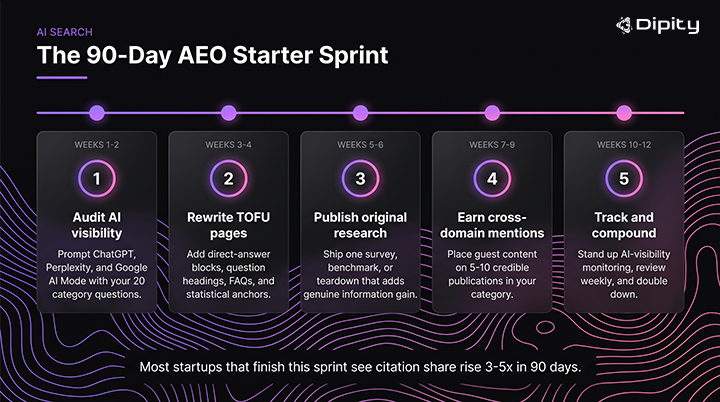
Two parts of that sprint are worth underlining. The original research in weeks five and six is the single highest-leverage AEO asset you can produce — and, not coincidentally, one of the few marketing assets I tell founders to keep human rather than hand to a model, for the reasons in our AI strategy guide. And the tracking in weeks ten to twelve is not optional: you cannot improve a citation share you cannot see, which is why AI-visibility monitoring now belongs in the measurement layer of your marketing stack. By day 90, most startups that finish this sprint see citation share rise three- to fivefold on Perplexity and start surfacing in Google’s AI Overviews for their core commercial questions.
Frequently Asked Questions
What is the difference between SEO, GEO, and AEO?
SEO optimizes for ranking on traditional search. GEO (generative engine optimization) and AEO (answer engine optimization) both focus on being included and cited inside AI-generated answers, and in practice the two terms are used interchangeably. Google’s own position is that optimizing for AI search is still just SEO done well.
Do I need to abandon traditional SEO to focus on AI search?
No. Traditional organic search still drives the majority of web traffic for most B2B SaaS sites. The goal is to evolve your existing SEO so it also satisfies AEO — clearer structure, direct answers, stronger sourcing. It is additive work, not a replacement.
How do I measure AI search performance?
Track your citation share for your top 20 commercial questions across ChatGPT, Perplexity, and Google’s AI Overviews, and monitor referral traffic from AI platforms separately in GA4. Citation share is the leading indicator; AI referral traffic is the lagging one.
Which AI engine sends the most traffic?
ChatGPT sends the most AI referral traffic by volume, having driven the large majority of AI referrals to top sites through 2025. Perplexity typically sends lower volume but higher-intent traffic per citation, because of its inline, clickable sources.
Is AI search optimization only for companies with big content teams?
No. A focused five-page AEO rewrite plus one piece of original research per quarter is often enough to earn meaningful citation share — especially in niche B2B categories where most competitors have not started yet.
Sources
- TechCrunch & Similarweb — AI referrals up 357% year over year, reaching 1.13B (July 2025)
- Gartner — Search engine volume predicted to drop 25% by 2026
- Pew Research Center — Users click less when an AI summary appears (July 2025)
- TechCrunch & Alphabet — Google AI Overviews reach 2 billion monthly users
- TechCrunch & OpenAI — ChatGPT hits 800 million weekly active users
- Google Search Central — Optimizing for generative AI search

.svg)


Get weekly updates
*We’ll never share your details.
Follow us — @Dipity











Join Our Newsletter
Get a weekly selection of curated articles from our editorial team.