

Why AI Startups Win by Defining the Game, Not Playing It
How early-stage AI and SaaS founders use category creation to own a market, command premium pricing, and stop competing for scraps inside someone else’s feature war.

Why AI Startups Win by Defining the Game, Not Playing It
Why AI Startups Win by Defining the Game, Not Playing It
By Morgan Von Druitt · Updated May 2026 · 8 min read
TL;DR Category creation is the work of defining a new market problem, naming the solution space, and positioning your company as the default answer to it. For AI and SaaS startups under $20M ARR it matters because the company that creates a category captures roughly 76% of its total market capitalization, according to research published in Harvard Business Review. If you are competing on features inside someone else’s category, you are already fighting over the remaining 24%.
Most early-stage founders I work with treat positioning as a messaging problem — a homepage headline they will get to once the product is further along. I understand the instinct, but it is backwards. Positioning is not what you say; it is the strategic decision about which problem you own, which buyer you serve, and which alternatives you make irrelevant. In a year when capital is pouring into anything labeled “AI,” that decision is the difference between a company the market remembers and one it quietly forgets. Here is how I think about category creation in 2026: what it actually is, when a startup under $20M ARR should attempt it, and how to build the foundation without a Gartner-sized budget.
What Is Category Creation, and How Is It Different From Positioning?
Category creation is the deliberate design of a new market frame — a named problem, a clear point of view, and a buyer who recognizes themselves in it. Positioning, by contrast, is how you communicate your place inside a market that already exists. Play Bigger, the firm that coined the term “category design,” describes the work as creating markets rather than competing in them, and it only pays off when you hold a genuinely different view of a problem buyers have not yet put into words. The simplest distinction I give founders: category creators change the question buyers are asking, while positioners answer an existing question better than anyone else.
The two are often conflated, which is how founders end up with clever messaging inside a mature category and wonder why nothing lands. I keep the four-layer model below on a whiteboard for every engagement, because each layer answers a different question and demands a different kind of work.
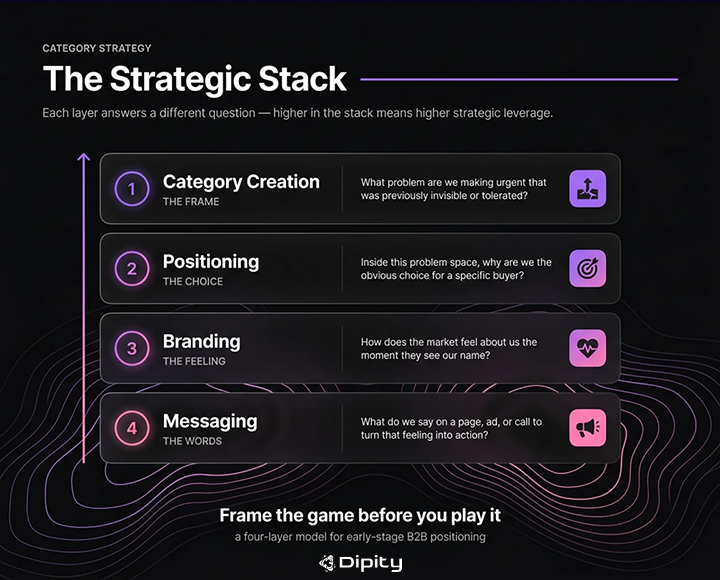
Read the stack from the top down. If your category already exists — CRM, email marketing software, observability — do not try to reinvent it; lead with positioning and win on clarity. But if your best customers are duct-taping five adjacent tools together and describing the same unnamed pain in their own words, you may be sitting on a category-creation opportunity. The rest of this post is about how to find out before you bet the roadmap on it.
Why Does Category Design Matter So Much for AI Startups in 2026?
Category design matters more for this cohort of AI startups than for any software generation before it, because the AI tooling market is structurally hostile to feature-led differentiation. Gartner forecasts worldwide IT spending will reach $6.31 trillion in 2026, with software the fastest-growing segment — and AI-native categories are absorbing the largest share of new funding. When that much capital floods a space, feature parity arrives in quarters, not years. Category design is how a company escapes the resulting commodity spiral and earns durable pricing power before the copycats ship.
The clearest example I point founders to is HubSpot. Rather than position against Marketo or Eloqua inside “marketing automation,” HubSpot created and evangelized the category of inbound marketing — a book, a certification program, and a named buyer behavior. By the time competitors tried to co-opt the term, HubSpot already owned the search intent, the educational pipeline, and the practitioner identity. It went public in 2014 and built an enduring, multibillion-dollar business on a category it largely authored. The lesson for AI founders is not “name your product.” It is name the new workflow, job title, or operating principle your product makes possible.
The economics are well documented. A separate Harvard Business Review analysis of the Fortune 100 fastest-growing companies found that the thirteen firms responsible for creating their categories drove 53% of the group’s incremental revenue growth and 74% of its incremental market-cap growth. Category ownership is not a branding flourish — it is where the enterprise value concentrates.
Ownership also compounds in a way feature competition never will. When you own the category, you get cited when analysts publish market maps, when buyers describe their problem in their own words, and — increasingly — when an AI engine generates the answer to “what tools solve this.” That last channel is reshaping B2B discovery fast enough that I now treat it as its own discipline, one I break down in our companion piece on how AI search is rewriting B2B discovery. Win the category early and you are not just first to market; you are first in the model’s memory.
When Should an Early-Stage Startup Attempt Category Creation?
Category creation is expensive, slow, and usually wrong for startups below roughly $2M ARR. I have watched founders invent a name nobody searches for while a competitor quietly executed against demand that already existed — and the competitor won. Before I let a client commit to a category play, I want three things validated: buyer language, analyst whitespace, and genuine founder conviction. The diagnostic below is the exact screen I run before we spend a dollar on category work.
Hit four of five and category creation is a defensible strategic bet. Hit three or fewer and you are not failing — you are simply early. Lead with sharp positioning inside an existing category, compound the revenue and the conviction, and revisit the category question after your Series A. There is no prize for being early to a category nobody is ready to join.
How Do You Build and Launch a Category as a Seed or Series A Startup?
Building a category is a 12-month sequence of evangelism, not a launch day. The operational core is always the same: a point of view, a named problem, a clear villain — the “old way” — and a flagship asset your buyers can forward to their boss. What follows is the top-of-funnel category sprint I run with startups under $20M ARR: compressed enough for a lean team, structured enough to actually compound.
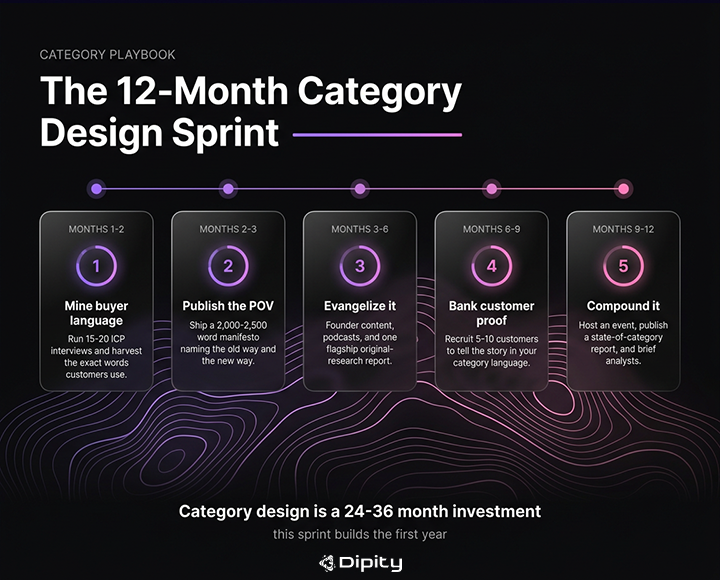
Three things the timeline cannot show. First, a category is carried by a person, not a logo — months three through six only work if the founder is personally publishing, which is why I treat this as a deliberate founder-led growth motion, not a content calendar. Second, sustaining eighteen months of evangelism takes an operational spine — clean attribution, a tracked pipeline, a tight tool stack — the kind I lay out in our guide to the minimum viable marketing stack. Third, the flagship report in months three to six should contain original research, and original research is one of the few marketing assets I tell founders never to fully hand to AI, for the reasons I cover in our AI strategy guide.
The companies that win category design are the ones that stay on message for eighteen months when it feels like nothing is happening. The compounding is real, but it is back-loaded. If you stop evangelizing at month six, you have simply funded your competitor’s education budget for free.
What Are the Most Common Category and Positioning Mistakes?
Even founders who understand category design intellectually stumble in execution, and the failure modes are predictable. The most common is premature category creation — naming a category before the buyer is ready to adopt the language, which reads as ego rather than insight. The second is vague positioning dressed up as category creation, where a company claims to have invented a space that is obviously a feature of an existing one. April Dunford, who wrote the definitive book on B2B positioning, argues that categories largely emerge rather than get “created,” and that most companies calling themselves category creators would win faster with sharper positioning inside a market buyers already understand — because the market is almost always smarter about its own problem than the founder is.
I sanity-check every client’s positioning against five fast tests. Run them against your own homepage and sales deck before you read the verdict column too closely.
That last test matters more every quarter. Google’s own guidance on optimizing for AI search confirms that the engines surface sources with a clear, first-hand point of view — which is exactly what a real category POV produces and a generic feature page never will. Positioning without category design is survivable. Category design without positioning is a branding exercise the market ignores. The founders I see win treat them as two layers of one strategic stack, never as a choice between them.
Frequently Asked Questions
What is the difference between category creation and category design?
I use them interchangeably, and most operators do too. Category design is the more formal, process-oriented term popularized by Play Bigger; category creation tends to describe the outcome. Both refer to the deliberate naming and shaping of a new market.
How long does category creation take for a B2B SaaS startup?
In my experience, most successful category plays take 18 to 36 months from manifesto to meaningful inbound pipeline. If a founder expects results faster than that, they are usually describing a positioning exercise, not a category one — and that is fine, because positioning pays off much sooner.
Can an AI startup create a category with less than $5M in funding?
Yes, but it requires an unusually strong founder voice, original research, and disciplined message consistency. Capital helps with paid distribution and events; the category itself is built through content, customer proof, and analyst relations — none of which a small budget rules out.
Is category creation the same as thought leadership?
No. Thought leadership is a tactic; category creation is a strategy. Thought leadership without a named category is marketing activity that produces no compounding asset — you are renting attention instead of building equity.
What share of market value does a category leader actually capture?
Research published in Harvard Business Review puts it at roughly 76% of the category’s total market capitalization for the category creator, with every other competitor splitting the remaining 24%. That concentration is the entire financial argument for doing this work.
Sources
- Harvard Business Review — “The Difference Between a First Mover and a Category Creator” (2019)
- Harvard Business Review — “Why It Pays to Be a Category Creator” (2013)
- Play Bigger — the firm that coined “category design”
- April Dunford — author of “Obviously Awesome” on B2B positioning
- Gartner — Worldwide IT Spending Forecast (April 2026)
- Google Search Central — Optimizing for generative AI search

.svg)


Get weekly updates
*We’ll never share your details.
Follow us — @Dipity











Join Our Newsletter
Get a weekly selection of curated articles from our editorial team.