

The Minimum Viable Stack for Seed to Series A AI and SaaS Founders
The tools, budget, hiring, and attribution a seed-to-Series-A startup actually needs — and the expensive complexity it should refuse.

The Minimum Viable Stack for Seed to Series A AI and SaaS Founders
The Minimum Viable Stack for Seed to Series A AI and SaaS Founders
By Morgan Von Druitt · Updated May 2026 · 8 min read
TL;DR Startup marketing operations is the infrastructure layer — tools, processes, and measurement — that turns founder intuition into repeatable pipeline. For seed and Series A AI and SaaS companies the right answer is 4–6 tools, a simple attribution model, and one dedicated operator. Gartner’s 2025 CMO Spend Survey puts marketing budgets at 7.7% of company revenue — but the gap between the startups that pull ahead and the ones that stall is almost always operational discipline, not creative output.
Founders love to talk strategy, and martech vendors love to sell complexity. The reality I see across our client base is that a startup under $20M ARR does not need 30 tools, a 200-step lead-scoring model, or a four-person ops team. It needs a tight system that captures intent, routes leads, and attributes revenue without breaking. The difference between a $3M ARR startup and a $15M one is rarely the quality of the content — it is almost always the quality of the marketing operations underneath it. Here is the minimum viable stack I build with seed and Series A clients, the budget benchmarks I actually trust, and the hiring path that gets a company from founder-run to a real ops function without torching a Series A round on software.
What Is Startup Marketing Operations, and Why Does It Matter Early?
Marketing operations is the function that owns the systems, data, and processes connecting marketing activity to revenue. At a large company it is a dedicated team running martech, attribution, and reporting. At a seed or Series A startup it is usually one person — or a fractional partner — making sure the CRM is clean, the website is tracked, the automations fire, and leadership agrees on what “pipeline” actually means. Without that spine, every dollar of ad spend, content, and outbound becomes harder to measure and nearly impossible to improve.
Operations matters disproportionately early because the founder’s attention is the scarcest resource in the company, and good ops shifts that attention from firefighting to decision-making. The signs that a startup has an operations problem — not a strategy problem — are consistent:
- Weekly reporting takes over an hour to assemble, and leadership still argues about which number is real.
- Leads enter from five different forms and none of them route to the right owner.
- Campaign-level ROI is impossible to calculate because tracking was bolted on after the fact.
- Sales and marketing use different definitions of “qualified,” and the handoff quietly leaks pipeline.
- The founder is personally copying data between Notion, the CRM, a spreadsheet, and Stripe.
If two or more of those are true, the bottleneck is operations, not ideas — and you can hire the best content strategist alive and watch their work evaporate inside a broken system. Operations is also the unglamorous spine that lets a founder sustain the eighteen months of consistent evangelism a real category play demands.
What Does a Minimum Viable Marketing Ops Stack Look Like in 2026?
A working stack for a B2B AI or SaaS startup under $20M ARR is five categories of tool: a CRM, a marketing-automation layer, a website and conversion platform, an analytics and attribution tool, and a content and social tool. That is the whole list. The discipline is resisting the vendor logic that every function needs its own best-in-class point solution.
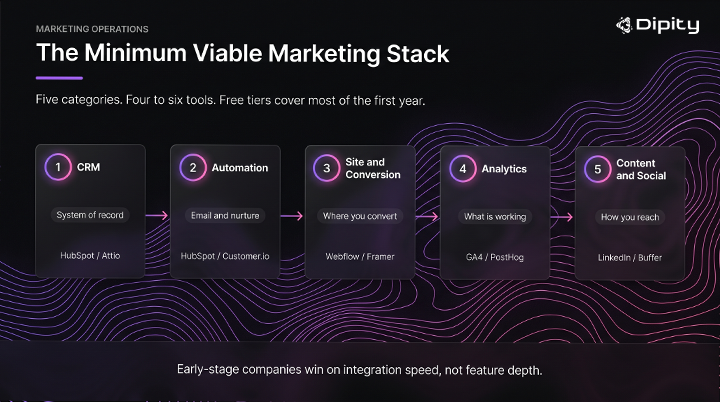
The temptation to over-buy is structural. Scott Brinker’s 2025 Marketing Technology Landscape counted 15,384 martech products — and you need four to six of them. Worse, Gartner’s research has found that marketers use only about a third of their martech stack’s capabilities, so most teams are paying for software they have never fully switched on. The right stack scales with stage, not with ambition.
The most expensive mistake I see is a seed-stage company buying Series A tools because a vendor sold them a vision of “scaling later.” Free tiers genuinely cover most of the first twelve months. One non-negotiable at every stage is the capture layer — the booking links, forms, and CRM routing — because that is also what makes a founder-led growth motion measurable instead of merely anecdotal.
How Much Should a B2B AI Startup Spend on Marketing at Each Stage?
Marketing budget is one of the most mis-benchmarked numbers in startup finance, because “average spend” figures usually come from mature public companies. Two anchors I trust: Gartner’s 2025 CMO Spend Survey found marketing budgets sit at 7.7% of company revenue, and SaaS Capital’s 2025 benchmarks put the median private-B2B-SaaS marketing spend at roughly 8% of ARR. Those are the mature, steady-state numbers — and an early-stage startup should expect to run well above them.
The reason is simple: at seed and Series A you are deliberately buying growth ahead of revenue, so reinvestment as a share of ARR runs much higher than the steady-state benchmark. The exact figure depends on your runway and growth target, not a rule of thumb. What matters more than the headline number is the allocation — and here is how I split an early-stage reinvestment budget.
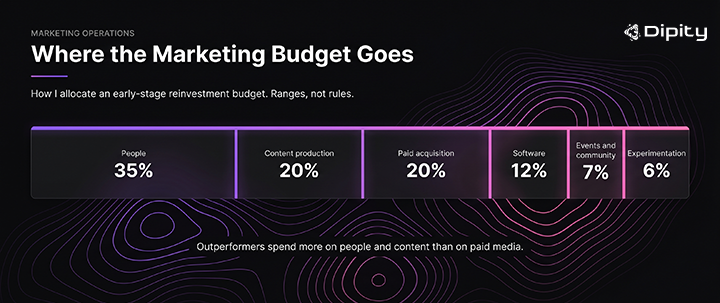
The startups that outperform consistently spend more of the budget on people and content than on paid media. Founders who flip that ratio — half the budget into ads, a sliver into people — tend to hit a customer-acquisition-cost wall within two or three quarters, because paid media rents attention while people and content compound it.
When Should a Startup Hire Its First Marketing Operations Person?
The simplest version of the answer: hire your first marketing-operations person when the founder or head of marketing is spending more than six hours a week fighting systems instead of building the business. In practice that happens around $500K–$1M ARR, or whenever the company runs its first real paid campaign. Hire too early and you are paying salary for a role with no surface area; hire too late and you are burning the founder’s time on work that compounds badly. The path I recommend:
- Pre-seed: the founder owns marketing ops — three to five hours a week on CRM, analytics, and reporting. No hire needed.
- Seed ($250K–$1M ARR): bring in a fractional marketing-ops partner five to ten hours a week, or cross-train a generalist already on the team.
- Late seed / early Series A ($1M–$3M ARR): hire a full-time marketing generalist who can also run ops, or retain a fractional CMO with operational depth.
- Series A ($3M–$10M ARR): hire a dedicated marketing-ops manager — three to five years in HubSpot or Salesforce administration, plus basic SQL fluency.
- Late Series A / Series B: expand to a small ops team and add attribution, CDP, and data-engineering capacity.
The founders who handle this transition well treat marketing ops as a finance-adjacent role, not a marketing-adjacent one — the best ops hires are obsessive about data integrity and allergic to ambiguity. They also lean hard on AI-augmented workflows to keep the team small, which is a deliberate strategic choice rather than a shortcut, and one I cover in our AI strategy guide.
What Attribution Model Actually Works for Early-Stage B2B SaaS?
Attribution is where early-stage startups most reliably over-engineer and under-deliver. Enterprise attribution platforms charge five figures a month for multi-touch models that a seed-stage company simply cannot feed enough data to make statistically meaningful. The pragmatic path is to start simple, instrument cleanly, and add complexity only as ARR justifies it. Multi-touch attribution genuinely does give a fuller picture of the funnel than last-touch — but only once your data volume is large enough to trust it.
The common, expensive mistake is buying a complex attribution tool before the company has the volume to trust its output. Start with self-reported, layer in UTM tracking, and graduate to multi-touch when revenue justifies the overhead. One modern addition to every model: make sure your analytics layer tags visits sourced from AI engines, because AI search is now a real pipeline channel and most attribution setups still miss it entirely.
Frequently Asked Questions
What is the difference between marketing operations and revenue operations?
Marketing ops focuses on the tools, data, and processes inside the marketing function. Revenue operations (RevOps) unifies marketing, sales, and customer-success operations under one function, and it usually makes sense at Series B and beyond — not before.
Do I need a CRM at pre-seed?
Yes, but a free tier is almost always enough. HubSpot’s free CRM, Attio, or even a well-structured Airtable can carry a pre-seed startup through its first 50 to 100 customers.
Should a seed-stage startup invest in a CDP?
Almost always no. A customer data platform solves data fragmentation across many systems, which is rarely a real problem before Series B. A seed-stage startup is far better served by a clean CRM and one good analytics tool.
How often should we audit the martech stack?
Quarterly. Look at cost per seat, overlap between tools, underused features, and any tool where active usage has dropped below half the licensed seats — that is your cancellation list.
What is the first marketing ops process every startup should document?
Lead routing. Every startup should have a written, one-page document describing how a lead enters the system, how it gets qualified, who owns it, and the follow-up time expected. That single document prevents most early pipeline leaks.
Sources
- Gartner — 2025 CMO Spend Survey (marketing budgets at 7.7% of revenue)
- chiefmartec — 2025 Marketing Technology Landscape (15,384 products)
- Gartner Marketing Technology Survey — martech stack utilization
- SaaS Capital — 2025 Spending Benchmarks for Private B2B SaaS Companies
- ICONIQ Growth — Marketing Budgets & Productivity benchmarks
- McKinsey — “Five Fundamental Truths: How B2B Winners Keep Growing”

.svg)


Get weekly updates
*We’ll never share your details.
Follow us — @Dipity











Join Our Newsletter
Get a weekly selection of curated articles from our editorial team.